

I noticed it during a normal evening, my dog leaning in for a nose-to-nose greeting like she always did, except this time I actually recoiled. Her breath had gone from “dog breath” to something sharper, almost sour. I remember thinking it was just a phase, maybe something she ate, and telling myself I’d keep an eye on it.
It wasn’t a phase. It was dog dental disease, and I didn’t know it yet because she was still eating fine, still playing fetch, still acting completely normal in every way that would have tipped me off.
That’s the part nobody warns you about: dogs are remarkably good at hiding dental pain, which is exactly why dog dental disease becomes so common before anyone notices something’s wrong.
This guide walks through what dog dental disease actually is, why it happens to most dogs eventually, and what genuinely helps, based on veterinary sources rather than guesswork or a single scary headline. No scare tactics, just the real progression, the real numbers, and the real options, laid out the way I wish someone had laid them out for me before that evening.
Dog dental disease affects over 80% of dogs by age three, according to VCA Animal Hospitals, and most dogs show no obvious signs despite active disease. It starts as gingivitis, a reversible gum inflammation, and can progress to periodontitis, which causes permanent tooth and bone loss if untreated.
Daily brushing, VOHC-approved dental products, and regular veterinary cleanings are the most effective ways to prevent dog dental disease from advancing.
Dog dental disease is almost entirely preventable, but prevention only works if it starts before symptoms appear, since most dogs mask the pain until the disease is already advanced.
How Common Is Dog Dental Disease, Really?
The numbers around dog dental disease are more striking than most owners expect.
According to VCA Animal Hospitals, dental disease is one of the most common medical conditions veterinarians see, with over 80% of dogs over the age of three showing active dental disease. That’s not a niche problem affecting unlucky dogs. That’s the majority outcome without intervention.
Over 80% of dogs over the age of three have active dental disease, according to VCA Animal Hospitals, making it one of the most common medical conditions veterinarians diagnose in dogs.
What makes dog dental disease particularly sneaky is how few dogs show obvious signs. VCA notes that most dogs mask their discomfort entirely, continuing to eat and play normally even with significant disease present.
When signs do show up, they tend to be subtle:
- Pawing at the mouth
- Head shaking
- Jaw chattering
- Eating with visible hesitation
This is exactly why annual dental checks matter even for a dog that seems completely fine. By the time a dog stops eating or clearly favors one side of its mouth, dog dental disease has often progressed considerably further than a checkup would have caught it.
Waiting for obvious symptoms means waiting for the disease to already be advanced, which is the opposite of how effective prevention is supposed to work.
Part of the challenge is that owners naturally look for the same warning signs they’d expect in themselves: visible pain, obvious avoidance of food, clear discomfort. Dogs evolved to hide vulnerability, including pain, since showing weakness carried real survival costs for their wild ancestors.
That instinct hasn’t gone away just because a dog now sleeps on the couch, and it means the burden falls on regular veterinary checks rather than waiting for a dog to “tell you” something’s wrong.
Gingivitis vs Periodontitis: The Two Stages of Dog Dental Disease
Dog dental disease isn’t one condition. It’s a progression through two distinct stages, and knowing where a dog sits on that progression changes everything about treatment.
According to the Merck Veterinary Manual, gum disease in dogs comes in two forms: gingivitis and periodontitis.
Gingivitis
Gingivitis is the early, reversible stage.
Bacterial plaque irritates the gums, causing inflammation, color change from coral-pink to red or purple, and swelling at the gum edge. The gums tend to bleed on contact.
Crucially, at this stage, the ligaments and bone supporting the tooth are not yet affected, which is why proper professional cleaning can fully reverse gingivitis.
Periodontitis
Periodontitis is what happens when gingivitis goes untreated.
The damage becomes more severe and permanent, involving the gums, ligaments, and bone. Merck notes that gingivitis is often first noticed around 2 years of age, while periodontitis typically begins developing between 4 and 6 years of age if the earlier stage isn’t addressed.
Gingivitis in dogs is typically first noticed around age 2 and is fully reversible with professional cleaning, while periodontitis usually begins developing between ages 4 and 6 and causes permanent bone and tooth loss.
That two-to-four-year window between the stages is where prevention has the most leverage. A dog with gingivitis today isn’t destined for periodontitis. The disease only advances if the underlying plaque and tartar buildup continues unaddressed, which means the outcome is genuinely still within an owner’s control at that point, not a foregone conclusion tied to age alone.
It’s worth being specific about what “permanent” means with periodontitis. Once the bone and ligament supporting a tooth are lost, that support doesn’t regenerate on its own. Treatment at that stage focuses on stopping further damage and managing existing loss, sometimes through extraction, rather than restoring what’s already gone.
That’s the core reason catching dog dental disease at the gingivitis stage matters so much more than it might initially seem.
Why Dogs Get Gum Disease, Not Cavities Like Humans
Here’s a detail that surprises a lot of dog owners: the most common dental disease in people isn’t the same as the most common dental disease in dogs.
VCA points out that while people most commonly develop cavities, or tooth decay, dogs rarely do. Tooth decay represents less than 10% of all dental problems in dogs. Instead, the dominant issue is periodontal disease, an infection of the tissue surrounding the tooth rather than decay of the tooth itself.
Tooth decay accounts for less than 10% of dental problems in dogs, unlike in humans where cavities are the most common issue, because periodontal disease affects the tissue around the tooth rather than the tooth’s surface.
The bacterial side of this is genuinely interesting. Research examining dental plaque in dogs has found periodontal-disease-associated bacteria, including a species called Porphyromonas gulae, present in nearly all dogs with periodontal disease, and in a meaningful portion of dogs without diagnosed disease as well.
That finding suggests these bacteria are widespread in dogs’ mouths generally, and it’s really the buildup, immune response, and lack of disruption from cleaning that determines whether disease actually develops, not merely bacterial presence alone.
This matters practically because brushing isn’t about eliminating all mouth bacteria, which isn’t realistic anyway. It’s about disrupting the plaque biofilm regularly enough that it never gets the chance to mineralize into tartar and trigger the inflammatory cascade that leads to gum disease.
What Causes Dog Dental Disease
Dog dental disease has a fairly predictable set of contributing factors, though not every dog is affected equally.
- Lack of daily plaque removal. Plaque forms constantly, and without regular brushing or an equivalent disruption method, it mineralizes into tartar within days.
- Breed and jaw structure. Small breeds and brachycephalic (short-nosed) dogs face higher risk due to crowded teeth and less room in the jaw.
- Age. Risk accumulates over time simply because plaque and tartar buildup is cumulative without intervention.
- Diet. Dry kibble provides some mechanical cleaning action compared to purely soft food, though it isn’t a substitute for brushing.
- Retained baby teeth. If a puppy’s deciduous teeth don’t fall out on schedule, adult teeth can come in overcrowded, creating pockets where plaque accumulates more easily. A vet may recommend extracting stubborn baby teeth specifically to prevent this.
- Genetics and immune response. Some dogs mount a stronger inflammatory response to the same bacterial load, accelerating disease progression even with similar hygiene habits.
None of these factors act alone. A small-breed dog with retained baby teeth and no brushing routine stacks multiple risk factors at once, which is part of why dog dental disease shows up earlier and more severely in some dogs than others.
Understanding your specific dog’s risk profile, rather than treating dental care as a one-size-fits-all routine, makes a real difference in how effective prevention actually is.
If you’re still in the puppy stage, catching issues with baby teeth early is one of the highest-leverage things you can do. Our guide on cleaning a puppy’s teeth at home covers how to start a habit early, well before adult teeth are even fully in.
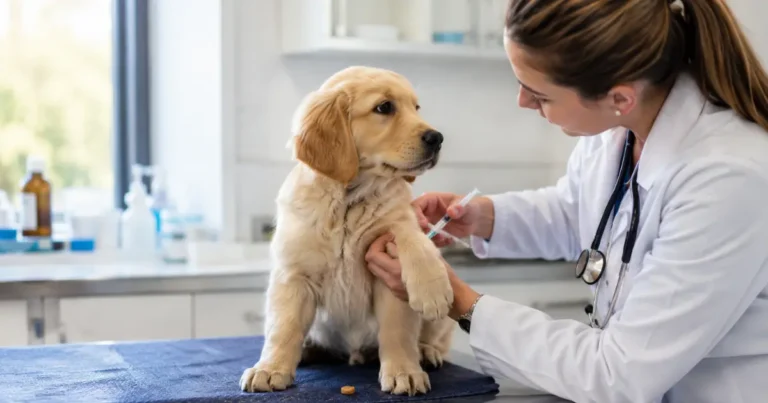
If you have a puppy, ask your vet to specifically check for retained baby teeth around 6 months old, when the adult teeth should be fully in. Catching this early is a simple fix that prevents years of crowding-related plaque buildup later.
Signs and Symptoms Most Owners Miss
Because dogs are so good at masking dental pain, the signs of dog dental disease tend to be subtle rather than dramatic.
- Persistent bad breath that doesn’t improve with time, distinct from normal “dog breath.”
- Visible tartar, a brownish-gold buildup near the gumline, especially on the back teeth.
- Red or bleeding gums, particularly when touched or during eating.
- Pawing at the mouth or face without an obvious cause.
- Chewing hesitantly, favoring one side, or dropping food while eating.
- Excessive drooling, sometimes with visible blood.
- Reduced appetite or reluctance to eat harder foods or chew toys.
Dental bacteria don’t necessarily stay confined to the mouth. Veterinary sources have found associations between advanced periodontal disease and changes in the heart, liver, and kidneys, since bacteria from infected gum tissue can enter the bloodstream.
This is one more reason dog dental disease deserves attention well before a dog seems to be in obvious pain.
Any single sign on its own might mean nothing serious. Several signs together, or bad breath that persists for more than a week or two, is worth a dental check rather than a wait-and-see approach.
Dogs can’t tell you when something hurts, so the pattern of small changes is often the only real signal an owner gets before the disease has already progressed.
It also helps to actually look inside your dog’s mouth periodically, not just watch for behavioral changes from a distance. Gently lifting the lip to check the gumline along the back teeth, where tartar accumulates first and most heavily, takes less than a minute and can catch early changes long before bad breath becomes noticeable.
Dogs that are used to having their mouths handled from puppyhood tolerate this far better than dogs encountering it for the first time as adults, which is one more reason early habit-building pays off later.
And if that look inside your dog’s mouth turns up a raw, red, or ulcerated spot, our guide to dog mouth sores and ulcers sorts the likely causes by where the sore is.
Professional Cleaning: What Actually Happens Under Anesthesia
A lot of owner anxiety around dog dental disease treatment centers on anesthesia, so it’s worth explaining exactly what a professional cleaning involves.
According to VCA, a routine dental cleaning starts with a thorough exam and pre-anesthetic blood work to confirm kidney and liver function can handle the procedure safely.
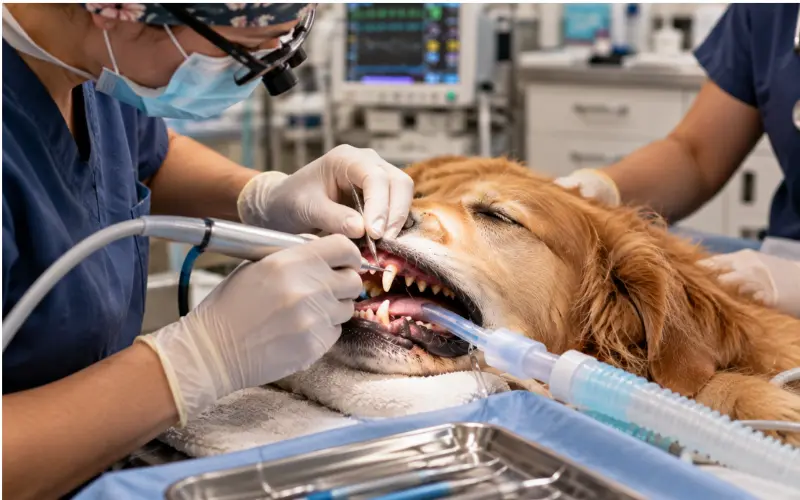
Once anesthetized, the vet examines tooth alignment and tartar extent, and dental X-rays assess the health of tooth roots and surrounding bone below the gumline, where most disease actually occurs.
The cleaning itself uses both hand scalers and ultrasonic equipment to remove tartar above and below the gumline, followed by polishing to smooth microscopic scratches that would otherwise attract new plaque.
In cases of severe periodontitis, some teeth may need extraction if they can’t be saved.
Professional dog dental cleanings require general anesthesia because most dental disease occurs below the gumline, and dental X-rays needed to assess tooth root health require a completely still patient that only anesthesia can reliably provide.
Anesthesia carries some risk, as any medical procedure does, but modern veterinary anesthesia protocols and pre-screening have made it substantially safer than it once was. Most dogs go home the same day, sometimes a bit groggy, but otherwise back to normal within 24 hours.
The pre-anesthetic blood work step deserves more attention than it usually gets in these conversations. That screening exists specifically to catch dogs whose kidney or liver function might make anesthesia riskier, allowing the vet to adjust the protocol or, in rare cases, delay the procedure until other health issues are addressed first.
This is the same reasoning behind keeping a dog first aid kit stocked and staying current on general wellness checks, since dental health rarely exists in isolation from a dog’s overall health picture.
For dogs with more advanced periodontitis, the cleaning appointment sometimes reveals problems that weren’t visible before the X-rays, meaning the actual procedure can run longer or involve extractions that weren’t planned going in.
Vets typically discuss this possibility beforehand and get consent for extractions during the same anesthesia event, since putting a dog under a second time just for extractions adds unnecessary risk and cost.
The Anesthesia-Free Cleaning Debate, What Vets Actually Say
Anesthesia-free dental cleanings are marketed as a gentler alternative, and it’s a genuinely common question for owners trying to avoid anesthesia risk.
The American Veterinary Medical Association is direct about this: the American Veterinary Dental College does not recommend anesthesia-free dental cleanings, because they don’t allow proper cleaning or inspection below the gumline, where most dog dental disease actually develops.
The procedure can also risk injury to the dog or the person performing it, since an awake dog understandably reacts to having its mouth handled.
That doesn’t mean the appeal isn’t understandable. Owners worried about anesthesia risk, especially for senior dogs, are asking a reasonable question.
The honest answer is that an anesthesia-free cleaning addresses the visible, cosmetic tartar above the gumline while leaving the actual disease process below the gumline completely unaddressed. It can look like progress without providing the diagnostic X-rays or subgingival cleaning that catches disease early.
If anesthesia risk is a genuine concern for your dog, the right conversation is with your vet about pre-anesthetic screening and protocol adjustments, not about skipping anesthesia altogether. Modern protocols account for age and health status far more than owners often expect.
The marketing around anesthesia-free cleanings often leans on words like “gentle” and “natural,” which resonates with owners who’ve read about anesthesia risk online without necessarily reading about how those risks compare to the risk of undiagnosed, progressing periodontal disease.
Framed that way, the choice isn’t really “risky anesthesia versus safe alternative.” It’s closer to “a small, well-managed risk now versus a larger, compounding risk from disease that goes undetected below the gumline for years.”
Some veterinary dental specialists do offer non-anesthetic cleaning in narrow circumstances, typically for dogs who are exceptionally calm and cooperative and only for surface tartar removal above the gumline, with the explicit understanding that it’s cosmetic maintenance rather than a substitute for a full anesthetized exam and cleaning.
That’s a different conversation than the anesthesia-free services marketed directly to the public, which typically make no such distinction.
At-Home Prevention That Actually Works
Daily habits do more for dog dental disease prevention than any single veterinary visit, since they address the plaque buildup that starts the entire disease process.
- Daily brushing with a toothpaste made specifically for dogs. Never use human toothpaste, since it often contains ingredients unsafe for dogs to swallow.
- VOHC-accepted dental products if brushing isn’t consistently possible. The Veterinary Oral Health Council evaluates dental chews, treats, and diets, and only awards its seal to products shown to actually reduce plaque or tartar.
- Dental-specific diets or chews, which provide mechanical or chemical plaque control, though they supplement rather than replace brushing.
- Regular veterinary checks, at least annually, so early gingivitis gets caught and treated before it can progress to periodontitis.
- Gauze wiping as a fallback for dogs that won’t tolerate a toothbrush, done every 2 to 3 days on the outside tooth surfaces.
The Veterinary Oral Health Council (VOHC) only awards its seal of acceptance to dental products that have been scientifically shown to reduce plaque or tartar buildup, making VOHC approval a more reliable signal than general marketing claims.
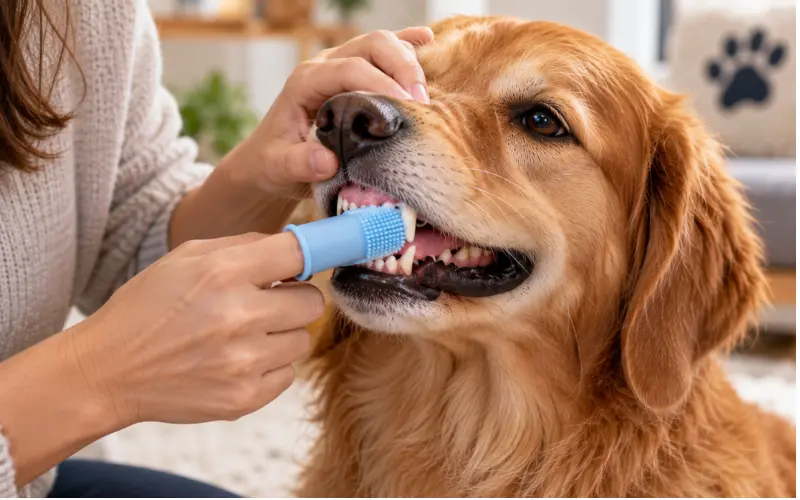
Start brushing with your finger wrapped in gauze before introducing an actual toothbrush, especially with a dog that’s never had their teeth handled. Building tolerance in stages gets you to consistent daily brushing far faster than forcing a toothbrush from day one.
Consistency matters more than perfection here. A dog brushed most days will fare better against dog dental disease than a dog brushed perfectly for a week and then not touched again for a month.
If brushing genuinely isn’t happening consistently despite good intentions, VOHC-approved dental chews are a legitimate fallback rather than an admission of failure, since some plaque control is meaningfully better than none.
The same applies to grooming routines more broadly. Dogs who are already comfortable being handled during regular grooming sessions tend to tolerate having their mouths checked and brushed with far less resistance, since it’s one more extension of a habit they already trust.
Small Breeds and Higher Dental Disease Risk
Not every dog faces the same odds against dog dental disease, and breed plays a bigger role than most owners realize.
Small-breed dogs and brachycephalic breeds face meaningfully higher risk, largely due to jaw structure. A smaller jaw still needs to fit the same 42 adult teeth as a larger dog’s jaw, which means more crowding, tighter spaces for plaque to collect, and gum tissue under more mechanical stress.
Breeds like Toy Poodles, Cavalier King Charles Spaniels, Yorkshire Terriers, and Chihuahuas show up consistently in veterinary literature as higher-risk for early and more severe dental disease.
This doesn’t mean large-breed dogs are exempt. It means small-breed owners specifically benefit from starting dental care habits earlier and taking symptoms more seriously sooner, since the anatomical deck is already stacked against them.
Brachycephalic breeds face a compounding issue worth calling out specifically: their shortened skull structure means teeth that would normally have adequate spacing in a longer jaw get crowded into less room, sometimes causing teeth to erupt at odd angles or overlap entirely.
That crowding creates hard-to-reach pockets that plaque exploits, which is part of why breeds like French Bulldogs and Pugs often need more frequent professional cleanings than their size alone would suggest.
If you have one of these breeds, mentioning this specifically to your vet, rather than assuming a generic small-dog dental schedule applies, tends to produce a more tailored and effective prevention plan.
I’m a dog owner sharing personal experience and research, not a veterinarian. This guide draws on published sources including VCA, AVMA, and the Merck Veterinary Manual, but it doesn’t replace professional veterinary care.
Always have your dog’s mouth examined by a veterinarian rather than diagnosing dental disease yourself.
Frequently Asked Questions (FAQ)
How common is dental disease in dogs?
Over 80% of dogs over the age of three have active dog dental disease, according to VCA Animal Hospitals, making it one of the most common medical conditions veterinarians diagnose.
Most affected dogs show no obvious outward signs, which is why the condition goes undiagnosed in so many cases until a routine check reveals it.
What’s the difference between gingivitis and periodontitis in dogs?
Gingivitis is the early, reversible stage of dog dental disease, involving gum inflammation without bone or ligament damage.
Periodontitis is the advanced stage, causing permanent damage to the bone and tissues supporting the teeth, typically developing between ages 4 and 6 if gingivitis goes untreated. Understanding which stage a dog is in changes the entire treatment conversation with a vet.
Can dog dental disease be reversed?
Gingivitis can be fully reversed with professional cleaning and consistent home care. Periodontitis cannot be reversed, since the bone and ligament damage is permanent, though further progression can be slowed or stopped with proper treatment and ongoing maintenance.
Why do dogs get gum disease instead of cavities?
Dogs rarely develop cavities, with tooth decay representing less than 10% of dental problems, because the dominant disease process in dogs is periodontal disease, an infection of the tissue surrounding the tooth rather than decay of the tooth’s surface.
Is anesthesia-free teeth cleaning safe for dogs?
The American Veterinary Dental College does not recommend anesthesia-free cleanings, since they can’t properly clean or inspect below the gumline where most dental disease actually occurs, and the procedure risks injury to the dog or handler during an awake cleaning attempt.
What are the first signs of dental disease in dogs?
Early signs include persistent bad breath, visible tartar near the gumline, red or bleeding gums, and pawing at the mouth.
Because dogs mask dental pain well, these subtle signs often appear well before any obvious change in eating or behavior shows up.
Can dog dental disease affect other organs?
Yes, veterinary sources have found associations between advanced periodontal disease and changes in the heart, liver, and kidneys, since bacteria from infected gum tissue can enter the bloodstream and affect other organ systems over time.
How often should a dog’s teeth be professionally cleaned?
Most dogs benefit from an annual veterinary dental check, with professional cleaning frequency for dog dental disease depending on individual risk factors like breed, age, and how consistently home dental care is maintained between visits.
Small breeds and dogs already showing tartar buildup often need cleanings more frequently than once a year.
Taking Dog Dental Disease Seriously Before Symptoms Show Up
My dog’s breath is back to normal now, after a professional cleaning and a genuinely boring nightly routine of two minutes with a finger toothbrush. Nothing dramatic.
Just consistency, applied before things got worse instead of after, which turned out to matter far more than any single product or appointment.
Three things worth carrying forward from this guide.
Dog dental disease affects the vast majority of dogs eventually, and the absence of obvious symptoms doesn’t mean the absence of disease, since most dogs hide dental pain remarkably well.
The two-stage progression from gingivitis to periodontitis means there’s a real window where damage is still fully reversible, and catching it there is worth far more than treating it later.
And prevention isn’t complicated: daily brushing, VOHC-verified products when brushing isn’t possible, and annual checkups do more heavy lifting than any single dramatic intervention ever will.
Dental health matters at every life stage, but it shifts as dogs age. Managing dog dental disease in senior years looks different from managing it in a young adult, and our guide on senior dog care covers how grooming and health routines, dental care included, need to adapt once a dog reaches their older years.
If you’re earlier in the journey and still building good habits, starting with a puppy essentials checklist makes it easier to fold dental care into a routine from day one, rather than trying to introduce it later once a dog is set in their ways.



Pingback: Dog Tooth Decay Stages: What Your Vet's PD Chart Means
Pingback: Dog Mouth Sores and Ulcers: Causes and When to Worry