


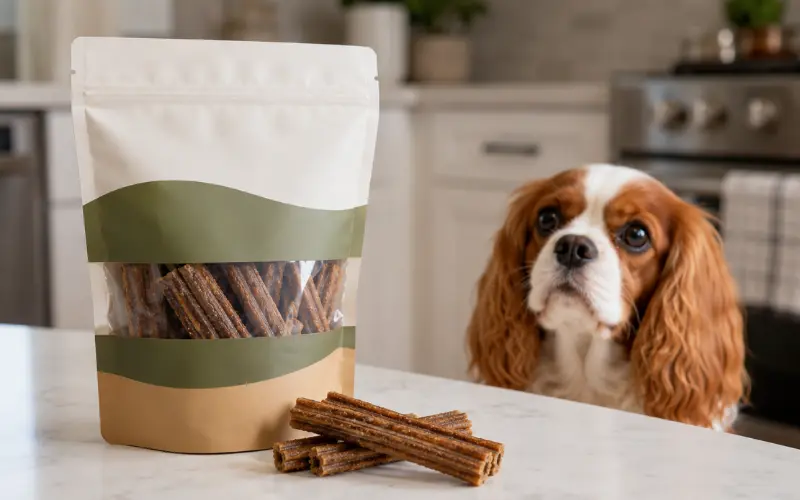
I almost bought a bag of dental chews shaped like tiny toothbrushes because the packaging said “vet recommended” in bold letters on the front.
Then I actually looked closer. Nothing on the bag said which vets, how many, or based on what evidence. It was a claim with no backing—the pet aisle equivalent of a supplement bottle promising “clinically proven” without citing a single study.
I put it back and spent twenty minutes learning what actually separates a real dental chew from a treat that just happens to be shaped like a toothbrush.
That twenty minutes taught me about something called the VOHC seal—an independent veterinary review board that tests dental products the way a real lab tests a real drug and only approves the ones that pass.
Once I knew to look for it, the entire shopping decision got simpler. Not more options. Fewer, better ones.
This guide is built around that filter. The best dog dental chews on this list all carry independent, third-party verification—not marketing copy—and I’ll show you exactly how to tell the difference yourself, because that skill is worth more than any single product recommendation.
Greenies Original is the most widely vet-recommended pick. Virbac C.E.T. VeggieDent is the best choice for dogs with poultry sensitivities. WHIMZEES Brushzees is the best plant-based, allergy-conscious option.
Give one appropriately sized chew daily, always supervised, and never to dogs under 6 to 9 months old.
Why the VOHC Seal Is the Filter That Actually Matters
Walk down any pet store dental aisle and nearly every bag claims to fight plaque and tartar.
Almost none of them can prove it.
The VOHC (Veterinary Oral Health Council) Seal of Acceptance requires a product to pass two independent clinical trials demonstrating a minimum 15 percent reduction in plaque or tartar before it can carry the seal.
That is why VOHC acceptance—not words like “vet recommended” on packaging—is the most reliable filter for choosing the best dog dental chews.
The VOHC is overseen by the American Veterinary Dental College and made up of nine veterinary dentists and dental scientists.
They don’t run the studies themselves—manufacturers submit trial data, and the council reviews it against a fixed scientific standard before granting the seal.
A product either meets that bar or it doesn’t.
There’s no partial credit for good marketing.
This matters because “vet recommended,” “clinically proven,” and “dentist approved” are phrases with no legal definition in pet products.
Any company can print them.
The VOHC seal is different—it’s earned through actual submitted data, reviewed by people with no financial stake in the outcome.
According to the American Kennel Club, the VOHC Seal of Acceptance means a dental product has been scientifically tested under standardized conditions and proven to reduce plaque or tartar.
Consulting the VOHC’s own list of accepted products is the most direct way for owners to verify a claim before buying.
3 Verified Picks—Each Solving a Different Problem
These three chews are not “the same product with different branding.” Each one earned its spot on this list of the best dog dental chews for solving a specific, common situation—not just for carrying the seal.
Independent analysis of clinical trial data, VOHC certifications, ingredient safety, and size-specific feeding rules to help you choose the safest, most effective dental chew for your dog.
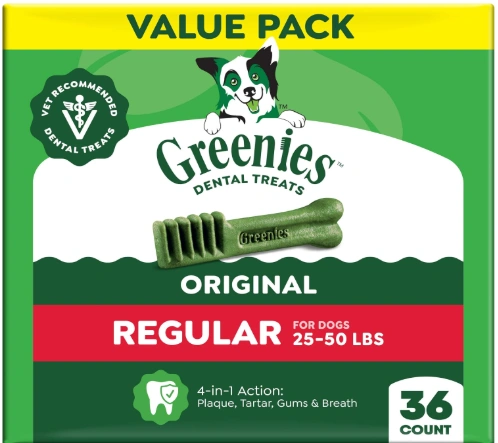
Greenies is the chew most consistently cited across independent veterinary review panels, carrying the VOHC seal for both plaque and tartar control. Manufacturer trial data demonstrates 47% less tartar buildup and 40% less plaque accumulation over 28 days of daily use.
- Engineered Texture Balance: Chewy, ridged texture is firm enough to scrape tooth surfaces but soft enough to break down safely during normal chewing—reducing choking risks.
- Precise Breed Sizing: Formulated from Teenie (5 to 15 lbs) through Large (50 to 100 lbs) to ensure appropriate chewing mechanical leverage.
- Safety Supervision Rule: Packaging explicitly advises monitoring your dog to confirm the treat is being chewed thoroughly rather than swallowed or gulped whole.
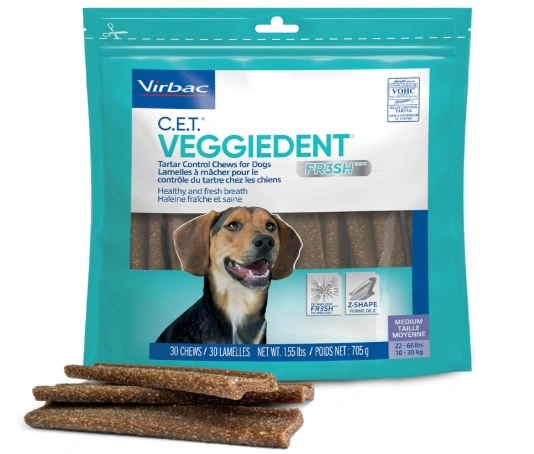
If your dog reacts to chicken or other poultry proteins, VeggieDent is the VOHC-accepted option built specifically around that gap. It contains zero chicken or poultry proteins and utilizes a 100% vegetable-based formula with an added prebiotic for digestive health.
- Innovative “Z-Shape” Architecture: Engineered to maximize contact with hard-to-reach back teeth and molars during natural chewing motions.
- Clinically Proven Results: Clinical data demonstrates up to 44% plaque reduction within one month of consistent daily feeding.
- Safe Breakdown Mechanics: Veggie-based chews break apart more readily than rawhide, providing a significant safety advantage for dogs prone to swallowing hard pieces whole.
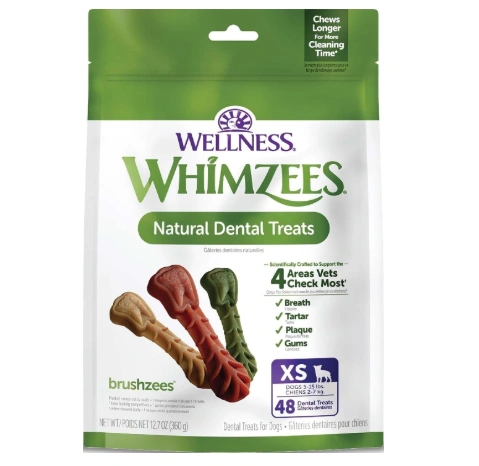
Six primary ingredients. Zero artificial colors, flavors, preservatives, or grains. Brushzees is recommended for dogs with severe food sensitivities that rule out traditional meat or grain-based chews, offering VOHC-accepted tartar reduction.
- Extended Mechanical Scraping: Firm texture delivers roughly 3 times longer chew duration than leading competitors, directly extending physical scrubbing time against tooth enamel.
- Allergy-Conscious Formula: Minimalist ingredient deck makes it ideal for elimination diets and dogs sensitive to animal proteins or corn/wheat fillers.
- Grooved Knobby Design: Unique shapes promote healthy blood flow through gums while scrubbing narrow spaces between teeth.
Quick Comparison
| Chew | Best For | VOHC Claim | Action |
|---|---|---|---|
🏆 BEST OVERALL
Greenies Original ↗
| Most dogs, best overall | 🦷 Plaque + Tartar | 🛒 Check Price → |
| Poultry allergies, sensitive stomachs | 🦷 Plaque + Tartar | 🛒 Check Price → | |
🌿 PLANT-BASED & GRAIN-FREE
WHIMZEES Brushzees ↗
| Plant-based, allergy-conscious | 🛡️ Tartar | 🛒 Check Price → |
Sizing and Safety – The Part That Actually Prevents Problems
Even the best dog dental chews are edible, and unsupervised chewing is how choking incidents happen.
This section matters more than which brand you pick.
Match Size to Weight – Exactly
Every VOHC-accepted brand sizes its chews by weight range, not by age or breed.
A Teenie Greenie for a 55-pound dog is too small and can be swallowed nearly whole.
A Large chew for a 12-pound dog is disproportionate to their jaw and bite force.
Check the weight range on the bag every single time you buy a new size, since ranges differ slightly between brands.
Supervise Every Single Time
This is printed directly on Greenies’ own packaging: monitor your dog to confirm the treat is being chewed adequately, because gulping any item can be harmful or even fatal.
That instruction applies to every dental chew on this list, regardless of brand or VOHC status.
A chew that’s safe when chewed properly is not automatically safe if swallowed in large pieces.
The two safety practices that prevent nearly all dental chew choking incidents are:
- Matching the chew size precisely to the dog’s current body weight
- Supervising every chewing session
Both are explicitly stated on VOHC-accepted product packaging, yet are the two steps most commonly skipped by owners who assume a “safe” product needs no oversight.
Never Under 6 Months – Some Brands Say 9
Puppies under roughly 6 months are still losing baby teeth and growing in adult ones.
A dental chew designed for adult tooth structure isn’t appropriate yet.
Greenies sets the line at 6 months; WHIMZEES sets it at 9 months.
Check the specific product, not a general rule of thumb.
For the complete puppy dental routine before chews are appropriate, read our guide on how to clean puppy teeth at home.

Most owners supervise the start and then walk away once the dog “seems fine.”
The riskiest moment is usually near the end, when the chew has softened and a large final piece can be swallowed in one motion.
Stay until it’s completely gone.
Best Dog Dental Chews Are a Supplement, Not a Substitute
Every veterinary source on dental chews says some version of the same thing, and it’s worth saying plainly: chewing helps, but it cannot reach below the gumline where periodontal disease actually starts.
By age 3, approximately 80 percent of dogs show some sign of periodontal disease, and while daily VOHC-accepted dental chews can reduce plaque and tartar buildup by 15 to 47 percent depending on the product, veterinary sources consistently note that chews complement rather than replace daily brushing and professional cleanings, since chewing cannot remove bacteria from below the gumline.
Brushing remains the single most effective thing you can do between professional cleanings.
Dental chews are what you add when daily brushing isn’t realistic every day—which, for most households, is most days.
The two aren’t competing strategies.
They’re the same strategy at different levels of effort.
According to the American Kennel Club, if brushing isn’t possible every day, choosing two to three different VOHC-accepted product types—such as a dental chew and a water additive—and rotating them daily gives broader coverage than relying on a single product type alone.
For the complete guide to keeping your dog’s teeth clean beyond chews, including brushing technique, read our guide on how to groom a dog at home step by step.
Common Mistakes Owners Make With Dental Chews
Trusting packaging language over the actual seal is the mistake I nearly made myself with the best dog dental chews I almost bought.
- “Vet recommended” on a bag means nothing verifiable. The VOHC seal, printed in the ingredient panel or on the company’s own product page, means something specific and checkable.
- Buying by age instead of weight leads to mis-sized chews more often than any other error. A “senior” label on a bag says nothing about whether the chew fits your dog’s actual jaw and body weight. Size by weight, every time.
- Walking away during the chewing session is how most close calls happen. The instinct to trust a “safe, VOHC-approved” product to run itself is understandable and wrong—every brand on this list explicitly instructs supervision on its own packaging.
- Assuming one chew replaces brushing entirely sets up disappointment and, more importantly, lets periodontal disease progress below the gumline where no chew can reach it.
According to the ASPCA, regular at-home dental care combined with professional checkups allows owners to catch developing dental and gum issues before they require more invasive treatment.
For the complete puppy first-year dental foundation, read our guide on how to take care of a puppy for the first time.
A chew that’s safe for most dogs isn’t automatically safe for a dog with an existing dental or swallowing issue.
The product information in this guide is based on VOHC’s published standards, AKC resources, and manufacturer clinical trial data as disclosed on product packaging and pages.
Always introduce new chews gradually, supervise every session, and consult your veterinarian about your dog’s specific dental needs — especially for dogs with existing dental issues or known allergies.
Frequently Asked Questions (FAQ)
What is the best dental chew for dogs?
Among the best dog dental chews available, Greenies Original is the most widely vet-recommended, carrying the VOHC seal for both plaque and tartar control, with manufacturer trial data showing 47 percent less tartar and 40 percent less plaque over 28 days of daily use.u003cbru003eFor dogs with poultry allergies, Virbac C.E.T. VeggieDent is the better match. For a plant-based, minimal-ingredient option, WHIMZEES Brushzees is the strongest choice.
What does VOHC-approved mean for dog dental chews?
VOHC stands for Veterinary Oral Health Council, an independent body overseen by the American Veterinary Dental College.u003cbru003eA product earns the VOHC Seal of Acceptance only after passing two independent clinical trials showing at least a 15 percent reduction in plaque or tartar.u003cbru003eIt is the most reliable third-party verification available in this product category—unlike phrases such as u0022vet recommended,u0022 which carry no formal requirement.
How often should I give my dog a dental chew?
Most veterinary sources recommend one appropriately sized dental chew daily as part of a consistent oral care routine.u003cbru003eIf daily brushing isn’t realistic, veterinarians suggest rotating two to three different VOHC-accepted product types—such as a chew and a water additive—to provide broader coverage than any single product alone.
Can dental chews replace brushing my dog’s teeth?
No. Dental chews reduce plaque and tartar through mechanical chewing action, but they cannot clean below the gumline, where periodontal disease actually begins.u003cbru003eVeterinary sources consistently describe dental chews as a supplement to brushing, not a replacement.u003cbru003eDaily or near-daily brushing remains the single most effective at-home dental care practice available.
At what age can puppies start having dental chews?
Most VOHC-accepted brands set a minimum age between 6 and 9 months, since puppies are still losing baby teeth and growing in adult teeth before that point.u003cbru003eGreenies sets its minimum at 6 months; WHIMZEES sets its minimum at 9 months.u003cbru003eAlways check the specific product’s packaging rather than assuming a universal age rule applies across brands.
Are dental chews safe for dogs to choke on?
Dental chews carry a real choking risk if the wrong size is chosen or the dog is left unsupervised.u003cbru003eManufacturer packaging for VOHC-accepted products explicitly instructs owners to match the size to their current body weight and to supervise every chewing session, since gulping large pieces can be harmful.u003cbru003eu003cstrongu003eThe risk is manageable with correct sizing and supervision, but it is not zero regardless of brand.u003c/strongu003e
Is Pedigree Dentastix VOHC approved?
The standard Pedigree Dentastix Original line sold in most retail listings is not VOHC approved, according to a direct manufacturer response to a customer question on Amazon.u003cbru003eA separate product, Pedigree Dentastix Advanced, does carry the VOHC seal for plaque and tartar.u003cbru003eIf VOHC certification matters to your buying decision, confirm which specific Dentastix product line you’re purchasing before assuming approval.
What ingredients should I avoid in dog dental chews?
Watch for chews with a long list of artificial colors, flavors, or preservatives, and check for poultry-based ingredients if your dog has a known sensitivity to chicken or turkey.u003cbru003eSome owner reports also flag reactions to sugar alcohols like sorbitol or erythritol in certain chew formulas.u003cbru003eIf your dog has shown food sensitivity before, read the full ingredient panel, not just the front-of-bag marketing claims.
The Bag I Almost Bought – Final Thoughts
I still think about that toothbrush-shaped bag with “vet recommended” printed across the front in bold letters, and nothing behind it to back the claim up.
The three chews in this guide aren’t here because they’re the most popular or the prettiest packaging on the shelf.
They’re here because each one has something verifiable behind it—an independent seal, published trial data, or both—and because each one solves a different real situation instead of being three versions of the same product.
Three things to take with you:
- Look for the seal, not the slogan. “Vet recommended” means nothing enforceable. VOHC acceptance means two independent trials and a minimum 15 percent improvement. Check the ingredient panel or the company’s product page—the seal is either there or it isn’t.
- Size by weight, every time, every bag. Age and breed labels are approximate. Weight ranges printed on the packaging are specific. When in doubt, size down and supervise closely rather than guessing up.
- Chews are one piece, not the whole plan. Combine daily chews with brushing when you can manage it, and don’t let a good chew talk you out of the annual dental checkup that catches what neither brushing nor chewing can reach.
For the complete home dental routine that pairs with these chews, read our guide on the best dog grooming kit for home use.
And for the complete list of every essential product category a dog owner actually needs, read our guide on essential dog products every owner needs.




Pingback: Dog Dental Disease: Complete Guide (Why 80% of Dogs Get It by Age 3)
Pingback: Prodogi Dental Strips Review 2026: Honest, Fact-Checked Verdict
Pingback: Dog Tooth Decay Stages: What Your Vet's PD Chart Means
Pingback: How to Clean Dog Teeth Without Brushing: 7 Vet-Backed Methods - PawWellCare
Pingback: Best VOHC-Verified Dog Dental Products (2026 Comparison)