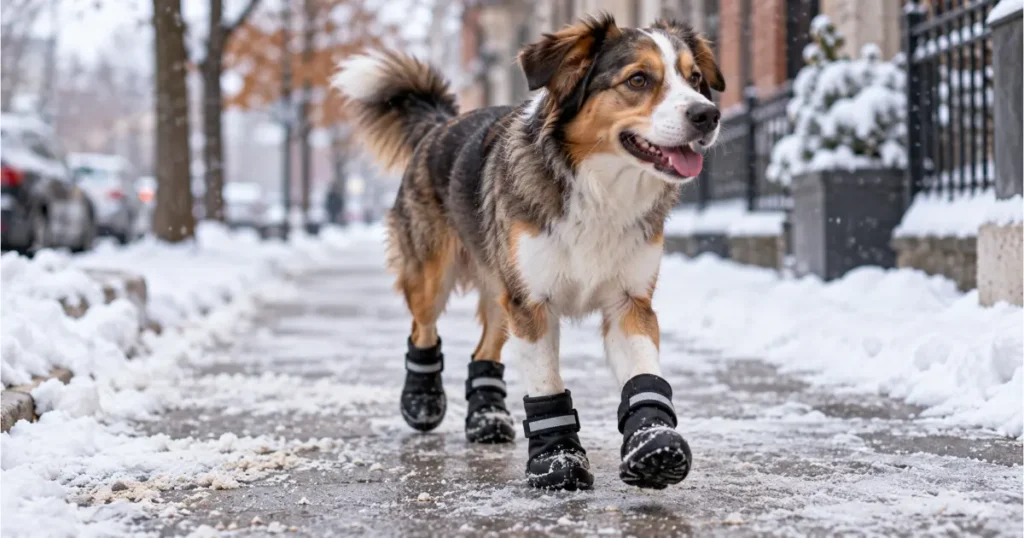
A dog boot can be waterproof and still be a poor winter boot.
It can keep road salt off the paw but fill with snow from the top. It can grip dry pavement but slide on packed ice. It can have warm insulation and still fly off halfway through the walk because the strap sits in the wrong place for your dog’s leg.
Pairing boots with a warm layer? See our guide to the best winter coats for dogs.
That’s the real problem with shopping for the best dog boots for winter.
Most product listings use the same handful of words – “waterproof,” “non-slip,” “warm” – for boots that are built for completely different jobs.
The right winter boot depends on six things:
- The weather you actually walk in
- The surface under your dog’s feet
- Your dog’s paw size and shape
- How well your dog tolerates wearing anything on their feet
- How securely the boot stays on
- How long your dog will be wearing it
This guide sorts seven currently available boots by the winter problem each one actually solves, then walks through sizing, fit, and training so the boots you buy end up on your dog’s paws instead of in a drawer.
The best dog boots for winter depend on your conditions.
For salted sidewalks, QUMY or XSY&G offer secure everyday protection. For deep snow and serious cold, the Ruffwear Polar Trex is the most winter-specific pick. For winter trails, Ruffwear Grip Trex adds rugged traction. For dogs that hate stiff boots, try Bark Brite or PawZ.
Quick Picks: Best Dog Boots for Winter in 2026
Here’s how the best dog boots for winter on this list compare at a glance.
At a Glance
- Best overall winter value: QUMY Dog Shoes
- Best budget option: XSY&G Dog Boots
- Best premium snow boot: Ruffwear Polar Trex
- Best for salted sidewalks: PawZ Rubber Boots
- Best for traction on trails: Ruffwear Grip Trex
- Best flexible boot: Bark Brite Neoprene
- Best for dogs that kick off boots: Ruffwear Polar Trex, with its gaiter-and-cinch closure
Choose the winter problem first, then the boot.
A waterproof boot is not automatically insulated, and an insulated boot is not automatically good on ice. Decide whether salt, deep snow, ice, or cold is your main issue before comparing features.
How We Chose These Winter Dog Boots
PawWellCare did not physically test every boot on this list.
Our picks for the best dog boots for winter are based on current manufacturer information, Amazon.com listings, product construction, sizing options, outsole design, cuff and closure design, and recurring patterns in buyer feedback.
For each boot, we looked at:
- Traction
- Water-resistance claims, including whether the manufacturer actually says waterproof or water-resistant
- Insulation
- Sole flexibility
- Cuff height
- Closure system
- How easy the boot is to put on
- Sizing range
- Reflective elements
- Whether the product is sold as a pair or a full set of four
That last point matters more than most roundups admit.
Ruffwear boots are sold as pairs, so covering all four paws means buying two packs. A set-of-four boot that looks more expensive per listing can actually cost less for a complete set.
We also took manufacturer wording at face value.
When a brand calls its own boot “water-resistant,” this guide doesn’t upgrade that claim to “waterproof,” even if a retailer listing does.
7 Best Dog Boots for Winter, Reviewed by Use Case
1. QUMY Dog Shoes: Best Value for Winter Walks
QUMY Dog Shoes are the best-value winter dog boots for everyday salted sidewalks, combining a rubber sole, dual hook-and-loop straps, and reflective strips in a set of four.
QUMY is one of the most-reviewed dog boots on Amazon and, among the best dog boots for winter on a budget, a practical everyday option for owners dealing with salted sidewalks, wet pavement, and light slush rather than deep backcountry snow.
The boot uses a molded rubber sole, a wide opening for easier paw entry, two adjustable hook-and-loop straps, and reflective strips for darker winter mornings and evenings.
The Amazon.com listing describes the boots as water-resistant, not fully waterproof, which is the honest way to think about them: good protection against wet pavement and salt spray, less suited to standing in deep, wet snow.
- Best for: daily neighborhood walks on salted or wet sidewalks, especially for medium and large dogs
- Skip it if: your dog regularly plunges into deep snow, since the cuff height won’t keep powder out on its own
- Main trade-off: a stiffer boot than neoprene or rubber options, so some dogs need more adjustment time
- Fit note: QUMY sizes by paw width, and its own guidance says the measured paw width should be smaller than the size chart’s listed width
- Winter use: city salt, slush, and cold pavement
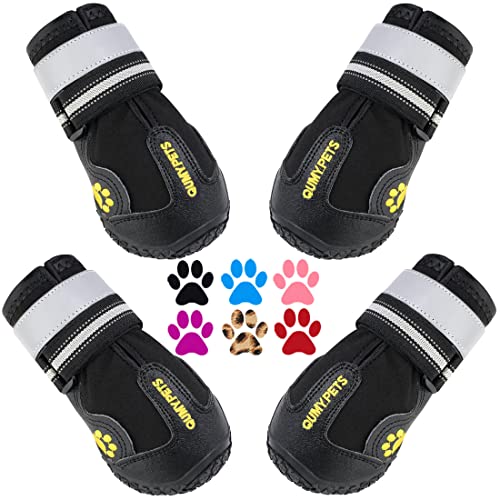
QUMY Dog Shoes for Hot Pavement, Dog Snow Boots & Paw Protectors for Winter | Dog Booties Medium Large Size Dogs, Water-resistant in the Rain, Outdoor Walking, Indoor Hardfloors Skid-resistant Sole Black
- Please be sure to measure the width of your dog's paws carefully, it is key to choosing the correct size for your dog, weight can only be used as an additional reference; Size 1: 1.8''x2.3''(W*L) for 11-23 lbs; size 2: 1.9''x2.4''(W*L) for 18-27 lbs; size 3: 2.0''x2.5''(W*L) for 23-33 lb; size 4: 2.2''x2.6''(W*L) for 31-40 lbs; size 5: 2.4''x2.8''(W*L) for 40-55 lbs; size 6: 2.6''x3.0''(W*L) for 52-65 lbs; size 7: 2.8''x3.2"(W*L) for 63-75 lbs; size 8: 3.0''x3.3"(W*L) for 74-88 lbs
- SECURE and ADJUSTABLE: Easy to put on / off. These dog shoes expands with a wide split seam opening and two adjustable and reflective straps to ensure a tight fit, also make your dog safe at night
- RUGGED: Tough slip-proof sole of dog boots provides stability and traction, protection from rough terrain
2. XSY&G Dog Boots: Best Budget Pick
XSY&G Dog Boots are the best budget winter dog boots for owners who want a full set of four with double straps and a rugged anti-slip sole, including sizes for larger dogs.
If you want the best dog boots for winter without paying premium prices, XSY&G is a lower-cost, set-of-four option that ranked in Amazon’s top five dog boots at the time of research, with more than 11,000 ratings.
It shares a similar build to QUMY: a rugged anti-slip rubber sole, reflective detailing, and a double hook-and-loop strap system that multiple buyers specifically mention when discussing fit.
Buyer feedback includes owners using these for urban service dogs across salt and cold in winter, which fits the boot’s realistic strength: everyday sidewalk protection rather than extreme winter conditions.
- Best for: owners wanting a full set of four at a lower cost, including owners of larger breeds
- Skip it if: you need insulation for very cold temperatures, since no insulation is claimed
- Main trade-off: the listing markets these as waterproof, but like most fabric-upper boots, water can still enter from the top in deep slush
- Fit note: measure paw width carefully; several buyers report that sizing worked well when measured correctly
- Winter use: salted sidewalks, wet pavement, and light snow
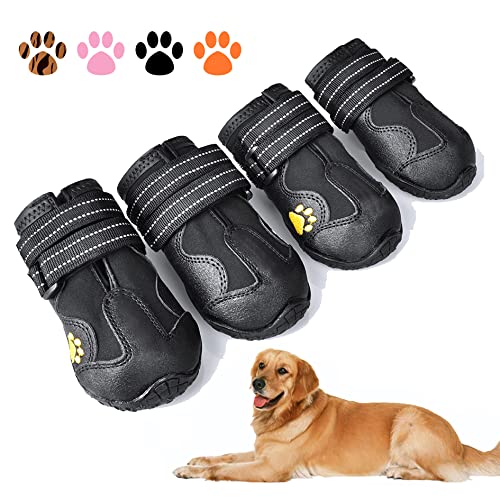
XSY&G Dog Shoes for Hot Pavement, Dog Snow Booties for Medium to Large Dogs | Dog Boots & Paw Protectors Waterproof&Anti-Slip with Reflective for Hardfloors,Walking,Rugged Skid-Resistant Sole Black Size5
- 【Size】Size 5:(2.51''x2.36'')(L*W) for 41-60lbs.Great for Border Collie;American Cooker Spaniel;Medium Chow Chow etc.Please refer to the picture size chart,You can choose the right size for your dog for the most comfortable fit.
- 【High-quality materials:】 High quality fabrics,wear resistant,to bear or endure dirty, Have cute pet paw embroidery, soft and hand washable, fashionable yet durable.Durable soles,tough anti-slip sole provides stability and traction,Helps dogs with mobility and stability on tile and the sand .
- 【Comfortable:】Soft and breathable to paws,so allows the boots to be used indoors or outdoors, hot and cold in wet and dry conditions.Protection from sharp thorns and hot pavement.Effectively protect dog claws from heat, stones, glass, etc. It protect the weak paw from snow, ice, salt during winter.
3. Bark Brite Neoprene Paw Protectors: Best Flexible Winter Boot
Bark Brite Neoprene Paw Protectors are the best flexible winter dog boots for dogs that refuse stiff footwear, because the neoprene conforms to the paw instead of forcing it into a rigid shape.
Bark Brite takes a different approach from rigid-sole boots.
The neoprene construction is designed to conform to the natural shape of the paw rather than forcing it into a fixed shoe shape, which is why owners of dogs that dislike stiff footwear often try this style first.
Each set includes four booties, one reflective strap per boot, and a travel zipper case. The manufacturer describes them as very water-resistant, with a non-skid sole.
Dogster named these its best overall snow boot, citing comfort and the lined interior.
- Best for: dogs that refuse stiff boots, wet sidewalks, slush, and moderate snow
- Skip it if: you need maximum traction on ice or protection in deep, crusty snow
- Main trade-off: more comfort and flexibility, but less rugged protection than lugged-sole boots
- Fit note: Bark Brite asks you to measure paw length and full rounded width. If you want a looser fit or don’t want to push the paw in, the brand suggests ordering the next size up
- Winter use: everyday walks, slush, and lighter snow

All Weather Neoprene Paw Protector Dog Boots with Reflective Straps in 5 Sizes! (Black Small)
- Dog Tested and Dog Approved! High Quality Breathable Neoprene Dog Booties that Conform to your Dog's Natural Paw Shape and will Not Inhibit Natural Paw Movements. New and Improved Durable Rubber Sole with Tread. Water Resistant, Puncture Resistant, and Aid in Traction.
- Bark Brite Booties are Great for all Weather Conditions, Indoor and Outdoor Activities including Walking, Running, Hiking, Hunting, Swimming, and other Moderate Performances. Great Water shoes, Snow shoes, and Protection on Rainy Days! Please note: These boots are not waterproof but are for protection.
- Will Keep your Pup's Paws Clean, Dry, and Safe with Protection from Ice and Snow, Hot Asphalt, Sharp Objects, Rocks, Wet Surfaces, and Many More.
4. PawZ Rubber Dog Boots: Best for Salted Sidewalks
PawZ Rubber Dog Boots are among the best dog boots for winter on salted sidewalks and short walks, because the strap-free natural rubber forms a waterproof barrier against road salt and slush.
PawZ are the odd one out on this list of the best dog boots for winter, and that’s exactly why they’re here.
They’re thin natural-rubber boots that stretch over the paw like a balloon, with no zippers, straps, or padding. Each pack contains 12 boots, and each boot can be reused several times before it wears out.
Because there’s no padding, dogs can still feel the ground, which PawZ says helps dogs that feel unstable in thicker footwear.
The rubber itself is waterproof, making these a strong barrier against road salt and slushy de-icer runoff on short city walks.
- Best for: short walks on salted or chemically treated sidewalks, and dogs that dislike strapped boots
- Skip it if: your dog has a known latex or natural-rubber sensitivity, you need warmth, or you’re walking in deep snow
- Main trade-off: zero insulation or cushioning, and the thin rubber wears faster than fabric boots, especially with longer nails
- Fit note: PawZ comes in multiple sizes sold as separate listings, so choose by paw width using the brand’s chart
- Winter use: salt, slush, and wet pavement

PawZ Rubber Dog Boots - Waterproof Non-Slip Dog Shoes for Hot Pavement, 12 Pack
- All-Weather Protection: Keep your furry friend's paws safe all year long with our rubber dog shoes for hot pavement, rainy days, or freezing winter months
- Perfect Fit for Small Paws: These dog shoes for small dogs are suitable for paws from 2"-2.5", ensuring a comfortable and secure fit for your four-legged companion
- Great Grip and Traction: Our anti-slip booties for dogs paws are made from natural rubber, providing excellent traction to prevent slips and falls on wet and slippery surfaces
5. Ruffwear Polar Trex: Best Premium Snow and Cold Boot
Ruffwear Polar Trex is the best dog boot for deep snow and serious cold, combining an insulated upper, a Vibram Icetrek ice-specific sole, and a zippered snow gaiter.
Polar Trex is the most winter-specific boot on this list.
If you only care about the best dog boots for winter in deep snow and real cold, it’s the one to look at first.
Ruffwear describes it as built for warmth, traction, and protection in winter conditions, using an insulated three-layer softshell upper that’s weather-resistant, wind-resistant, and breathable.
The outsole is a Ruffwear-designed Vibram Icetrek compound with a winter-specific lug pattern intended for grip on frozen surfaces.
The closure combines a hook-and-loop cinch with a pullover stretch gaiter that zips closed. That design helps keep snow out and can improve retention in deep snow.
Whole Dog Journal named it the best candidate among the boots it tested for hiking in deep or crusty snow.
- Best for: deep snow, sustained cold, winter hiking, and dogs that lose ordinary boots in powder
- Skip it if: you mainly walk short distances on salted city sidewalks, where this is more boot than you need
- Main trade-off: premium pricing, and the current Amazon listing is a pair of two, so a full set means buying two packs
- Fit note: Ruffwear sizes by paw width and provides its own measurement chart. Use that chart rather than guessing from a general size
- Winter use: deep snow, packed snow, ice, and extended cold

Ruffwear, Polar Trex Dog Boots - 2 Count, Obsidian Black, 2.50" | 2 Boots (1 pair) Ultimate Waterproof Winter Paw Protection, Insulated Grip & Anti-Snow Gaiter for Extreme Cold Adventures
- INSULATED WINTER DEFENSE. Features an insulated softshell upper for breathable, weatherproof warmth, actively trapping heat to prevent frostbite and discomfort during prolonged exposure to extreme cold outdoor.
- SOLD IN PAIRS – NOT A SET OF 4. Dogs often have wider front paws than rear paws. That’s why we sell our dog boots in pairs. So you can mix sizes and get the perfect fit on all four paws. A better fit means fewer slips and more miles together.
- UNYIELDING ICE TRACTION. Equipped with the Vibram Icetrek non-marking rubber outsole and a winter-specific lug pattern for superb, reliable grip on packed snow, slippery trails, and challenging sheer ice surfaces.
6. Ruffwear Grip Trex: Best Rugged-Traction Boot
Ruffwear Grip Trex is the best dog boot for winter trails and mixed terrain, with a Vibram outsole built for traction, though it is not insulated like the Polar Trex.
Grip Trex is not the same product as Polar Trex, and it’s worth being clear about the difference.
Grip Trex is Ruffwear’s all-terrain hiking boot, with a Vibram outsole and a breathable mesh upper designed to keep dirt and debris out. It’s not insulated and doesn’t have the Polar Trex snow gaiter.
That makes Grip Trex one of the best dog boots for winter trail use specifically.
It’s the better pick for active hiking, mixed rock-and-snow terrain, and dogs that keep moving, while Polar Trex makes more sense for colder, snowier, slower conditions.
The current Amazon listing is also sold as a pair of two.
- Best for: winter trail hiking, rocky or mixed terrain, and dogs that also need boots in summer
- Skip it if: your main concern is warmth or deep snow getting into the boot
- Main trade-off: excellent grip and durability, but no insulation and pair-only packaging
- Fit note: use the same Ruffwear paw-width chart as Polar Trex, measured while your dog is standing
- Winter use: trails, packed snow, and mixed winter terrain

Ruffwear, Grip Trex Dog Shoes - 2 Count, Red Sumac, 3.25" | 2 Shoes (1 pair) Non-Slip Boots for Hot Pavement & Snow, Weatherproof Paw Protection with Breathable Mesh, Rugged Hiking Sole
- SOLD IN PAIRS – NOT A SET OF 4. Dogs often have wider front paws than rear paws. That’s why we sell our dog boots in pairs—so you can mix sizes and get the perfect fit on all four paws. A better fit means fewer slips and more miles together.
- FIND THE RIGHT FIT WITH EASE. Not sure which size to choose? Check out our sizing chart image and how-to-fit video to help you measure your dog's paws correctly. A proper fit means more comfort, control, and confidence on every adventure.
- TRAIL-TESTED GRIP FOR EVERY TERRAIN. Built with rugged Vibram Outsoles for non-slip traction. Whether you're crossing hot pavement, slick tile, rocky trails or everything else in between.
7. CovertSafe Dog Boots: Solid Secure-Fit Alternative
CovertSafe Dog Boots are a solid secure-fit alternative for medium to large dogs, with adjustable straps and a rugged sole in a set of four.
CovertSafe is a set-of-four boot aimed at medium to large dogs, with a rugged anti-slip sole, adjustable hook-and-loop straps, and hand-washable fabric uppers.
Sizes range from small dogs around 10 pounds up to large dogs around 90 pounds.
It rounds out this list of the best dog boots for winter as a reasonable alternative to QUMY or XSY&G if those don’t suit your dog’s paw shape, with similar everyday-winter strengths and limits.
- Best for: medium to large dogs on everyday winter walks
- Skip it if: you need insulation or a tall snow cuff
- Main trade-off: very similar to other fabric-and-rubber boots, so fit to your dog’s paw is the main reason to choose it
- Fit note: sizes are listed by length and width, so measure both
- Winter use: salted sidewalks, light snow, and wet pavement

CovertSafe& Dog Boots & Paw Protectors Non-Slip Waterproof | Dog Booties Adjustable Straps for Hot Pavement and Winter, Dog Shoes for Medium to Large Dogs 4Pcs with Rugged Sole
- Size 6: (2.9''x2.5'')(L*W) for 52-70 lbs. Please refer to the picture size chart,You can choose the right size for your dog for the most comfortable fit.
- FASHIONABLE: dog boots are with cute pet paw embroidery, paws side is the outside, soft and hand washable.
- QUALITY: The dog boots have a rugged sole and high quality fabrics that are then sewn together to ensure they are ready for your adventure.
⚡ Direct Answer: What Should I Look for in Winter Dog Boots?
Look for:
- A secure closure that sits at the narrowest part of the leg
- A sole suited to the surface you actually walk on
- Weather protection that matches your conditions
- Enough cuff height to stop snow from entering
- The correct paw width and length
- A design your dog can walk in normally without rubbing
Which Winter Dog Boot Fits Your Conditions?
This is where most guides to the best dog boots for winter fall short.
They rank boots in a single list, when the “best” boot for a salted city sidewalk is often the wrong boot for deep snow.
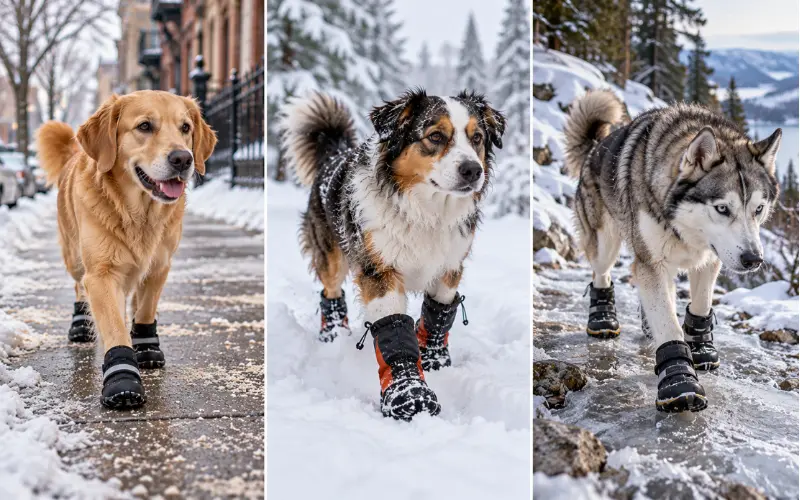
Three distinctions are worth keeping in mind:
- Salt protection is not the same as deep-snow performance.
- Waterproofing is not the same as insulation.
- A traction-focused sole can improve grip on ice without guaranteeing your dog won’t slip.
Best Dog Boots for Road Salt and De-Icers
For many U.S. dog owners, salt is the real winter problem, not snow.
That means the best dog boots for winter in a city often look very different from the best boots for a mountain trail.
According to the American Kennel Club, common de-icers such as calcium chloride and sodium chloride can irritate or hurt a dog’s paws, and some can be toxic if a dog licks residue off later.
Boots help by keeping treated pavement from touching the paw pads directly.
For short city walks, you usually don’t need an expedition boot. A secure everyday option like QUMY or XSY&G, or a strap-free rubber option like PawZ, can provide practical protection and is easier to rinse afterward.
The AKC also recommends removing boots as soon as you get home so any chemicals on them don’t get tracked through the house.
Winter boots are protective equipment, not a substitute for checking your dog’s paws.
Inspect the pads and the spaces between the toes after snowy or salted walks, and rinse off any salt residue.
Best Dog Boots for Snow and Ice
Snow and ice demand different things from a boot, so when comparing the best dog boots for winter, it helps to separate them.
In Snow
The biggest problems are snow entering from the top and boots pulling off in deeper powder.
For snow, prioritize:
- Cuff height
- Secure closure
- A boot that stays on during deeper steps
- An upper that won’t become saturated too quickly
For light snow, most everyday boots work fine.
For packed snow, a lugged outsole helps. For deep snow, a gaiter-style boot like the Polar Trex is the more realistic choice, since short cuffs can scoop snow in with every step.
Fabric uppers can also become saturated on longer snowy walks, which can cool the paw even if the sole itself performs well.
On Ice
On ice, the sole matters more.
Look for a traction-oriented outsole designed for winter grip, such as Ruffwear’s Vibram Icetrek.
Even then, better traction is not the same as guaranteed grip.
No dog boot makes slipping on ice impossible, and any product claiming otherwise is overselling it.
For the best dog snow boots, prioritize the cuff.
For dog boots that need to handle both snow and ice, prioritize a design that can manage both conditions. On this list, the Polar Trex is the clearest example.
Waterproof vs Insulated vs Traction Boots
Most listings for the best dog boots for winter bundle waterproofing, insulation, and traction together in one sentence.
Reading those features separately makes it much easier to tell whether a boot actually solves your specific winter problem.
Fit, Sizing & Boots That Actually Stay On
Even the best dog boots for winter are useless if they fall off.
And most retention problems start with sizing rather than the boot itself.
How to Measure Your Dog’s Paws
According to the AKC’s guide to winter dog boots, one simple method is to press your dog’s paw onto a sheet of paper so it spreads the way it does while walking, then measure across the widest part of the tracing.
For the most accurate fit:
- Measure while your dog is standing: the paw should be bearing weight, not relaxed while lying down.
- Measure paw length too: some brands use both width and length in their size charts.
- Check front and rear paws separately: they can be different sizes.
- Use the exact brand’s chart: don’t assume a general Small, Medium, or Large will match across brands.
Front and rear paws may need different sizes.
If your dog’s rear paws measure noticeably smaller, a boot that fits the front paws can twist or slide off the back paws. Check the brand’s chart for each pair.
How Should Dog Boots Fit?
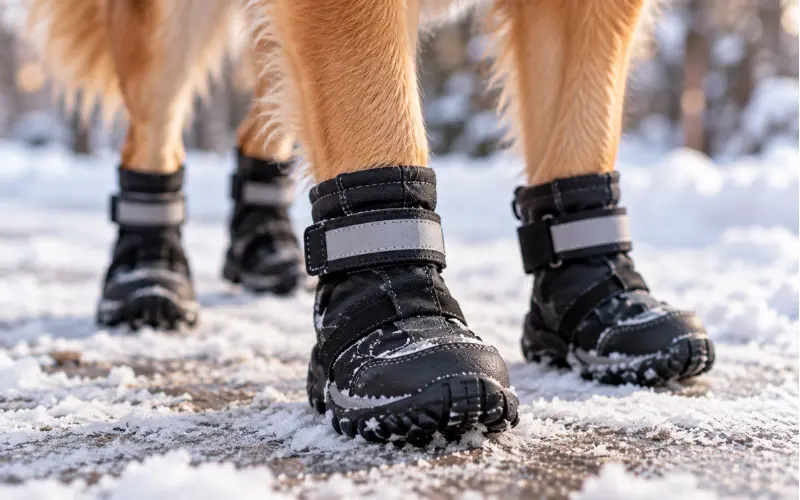
How should dog boots fit? Dog boots should be secure but not tight. The paw should sit flat, the toes shouldn’t be squeezed, the boot shouldn’t rotate much when your dog walks, and there should be no rubbing at the ankle or dewclaw. Your dog should be able to walk with a close-to-normal gait.
Too loose, and boots twist, fall off, and let snow in.
Too tight, and you get rubbing, pressure, and an altered gait.
The goal is secure, not restrictive.
Why Boots Keep Falling Off
Why do my dog’s boots keep falling off? Usually the paw width is wrong, the strap sits below the narrowest part of the leg, or the front and rear paws need different sizes. Stiff boots on a dog with an unusual gait can also work loose. Re-measure while your dog is standing before switching brands.
Closure design matters too:
- Single strap: easiest to put on, but usually the least secure
- Dual straps: better retention for active dogs
- Gaiter-style cuffs: add retention in deep snow, as with the Polar Trex
- Connected boot systems: useful for dogs that lose every ordinary boot, though no design stays on every dog
Best Winter Boots for Small vs Large Dogs
Small Dogs
The best dog boots for winter for a small dog aren’t just scaled-down large-dog boots.
Small dogs have short legs that sit closer to cold ground and deep snow, which means snow reaches the body faster.
Lightweight construction and flexible soles matter more for them because a heavy boot can noticeably change how a small dog walks.
Narrow paw sizing is also common, so check that the brand actually offers small enough widths rather than assuming “extra small” will fit.
Large Dogs
Large dogs need wider sizing, stronger closures, and boots durable enough for longer walks.
Front and rear paw differences can be more noticeable in bigger dogs, so separate measurements matter even more.
Don’t assume a large dog will tolerate a stiff boot better than a small dog. Tolerance depends on the individual, not body size.
How to Get Your Dog Used to Wearing Boots
Even with the best dog boots for winter, most dogs walk strangely in their first pair.
That’s normal and usually temporary with gradual practice.
- Let your dog sniff and investigate one boot indoors, and reward calm interest.
- Put one boot on for a few seconds, reward, and take it off.
- Build up to two boots, then all four, over several short sessions.
- Practice walking around the house in all four boots.
- Try a short outdoor walk on an easy surface.
- Gradually extend the time outside.
Rewarding calm behavior at each step works far better than forcing prolonged wear.
Our guide to positive reinforcement dog training covers how to use rewards for exactly this kind of step-by-step introduction.
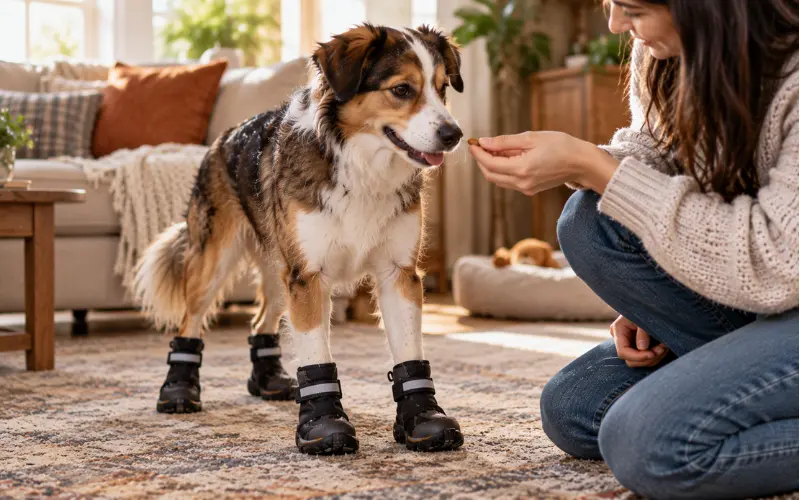
Your dog’s first winter walk shouldn’t be the first time they wear boots.
Practice indoors before snow or salted sidewalks arrive, so the first real walk isn’t also the first time they feel something on their feet.
Does Your Dog Actually Need Winter Boots?
Not every dog needs boots for every cold walk, and a guide to the best dog boots for winter should be honest about that.
Boots are genuinely useful in these situations:
- Salted or de-iced sidewalks
- Snow that balls up between the toes
- Icy surfaces
- Very cold ground on longer walks
- Extended outdoor winter activity, such as hiking
- Paw injuries, but only when your veterinarian recommends a specific type of protection
The AKC notes that snow can quickly turn into ice balls between the paw pads, which can be uncomfortable and may lead a dog to chew at them and swallow de-icer residue.
Dogs with long fur between their pads are more prone to this. Keeping that fur trimmed, as covered in our guide to grooming a dog at home, can help.
Do dogs need boots in winter? Not always. Boots are most useful on salted sidewalks, in deep or balling snow, on ice, and during long cold outings. A quick potty break in light snow may not need them. Weather, coat, paw condition, walk length, and surface all matter more than any single temperature.
There’s no universal temperature at which every dog needs boots.
Coat type, age, paw condition, walk length, and surface matter more than a single number.
Older dogs can be more sensitive to cold, which our senior dog care guide covers in more detail.
Winter Dog Boot Safety Checklist & Common Mistakes
Before and During Walks
- Check the fit: there should be no rubbing
- Keep straps snug: but not tight enough to restrict circulation
- Check dewclaws: make sure straps or seams don’t press on them
- Keep nails at a reasonable length
- Watch the cuffs: snow shouldn’t collect inside
- Watch your dog’s gait: remove the boots if your dog starts walking abnormally
- Supervise: especially when your dog is new to wearing boots
After Walks
- Remove the boots promptly
- Inspect the paw pads and spaces between the toes
- Clean the paws after salt exposure
- Dry the boots fully before the next use
The AKC also notes that excess moisture trapped between the toe pads can increase the likelihood of yeast problems, which is one more reason not to leave wet boots on longer than necessary.
Common Mistakes to Avoid
- Buying by breed instead of paw measurement
- Ignoring front and rear paw differences
- Buying waterproof boots when insulation is what you actually need
- Choosing a short cuff for deep snow
- Over-tightening straps
- Keeping boots that visibly rotate on the paw
- Expecting instant acceptance on day one
- Leaving wet boots on after the walk
- Assuming “non-slip” means impossible to slip on ice
How to Clean and Dry Dog Boots After Winter Walks
Salt residue left on boots can damage materials and irritate paws the next time they’re worn, so cleaning matters as much as choosing the best dog boots for winter in the first place.
After winter walks:
- Knock off loose salt and grit before bringing the boots inside
- Rinse according to the manufacturer’s instructions
- Wipe the interior to remove salt that got past the cuff
- Air dry fully, away from direct high heat
- Check straps and soles for wear before the next walk
- Never store boots wet
Many fabric boots, including Ruffwear and QUMY, are listed as hand-wash only.
Follow each brand’s care instructions rather than assuming every boot can go in a washing machine.
Frequently Asked Questions (FAQ)
What are the best dog boots for winter?
The best dog boots for winter depend on your conditions.
For everyday salted sidewalks, QUMY or XSY&G offer good value. For deep snow and serious cold, the Ruffwear Polar Trex is the most winter-specific option. For dogs that dislike stiff boots, Bark Brite or PawZ are more flexible.
Are waterproof dog boots warm?
Not necessarily.
Waterproofing keeps water out but doesn’t add warmth. For cold temperatures, look for boots that specifically list insulation, such as the Ruffwear Polar Trex.
How do I keep snow from getting inside dog boots?
Choose a taller cuff or gaiter-style boot, fasten the strap at the narrowest part of the leg, and make sure the paw width is correct so the boot doesn’t gap at the top.
How long can my dog wear winter boots?
Boots are meant for walks and outdoor activity, not all-day wear.
Remove them once you’re back inside, check for rubbing, and let both the paws and boots dry.
Should I buy boots for all four paws?
In most cases, yes, since salt and snow affect all four paws.
Just note that some brands, including Ruffwear, sell boots in pairs, so you’ll need two packs for a full set.
Can I use the same boots for winter and hot summer pavement?
Some boots, such as Ruffwear Grip Trex, are designed for use across seasons.
Insulated boots like the Polar Trex are winter-specific and can be too warm for summer.
What if my dog refuses to wear boots at all?
Try a strap-free rubber option like PawZ or a flexible neoprene boot, and introduce it gradually indoors.
If boots still don’t work, keep walks shorter, rinse paws after every salted walk, and use a pet-safe ice melt around your own home, as the AKC recommends.
Final Verdict: Choose the Boot for the Winter Problem
The best dog boots for winter aren’t the ones with the longest feature list.
They’re the ones that fit your dog’s paws and match the conditions you actually walk in.
Use this simple decision path:
- Salted sidewalks: choose an easy-to-clean, secure everyday boot like QUMY or XSY&G, or strap-free PawZ for short walks
- Snow and serious cold: choose a winter-specific boot with insulation and a gaiter, like the Ruffwear Polar Trex
- Ice or rugged terrain: prioritize a traction-oriented outsole, like the Polar Trex or Grip Trex
- Dog hates stiff shoes: start with flexible construction like Bark Brite or PawZ
- Boots keep falling off: fix sizing and retention before worrying about insulation
Measure your dog’s paws while they’re standing, check the brand’s own chart, and practice indoors before the first snowy walk.
If you’re still building out your dog’s basic gear, our guide to essential dog products covers the rest of the starter kit.
The best winter dog boot is not the one with the most features. It’s the one that fits your dog’s paw correctly and solves the conditions you actually walk in.