


I put the American Animal Hospital Association’s staging page next to several vet-clinic articles on dog tooth decay stages, and the numbers didn’t line up.
On one clinic’s blog, “Stage 2” meant gingivitis. On the chart vets actually use, gingivitis is Stage 1, and Stage 2 is early periodontitis, where the tissue anchoring the tooth has started to break down.
That gap matters.
Say your vet writes “PD2” on your dog’s dental chart, and that night you search “dog tooth decay stage 2.” You may land on a page describing something milder and walk away thinking the problem is smaller than it is.
This guide translates the vet’s Stage 0 to 4 chart into plain English.
Here’s what you’ll get:
- What you can and can’t spot at home
- What usually happens at each stage
- When to call your vet
- Why “tooth decay” in dogs isn’t quite the same as cavities
- Why teeth can look fine while the damage happens below the gum line
⚡ Quick Answer
What owners call tooth decay in dogs is usually periodontal disease, an infection of the gums and the ligament and bone that hold teeth in place. The dog tooth decay stages vets use run from 0 to 4, based on how much of that support has been lost. Only Stage 1, gingivitis, can return fully to normal with cleaning. Staging takes probing and dental X-rays, so only your vet can tell you your dog’s stage.
⚠️ Disclaimer
I’m not a veterinarian. This guide summarizes published veterinary guidelines (AAHA, Merck Veterinary Manual) and can’t diagnose your dog. Only a vet exam, with probing and dental X-rays, can tell you your dog’s stage. If your dog can’t eat, has facial swelling, or seems to be in pain, call your vet.
Do Dogs Get Tooth Decay (Cavities)?
Sometimes, but not as often as you’d think, and not the way most owners picture it.
In people, tooth decay means cavities, holes that acid from bacteria eats into the enamel. Dogs can get those too, and the veterinary term is dental caries.
One widely cited study, published in the Journal of Veterinary Dentistry in 1998, reviewed the records of 435 dogs seen at a dental referral practice:
- 23 dogs, or 5.3%, had at least one caries lesion
- The teeth most often involved were the fourth premolars and the first and second molars
What a Cavity Can Look Like
According to PetMD, a cavity may appear as:
- A dark spot on the tooth surface
- A lesion more likely to occur on a back tooth
- Something a vet may notice during a regular exam, although fully assessing it, including probing the area, requires anesthesia
That 5.3% comes from 435 dogs seen at a dental referral practice, so it isn’t a rate for all dogs. Today’s Veterinary Practice notes that prevalence reports vary widely, possibly because discolored surfaces get over-called as cavities. A brown spot needs a vet’s look, not a guess.
So when someone says their dog has “tooth decay,” they usually mean periodontal disease instead, an infection of the tissues that hold the teeth in place.
It’s far more common than cavities, and it’s what the stages in this guide describe. I use both terms side by side so you can match what you read online to what your vet says.
How Dog Tooth Decay Starts: Plaque, Tartar, and the Gum Line
It starts with a film you barely notice and does its worst damage where you can’t see at all.
Plaque: The Part That Does the Damage
Plaque is a soft film of food particles, saliva, and bacteria that coats the teeth.
- It forms constantly, on tooth surfaces and between teeth.
- Brushing and a professional cleaning remove it, but Merck’s veterinary manual notes a new layer starts forming by the next day.
- The bacteria irritate the gums first, which causes gingivitis.
- The more serious damage happens below the gum line. Periodontitis is caused by your dog’s immune response to plaque under the gum line, and the bacteria and their byproducts add to the bone damage.
Tartar: Easy to See, Not the Whole Story
- If plaque stays on the teeth for more than two days, minerals in saliva harden it into tartar, also called calculus.
- Brushing can’t remove tartar. Only professional scaling and polishing can.
- Tartar isn’t harmless. It gives bacteria a protective shield and irritates the gums.
- Still, Merck calls tartar’s own contribution to periodontal disease minor. The disease itself starts with plaque.
How Common Is It, and Who’s at Higher Risk?
Very common, though the numbers vary.
- Merck’s veterinary manual: up to 80% of dogs have some level of periodontal disease by age 2.
- VCA Animal Hospitals: over 80% of dogs over age 3 have active dental disease, and elsewhere on the same page, more than two-thirds have some degree of periodontal disease.
The figures depend on the age group and the definition, so treat them as a range, not one exact number.
Risk isn’t equal:
- Merck lists toy breeds, misaligned teeth, poor nutritional status, and conditions like diabetes and Cushing’s disease.
- VCA adds that small and short-nosed breeds are more prone because of smaller jaws and crowded teeth.
For the bigger picture on gum disease in dogs, see my complete guide to dog dental disease.
Dog Tooth Decay Stages: Your Vet’s PD Chart in Plain English
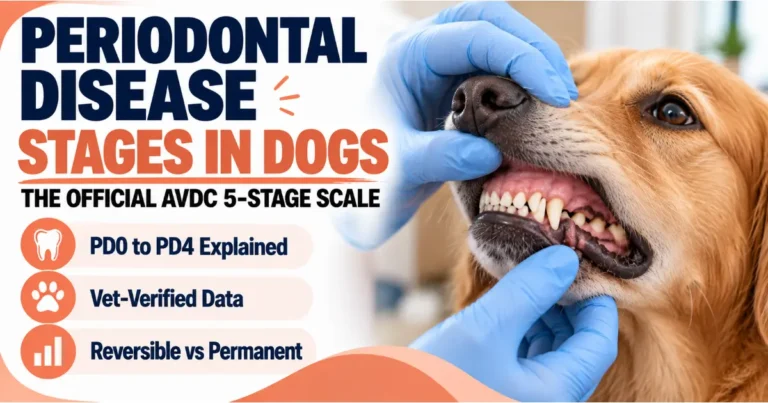
Vets don’t stage dental disease by how much tartar they see. They stage it by how much of the tooth’s support system is gone, a measure called attachment loss.
Findings get recorded tooth by tooth on a dental chart, using a 0 to 4 scale that vets write as PD0 through PD4. PD stands for periodontal disease.
AAHA’s dental guidelines use the same scale.
This table shows what vets measure, not a home checklist. Attachment loss is measured with a probe and X-rays, and AAHA says staging is most accurate on an anesthetized dog.
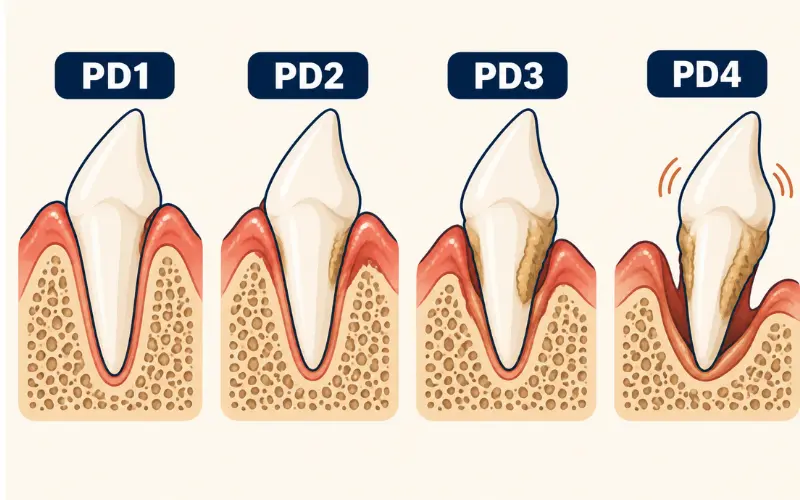
PD1: Gingivitis
- What’s happening: Plaque bacteria irritate the gum edge, and the gums respond with inflammation. The ligament and bone haven’t been touched yet.
- What you may notice: Merck’s owner guide describes gums that shift from coral-pink to red or purple, with a swollen edge that tends to bleed on contact. Bad breath is common.
- What your vet does: AAHA’s plan is scaling, polishing, irrigation, and home dental care.
- Why it matters: This is the one stage where a professional cleaning can return the gums to normal. Merck adds that gingivitis comes back if the teeth aren’t kept free of plaque, so home care and cleanings work as a pair.
PD2: Early Periodontitis
- What’s happening: The infection has reached the tissues that anchor the tooth. Less than 25% of that attachment is gone, and X-rays may show the first signs of bone loss.
- When it shows up: Merck’s owner guide says periodontitis usually begins at 4 to 6 years of age, while gingivitis is often first noticed around age 2.
- Why it’s easy to miss: You can’t reliably tell PD2 from PD1 by looking. Merck states that periodontal probing and dental imaging are necessary to assess the stage.
- What your vet does: AAHA’s plan builds on PD1 care with locally applied antimicrobials and subgingival scaling if pocketing exists.
PD3: Moderate Periodontitis
- What’s happening: Between 25% and 50% of the attachment is gone, and teeth can loosen as attachment is lost.
- Signs vets look for: Merck lists bad breath, plaque and tartar, inflamed and bleeding gums, gum recession, pockets, bone loss, and mobile teeth.
- What your vet does: AAHA says periodontal therapy, including surgery, only succeeds if the owner commits to consistent home care. Extraction is indicated when the owner and dog won’t commit to daily home hygiene.
- Pocket depth: Merck says pockets deeper than 5 to 6 mm need open surgery to clean properly. A healthy pocket in a dog measures 1 to 3 mm.
PD4: Advanced Periodontitis
- What’s happening: More than half of the attachment is gone.
- What your vet does: AAHA’s guidance is extraction or periodontal surgery, followed by consistent home care, and it calls the prognosis guarded. Merck says teeth that have become mobile because of lost attachment should be extracted.
- Not as drastic as it sounds: Merck notes a dog can function without teeth and can have a potentially improved quality of life once the diseased teeth are out.
- Mixed stages are normal: Because vets assess tooth by tooth, one mouth can hold more than one stage. Merck describes the grade as either localized or generalized.
Why “Stage 2” Confuses Everyone
Search for dog tooth decay stages and you’ll run into at least three numbering systems:
- Some clinic blogs count plaque and tartar as Stage 1, which turns their Stage 2 into gingivitis.
- Some use three stages in total.
- Others use four but define Stage 2 by tartar.
On the vet’s chart, tartar gets its own 0 to 3 score in Merck’s manual, and the PD stages start counting at gingivitis.
The numbering is what doesn’t match. When your vet gives you a stage, go by the PD number on the chart, not a number you read online.
For a closer look at what each PD stage looks like in a real dog, see my guide to dog periodontal disease stages.
💡 Pro Tip
When your vet says “Stage 2,” ask two things: “Is that the AVDC PD stage?” and “Is that for one tooth or the whole mouth?” Clinic blogs number stages differently, and the dental chart records findings tooth by tooth.
Why Your Dog’s Teeth Can Look Fine at Stage 3
A clean-looking front tooth tells you very little. Periodontal disease does its damage below the gum line, in the ligament and bone you can’t see.
Merck’s owner guide notes that most dogs mask tooth pain, which is one reason the signs your dog is in pain and hiding it are so easy to miss.
A dog can eat, play, and act normal with a diseased mouth.
What You Can See at Home, and Where to Look
Some changes are visible:
- Gums that turn from coral-pink to red or purple, swell at the edge, and bleed easily, according to Merck’s owner guide
- Bad breath, which Merck’s owner guide lists as common
- Tartar, gum recession, and mobile teeth, according to Merck’s professional manual
Where you look matters. Merck’s owner guide says:
- Back teeth are affected more often than front teeth
- Upper teeth are affected more severely than lower ones
- The cheek side of the teeth has more disease than the tongue side
If you only glance at the front teeth, you’ll miss most of the story.
Lift your dog’s lip and check along the cheek side of the upper back teeth.
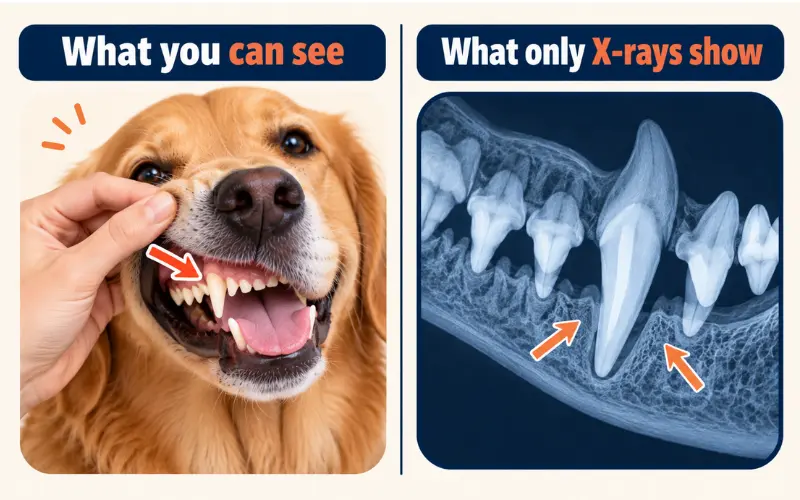
What Only Probing and X-Rays Show
Vets assess tooth by tooth:
- A probe measures pocket depth, checks how far it reaches between the roots of multi-rooted teeth, and tests how much each tooth moves.
- X-rays show the bone.
- Merck cautions that on an awake dog only the outer surface of the teeth can be seen, so those findings need careful interpretation.
- AAHA says staging is most accurate on an anesthetized dog after X-rays and probing.
Why an Awake Cleaning Doesn’t Fix It
If someone offers to scrape your dog’s teeth without anesthesia, know what it can and can’t do.
Merck’s professional manual says:
- Cleaning an awake dog improves how the crowns look.
- It does not improve periodontal health.
- An owner might falsely believe the problem has been treated while the disease keeps advancing below the gum line.
A cleaner-looking tooth is not the same as a healthier periodontal structure underneath.
What Happens at Each Stage: Treatment and Your Role
Your vet’s plan depends on the stage, and from PD3 on it also depends on you.
AAHA ties the plan to whether an owner can keep up daily home care.
What a Professional Dental Involves
Here’s the usual order:
- Anesthetized exam. The vet probes each tooth.
- Full-mouth X-rays. Merck says the 2019 AAHA guidelines strongly recommend them for every dental patient.
- Dental chart. The findings are recorded tooth by tooth.
- Scaling and polishing above and below the gum line.
- Treatment as needed, which can include extractions or periodontal treatment.
- Sealant, if appropriate. Merck’s owner guide says the vet may apply one afterward to help prevent bacterial buildup.
Extractions: What Owners Worry About
Losing teeth sounds like the worst outcome, but the sources are reassuring:
- Merck’s owner guide says dogs do surprisingly well without teeth, and its professional manual notes a dog can function without them, with a potentially improved quality of life.
- PetMD says dogs that have teeth pulled typically recover within seven days, though your vet will give you specific aftercare instructions.
- Home care still matters afterward, because Merck says the disease will recur without drastic changes in home oral hygiene.
Does Gum Disease Affect the Rest of the Body?
Possibly, but the evidence is narrower than many articles suggest.
- Kidneys, Merck: Merck’s manual notes an association between periodontal disease and chronic kidney disease, though two of its three references are cat studies.
- Kidneys, dogs: A large dog study compared records from 164,706 dogs with periodontal disease against age-matched dogs without it. The rate of new chronic kidney disease diagnoses rose with each stage, with hazard ratios of 1.8, 2.0, and 2.7 for stages 1, 2, and 3/4.
- The catch: It’s a records study, so it shows an association, not proof that gum disease causes kidney disease.
- Heart and liver: VCA says some studies point to a link with severe oral disease, while a Purdue extension guide says a causal relationship hasn’t been determined.
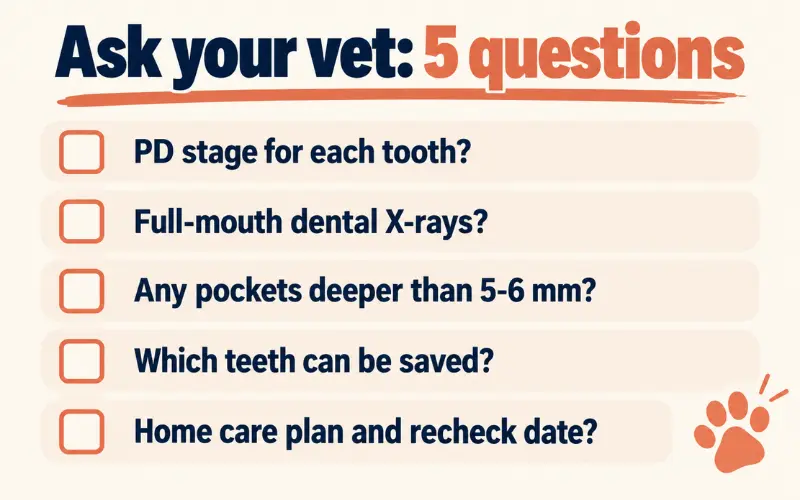
5 Questions to Ask Your Vet
Ask these when your vet gives you a stage:
- What PD stage is each tooth, and can I have a copy of the dental chart?
- Did you take full-mouth dental X-rays?
- Do any teeth have pockets deeper than 5 to 6 mm?
- Which teeth can be saved, and what daily home care does that plan depend on?
- What should home care look like afterward, and when should we recheck?
Home Care for Dog Teeth: What Helps and What Doesn’t
Home care is the part you control.
For gingivitis, Merck says prevention and treatment are the same thing: plaque removal and control. From PD2 on, home care supports your vet’s treatment but doesn’t replace it.
Brushing Comes First
Merck and VCA both name brushing as the most effective home care.
- How often: daily, or at least every other day, according to Merck
- Where: only the outside surfaces of the teeth need it in most dogs, according to Merck
- Toothpaste: one made for dogs, which VCA notes should be designed to be swallowed. Never use toothpaste made for people.
- If your dog won’t tolerate a brush: wipe the teeth with a gauze pad
Starting with a puppy? My guide on how to clean puppy teeth at home covers the puppy dental routine.
💡 Pro Tip
Plaque left on the teeth for more than two days hardens into tartar, and Merck says brushing can’t remove it after that. Aim to brush daily, or at least every other day. If your dog won’t accept a brush, wipe the teeth with gauze every second day.
Chews, Diets, and Water Additives
These can help between brushings. Here’s what to know:
- VOHC-accepted chews are the ones with trial data behind them.
- They work on plaque and tartar, not on established gum disease.
- The Veterinary Oral Health Council awards its seal only after two manufacturer-run trials, with at least a 15% plaque or tartar reduction in each and a 20% average across both.
- PetMD says no over-the-counter product treats dental disease.
- Don’t count on kibble to do the cleaning either. Merck’s professional manual says the common belief that dry kibble cleans teeth doesn’t always hold true.
What to Skip
Hard chews can do more harm than good:
- Merck lists bones and hooves as items that can crack teeth.
- VCA adds ice cubes, hard nylon chews, and antlers.
- VCA’s rule of thumb: any chew or treat should bend and give when you press on it.
When to Call Your Vet About Your Dog’s Teeth
Most dental disease is quiet.
VCA says few dogs show obvious signs, so waiting for symptoms means waiting too long. Use these three tiers as a guide, and remember that only a vet can tell which one your dog is in.
Routine: Book an Oral Exam
- AAHA says oral health should come up at every vet visit.
- Bad breath that doesn’t go away, or tartar building up along the gum line.
- It’s been a year or more since a real oral exam.
Soon: Call and Book a Visit
- Pawing at the mouth, head shaking, jaw chattering, or drooling, according to VCA
- Chewing with obvious discomfort, dropping food, or trouble swallowing, according to VCA
- Gums that stay red or bleed, or loose teeth, according to the Purdue extension guide
- A broken tooth, or one that has turned reddish-brown, purple, or gray, according to Merck’s owner guide
Right Away: Call Your Vet Today
- Swelling on the face, according to Merck’s owner guide
- A draining sore in the mouth, on the face, or under the chin, according to VCA
- A dog that has stopped eating
If your dog seems unwell in other ways too, my guide to common dog illnesses and symptoms to watch for covers what else to look out for.
Seeing a raw spot on the gum, lip, or tongue instead of a tooth problem? My guide to dog mouth sores and ulcers sorts the likely causes by location.
💡 Pro Tip
Take a photo of your dog’s gum line in the same light once a month. A side-by-side comparison makes changes easier to describe to your vet.
Frequently Asked Questions (FAQ)
Can dog tooth decay be reversed?
Only the first stage. Gingivitis (PD1) can return to normal with a professional cleaning, and VCA calls it the only truly reversible stage of periodontal disease. Once the ligament and bone start breaking down (PD2 and beyond), treatment aims to stop further loss, and lost support is hard to regain.
Can I use human toothpaste on my dog?
No. Merck’s owner guide says toothpaste made for people should not be used. VCA recommends a toothpaste made for dogs and designed to be swallowed.
Do dental chews or water additives replace brushing?
No. Merck’s professional manual calls daily or every-other-day brushing the most effective home care, and it treats chews, diets, gels, and additives as extras that help stabilize disease.
How often does a dog need a dental exam and cleaning?
The advice varies, but about once a year is the most common recommendation I found. AAHA recommends a first complete dental cleaning with X-rays by age 1 for small and medium-breed dogs and by age 2 for larger breeds, and says an awake oral exam every six months is appropriate. Colorado State’s veterinary hospital summarizes AAHA’s advice as at least yearly cleanings under anesthesia for adult dogs, and Purdue’s extension guide says yearly from age 2 to 3, adjusted for size, breed, and home care. Ask your vet what fits you
What to Do Next
You don’t need to memorize the stages of dog tooth decay. You just need to know three things:
- The number on your vet’s chart means something specific.
- The teeth you can see are only part of the picture.
- Gingivitis is the one stage you can still fully undo.
So this week:
- Lift your dog’s lip and look along the cheek side of the back teeth.
- If the gums are red, the breath is getting worse, you notice signs your dog is hiding pain, or it’s been a year since a real oral exam, book one and bring the five questions from this guide.
- Ask for the PD stage in writing.
That one number tells you where you stand and what happens next.
For the bigger picture, see my complete guide to keeping your dog healthy and happy.


Pingback: Dog Periodontal Disease Stages: What Each Stage Looks Like
Pingback: Dog Mouth Sores and Ulcers: Causes and When to Worry