


You lift your dog’s lip to check a bad smell and spot what looks like a dog mouth sore: a raw, red patch on the inside of the lip, or a white-edged spot on the gum. Your dog is still eating, mostly. Maybe chewing a little more on one side.
That’s when the questions start. Will it heal on its own? Could it be a dog mouth ulcer from something serious? Should you call the vet tonight or wait?
A sore’s location tells you a lot, but only an exam shows the cause. This guide sorts the common causes by where the sore is, lists the signs that go with them, explains what a vet usually does, and shows which signs mean you shouldn’t wait.
⚡ Quick Answer
A dog mouth sore is usually an ulcer, an open spot where the lining of the mouth or lip has broken down. Merck’s veterinary manual calls gum disease the most common oral problem in small animals, and plaque on the teeth can trigger ulcers where the lip or cheek touches them. Burns, plants, kidney disease, infections, and growths can also cause them. Location helps narrow the cause, but only a vet exam can name it.
What Counts as a Dog Mouth Sore or Ulcer?
Owners say “sore.” Vets usually say “ulcer” or “mucositis.”
An ulcer is an open spot where the surface layer of tissue has worn away.
Vets also use different words depending on where the inflammation sits, according to Merck’s professional manual:
- Mucositis: inflammation of the lining of the mouth
- Gingivitis and periodontitis: inflammation of the gums and the tissues that hold the teeth
- Cheilitis: inflammation of the lip
- Glossitis: inflammation of the tongue
- Stomatitis: widespread inflammation of the mouth lining that goes beyond the gums
You may see “canker sore” used for dogs online. In Merck’s veterinary manual pages on mouth disorders in dogs, I didn’t find that term. Merck names specific conditions instead, such as contact ulcers, stomatitis, and lip fold dermatitis. Treat “canker sore” as an everyday label for a sore that still needs a cause.
Where Is the Sore? Likely Causes by Location
Location is the best clue you can gather at home.
Look gently, and stop if your dog pulls away or seems to be in pain.
The “next step” column is my grouping. Merck lists causes and signs, not deadlines, so treat it as a cautious default. If you’re unsure, call your vet.
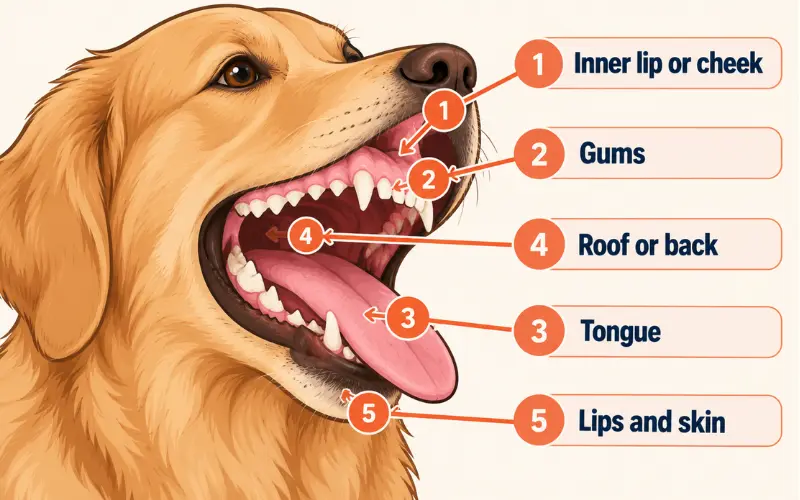
Sores Inside the Cheek or Lip Where They Touch Teeth
Vets call these contact ulcers or “kissing ulcers.”
They form where the lining of the lip or cheek touches a tooth surface carrying plaque, according to Merck. dvm360’s veterinary dentistry series describes the same pattern in susceptible dogs.
They show up most often on the inner upper lip and cheek, next to the upper canine and the big back tooth called the fourth premolar.
Merck names Maltese, Miniature Schnauzers, Labrador Retrievers, and Greyhounds among the breeds affected.
When the ulcers are widespread and long-term, vets may call it canine chronic ulcerative stomatitis.
Merck says the cause isn’t known, but it’s thought to be an exaggerated local immune response to plaque. It isn’t an autoimmune disease, because no autoantibodies are found.
The usual plan, according to Merck, includes:
- Professional cleaning
- Removing teeth that touch the ulcers, when needed
- Twice-daily brushing at home
Even slight leftover plaque can keep the ulcers going, and extractions don’t always cure the problem.
💡 Pro Tip
If your vet says “stomatitis,” ask two questions: “Which kind, contact ulcers from plaque or something else?” and “Do we need a biopsy?” Merck recommends a biopsy to rule out other ulcer-causing conditions.
Because these ulcers often come with gum disease, my guide to dog tooth decay stages explains how vets stage it.
Sores on the Gums
Gum disease is the most common cause. Merck calls it the most common oral problem in small animals, and my guide to dog periodontal disease stages shows what each stage means.
A raised, inflamed spot with a tiny opening near the gum line is called a parulis, or draining bump.
Merck says it usually comes from an infection spreading out of an injured tooth, and the tract can sometimes be traced back to the problem tooth.
Trench mouth, or acute necrotizing ulcerative gingivitis, is rarer. Merck calls it relatively uncommon, and it brings severe gum inflammation, ulcers, and dead tissue.
Possible contributors include:
- Stress
- Too much corticosteroid medication
- Poor nutrition
Malignant mouth tumors are another rare cause. Merck says they frequently ulcerate and bleed, and a biopsy confirms what a growth is.
Signs Merck links to these rarer causes include:
- Very bad breath
- Drooling, sometimes with blood in the saliva
- Not wanting to eat
- A swollen face, particularly with tumors
Sores on or Under the Tongue
Heavy plaque and tartar on the inner side of the lower teeth can rub the tongue. Merck says this can cause red, swollen edges and sometimes ulcers on the sides and tip.
Objects are another major cause.
A thread or string can catch under the tongue and cut into it, and burrs, hair, and other debris can embed too deeply to see. Long-haired dogs that chew burrs out of their coats are more at risk.
Sudden tongue swelling can come from insect stings or venomous animal bites, and Merck says it may need emergency treatment.
According to Merck’s owner guide, common signs include:
- Drooling
- Not wanting to eat
The cause can go unnoticed unless someone looks carefully.
Sores on the Lips and Around the Mouth
Lip fold dermatitis is chronic moist inflammation in dogs with droopy lower lips or deep lip folds, such as English Bulldogs, Saint Bernards, Cocker Spaniels, and Labrador Retrievers.
Saliva collects in the folds, and the area can turn smelly, red, and swollen.
Injuries are another cause. Fights, sharp chews, thorns, grass awns, burrs, and even fishhooks can wound or become embedded in the lip.
Lip inflammation, or cheilitis, can also spread from severe gum disease or stomatitis, or from licking infected skin. Parasites, autoimmune skin disease, and growths can cause it too.
Viral warts are most common in young dogs, often at the corners of the lips. Merck says they may disappear on their own within weeks to months, so removal is often not needed.
Signs to look for include:
- Pawing or rubbing at the mouth
- Bad breath and drooling
- Discolored, matted hair around the lips
- A foul yellowish or brown discharge
Sores in the Mouth From Other Causes
Sometimes the mouth is showing a problem elsewhere.
Merck’s owner guide says chronic kidney failure can cause inflammation and sores in the mouth, and blood tests help vets rule it out. Canine distemper virus and certain Leptospira bacteria have also been linked to oral inflammation and ulcers.
Things your dog puts in its mouth can cause sores too.
Heat, chemicals, and electrical cords can burn the mouth. Merck says puppies sometimes chew electrical cords, and the full extent of a burn may not show for 3 to 4 days.
Chewing Dieffenbachia, also called dumb cane, plant awns, or fiberglass insulation can cause mouth inflammation and sores.
A dog with a mouth burn may:
- Drool
- Resist handling
- Hesitate to eat or drink
Rarer causes include a yeast overgrowth, or Candida, usually after other mouth disease, long-term antibiotics, or a weak immune system.
Some autoimmune diseases, such as pemphigus vulgaris and lupus, can look like plaque-related ulcers, which is one reason vets recommend a biopsy.
💡 Pro Tip
If you saw your dog chew a cord, a plant, or a chemical, tell your vet exactly what it was and when. Merck says those details help, and a vet who sees your dog soon after a chemical burn may be able to flush the area with water.
Signs That Often Come With Mouth Sores
Merck lists these signs, and they vary with the cause:
- Loss of appetite
- Bad breath
- Drooling
- Saliva tinged with blood
- Pawing at the mouth
- Pulling away or resisting when you touch the mouth
- Swollen lymph nodes under the jaw
Dogs can hide pain well, so small changes count. My guide to the signs your dog is in pain and hiding it covers what else to watch for.
What Your Vet Will Do
Mouth sores are painful, and Merck notes a dog in pain may resist a mouth exam.
Vets usually work through these steps:
- Look and ask questions. Merck says a complete oral exam should be part of every physical exam. Tell your vet what your dog chewed and when the signs began. If your dog is too sore to allow a proper look, your vet may suggest sedation or anesthesia.
- Rule out whole-body causes. Blood tests can help rule out conditions such as advanced kidney disease.
- Take a tissue sample when needed. A biopsy separates plaque-related ulcers from autoimmune disease, erythema multiforme, and tumors, and it confirms what a growth is.
- Look at the teeth. Merck says the 2019 AAHA guidelines strongly recommend full-mouth dental X-rays for every dental patient. You can read more in Merck’s periodontal disease page.
Treatment depends on the cause:
- Plaque-related ulcers: professional cleaning, removing teeth that touch the ulcers when needed, strict home hygiene, antiseptic rinses or gels, and medicine for infection, inflammation, or pain
- Lip fold dermatitis: clipping the hair, cleaning the folds, keeping them dry, and sometimes surgery
- Burns and foreign objects: removing the object, cleaning the wound, and antibiotics if infection is a risk
- Kidney disease or other whole-body illness: treating the underlying disease
- Warts: often no treatment, since they may go away by themselves
- Growths: a biopsy first, then surgery or other treatment based on the type
While You Wait for the Appointment
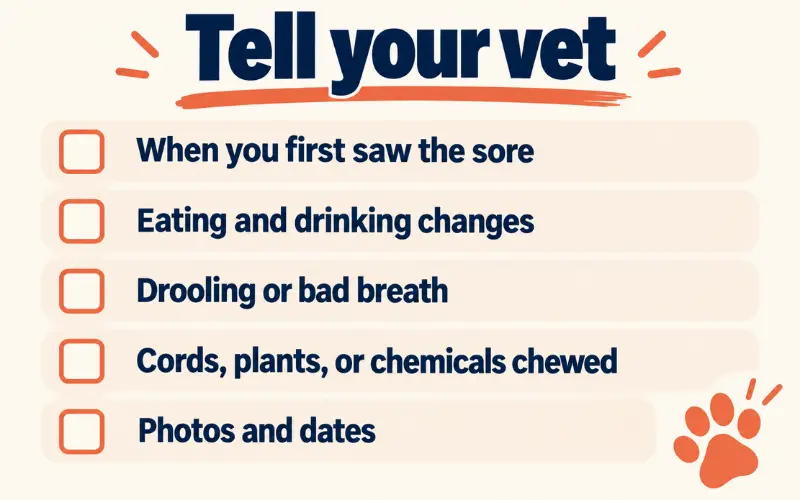
- Write down what changed: appetite, drooling, breath, and when you first noticed the sore
- Tell your vet what your dog may have chewed or licked: cords, chemicals, plants, or new chews
- Don’t force the mouth open: a sore mouth hurts, and a painful dog may bite
- Ask before giving anything: that includes human medicine and mouth rinses. The right treatment depends on the cause.
💡 Pro Tip
Take a clear photo of the sore in good light, and note the date. A photo helps your vet see how it changes, especially if the sore comes and goes.
When to Call Your Vet About a Dog Mouth Sore
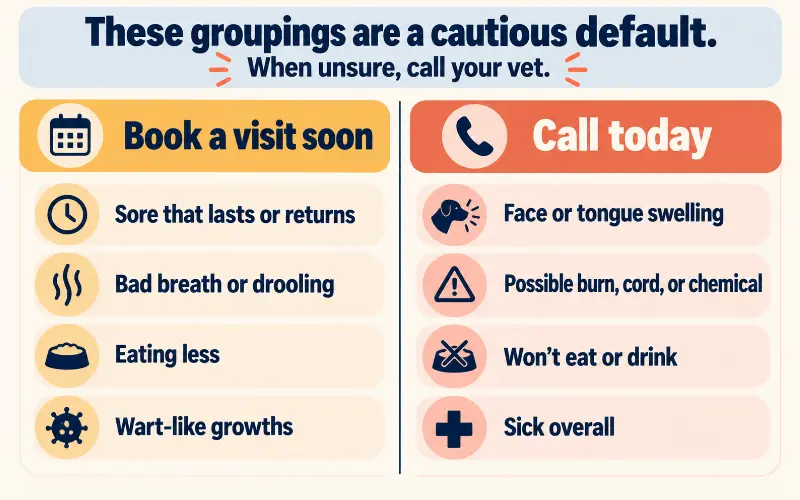
Any sore you can see is worth a vet visit. Merck says many mouth diseases stay hidden and are easier to treat when they’re caught early.
The groupings below are my cautious default, not deadlines from a source.
Book a Visit Soon
- A sore that lasts or keeps coming back
- Bad breath, drooling, or saliva with blood in it
- Eating less, or chewing on one side
- Pawing at the mouth or pulling away when touched
- Wart-like growths, or a lump you can see in the mouth
- Matted, discolored hair on the lips with a foul discharge
Call Today
- Swelling of the face or tongue, especially if it comes on fast
- A dog that may have chewed a cord or chemical, or has a burn
- Won’t eat or drink
- Mouth sores along with vomiting, weakness, or a dog that seems sick overall
How to Lower the Odds of Mouth Sores
- Keep plaque under control: Plaque drives many contact ulcers. My guide to dog tooth decay stages covers brushing and cleaning schedules.
- Ask for a mouth check at every visit: AAHA says oral health should come up at every vet visit, and an awake oral exam every six months is appropriate.
- Keep hazards out of reach: Store cords and chemicals where your dog can’t get them, and keep Dieffenbachia away from dogs, according to Merck.
- Check the lips and tongue after walks through tall grass: Burrs and plant awns can lodge in the lips and tongue.
- Keep lip folds clean and dry: This matters most for breeds with deep folds.
⚠️ Disclaimer
I’m not a veterinarian. This guide summarizes published veterinary sources, mainly the Merck Veterinary Manual, and can’t diagnose your dog. A mouth sore can have many causes, and only a vet exam can tell which one your dog has. If your dog can’t eat or drink, has swelling on the face or tongue, or may have chewed a cord or chemical, call your vet right away.
Frequently Asked Questions (FAQ)
Are dog mouth sores an emergency?
Sometimes. Most are not, but a few causes are urgent, and you can’t tell which from the outside.
Merck notes that some mouth burns can be life-threatening and that sudden tongue swelling from stings or bites may need emergency treatment. If you’re unsure, call your vet.
Can dogs get canker sores?
Vets don’t usually use that term for dogs.
Merck’s pages on mouth disorders in dogs describe ulcers by cause, such as contact ulcers, stomatitis, or lip fold dermatitis. What matters is finding the cause.
Can I treat a dog mouth ulcer at home?
Home care alone rarely fixes the cause.
Merck’s treatment list includes professional cleaning, removing foreign objects, medicine, and sometimes surgery, depending on the cause. For plaque-related ulcers, brushing at home is part of the long-term plan, under your vet’s direction.
Can kidney disease cause mouth sores in dogs?
Yes. Merck’s owner guide says chronic kidney failure can cause inflammation and sores in the mouth, and vets use blood tests to rule it out.
A sore doesn’t mean kidney disease by itself, since it has many other causes.
What to Do Next
A mouth sore is hard to ignore once you’ve seen it, and just as hard to judge by eye.
You don’t have to work out the cause yourself. You just need to get it in front of someone who can.
So today:
- Note where the sore is and when you first saw it.
- Take a clear photo in good light.
- Book a vet visit. Go today if your dog can’t eat or drink, or if the face or tongue is swelling.
At the visit, ask which kind of ulcer it is, whether a biopsy is needed, and what the plaque plan looks like.
If gum disease is part of the picture, my complete guide to dog dental disease explains prevention and treatment.
For symptoms outside the mouth, see common dog illnesses and symptoms to watch for.
And for the bigger picture, my complete guide to keeping your dog healthy and happy covers the broader health routine.



Pingback: Dog Periodontal Disease Stages: What Each Stage Looks Like