


My dog scratched his ears raw before I realized he had allergies.
For three months, I assumed it was normal. Dogs scratch, right? But the scratching became constant — not the casual itch-and-move-on kind.
This was frantic, repetitive, wake-up-in-the-middle-of-the-night scratching that left his ears inflamed, his paw pads stained reddish-brown from constant licking, and patches of thinning fur under his arms.
The vet took one look and said, “He has allergies. Probably environmental — and he’s been dealing with this for a while.”
Three months.
My dog had been uncomfortable for three months because I did not know what dog allergy symptoms actually look like. I thought allergies meant sneezing — like humans. In dogs, allergies almost always show up in the skin, not the nose.
That visit taught me the one thing I want every dog owner to know: dog allergy symptoms are not obvious.
They look like normal dog behavior — scratching, licking, ear shaking — until the pattern becomes constant enough that you realize something is wrong.
This guide covers the 12 most common dog allergy symptoms, the 3 types of allergies your vet will investigate, what causes them, and the exact point where “wait and see” becomes “call the vet today.”
Dog allergies show up in the skin — not sneezing like humans.
If your dog has 3 or more of these symptoms consistently, see your vet.
Allergic dermatitis is the number 1 reason dogs visit the veterinarian in the United States.
Why Dog Allergies Look Nothing Like Human Allergies
In humans, allergies mean sneezing, runny nose, watery eyes. In dogs, allergies mean itchy skin.
Unlike humans who typically experience allergies through respiratory symptoms like sneezing and runny nose, dogs experience allergies primarily through their skin — with excessive scratching, chronic ear infections, paw licking, and skin redness being the most common dog allergy symptoms.
This is why allergic dermatitis is the number 1 reason dogs visit the vet in the United States.
This is why most owners miss dog allergies for months. You are looking for sneezing while your dog is scratching their ears raw. The signals do not match what you expect.
According to the American Kennel Club, allergic dermatitis, or skin allergies, has been the top reason dogs are brought into the vet for eleven consecutive years — making it the most common health condition in domestic dogs.
The good news: once you know what dog allergy symptoms actually look like, they become obvious. The patterns are consistent and recognizable — you just need to know where to look.
The 12 Most Common Dog Allergy Symptoms
These are the signs that mean your dog is likely dealing with an allergic reaction — not just a random itch.
Skin Symptoms (Most Common)
Excessive scratching — not occasional. Constant, repetitive, wakes-them-up-at-night scratching that targets the same areas: ears, belly, underarms, groin, and between the toes.
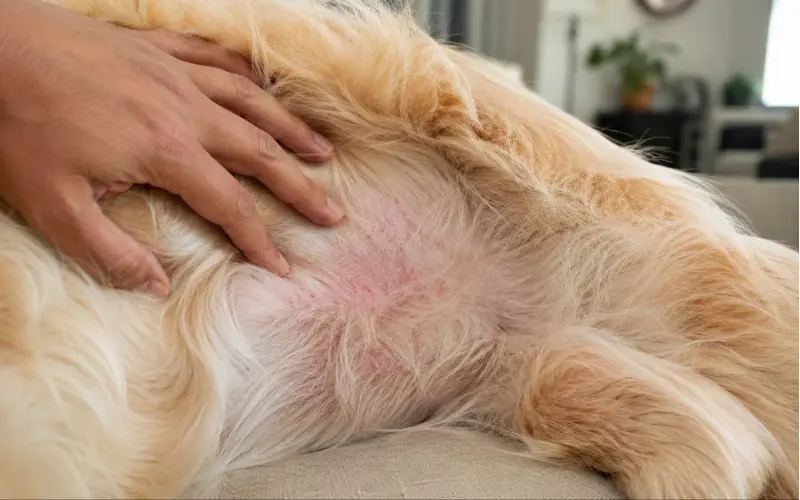
Red or inflamed skin — especially on the belly, inner legs, underarms, and groin where fur is thinnest and skin is most exposed.
Hot spots — moist, red, painful patches of inflamed skin that appear suddenly. These are secondary infections caused by the dog breaking the skin through constant scratching and licking.
Hair loss — patches of thinning or missing fur, often around the face, ears, and legs. The hair is not falling out from the allergy itself — the dog is scratching and licking it away.
Dry, flaky, or scaly skin — visible dandruff-like flaking, especially along the back.
Ear Symptoms
Chronic ear infections — recurring ear infections, more than 2 per year, are one of the most reliable indicators of underlying allergies. The ears produce excess wax and moisture in response to allergens, creating an environment where yeast and bacteria thrive.
Head shaking and ear scratching — persistent, not occasional.
Dark, waxy ear discharge — brown or black buildup that returns within days of cleaning.
Recurring ear infections — defined as more than 2 per year — are one of the most reliable early dog allergy symptoms, because allergic inflammation causes excess wax and moisture production in the ear canal, creating conditions where yeast and bacterial infections develop repeatedly.
Paw and Face Symptoms
Chronic paw licking — the single most recognizable sign. Dogs with allergies lick their paws obsessively, often staining the fur reddish-brown from a pigment called porphyrin in their saliva.
Face rubbing — rubbing the face against furniture, carpet, or the floor to relieve itching around the eyes, muzzle, and muzzle folds.
Watery or red eyes — less common than skin symptoms but present in some dogs, especially with environmental allergens.
If the fur is stained reddish-brown or rust-colored, that is porphyrin staining from chronic licking.
This simple visual clue can reveal an allergy pattern your dog may have been hiding for weeks.
The 3 Types of Dog Allergies — What Your Vet Will Investigate
All dog allergy symptoms look similar on the surface — scratching, licking, ear infections. But the cause underneath determines the treatment. Your vet investigates these three categories.
Environmental Allergies (Atopic Dermatitis)
The most common type. Your dog reacts to things in the air and environment — pollen, dust mites, mold spores, grass, and dander.
Environmental allergies, or atopic dermatitis, are the most common type of allergy in dogs and are primarily hereditary — most dogs with environmental allergies begin showing symptoms between 1 and 3 years of age, with itching concentrated on the paws, ears, face, belly, underarms, and groin areas.
Environmental allergies are often seasonal — worse in spring and fall when pollen counts are high. But year-round allergens like dust mites and mold cause symptoms that never fully resolve.
The most commonly affected areas: paws, ears, face, underarms, groin, and between the toes. If your dog scratches these specific areas more than others, environmental allergens are the most likely cause.
According to the AKC, environmental allergens either enter the body through inhalation or settle on the skin and migrate between skin cells — either way triggering an immune response that releases histamine and causes the itching.
Food Allergies
Less common than most owners think. True food allergies — where the immune system reacts to a specific protein — affect a smaller percentage of dogs than environmental allergies.
True food allergies in dogs are less common than most owners assume — they involve an immune response to specific proteins, most commonly beef, dairy, chicken, and wheat, and develop over time, meaning a dog can eat the same food for years before suddenly showing symptoms like itchy ears, itchy paws, and gastrointestinal issues.
Key difference from environmental allergies: food allergies cause year-round symptoms that do not change with seasons. If your dog itches equally in January and July — food allergy is more likely than environmental.
Common food allergens in dogs: beef, dairy, chicken, wheat, soy, lamb, egg. The only reliable way to diagnose a food allergy is an elimination diet trial lasting 8 to 12 weeks — not a blood test.
According to the AKC, food allergies develop over time through repeated exposure, which means a dog can eat the same food for years before having a reaction — making the sudden onset of symptoms confusing for owners who have not changed anything.
For nutrition guidance related to food allergies, read our guide on best dog food for puppies with allergies.
Flea Allergy Dermatitis
Some dogs are allergic to flea saliva — not just bothered by flea bites. A single flea bite on an allergic dog can cause intense itching for 7 to 14 days.
Concentrated at the base of the tail, lower back, and hind legs. If your dog scratches these areas specifically, check for fleas or flea dirt, tiny black specks that look like pepper.

How Allergies Are Diagnosed — What to Expect at the Vet
Your vet cannot diagnose an allergy from symptoms alone — the symptoms overlap across all three types. Diagnosis requires a systematic process of elimination.
Flea Elimination First
Your vet will rule out fleas first because it is the fastest and simplest diagnosis. If flea prevention resolves the itching, you have your answer.
Skin Scraping and Cytology
Your vet takes skin scrapings to check under a microscope for mites, yeast, bacteria, and fungal infections. These conditions mimic allergy symptoms and must be ruled out before allergy testing.
Elimination Diet Trial (Food Allergies)
The only reliable way to diagnose food allergies. Your dog eats a novel protein diet, a protein they have never eaten before, or hydrolyzed protein diet for 8 to 12 weeks.
If symptoms improve, a food allergy is confirmed. Then individual ingredients are reintroduced one at a time to identify the specific allergen.
The only reliable method for diagnosing food allergies in dogs is an elimination diet trial lasting 8 to 12 weeks — where the dog eats a single novel protein diet and symptoms are monitored — because blood tests for food allergies in dogs are not considered accurate by veterinary dermatologists.
Intradermal Skin Testing (Environmental Allergies)
Small amounts of common allergens are injected under the skin in a grid pattern. Reactions, swelling and redness, indicate which specific allergens your dog reacts to. This is the gold standard for diagnosing environmental allergies.
Blood tests, allergen-specific IgE, are also available and are reasonably accurate when done during the season the allergen is present.
According to the AKC, veterinary dermatologists consider intradermal skin testing the most accurate method for identifying environmental allergens — and the results directly inform immunotherapy, allergy shot, treatment plans.
Note when itching is worst, which body parts are affected, whether symptoms change after meals, and if they improve indoors or outdoors.
This pattern helps your vet identify food, environmental, or flea allergies much faster.
Managing Dog Allergy Symptoms at Home
Allergies cannot be cured. They can be managed — and the home management component matters as much as the veterinary treatment.
Frequent Bathing with Medicated Shampoo
Bathing removes allergens from the skin surface and soothes inflammation. Your vet may prescribe or recommend an oatmeal-based or chlorhexidine shampoo depending on whether secondary infection is present.
For itchy skin specifically, read our guide on the best dog shampoo for itchy sensitive skin.
Paw Wipes After Every Walk
If environmental allergens are the trigger, your dog collects pollen, grass, and dust on their paws every walk.
Wiping paws with a damp cloth or hypoallergenic wipe after every outdoor session removes allergens before they cause a reaction.
Air Purifiers and Clean Bedding
HEPA air purifiers reduce indoor allergens. Wash your dog’s bedding weekly in hot water.
Vacuum frequently — especially carpets and upholstered furniture where dust mites and dander accumulate.
Omega-3 Fatty Acid Supplements
Omega-3 fatty acids, fish oil, reduce inflammatory response and support skin barrier function.
Many vets recommend daily fish oil supplementation for allergic dogs — it does not eliminate allergies but reduces the severity of flare-ups.
For the nutrition approach that supports skin health, read our complete dog nutrition guide for beginners.

Veterinary Treatment Options
Your vet has several tools beyond home management for controlling dog allergy symptoms.
- Cytopoint — an injectable monoclonal antibody that targets the itch signal directly. Given every 4 to 8 weeks. Fast-acting, with relief within 24 hours, and minimal side effects. One of the most effective modern treatments for allergic itch.
- Apoquel — an oral medication that blocks the itch pathway. Daily dosing. Effective for both food and environmental allergies. Requires liver function monitoring with long-term use.
- Immunotherapy, or allergy shots — the only treatment that addresses the root cause rather than managing symptoms. Based on intradermal skin test results, your dog receives regular injections of the specific allergens they react to in gradually increasing doses.
Over 6 to 12 months, the immune system adjusts. About two-thirds of dogs improve significantly.
- Medicated shampoos and sprays — prescribed by your vet for secondary skin infections caused by scratching.
- Elimination diet — for food allergies, switching to a novel or hydrolyzed protein diet is the treatment.
Common Mistakes Owners Make with Dog Allergies
Assuming seasonal itching is normal delays diagnosis. A dog that scratches more in spring and fall has a pattern — and that pattern is environmental allergies, not “just being a dog.”
Switching dog food brands randomly without veterinary guidance does not diagnose food allergies. An elimination diet requires a specific protocol — a single novel protein for 8 to 12 weeks with zero treats, table scraps, or other food sources.
Randomly trying different brands introduces too many variables to identify the specific allergen.
Using over-the-counter antihistamines without vet guidance may not help. The AKC notes that antihistamines are less effective in dogs than in humans — they offer little to no benefit for environmental allergies in many dogs.
Ignoring ear infections as standalone problems rather than recognizing them as dog allergy symptoms leads to repeated treatment of the infection without addressing the allergy causing it.
A dog that gets 3 or more ear infections per year almost certainly has an underlying allergy.
For understanding all the signs your dog might be hiding discomfort, read our guide on signs your dog is in pain and hiding it.
According to the ASPCA, monitoring your dog’s skin, ears, and behavior patterns is one of the most effective early detection tools for allergies and other health conditions.
Drive immediately to the nearest emergency animal hospital.
Anaphylaxis from bee stings, vaccines, or food is rare but can be life-threatening.
This guide is based on published veterinary research from the AKC and ASPCA.
If you suspect your dog has allergies, consult your veterinarian for proper diagnosis and treatment.
Frequently Asked Questions (FAQ)
What are the most common signs of allergies in dogs?
The most common dog allergy symptoms are excessive scratching, especially ears, belly, and paws, chronic paw licking with reddish-brown staining, recurring ear infections, more than 2 per year, red or inflamed skin on the belly and underarms, hot spots, face rubbing, and hair loss.
Unlike humans, dogs rarely sneeze from allergies — symptoms appear almost exclusively in the skin.
How can I tell if my dog has food allergies vs environmental allergies?
Food allergies cause year-round symptoms that do not change with seasons — and typically affect the ears and paws first.
Environmental allergies are often seasonal, worse in spring and fall, and affect the paws, ears, face, underarms, and groin.
If your dog itches equally in January and July, food allergy is more likely. If symptoms worsen during pollen season, environmental allergy is more likely.
What is the most common food allergy in dogs?
The most common food allergens in dogs are beef, dairy, chicken, wheat, soy, and lamb — with beef and dairy being the most frequently identified triggers.
True food allergies involve an immune response and develop over time, meaning a dog can eat the same food for years before developing a reaction.
How do vets test for dog allergies?
Vets use a systematic approach: first ruling out fleas and skin infections through examination and skin scraping, then conducting either an elimination diet trial (8 to 12 weeks) for food allergies or intradermal skin testing, injecting common allergens under the skin to identify environmental triggers.
Blood tests are also available for environmental allergies, but are considered less accurate than skin testing.
Can dog allergies be cured?
No — dog allergies cannot be cured. They can be managed with a combination of allergen avoidance, veterinary medications, Cytopoint and Apoquel, immunotherapy, allergy shots, medicated bathing, and dietary changes for food allergies.
The goal of treatment is to control symptoms and prevent secondary infections — not to eliminate the allergy itself.
At what age do dog allergies usually start?
Most dogs with environmental allergies begin showing symptoms between 1 and 3 years of age, after they have been exposed to the allergen through at least one full season.
Food allergies can develop at any age, but often appear in young dogs. Flea allergies can appear at any age upon exposure.
Why does my dog keep getting ear infections?
Recurring ear infections — more than 2 per year — are one of the most common and most overlooked dog allergy symptoms.
Allergic inflammation causes excess earwax and moisture in the ear canal, creating conditions in which yeast and bacteria thrive.
Treating the infection alone does not solve the problem — the underlying allergy must be identified and managed to prevent recurrence.
Why does my dog lick his paws constantly?
Chronic paw licking is the single most recognizable sign of allergies in dogs.
Allergens — whether environmental or food-based — cause itching concentrated in the paws, and dogs lick to relieve the discomfort.
The saliva contains a pigment called porphyrin that stains the paw fur reddish-brown over time.
If your dog’s paw fur is discolored, allergies are the most likely cause.
Three Months Too Late — Final Thoughts
Three months. That is how long my dog scratched his ears raw before I understood what dog allergy symptoms actually look like.
I was looking for sneezing. He was showing me inflamed ears, reddish-brown paws, and patches of thinning fur. The signs were there from the start — I just did not know what they meant.
Allergies cannot be cured. But once diagnosed and managed, the difference is visible within weeks.
My dog went from frantic nighttime scratching to sleeping through the night. From raw, inflamed ears to clean, healthy ears. From constant paw licking to occasional licking that tells me pollen count is high today.
Three things to take with you:
- Itchy skin is the signal, not sneezing. If your dog scratches the same areas repeatedly — ears, paws, belly, underarms — for more than 2 weeks, that is a vet conversation, not a “wait and see.”
- Reddish-brown paw staining is the fastest visual confirmation. Check the fur between the toes and on top of the paws. Rust-colored staining from chronic licking is a nearly definitive sign of allergic itch.
- Recurring ear infections are allergy symptoms, not standalone problems. If your dog gets 3 or more ear infections per year, your vet should investigate allergies as the underlying cause — not just treat each infection individually.
For the complete approach to keeping your dog healthy including allergy prevention, read our guide on keeping your dog healthy and happy.
For ear cleaning that helps manage allergy-related ear issues, read our guide on how to clean dog ears at home.




Pingback: Common Dog Illnesses and Symptoms to Watch For — Complete Owner's Guide