
My puppy would not stop scratching.
Ears, paws, belly — all day, every day. Three weeks into ownership and I had already been to the vet twice. No fleas. No mites. Nothing environmental they could find.
“Could be the food,” the vet said on visit two.
I was skeptical. I was feeding a top-rated puppy food with great reviews. The idea that food allergies could show up this early — in a puppy barely 10 weeks old — genuinely surprised me.
They absolutely can. And they are far more common than most new owners realize.
Finding the best dog food for puppies with allergies was not quick for us. It took an elimination diet, two failed food trials, a lot of carpet vacuuming, and real patience.
But the result — a puppy who finally stopped scratching at 3 AM, stopped getting monthly ear infections, and grew into the soft shiny coat he was always supposed to have — was worth every week of it.
This guide gives you everything I wish I had found on day one. The signs, the allergens, the best dog food for puppies with allergies available right now, the elimination diet process, and the mistakes that extend the suffering by months.
Let’s get your puppy comfortable again.
The top vet-recommended picks are Purina Pro Plan Puppy Sensitive Skin and Stomach (salmon), Blue Buffalo Basics Puppy (turkey), and Royal Canin Veterinary HP (hydrolyzed — prescription).
Always run an 8-week elimination diet before committing to any formula long-term.
What Is a Food Allergy in Puppies — And Is That What You Have
Before switching to the best dog food for puppies with allergies, you need to confirm that food allergy is actually the problem.
Two conditions look almost identical on the surface but require completely different solutions.
A food allergy is an immune system response.
The immune system mistakenly identifies a specific protein as a threat and launches an inflammatory response whenever that protein is consumed.
The symptoms are primarily skin-based — itching, redness, ear infections, paw chewing — and they are consistent, not seasonal.
A food sensitivity is a digestive response.
The gut struggles to process certain ingredients, leading to soft stools, vomiting, and gas.
No immune response is involved. A more digestible food resolves it.
If your puppy has itchy skin and ear infections, along with digestive issues, a food allergy is the more likely diagnosis.
If it is purely digestive symptoms with no skin involvement, sensitivity is more likely.
Signs That Point to a Food Allergy
These are the symptoms that made me finally ask our vet about the food:
- Persistent itching and scratching that does not respond to flea treatment or antihistamines
- Chronic ear infections — more than one in two months is a significant red flag
- Paw chewing and licking, especially between the toes
- Red or inflamed skin around the ears, belly, and armpits
- Rubbing the face on furniture or carpet
- Hot spots appearing and reappearing
- Digestive symptoms alongside the skin issues — soft stools, occasional vomiting
The skin symptoms are year-round and consistent.
That is what separates food allergy from environmental allergy — pollen and dust cause seasonal reactions, food causes constant ones.
When It Is Not a Food Allergy
See your vet before changing food if your puppy has:
- Severe skin infections, open sores, or significant hair loss — these need medical treatment alongside any dietary change
- Sudden onset symptoms with no history of chronic issues — could be contact allergy or parasite
- Digestive symptoms only with no skin involvement — more likely food sensitivity than allergy
- Symptoms that change with seasons — more likely environmental allergy
According to the American Kennel Club, true food allergies in dogs trigger an immune response that can range from hives and itchiness to gastrointestinal signs—and always require dietary management as the primary treatment, with blood tests for food allergy being unreliable compared to elimination diets.

The Most Common Allergens in Puppy Food — Know These
Here is the counterintuitive truth about the best dog food for puppies with allergies:
Dogs become allergic to proteins they have eaten the most — not the least.
A puppy fed chicken-based food for six months is more likely to develop a chicken allergy than a puppy who has rarely eaten chicken.
The immune system builds sensitization through repeated exposure.
This is why the treatment uses novel proteins — proteins the puppy has never encountered.
The Big Five Allergens
Beef and chicken cause the majority of food allergies in dogs.
Studies referenced by the AKC suggest dairy, wheat, and soy round out the top five.
All five are found in the majority of standard commercial puppy foods — which is precisely why so many puppies develop allergies to their everyday food.
What this means practically:
Switching from one chicken-based food to another chicken-based food — no matter how different the brands or how premium the formula — will not resolve a chicken allergy.
The protein source must change, not just the brand.
Novel Proteins — The Real Solution
Novel proteins are proteins your puppy has genuinely never eaten before.
Their immune system has no prior sensitization to them — so no allergic response is triggered.
The most commonly used novel proteins are salmon and other fish, duck, venison, rabbit, kangaroo, and bison.
Of these, salmon is the most widely available in quality puppy formulas and the most frequently recommended by veterinarians as a first-choice novel protein.
The grain-free question comes up constantly here — and the honest answer is that most food allergies in puppies are protein-based, not grain-based.
A puppy allergic to chicken does not benefit from grain-free chicken food.
What they need is a different protein entirely.
According to the ASPCA, dietary elimination trials using a single novel protein are the preferred veterinary method for diagnosing food allergy in dogs — and the protein source, not the grain content, is almost always the relevant variable.
Best Dog Food for Puppies With Allergies — Top Picks
Every food below meets AAFCO nutritional standards for puppy growth, comes from a manufacturer with veterinary nutritionists on staff, and has a documented track record for managing food allergies.
These are not the most popular puppy foods — they are the ones that specifically address the best dog food for puppies with allergies.
Purina Pro Plan Puppy Sensitive Skin and Stomach — Top Pick
This is the food that finally worked for my puppy.
Salmon as the first ingredient, rice as the primary carbohydrate, live probiotics, and no chicken, no corn, no soy.
Our vet had recommended it during the elimination trial and it was the first food that showed meaningful improvement by week 5.
Why it works for allergic puppies:
- Salmon is a novel protein for most puppies — they have never been exposed to it in standard formulas.
- The immune system has no prior sensitization to fish protein, so no allergic response is triggered.
- The rice base is gentle and easily digestible.
- Live probiotics are added and guaranteed viable at time of feeding — not just at manufacturing.
- This supports the gut-immune connection that drives many allergy responses.
No artificial colors or flavors.
No corn, wheat, or soy.
AAFCO complete and balanced for puppy growth.
Not perfect for: puppies with confirmed fish allergy or dogs that are extremely sensitive to even trace amounts of chicken, since some manufacturing facilities process multiple proteins.
Purina Pro Plan Puppy Sensitive Skin and Stomach — Salmon and Rice — available in 4 lb, 16 lb, and 24 lb bags. Start with the 4 lb bag for the trial period.
Blue Buffalo Basics Limited Ingredient Puppy — Turkey
Blue Buffalo Basics uses a single animal protein and minimal ingredients — a limited ingredient approach that makes identifying and avoiding allergens easier.
Why it works:
- Turkey is a novel protein for most puppies raised on chicken or beef-based food.
- The ingredient list is deliberately short, reducing potential allergy triggers.
- No chicken, beef, corn, wheat, soy, dairy, or eggs.
Not perfect for: Puppies with turkey sensitivity (less common but possible) and larger breeds who need higher protein density for proper growth.
Blue Buffalo Basics Limited Ingredient Puppy Turkey — available in 11 lb and 22 lb bags.
Royal Canin Veterinary HP — For Severe Allergies
This is a prescription-only option, available through your veterinarian.
Royal Canin HP uses hydrolyzed protein, meaning the protein is broken down into fragments so small the immune system cannot recognize them as allergens. No allergic reaction is possible because the trigger is chemically removed.
Why it works:
- When over-the-counter limited ingredient foods are not enough — when the puppy reacts to every whole protein tried — hydrolyzed protein eliminates the allergic trigger entirely rather than replacing it with a different one.
Not perfect for:
- Price-sensitive owners (significantly more expensive than OTC options)
- Puppies who do well on simpler novel protein diets
Requires a veterinary prescription. Ask specifically for the puppy version (Royal Canin Veterinary HP Puppy) to ensure it meets growth requirements.
Natural Balance L.I.D. Puppy — Budget-Friendly Option
Natural Balance Limited Ingredient Diets offers single protein formulas at a significantly lower price point than premium options.
Why it works:
- Single named protein (lamb or duck)
- Deliberately minimal ingredient list
- No artificial preservatives
- AAFCO complete for growth
- Approximately 30–40% less expensive than Purina Pro Plan
Not perfect for:
- Puppies with severe allergies who need the most stringent ingredient control — Natural Balance facilities process multiple proteins, so cross-contamination is possible.
Natural Balance Limited Ingredient Puppy — available in lamb or duck formulas.
If the food works after a full 8-week trial, then buy larger bags.
If it does not resolve symptoms, you have wasted $15 to $20 instead of $60 to $80.
For elimination diet trials especially — where you may need to try 2 to 3 proteins before finding the right one — small bags protect both your wallet and your patience.
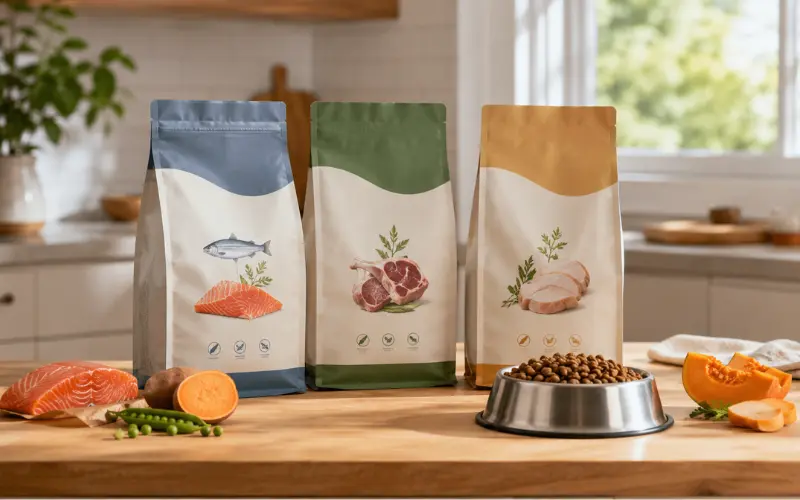
How to Read Labels When Buying Allergy Food for Puppies
Knowing what makes the best dog food for puppies with allergies actually work gives you the ability to evaluate any formula yourself — not just follow brand recommendations blindly.
What the Label Must Show
AAFCO statement confirming the food is “complete and balanced for growth” — not just “all life stages.”
This confirms the formula meets puppy-specific nutritional requirements.
A single named animal protein as the first ingredient — “salmon”, not “fish meal” or “ocean whitefish blend.”
Blended or generic protein sources make allergen identification impossible.
A short ingredient list — fewer than 12 main ingredients is ideal for an allergy formula.
More ingredients mean more potential triggers and more difficulty identifying the problematic one.
No common allergens in any form — check for the absence of chicken, beef, corn, wheat, soy, and dairy anywhere in the ingredient list.
Hidden Allergens to Watch For
Natural flavors are the most common hidden allergen on puppy food labels.
This term can legally include protein sources not listed elsewhere on the bag.
A salmon-based food labeled as “natural flavor added” may contain trace amounts of chicken or beef protein in that flavoring.
For severely allergic puppies, choose foods that explicitly state no chicken, no beef — not just foods where chicken is not the primary protein.
Chicken fat is another one to watch.
Many salmon or duck-based foods use chicken fat as their fat source.
For puppies with severe chicken allergy, even chicken fat can trigger a reaction.
Look for “fish oil” or “sunflower oil” as the fat source instead.
Facility processing warnings — “manufactured in a facility that also processes chicken and beef” — may appear on lower-cost limited-ingredient foods.
For most allergic puppies, this is acceptable.
For those with extreme sensitivity, pharmaceutical-grade hydrolyzed prescription diets eliminate this risk.
What to Look for Beyond Ingredients
Omega-3 fatty acids — from fish oil — actively reduce skin inflammation alongside the dietary changes.
Any allergy formula worth buying includes fish oil or lists EPA and DHA on the guaranteed analysis.
Probiotics and prebiotics — the gut-immune connection in allergic dogs is real.
Formulas with live probiotic cultures support the immune system alongside the dietary protein change.
Fat content between 10 and 14% — high fat content can trigger inflammation in allergy-prone puppies.
Check the guaranteed analysis panel, not just the ingredient list.
The Elimination Diet — The Only Way to Confirm Food Allergies
Blood tests and skin tests for food allergies in dogs are unreliable.
Every veterinary dermatologist agrees on this.
The only scientifically valid method to confirm a food allergy and identify the specific allergen is the dietary elimination trial.
This is also how you confirm which of the best dog food for puppies with allergies options actually works for your specific puppy, because not every allergic puppy reacts to the same protein.
How the Elimination Diet Works
Switch your puppy to a single novel protein food they have never eaten before.
Feed only this food for 8 to 12 weeks.
Nothing else — no treats except pieces of the trial kibble, no table scraps, no flavored medications, no dental chews.
If symptoms improve significantly by week 6 to 8, a food allergy is confirmed.
Then reintroduce the previous food.
If symptoms return within 1 to 2 weeks of reintroduction, the specific allergen is confirmed.
This two-phase process — elimination then reintroduction — is what distinguishes a confirmed food allergy diagnosis from an educated guess.
Week by Week — What to Expect
Why 8 Weeks — Not 3 Weeks
Most owners want results in two weeks.
The biology does not cooperate.
The inflammatory response from the allergen takes 6 to 8 weeks to fully clear from the dog’s immune system.
A 3-week trial that shows no improvement does not mean the diet is not working.
It may mean the immune system has not had enough time to reset.
This is the single most common reason elimination diets “fail” — they are abandoned at week 3 or 4 when they would have shown results by week 6.
Commit to the full 8 weeks.
Keep a daily log.
The data at week 8 is what actually tells you whether the food allergy hypothesis is correct.

That means no training treats except pieces of actual trial kibble, no dental chews, no flavored heartworm medications (switch to unflavored — ask your vet), no table scraps, and especially nothing from well-meaning family members or house guests.
One chicken-flavored treat at week 5 can invalidate the entire 8-week trial and restart the immune clearance clock from zero.
Be ruthlessly consistent.
Common Mistakes That Keep Allergic Puppies Suffering
These are the mistakes that extended my puppy’s scratching by months.
Most of them are completely understandable — and completely avoidable.
Stopping the elimination trial too early is the most damaging one.
The immune response needs 6 to 8 weeks to clear.
Judging a food trial at 3 weeks produces false negatives that cause owners to abandon a correct diagnosis.
Commit to the full 8 weeks before drawing any conclusion.
Giving treats during the trial is the most common sabotage.
One chicken-flavored biscuit at week 5 restarts the immune response and invalidates weeks of careful work.
Training treats must be pieces of the trial food itself — nothing else.
Assuming grain-free equals allergy-safe is the most expensive mistake.
Most puppy food allergies are protein allergies — to chicken, beef, or dairy — not grain allergies.
Switching from chicken kibble to grain-free chicken kibble does not help a chicken-allergic puppy.
The protein must change, not the grain status.
Switching between allergy foods frequently is the most counterproductive response to slow results.
Each switch disrupts gut bacteria and resets the immune clearance timeline.
Choose one novel protein food and commit to the full trial before switching.
Not telling family members about the restriction is the most emotionally difficult mistake to fix.
Your dog’s allergy management depends entirely on zero exposure to the allergen.
The person most likely to give your puppy a “harmless” treat is a family member who does not know the restrictions.
Tell everyone.
Post a reminder on the fridge if necessary.
For the complete guide on food sensitivity versus food allergy and how to choose the right sensitive stomach food — read our guide on best dog food for sensitive stomach.
When to Go Back to Your Vet — And What to Ask
Food allergy management is not always something you can handle alone. These situations need professional support.
See your vet before starting an elimination diet if your puppy has never been examined for the current symptoms — environmental allergies, parasites, and skin infections look identical to food allergy from the outside. A proper exam rules these out.
Return to your vet if symptoms persist unchanged after a full 8-week trial, if symptoms worsen at any point during the trial, if your puppy develops secondary skin infections from the scratching, or if you see blood in stool or any signs of systemic illness.
Ask your vet specifically about prescription options if over-the-counter novel protein diets are not producing results after two complete 8-week trials.
Royal Canin Veterinary HP or Hill’s z/d Puppy — hydrolyzed protein prescription diets — are the next step when whole protein novel diets are insufficient.
Ask about short-term medication if itching is severe enough to disrupt your puppy’s sleep or cause skin damage.
Apoquel and Cytopoint are prescription options that reduce itch response while dietary management takes effect — they do not treat the allergy, but they make the waiting period more humane for your puppy.
According to the American Veterinary Medical Association, dietary management is the primary long-term treatment for food allergy in dogs, and veterinary oversight ensures nutritional adequacy is maintained during elimination trials, especially for growing puppies with precise developmental needs.
See your veterinarian immediately for short-term itch relief while starting the dietary change.
Severe untreated allergic inflammation causes permanent skin damage and secondary infections that require separate medical treatment entirely.
The information in this guide is based on widely accepted veterinary allergy management principles.
Food allergies in puppies require proper veterinary diagnosis — always consult your vet before starting an elimination diet or switching to any specialized allergy formula.
Frequently Asked Questions (FAQ)
What is the most common food allergy in puppies?
Beef and chicken are the two most common food allergens in puppies.
This is because these proteins are most frequently found in commercial puppy food — and allergies develop through repeated exposure over time, not from a single encounter.
A puppy fed chicken-based food since weaning can develop a chicken allergy by 4 to 6 months.
Dairy, wheat, and soy follow as the next most common allergens, but protein-based allergies to chicken and beef represent the majority of diagnosed cases.
How long does the elimination diet take to show results?
Most puppies with food allergies show initial improvement — reduced itching, clearing ears, calmer skin — by week 4 to 6 of a strict elimination diet.
Full resolution of symptoms and confirmation of the allergy through reintroduction typically takes 8 to 12 weeks from the start of the trial.
The 8-week minimum is not optional — the immune inflammatory response needs that time to fully clear from the body.
Stopping at 3 or 4 weeks produces unreliable results and causes owners to abandon correct diagnoses.
How do I know if my puppy has a food allergy or an environmental allergy?
Food allergies produce year-round, consistent symptoms that do not change with seasons — persistent itching, chronic ear infections, and paw chewing that happens in winter and summer equally.
Environmental allergies are typically seasonal — worse in spring and fall when pollen counts are high, better in winter.
If your puppy’s itching and ear infections are constant regardless of the time of year, food allergy is the more likely explanation.
Can puppies outgrow food allergies?
Most food allergies in dogs are lifelong once established.
Unlike some childhood human food allergies that are outgrown, canine food allergies generally persist.
Once a specific allergen is confirmed through an elimination diet, that protein should be avoided permanently.
The management is straightforward — the confirmed allergen simply stays out of the diet for life — and most dogs thrive on appropriate novel protein or hydrolyzed formulas long-term.
Is grain-free food better for puppies with allergies?
Not automatically — and this is one of the most common and expensive misconceptions.
Most puppy food allergies are reactions to animal proteins, not grains.
A puppy allergic to chicken does not benefit from grain-free chicken food.
The protein must change, not the grain status.
Grain-free formulas also replace grains with legumes and potatoes, which the FDA has been investigating for a potential link to heart disease in dogs.
Unless a grain allergy has been specifically confirmed, grain-inclusive novel protein diets are the safer default.
Can I use homemade food for the elimination diet?
Yes — a simple homemade diet using a single novel protein your puppy has never eaten, like plain cooked salmon with white rice, can serve as an elimination diet food under veterinary guidance.
However, homemade food requires proper calcium supplementation and a canine multivitamin to be nutritionally complete for growing puppies.
For the complete guide on safe homemade recipes with proper supplementation, read our homemade dog food recipes vet-approved guide.
What should I do if my puppy reacts to every novel protein I try?
If your puppy shows allergic symptoms to salmon, then duck, then venison — each tried for a full 8 weeks — this suggests either extreme sensitization or the possibility that the food trials were contaminated by treats or other exposures.
At this point, ask your veterinarian for a prescription hydrolyzed protein diet like Royal Canin Veterinary HP or Hill’s z/d.
Hydrolyzed diets break protein down to fragments too small for the immune system to recognize — eliminating the allergic trigger entirely rather than replacing it.
How much more expensive is allergy puppy food?
Over-the-counter limited ingredient novel protein puppy foods like Natural Balance L.I.D. cost $40 to $60 for a 20 to 22-pound bag — roughly 20 to 30% more than standard puppy food.
Premium options like Purina Pro Plan Sensitive range from $55 to $75.
Prescription hydrolyzed protein diets are the most expensive at $80 to $120 for a similar-sized bag.
The cost difference is usually offset by fewer vet visits for ear infections and skin problems that can easily run $150 to $300 per visit when left unmanaged.
Should I give my allergic puppy omega-3 supplements?
Yes — omega-3 fatty acids from fish oil actively reduce skin inflammation alongside dietary management and are worth adding even when the allergic food already contains fish oil.
The dosage from food alone is often insufficient for a puppy with active inflammation.
Ask your vet about the appropriate fish oil dosage for your puppy’s weight.
Zesty Paws Salmon Oil is one of the most widely recommended options for dogs and is available on Amazon.
Eight Weeks Later — Final Thoughts
My puppy stopped scratching at 3 a.m. sometime around week seven of the salmon elimination diet. I only noticed because the house was suddenly quiet in a way it had not been in months.
By week eight, he had clear ears for the first time since we brought him home. By month three, his coat had changed completely — thicker, softer, actually shiny instead of dull and slightly dry.
Finding the best dog food for puppies with allergies is not a quick process. But it is a process with a clear path, a clear methodology, and — when you follow it completely — a clear resolution.
Three things to take with you:
- Change the protein, not the grain.
- Most puppy food allergies are reactions to chicken or beef that the puppy has been eating since weaning. Switch to salmon, duck, or venison before making any other change.
- Commit to 8 weeks without compromise.
- The immune inflammatory response needs that time to clear. Stopping at week 3 because results are not visible yet is the most common reason elimination diets fail — and they fail at the exact point they were about to work.
- Nothing else goes in the mouth during the trial.
- One chicken treat at week 5 restarts the immune clock. Tell every person in your household. Post a reminder. The trial is only as strict as the least informed person who has access to your puppy.
For the complete nutrition foundation — what to feed, how to read labels, and how to choose quality food for any puppy — read our complete dog nutrition guide for beginners.
And if your puppy has digestive symptoms rather than skin symptoms, the solution is different — read our guide on best dog food for sensitive stomach for the right approach.