My dog dragged me face-first into a bush.
Not a gentle tug. A full sprint toward a squirrel that ended with me stumbling off the sidewalk, losing the leash, and watching him disappear around a corner while I picked leaves out of my hair.
He was wearing a flat collar. I was using a standard back-clip harness that I later learned actually made pulling easier — not harder. And I had zero control over a 70-pound dog whose only goal in life was reaching that squirrel before it reached the tree.
That was the walk that made me research what actually stops pulling — not just contains it. And the answer was not a different collar or a stronger grip. It was the right harness.
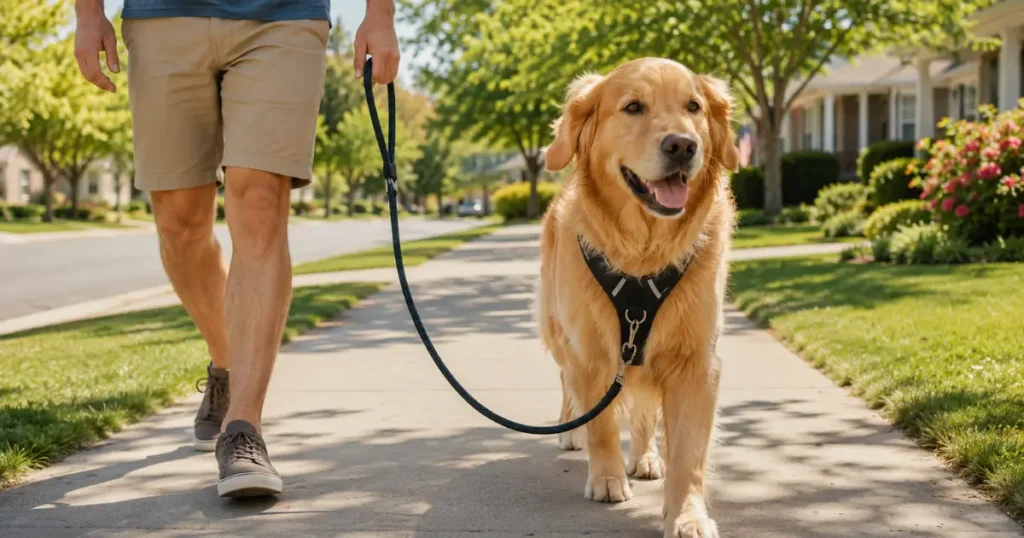
A front-clip no-pull harness changed our walks completely. Not overnight — the harness is a tool, not a miracle — but within a week of consistent use, the pulling dropped by roughly 80%. Within a month, I could walk him past squirrels with a loose leash.
This guide covers the best no pull dog harness options for every size, pulling intensity, and budget — with honest assessments of what each one does well and where it falls short.
For large powerful pullers, the Ruffwear Front Range ($45 to $55) offers premium build quality with dual clips.
Budget pick: Rabbitgoo No-Pull ($16 to $22).
Always measure chest girth before ordering — sizing is the number one reason harnesses fail.
Why Dogs Pull — And Why Most Harnesses Make It Worse
Before picking the best no pull dog harness, you need to understand why your dog pulls in the first place — and why the harness you are probably using now is making the problem worse.
Dogs pull because pulling works.
Every time your dog lunges forward and reaches the smell, the dog, the fire hydrant — they learn that pulling produces results.
It is not defiance.
It is not dominance.
It is a dog doing what has been reinforced thousands of times over thousands of walks.
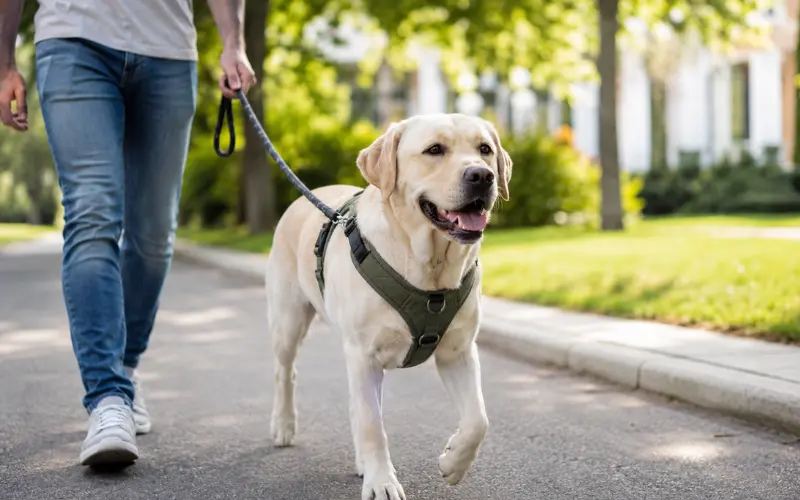
Dogs pull on the leash because pulling has been unintentionally reinforced — every time a dog moves forward while pulling, they learn that pulling produces the result they want, making front-clip no-pull harnesses effective because they physically redirect the dog’s momentum back toward the handler.
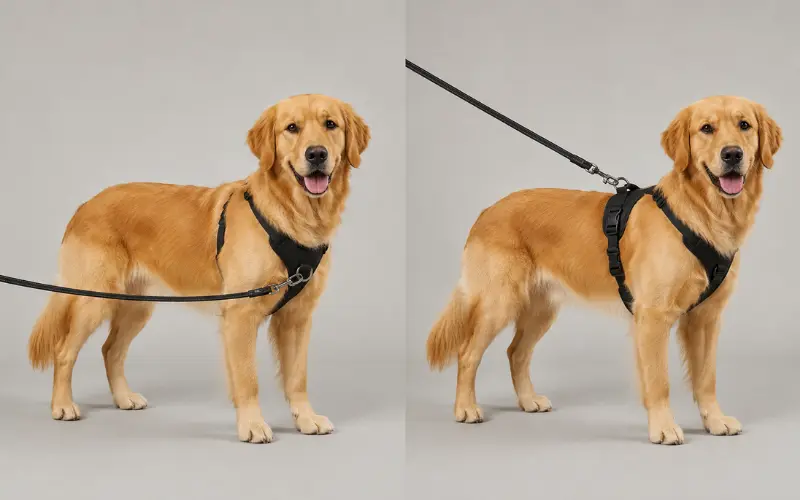
Standard back-clip harnesses make pulling worse because they put the leash attachment between the shoulder blades — which is exactly where sled dogs are harnessed.
The position gives dogs leverage to pull harder with their entire body weight.
A front-clip no-pull harness puts the leash attachment at the chest.
When the dog lunges forward, the chest attachment pivots their body back toward you instead of letting them drive forward.
Physics does the work — not pain, not choking, not corrections.
According to the American Kennel Club, front-clip harnesses are the recommended tool for dogs that pull because they redirect the dog’s forward momentum without putting pressure on the neck or throat.
How to Choose the Right No Pull Harness — What Matters
Not every no-pull harness works the same way.
Knowing what to look for in the best no pull dog harness saves you from buying 3 harnesses before finding one that fits.
Front Clip vs Dual Clip
Front-clip only harnesses are simpler and cheaper.
The leash attaches at the chest for no-pull function.
Best for: training and dogs learning leash manners.
Dual-clip harnesses have both front and back attachment points.
Use the front clip for training walks and the back clip for casual walks once pulling improves.
Best for: versatility and long-term use.
Adjustability
A harness with 4 or more adjustment points fits significantly more body types than one with 2.
Dogs with barrel chests (Bulldogs), deep chests (Greyhounds), or narrow waists (Whippets) need multiple adjustment points to get a secure fit.
Hardware Quality
Plastic buckles are fine for dogs under 40 pounds.
Dogs over 50 pounds need metal or high-impact polymer hardware that will not snap under strong forward surges.
The most important factor when choosing a no-pull dog harness is the front chest clip placement.
This attachment point physically redirects a pulling dog’s momentum back toward the handler, which is why front-clip designs are significantly more effective than back-clip harnesses for reducing pulling behavior.
Padding
Daily walkers need padding.
A harness worn for 30 to 60 minutes every day will cause chafing under the armpits and across the chest if unpadded.
Padded chest and belly panels prevent this.
Best No Pull Dog Harness — 6 Picks for Every Dog
Each harness reviewed includes: what makes it work, who it is best for, who should skip it, and current pricing.
1. PetSafe Easy Walk — Best Overall for Most Dogs
This is where most owners should start.
The PetSafe Easy Walk is the harness veterinarians and trainers have recommended since 2004 — and for good reason.
The patented martingale loop at the front tightens gently across the chest when your dog pulls, applying gradual shoulder pressure that naturally redirects their momentum back toward you.
It works on the first walk for most dogs without any training required.
Lightweight, breathable, and simple to put on — the belly strap is a different color from the shoulder strap so you always know which side goes where.
The PetSafe Easy Walk No-Pull Dog Harness — Large, Black — is the most recommended no-pull harness by veterinarians and trainers since 2004.
Features include:
- Patented martingale front loop
- Lightweight, breathable design
- Color-coded straps for easy fitting
- Sizes from Petite to X-Large
Not ideal for: dogs over 80 lbs who pull extremely hard — the nylon webbing and plastic buckles may not hold up long-term under heavy sustained force.
Also not ideal for dogs with very deep or barrel chests that need more than 2 adjustment points.
2. Ruffwear Front Range — Best Premium Pick
If you want one harness that lasts years and handles everything from training walks to trail hikes, this is it.
Dual leash clips — front for no-pull training, back for running or casual walks.
Four-point adjustability fits virtually every body type.
Padded chest and belly panels prevent chafing during long walks and hikes.
Aluminum V-ring hardware rated for heavy use.
The build quality is visibly different from budget options — you can feel it in the materials, the stitching, and the hardware.
This is a harness built for dogs that wear it daily for years.
The Ruffwear Front Range Dog Harness — Medium — features dual leash clips (front + back), four-point adjustability, padded chest and belly panels, aluminum hardware, and reflective trim.
The premium standard for active dogs.
Machine washable.
Not ideal for: owners on a tight budget — at $45 to $60, it costs 3 to 4 times more than the PetSafe.
If your dog only walks 15 minutes a day on flat sidewalks, the PetSafe Easy Walk does the same job for less.
3. Rabbitgoo No-Pull Harness — Best Budget Pick
The best no pull dog harness under $20.
Dual clip design (front and back), four adjustment points, padded vest-style chest panel, and reflective strips.
At $16 to $22, it delivers features that compete with harnesses twice the price.
Over 100,000 Amazon reviews with a 4.5 average.
Metal D-rings on the front and back clips.
Sizes from X-Small to X-Large.
The trade-off is durability — the nylon and stitching will not last as long as Ruffwear or PetSafe under heavy daily use.
But for dogs under 50 lbs or as a first no-pull harness to test if front-clip works for your dog, it is excellent value.
The Rabbitgoo No-Pull Dog Harness — Medium — features a dual-clip design, four-point adjustability, a padded vest-style chest panel, and reflective detailing.
Over 150,000 reviews.
The best value no-pull harness on Amazon for dogs under 60 lbs.
Not ideal for: large breeds over 70 lbs that pull hard — the hardware and stitching are not rated for sustained heavy force.
Upgrade to Julius-K9 or Ruffwear for big pullers.
4. Julius-K9 IDC Powerharness — Best for Large Powerful Dogs
Built for dogs that break lighter harnesses.
The Julius-K9 is the harness used by law enforcement, search-and-rescue, and military working dog handlers.
European military-grade nylon.
Reinforced stitching rated for dogs up to 99 lbs.
A top handle that gives you immediate physical control in crowds, traffic, or emergencies.
Interchangeable Velcro ID patches on the sides — a signature feature popular with service dog handlers.
The Julius-K9 IDC Powerharness is rated for dogs up to 99 lbs and uses military-grade nylon construction trusted by law enforcement and search-and-rescue teams worldwide — making it the most durable consumer no-pull harness available for large, powerful breeds like German Shepherds, Rottweilers, and Huskies.
The Julius-K9 IDC Powerharness — Size 1, Black — features military-grade nylon construction, reinforced stitching, a top control handle, and interchangeable ID patches.
Rated for dogs up to 99 lbs.
The professional handler’s choice for large breeds.
Not ideal for: small or medium dogs under 40 lbs — the harness is bulky and heavy for smaller frames.
Also lacks a standard front clip — the front attachment is sold separately.
Not a dedicated no-pull design — more of a heavy-duty control harness.
5. 2 Hounds Design Freedom No-Pull Harness — Best for Escape Artists
If your dog has backed out of every harness you have tried, the Freedom is designed to solve that.
Dual clip system with a unique martingale loop at the back that prevents the harness from shifting.
Swiss Velvet lining prevents chafing.
Four adjustment points.
US-made stainless steel hardware.
The martingale back loop is the key feature — when the dog pulls backward (trying to escape), the loop tightens evenly rather than allowing the harness to slide off.
The 2 Hounds Design Freedom No-Pull Harness — Medium — features a dual-clip design, a martingale correction loop, Swiss Velvet lining, and US-made stainless steel hardware.
Designed specifically for dogs that slip out of standard harnesses.
Not ideal for: dogs that do not attempt to escape harnesses — the martingale back loop is the main selling point.
If your dog stays in a standard harness, the PetSafe or Rabbitgoo offers similar no-pull function at a lower price.
Quick Comparison — Which Harness Fits Your Dog
It is under $20, works on the first walk for most dogs, and tells you within a week whether a front-clip design solves your pulling problem.
If it does — you are done.
If your dog needs more adjustability or durability, then upgrade to the Ruffwear or 2 Hounds knowing that the front-clip concept works for your dog.
Start cheap, verify, then invest.
How to Measure Your Dog for a Harness — Get It Right First Time
Sizing is the number one reason harnesses fail.
Even the best no pull dog harness will not stop pulling if it does not fit correctly — it will chafe, shift, and eventually be backed out of.
The Two Measurements You Need
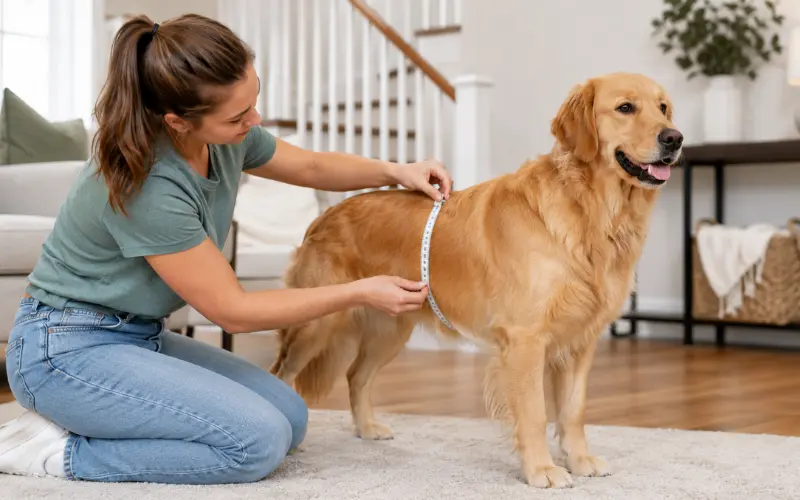
Chest girth — the most important measurement.
Wrap a flexible measuring tape around the widest part of your dog’s ribcage, just behind the front legs.
This is the primary sizing measurement for every harness brand.
Neck circumference — wrap the tape around the base of the neck where a collar would sit.
The Two-Finger Rule
Once the harness is on, you should be able to slide two fingers (flat, not stacked) between any strap and your dog’s body.
If you cannot fit two fingers — too tight.
If you can fit your whole hand — too loose.
The correct way to size a no-pull dog harness is to measure chest girth — the widest part of the ribcage just behind the front legs — using a flexible tape measure, then check the specific brand’s sizing chart, as sizes vary significantly between manufacturers.
When between sizes, size up.
A slightly loose harness can be tightened with adjustment straps.
A too-small harness cannot be loosened enough and will restrict shoulder movement.
A Harness Is Not Enough — Training Still Matters
The best no pull dog harness reduces pulling immediately.
But eliminating it permanently requires consistent training alongside the harness.
A front-clip harness is a management tool — it makes pulling mechanically harder.
Training is what teaches your dog that walking beside you is more rewarding than lunging ahead.
The combination is what works: the harness prevents pulling in the moment while training builds the habit of loose-leash walking over time.
For the complete positive reinforcement leash training method, read our guide on leash training a puppy that pulls on walks.
A no-pull harness is a management tool that makes pulling mechanically harder — but permanent loose-leash walking requires consistent positive reinforcement training alongside the harness, with most dogs showing significant improvement within 2 to 4 weeks of combined harness use and reward-based leash training.
For the complete positive reinforcement training foundation, read our guide on positive reinforcement dog training for beginners.
According to the AKC, the most effective approach to leash pulling combines a front-clip harness with consistent positive reinforcement — stopping when the dog pulls and rewarding when the leash is loose.
Every single time.
Not just the first day — every walk for the first month.
You are building the habit that walking beside you is more rewarding than lunging ahead.
The harness stops pulling physically.
The treats stop pulling motivationally.
Together, they work faster than either one alone.
Common Harness Mistakes That Hurt Your Progress
These mistakes undo the work the best no pull dog harness is designed to do — and most owners make at least one of them.
Using the back clip for training defeats the purpose.
Back-clip attachment gives your dog sled-dog leverage to pull harder.
Use the front clip during every training walk until pulling is resolved.
Back clip is for casual walks after training is established.
Not adjusting after purchase causes chafing and escape.
Every harness needs fine-tuning once it is on your dog — tighten until the two-finger rule is met on every strap.
A loose harness shifts, rubs, and eventually gets backed out of.
Giving up after one walk because “it didn’t work.”
A harness reduces pulling immediately — but your dog still needs time to learn the new expectation.
Give it 5 to 7 consistent walks before evaluating whether it is working.
Using a retractable leash with a no-pull harness teaches your dog that pulling extends the leash — which is the exact opposite of what you are trying to accomplish.
Use a standard 4 to 6 foot fixed-length leash.
Always.
According to the ASPCA, positive walking experiences contribute significantly to a dog’s physical exercise and mental stimulation needs — making proper leash equipment an investment in long-term behavioral health.
According to the AKC, choosing between a harness and collar depends on your dog’s size, behavior, and walking habits — with harnesses being the recommended choice for any dog that pulls because they distribute pressure across the chest rather than concentrating it on the neck.
Harness straps can catch on crate wires, furniture, fence hardware, or other objects — creating a strangulation risk.
Put the harness on before walks and remove it when you get home.
This also preserves the padding and hardware longevity.
The product recommendations in this guide are based on published research, professional trainer endorsements, and real-world owner reviews.
Every dog is different — what works for one may not work for another.
If your dog has severe reactivity or aggression on leash, consult a certified professional dog trainer before relying on equipment changes alone.
Frequently Asked Questions (FAQ)
What is the best no pull harness for dogs that pull hard?
The PetSafe Easy Walk is the best starting point for most dogs — it uses a patented martingale front loop that immediately redirects pulling without pain or corrections.
For large, powerful breeds over 70 lbs, the Julius-K9 IDC Powerharness offers military-grade construction rated to 99 lbs.
For the best all-around premium option with dual clips and padding, the Ruffwear Front Range is the long-term investment pick.
Do no pull harnesses actually work?
Yes — front-clip no-pull harnesses are the most effective single tool for reducing leash pulling.
Physics is the mechanism: when the leash attaches at the chest, forward lunging pivots the dog’s body back toward the handler, making sustained pulling mechanically difficult.
Most dogs show a 50 to 80 percent reduction in pulling on the first walk with a properly fitted front-clip harness.
Are no pull harnesses safe for dogs?
Yes — front-clip no-pull harnesses are safe and recommended by veterinarians and professional trainers.
They distribute pressure across the chest and shoulders rather than concentrating it on the neck like collars do.
No choking, no corrections, no pain.
The only safety consideration is ensuring proper fit — a harness that is too tight restricts shoulder movement, and one that is too loose allows escape.
What size no pull harness does my dog need?
Measure your dog’s chest girth — the widest part of the ribcage just behind the front legs — with a flexible tape measure.
Compare this measurement to the specific brand’s sizing chart, as sizes vary between manufacturers.
A medium in PetSafe is different from a medium in Ruffwear.
When between sizes, size up and adjust the straps for a snug fit using the two-finger rule.
Front clip or back clip — which is better for pulling?
The front clip is significantly better for reducing pulling.
The front chest attachment physically redirects your dog’s forward momentum back toward you.
Back clip attachment gives dogs leverage to pull harder — it is essentially the same position used to harness sled dogs.
Use the front clip for all training walks.
Switch to the back clip only for casual walks after pulling is resolved.
How long does it take for a no pull harness to stop pulling?
Most dogs show an immediate reduction in pulling force on the first walk — typically 50 to 80 percent less pulling.
Complete loose-leash walking usually takes 2 to 4 weeks of consistent harness use combined with positive reinforcement training.
The harness manages pulling in the moment, while training builds the long-term habit.
Can I leave a no pull harness on my dog all day?
No.
Harnesses should be removed when your dog is not being walked.
Extended wear causes chafing under the armpits and across the chest, and harness straps can catch on crate wires or furniture, creating a safety risk.
Put the harness on before walks and remove it when you return home.
This also extends the life of the padding and hardware.
My dog slips out of every harness — what should I buy?
The 2 Hounds Design Freedom Harness is specifically designed for escape artists.
Its martingale back loop tightens evenly as the dog tries to back out, preventing the slide-over-the-head escape that standard harnesses allow.
The Blue-9 Balance Harness with six adjustment points is another strong option for dogs that slip out due to unusual body proportions.
The Right Harness Changes Everything — Final Thoughts
Face-first into a bush.
That is where the wrong harness got me.
A $15 PetSafe Easy Walk got me back to actually enjoying walks within a week.
Not perfect walks — my dog still noticed squirrels.
But the leash stayed loose, my feet stayed on the sidewalk, and I did not end up wearing a hedge.
Three things to take with you:
Start with the PetSafe Easy Walk if you are unsure.
Under $20, works on the first walk, recommended by vets and trainers for over 20 years.
If front-clip works for your dog — you never need to spend more.
Measure before you buy.
Chest girth is the only measurement that matters.
Check the brand’s specific sizing chart — not a generic size guide.
When between sizes, size up.
The harness manages pulling. Training eliminates it.
Use both together for the fastest, most lasting results.
The harness buys you time and control while the training builds the habit that makes the harness eventually unnecessary.
For the complete leash training method that pairs perfectly with any no-pull harness, read our guide on leash training a puppy that pulls on walks.
For the foundation training method that makes every walk easier, read our guide on how to teach a dog to sit step by step — the first command that builds focus and impulse control.