

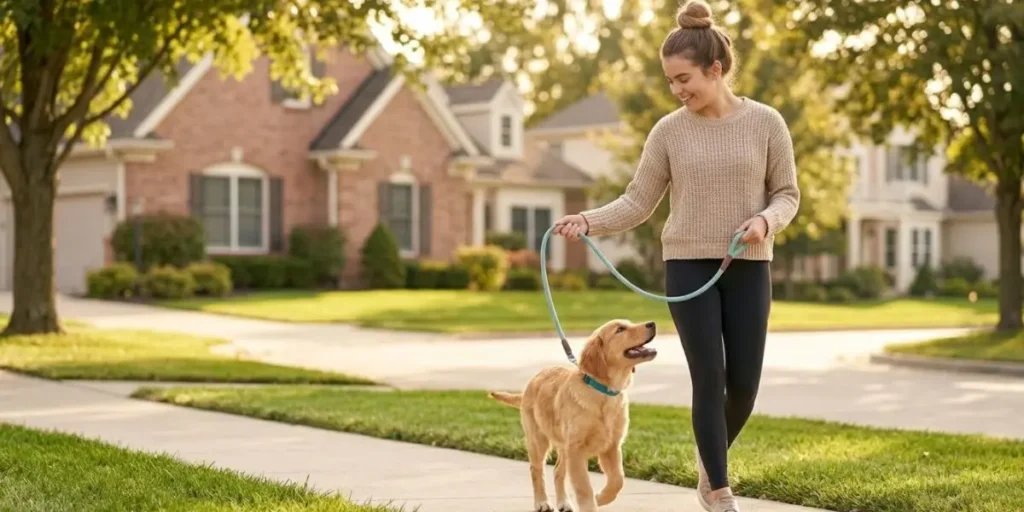
My puppy walked me. Not the other way around.
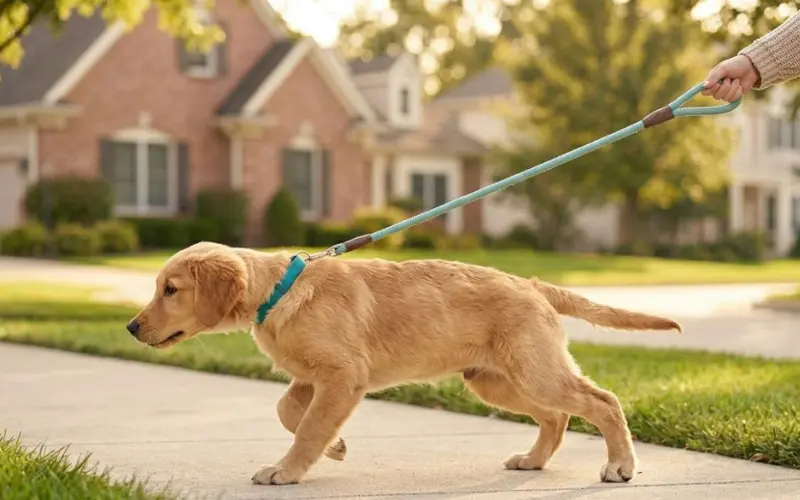
For the first three weeks of our walks, I was just the person attached to the other end of the leash while he decided where we were going, how fast we were getting there, and which interesting smell required an immediate full-body lunge. My shoulder genuinely hurt. I started dreading something that was supposed to be the best part of the day.
The frustrating part was that everyone made it sound so simple. “Just stop walking when he pulls.” I tried that. He would look back at me, look forward at the smell, and then slowly, dramatically, pull even harder while making eye contact.
Leash training a puppy that pulls on walks is one of those things that sounds straightforward in theory and requires a real system in practice. The stopping alone never works — not consistently, not quickly.
This guide gives you that system. Why puppies pull, why leash training a puppy that pulls on walks requires more than one technique, and the complete method that builds a loose leash in days — not months.
Your shoulder will thank you.
When they pull, stop completely or change direction. Never allow pulling to move them forward.
Most puppies show real improvement within 1 to 2 weeks of consistent daily practice using this reward and direction-change method.
Why Puppies Pull on the Leash — What Is Actually Happening
Leash training a puppy that pulls on walks starts with understanding why pulling happens — because the reason tells you exactly how to fix it.
Here is the honest answer: pulling works.
Every time your puppy pulls forward, and you follow — even one step — they learn that pulling moves them toward the interesting thing. The behavior is reinforced thousands of times before most owners realize a pattern has formed.
Puppies pull on the leash because pulling has been accidentally reinforced — every time they pulled and the owner followed, the puppy learned that pulling is the way to move forward.
The Reinforcement Problem
Walking on a leash is not natural for dogs. In the wild, dogs move at their own pace, sniff what they want, and change direction freely. Asking a puppy to walk at a human pace in a straight line while attached to a restraint is genuinely counterintuitive to them.
Combine that with the fact that every smell, sight, and sound in the outside world is dramatically more exciting than the person holding the leash, and you have a recipe for pulling.
The solution is not to punish the pulling. It is to make walking beside you more rewarding than pulling away from you. That shift in value is what leash training a puppy that pulls on walks is actually built on.
The 4 Most Common Pulling Triggers
Why Traditional “Just Stop Walking” Often Fails Alone
Stopping when the puppy pulls is part of the solution — but not all of it. Here is why stopping alone often produces slow results:
- It removes forward movement but gives no information
about what the right behavior actually is - A puppy that stops pulling for 3 seconds and then
pulls again learns that 3 seconds of patience is the
price of forward movement - It takes an extremely long time without a reward
component to make the stopping meaningful
Stopping works best when combined with rewarding the moment the leash goes loose — that combination teaches both what not to do and what to do instead.
Equipment That Helps — and Equipment That Hurts
Before covering the training method, equipment choice matters significantly for leash training a puppy that pulls on walks. The right equipment makes training easier. The wrong equipment can make it harder or cause physical harm.
Equipment Comparison — What Works and What Doesn’t
The Front-Clip Harness — Best Starting Point
A front-clip harness is the single most practical tool for leash training a puppy that pulls. When your puppy pulls forward, the chest clip naturally redirects their body to the side, rather than allowing them to use their full weight to drag you forward.
It does not stop pulling on its own, but it significantly reduces the physical force, making the training component easier to implement.
Popular options:
- PetSafe Easy Walk Harness — widely available
- Ruffwear Front Range — durable for active dogs
- Blue-9 Balance Harness — highly adjustable
Leash Length Matters
- Training leash length: 4 to 6 feet — standard
- Retractable leashes: avoid completely during training
- Long lines 15 to 30 feet: for recall training only
Retractable leashes actively teach pulling because they give more leash when forward pressure is applied. They reinforce the exact behavior you are trying to eliminate. Put them away until loose leash walking is fully trained.
A puppy that fights the harness on every walk will spend the first 5 minutes of every session distracted by the equipment.
A puppy comfortable in their harness is ready to train from step one.
Leash Training a Puppy That Pulls on Walks — Step by Step
This is the complete method. It combines three techniques that work together — none of them alone produces consistent results as quickly as the three together.
Step 1 — Establish the Reward Zone
Before you ever leave the house, your puppy should understand where rewards happen and have a reliable sit command. If your dog doesn’t know “sit” yet, read our how to teach a dog to sit step by step before starting loose leash training.
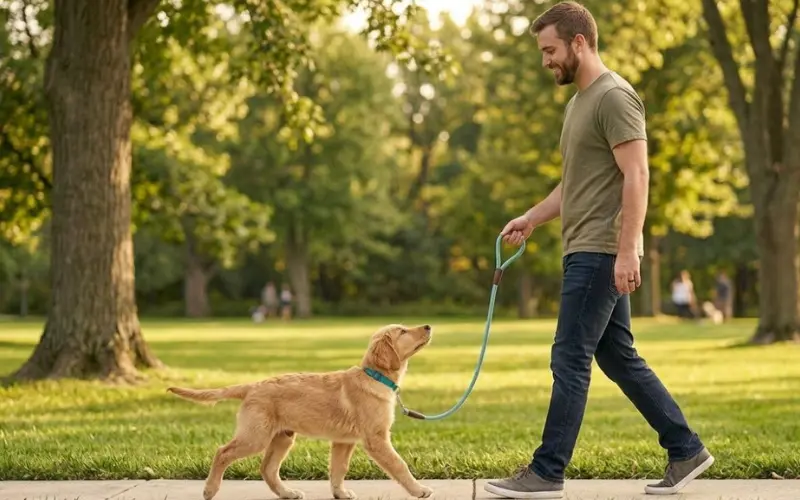
The reward zone is the position directly beside your left leg — hip to hip, walking together. This position has a name in formal training: heel position. But you do not need formal heelwork. You just need your puppy to know that being beside you is the most rewarding place they can be on a walk.
How to build it:
- Stand still with your puppy on a leash
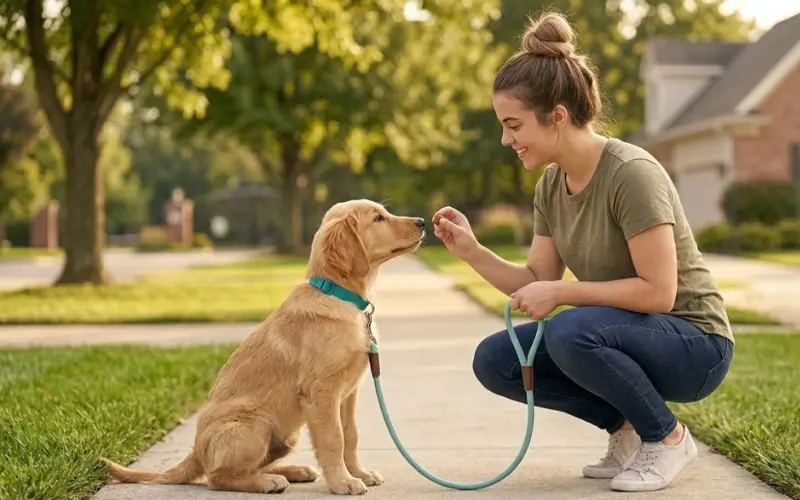
- The moment your puppy positions beside your left leg, Mark with “yes” and reward immediately
- Take one step forward — if the puppy stays beside you, mark and reward
- Build from 1 step to 3 steps to 5 steps to 10 steps
- Do this in the house and yard before ever hitting the street
Step 2 — Pulling Stops All Forward Movement
This is the foundational rule of leash training a puppy that pulls on walks. Simple, clear, consistent:
Tight leash = walk stops
Loose leash = walk continues
How to apply it:
- The moment you feel tension in the leash — stop immediately. Plant your feet.
- Stand still. Say nothing. Do not pull back or jerk the leash.
- Wait for your puppy to turn back toward you and create slack.
- The moment the leash has a natural J-shaped curve — Mark with “yes” and reward immediately.
- Then continue walking.
The key word is immediately. If you wait 5 seconds after the leash goes loose before rewarding, your puppy has already sniffed the ground, looked around, and the connection between loose leash and reward is lost.
Step 3 — Direction Changes
Stopping alone is passive. Direction changes are active — and they significantly speed up the learning process.
How to apply it:
- When your puppy pulls ahead, calmly and quietly turn 180 degrees and walk in the opposite direction.
- No announcement. No “this way.” No leash jerk. Just turn.
- When your puppy catches up and falls into position beside you — mark and reward enthusiastically.
- Continue walking. When they pull again — turn again.
What your puppy learns:
Pulling makes them lose the thing they were headed for. Staying beside the owner means they keep moving forward and treats appear. That value shift is what makes loose leash walking stick.
Step 4 — Reward Every Single Check-In
A check-in is when your puppy voluntarily looks up at your face during a walk. It is the single most valuable behavior you can build in a puppy — and most owners ignore it completely.
The moment your puppy’s eyes come to your face:
- Mark with “yes” immediately
- Give the best treat of the walk
- Make it genuinely exciting — not a quiet, understated reward
You are building a habit of your puppy checking in with you instead of fixating entirely on the environment. Over weeks, this habit becomes automatic — and a puppy that regularly checks in rarely pulls hard enough to matter.
Step 5 — Build Gradually Into Busier Environments
A puppy that walks beautifully on a quiet street may pull hard in a busy park. This is not regression — it is normal. Every new environment requires building the behavior again at a lower level.
Environment progression for leash training:
At each new stage, go back to heavy rewarding and short sessions. Never expect the same performance in a new, exciting environment as at home.
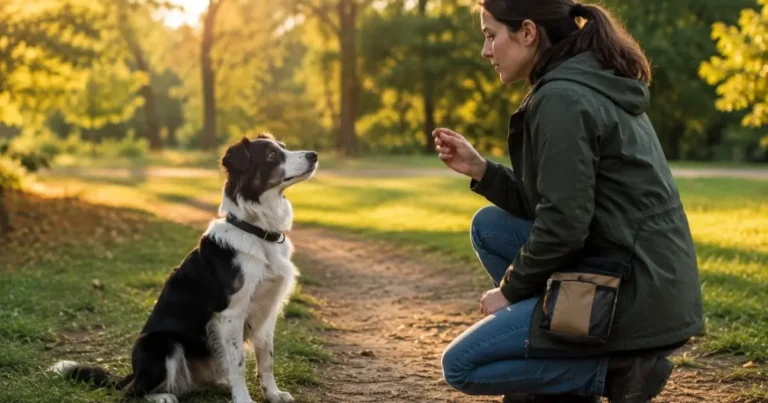
Most owners keep treats in a pocket on the opposite side, which means reaching across to reward breaks the walking position every single time.
Same-side pouch keeps the training flow smooth and the puppy naturally positioned where you want them.
The Week by Week Progress Guide
Here is what realistic progress looks like for leash training a puppy that pulls on walks when the method is applied consistently.
Week 1
Focus: Reward zone at home and introduce the stop method.
Success Looks Like: Your puppy begins to understand that a loose leash makes the walk continue.
Week 2
Focus: Direction changes and rewarding voluntary check-ins.
Success Looks Like: Fewer pulling attempts and more attention on you during walks.
Week 3
Focus: Longer sessions on quiet residential streets.
Success Looks Like: Pulling becomes occasional rather than constant.
Week 4
Focus: Extend walk duration and introduce mild distractions.
Success Looks Like: Loose leash walking for most of the walk.
Month 2
Focus: Begin working in busier environments.
Success Looks Like: Reliable loose leash walking on normal neighborhood walks.
Month 3+
Focus: Proof behaviors in parks and high-distraction locations.
Success Looks Like: Reliable loose leash walking in most real-world situations.
Honest expectations:
- Perfect loose leash in all environments: 3 to 6 months
- Significant improvement on regular walks: 3 to 4 weeks
- First noticeable improvement: end of week 1 to 2
Common Leash Training Mistakes That Slow Everything Down
Quick Reference — Mistakes and Fixes
❌ Following When Puppy Pulls
What It Does: Reinforces pulling directly.
Fix: Stop immediately — every single time.
❌ Retractable Leash During Training
What It Does: Teaches pulling = more leash.
Fix: Switch to a standard 4 to 6 foot leash.
❌ Inconsistent Response
What It Does: Dog learns pulling sometimes works.
Fix: Use the same response every pull, every walk.
❌ Sessions Too Long
What It Does: Mental fatigue increases pulling.
Fix: Keep sessions to 10–15 minutes maximum.
❌ Jumping Straight to Busy Areas
What It Does: Too much stimulation to learn effectively.
Fix: Start in quiet areas and gradually build to busier environments.
❌ Rewarding Too Late
What It Does: Puppy doesn’t connect the reward to the correct position.
Fix: Reward within 1 to 2 seconds of loose leash behavior.
The Most Damaging Mistake — Letting the Walk Continue
This one is worth going deeper on because it is the most common error and the hardest habit to break.
When your puppy pulls, and you keep walking — even for just 3 or 4 steps before you stop — you have reinforced the pulling. Three steps toward that smell are three steps of reward for pulling behavior. The puppy learns: pulling gets me closer, even if the walk eventually stops.
The rule has to be absolute:
First sign of tension = immediate stop.
Not after 3 steps. Not after you finish your sentence.
The moment the leash goes tight.
Timing on Rewards — The Common Miss
Most owners reward 3 to 5 seconds after the leash goes loose. By then, the puppy has already begun sniffing the ground or looking at something else.
The reward lands on whatever the puppy is doing when the treat arrives — not on the loose leash that happened 4 seconds ago.
Reward the loose leash. Within 1 to 2 seconds. Every single time for the first 2 to 3 weeks.
According to the ASPCA, the effectiveness of positive reinforcement in leash training depends almost entirely on the precision of reward timing — the reward must connect to the exact behavior, not what follows it.
Leash Training Puppies at Different Ages
The earlier you start leash training a puppy that pulls on walks, the easier it is — but every age has its own considerations.
Age-Specific Leash Training Guide
8 to 12 Weeks
Attention Span: Very short
Session Length: 3 to 5 minutes
Main Challenge: Everything is new and exciting
Key Focus: Reward zone position only
3 to 4 Months
Attention Span: Improving
Session Length: 5 to 8 minutes
Main Challenge: Teething distracts from training
Key Focus: Stop method + check-ins
4 to 6 Months
Attention Span: Moderate
Session Length: 8 to 12 minutes
Main Challenge: Adolescent distraction peak begins
Key Focus: Consistency critical
6 to 12 Months
Attention Span: Good
Session Length: 10 to 15 minutes
Main Challenge: Adolescent testing phase
Key Focus: Direction changes + proofing
Adult Dog
Attention Span: Long
Session Length: 15 to 20 minutes
Main Challenge: Established pulling habit
Key Focus: Full method — takes longer
Starting at 8 Weeks — The Advantage
The puppy that starts loose leash training at 8 weeks old has a massive advantage over the puppy that starts at 6 months. Here is why:
- No established pulling habit to undo
- The brain is in peak learning mode
- Physical strength is low — early practice is easy
- Habits formed before 16 weeks are the most durable
Even 3 minutes of loose-leash reward practice in the front yard at 8 weeks lays a foundation that dramatically reduces pulling later.
Adult Dog Leash Training — It Takes Longer But Works
An adult dog that has been pulling for 2 years is not impossible to retrain. The process takes longer — expect 2 to 4 months instead of 2 to 4 weeks — because an established habit requires significantly more repetitions to replace.
According to the American Kennel Club, adult dogs with established pulling habits respond well to consistent loose-leash training but typically require 3 to 4 times as many training sessions as puppies to achieve the same level of reliability.
Consult a certified professional trainer before continuing. Aggressive lunging on leash can escalate if handled incorrectly and is best addressed with professional in-person guidance.
Every dog is different — if your puppy shows signs of fear, aggression, or extreme anxiety on walks, please consult a certified professional trainer or your veterinarian.
Frequently Asked Questions (FAQ)
At what age should you start leash training a puppy?
You can start leash training as early as 8 weeks old.u003cbru003eThe younger you start, the easier it is — no established pulling habit exists yet, and the puppy’s brain is in peak learning mode.u003cbru003eEven 3 to 5 minutes of loose-leash reward practice in your yard at 8 weeks lays a foundation that dramatically reduces pulling problems lateru003cbru003eMost puppies who start loose-leash training at 8 weeks walk reliably within 4 to 6 weeks of consistent daily practice.
How long does it take to stop a puppy pulling on the leash?
Most puppies show noticeable improvement within 1 to 2 weeks of consistent daily training using the stop method combined with direction changes and check-in rewards.u003cbru003eReliable loose-leash walking during regular neighborhood walks typically takes 4 to 6 weeks.u003cbru003eFull reliability in high-distract environments, such as busy parks, takes 3 to 6 months of gradual proofing.u003cbru003eThe speed depends almost entirely on consistency — daily 10-minute sessions produce dramatically faster results than occasional long walks.
Should I use a choke chain or prong collar to stop pulling?
No — choke chains and prong collars are not recommended for leash training puppies.u003cbru003eThey work through pain and discomfort rather than teaching the puppy what the correct behavior actually is.u003cbru003eDogs trained with these tools often pull to the point of pain tolerance, develop anxiety around walks, or transfer the reaction to fear or aggression.u003cbru003eA front-clip harness combined with positive reinforcement training is significantly more effective and builds a genuinely enjoyable walking relationship.
Why does my puppy pull toward every smell but walk well otherwise?
This is very common — dogs experience the world primarily through their nose, and interesting smells trigger a strong pulling response even in dogs that walk well otherwise.u003cbru003eThe fix is to give structured sniff breaks — when you reach a natural stopping point, say u0022go sniffu0022 and let them explore freely for 30 to 60 seconds.u003cbru003eWhen you are ready to move, say u0022let’s gou0022 and reward for returning to the position.u003cbru003eSniffing becomes a reward for good leash walking rather than a destination that requires pulling.
My puppy is great on leash at home but terrible in public — why?
You can start leash training as early as 8 weeks old.u003cbru003eThe younger you start, the easier it is — no established pulling habit exists yet, and the puppy’s brain is in peak learning mode.u003cbru003eEven 3 to 5 minutes of loose-leash reward practice in your yard at 8 weeks lays a foundation that dramatically reduces pulling problems later.u003cbru003eMost puppies who start loose-leash training at 8 weeks walk reliably within 4 to 6 weeks of consistent daily practice.
What is the best harness for a puppy that pulls?
A front-clip harness is the best starting point for most puppies that pull.u003cbru003eThe clip on the chest naturally redirects the dog’s body when they pull forward, significantly reducing the physical force without causing pain.u003cbru003eThe PetSafe Easy Walk, Blue-9 Balance Harness, and Ruffwear Front Range are all widely recommended options.u003cbru003eAvoid back-clip harnesses for pulling dogs — the back clip position actually gives a pulling dog more leverage to pull harder.
Can I use treats on every walk forever?
You do not need to treat on every walk forever, but for the first 4 to 8 weeks of training, treats on every walk produce significantly faster and more reliable results.u003cbru003eAfter loose-leash walking is established, you can gradually shift to intermittent rewards—treating randomly rather than every time.u003cbru003eIntermittent rewards actually strengthen behavior over time because the unpredictability keeps dogs engaged.u003cbru003eThe goal is not to bribe your dog on every walk forever but to use rewards heavily enough during learning to build the habit permanently.
My puppy stops walking completely on the leash — what do I do?
Some puppies freeze and refuse to move rather than pull.u003cbru003eThis is usually fear or overwhelm rather than stubbornness.u003cbru003eIf your puppy freezes during walks, reduce the environmental challenge — go back to a quieter, more familiar location.u003cbru003eUse high-value treats to encourage forward movement without pressure or leash-pulling.u003cbru003eNever drag a frozen puppy — this increases the fear response.u003cbru003eBuild confidence gradually through shorter positive outings in less stimulating environments.
The Walk You Have Been Working Toward — Final Thoughts
The morning my puppy walked the entire block beside me without a single pull, leash hanging loose, ears up, occasionally glancing at my face, I stood at the end of the street for a minute before turning back. Not because I was tired. Because I wanted to do it again.
That is what leash training a puppy that pulls on walks actually builds. Not just a dog that does not pull. A dog that genuinely enjoys walking beside you because that is where the good things happen.
Here are your three key takeaways:
- Pulling only works when it moves them forward — the moment that stops being true, consistently, every single time, the pulling stops being worth the effort. Be absolute about this rule.
- Reward the loose leash within 1 to 2 seconds — timing is everything. Late rewards teach the wrong behavior. Precise rewards build the right one.
- Build gradually into harder environments — a dog that walks beautifully at home and pulls in the park needs more park practice, not different training. Every environment is a new training level. Go slowly and build each one properly.
For the complete foundation of positive training methods, this guide builds on our complete positive reinforcement dog training for beginners guide.
And if your dog is also barking at strangers on walks, alongside the pulling — read our guide on how to stop a dog from barking at strangers for the complete method to handle both together.


Pingback: German Shepherd Puppy Training, Complete Timeline & Commands (2026)
Pingback: Dog Leash Reactivity Training, 7 Steps to Stop Reacting (2026)
Pingback: Golden Retriever Puppy Training, Step-by-Step Guide (2026)