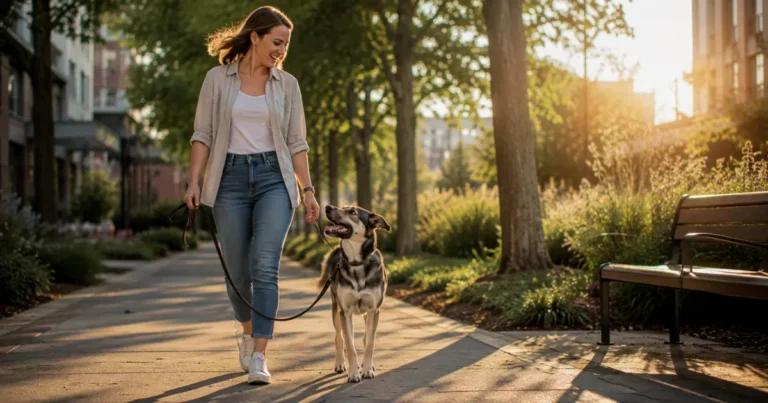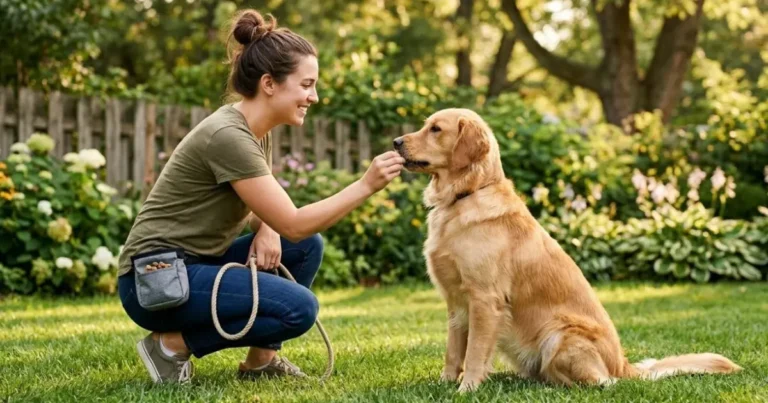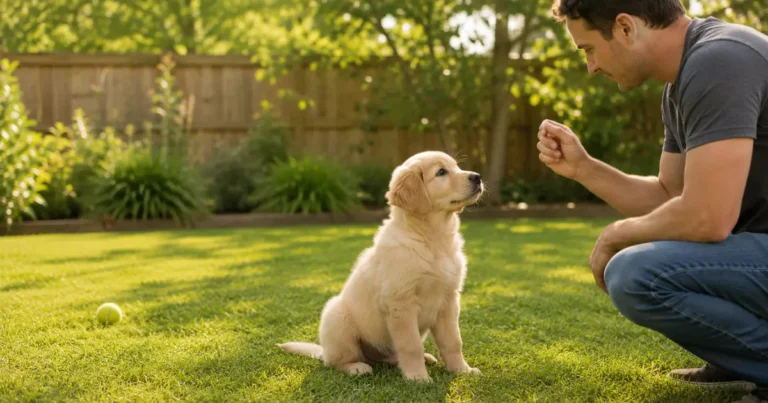
My dog had a beautiful stay. At home. In the kitchen.
Standing right in front of him.
The first time I tried it in the backyard with our neighbor walking past — he broke it before I had taken two steps back.
The second time I tried it at the park, he lasted about four seconds before a pigeon made a decision for both of us.
I had been practicing stay for three weeks and had absolutely nothing to show for it outside of my own house.
The problem wasn’t that my dog didn’t know stay. He did.
The problem was that I had never taught him to stay when the world was competing for his attention.
That is a completely different skill — and nobody had told me that.
Knowing how to train a dog to stay with distractions is what separates a stay that works at home from a stay that works everywhere.
This guide gives you the complete system — from building the foundation correctly to proofing it against every real-world distraction your dog will ever encounter.
A stay that holds anywhere is worth every minute of this process.
Start with 3-second stays in a quiet room, build to 60 seconds before adding any distance, and only introduce distractions after duration and distance are both solid.
Most dogs achieve reliable stay with mild distractions within 3 to 4 weeks of consistent daily practice.
Why Stay With Distractions Is Harder Than It Looks
Most owners teach stay and feel good about it.
Their dog sits, they step back three feet, five seconds pass, they return and reward.
Done — stay trained.
Then they try it at the park, and the whole thing falls apart.
This is not a training failure.
It is a completely predictable result of how stay is typically taught — and understanding why changes everything about how you approach how to train a dog to stay with distractions.
Stay is not a single behavior — it is three separate skills combined: duration, distance, and distraction resistance.
Most dogs that fail in public have only been taught duration and distance at home.
The Three Pillars of a Reliable Stay
⏱️ Duration (Build First)
What It Means: Your dog remains in position for a specific length of time.
Common Mistake: Adding distance before your dog can reliably hold the stay.
Build Order: First
🚶 Distance (Build Second)
What It Means: Your dog holds the stay while you move farther away.
Common Mistake: Moving too far too quickly and causing the dog to break position.
Build Order: Second
🎯 Distraction (Build Last)
What It Means: Your dog maintains the stay despite competing sights, sounds, or movement.
Common Mistake: Introducing distractions before duration and distance are fully reliable.
Build Order: Third — Always Last
The three Ds — Duration, Distance, Distraction — must be built in this exact order.
This is not optional.
This is why how to train a dog to stay with distractions requires its own dedicated training phase after basic stay is established.
Why Your Dog Breaks the Stay
Understanding the specific reason for a broken stay tells you exactly where to go back in the training.
⚠️ Breaks When You Move Away
What It Means: Distance was added too quickly before the stay was fully reliable.
What to Do: Return to a shorter distance and rebuild gradually.
⚠️ Breaks When a Distraction Appears
What It Means: The distraction level exceeded your dog’s current training threshold.
What to Do: Reduce the intensity of the distraction and practice at an easier level.
⚠️ Breaks After a Few Seconds
What It Means: Duration is not yet strong enough.
What to Do: Rebuild duration starting from 5-second stays.
⚠️ Breaks When You Return to Reward
What It Means: Your dog is anticipating the reward and leaving position early.
What to Do: Vary your return timing and reward while the dog remains in position.
⚠️ Breaks in a New Location
What It Means: The behavior has not been generalized to new environments yet.
What to Do: Start again at an easier level and rebuild success in the new location.
The Release Word — Most Owners Miss This
Here is something that significantly impacts stay reliability and most guides skip entirely.
Your dog should only leave the stay when you release them — not when they decide they have waited long enough.
A release word gives your dog a clear signal that the stay is finished.
Choose one word and use it every single time:
- “Okay” — most common, easy to remember
- “Free” — clear and distinct
- “Break” — used by many professional trainers
Never release by calling your dog from the stay position — this teaches them that “come” breaks a stay, which causes problems later when stay and recall are used together.
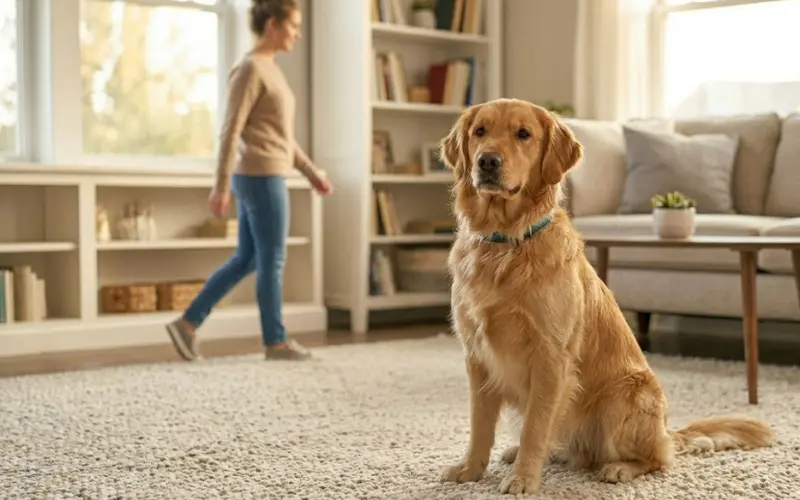
Building the Foundation — Duration and Distance First
Before how to train a dog to stay with distractions becomes possible, your dog needs a genuinely solid stay at home with no distractions.
If the foundation is shaky, adding distractions will collapse it completely.
Here is how to build duration and distance correctly before you ever go near anything exciting.
Stage 1 — Building Duration to 60 Seconds
Start here — not at distance, not outside.
How to build duration:
- Ask your dog to sit
- Say “stay” in a calm, clear voice
- Count silently — start at just 3 seconds
- Return to your dog before they break
- Reward while they are still in the stay position
- Say your release word — “okay”
- Reset and repeat
Duration building progression:
Session 1
Target Duration: 3 to 5 seconds
Success Criteria: Dog holds the stay without breaking position.
Session 2 to 3
Target Duration: 10 seconds
Success Criteria: Consistent success across 5 repetitions.
Session 4 to 5
Target Duration: 20 seconds
Success Criteria: No breaking at 20 seconds reliably.
Session 6 to 7
Target Duration: 30 seconds
Success Criteria: Stay remains solid and calm.
Session 8 to 10
Target Duration: 60 seconds
Success Criteria: Reliable performance — ready to begin adding distance.
Never increase duration more than 50% per session.
Jumping from 10 seconds to 60 seconds in one day will produce a broken stay and a confused dog.
Stage 2 — Adding Distance
The rule here is simple: always return to the dog to reward.
Never call them out of the stay.
Why this matters:
- Calling from stay teaches the dog that “come” breaks position — causing problems with both stay and recall
- Returning to reward keeps the dog expecting you to come back rather than deciding to come to you
Distance building guide:
Step 1
Distance: 1 foot back
What to Do: Return immediately and reward.
Step 2
Distance: 3 feet back
What to Do: Return after 5 seconds and reward.
Step 3
Distance: 5 feet
What to Do: Return after 10 seconds and reward.
Step 4
Distance: 10 feet
What to Do: Return after 15 seconds and reward.
Step 5
Distance: Across the room
What to Do: Return after 20 seconds and reward.
Step 6
Distance: Briefly out of sight
What to Do: Return after 5 seconds and reward.
Only progress to the next distance when your dog is completely reliable at the current one across multiple sessions and multiple days.
Many dogs don’t break the stay in one obvious movement — they slowly inch forward, millimeter by millimeter, while technically holding the position.
Reset them to the original spot every single time you notice creeping.
A dog that creeps has learned that gradual movement is acceptable. Resetting trains precision — stay means stay in this exact spot, not approximately near this spot.
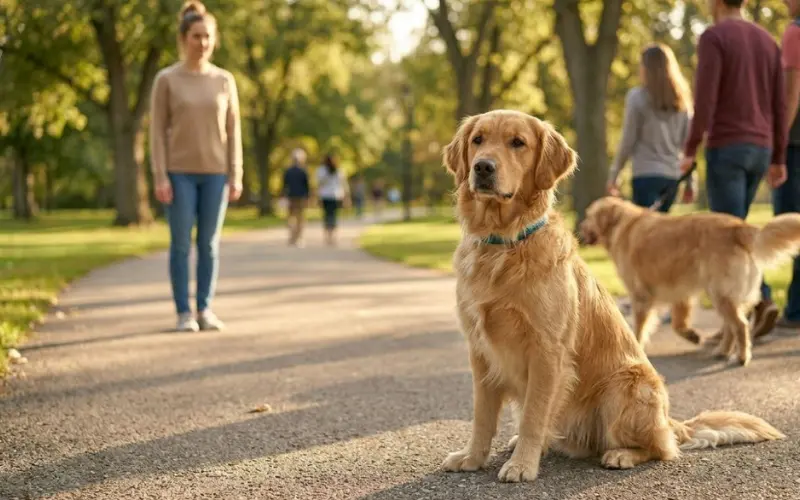
How to Train a Dog to Stay With Distractions — Step by Step
This is the stage most guides skip entirely.
Your dog holds a 60-second stay at 10 feet in the kitchen.
Now you need to teach that same stay to hold when the world is trying to pull their attention away.
The method is systematic distraction introduction — starting with the least challenging distractions and building toward the most challenging over weeks.
Distraction Difficulty Levels
Understanding which distractions are easy and which are hard lets you build a logical progression.
Level 1 — Easy
Distraction Type: Stationary Objects
Examples: Toy on the floor, bag near the crate
Training Stage: Week 1 of distraction training
Level 2 — Low
Distraction Type: Mild Movement
Examples: Owner moving arms, bouncing a ball
Training Stage: Week 1 to 2
Level 3 — Medium
Distraction Type: Environmental Sounds
Examples: TV playing, doorbell recordings
Training Stage: Week 2
Level 4 — Moderate
Distraction Type: Other People Present
Examples: Family member walking past
Training Stage: Week 2 to 3
Level 5 — Hard
Distraction Type: Other Dogs Nearby
Examples: Calm dog at a distance
Training Stage: Week 3 to 4
Level 6 — Very Hard
Distraction Type: High-Excitement Environment
Examples: Park, pet store, busy street
Training Stage: Month 2+
Always start at Level 1 — even if your dog seems unimpressed.
Building on easy wins creates the confidence for harder levels.
The Distraction Introduction Method
For every new distraction, use this 3-step process:
Step 1 — Introduce at reduced difficulty
Make the distraction less intense than its maximum.
A running child is Level 6. A child standing still 30 feet away is Level 3.
Start at the reduced version.
Step 2 — Ask for a short easy stay
Go back to a shorter duration and shorter distance than your current best.
If you have a solid 60-second stay at 10 feet with no distractions — ask for a 10-second stay at 3 feet with the new distraction present.
Make success easy.
Step 3 — Build up from there
Gradually increase duration, then distance, then distraction intensity — one variable at a time.
Environment Progression for Distraction Training
The Emergency Stay — Worth Training Separately
Once your dog has a reliable distraction-proof stay, consider training an emergency stay — a single, sharp “STAY” command that your dog responds to instantly without thinking.
This is different from the normal stay — it is reserved for genuine safety situations:
- Dog heading toward a road
- Dog approaching an aggressive animal
- Dog about to dart through an open gate
Train it by using a dramatically different tone — louder and more urgent — paired with the biggest possible reward when the dog holds.
Practice it rarely so the urgency of the tone maintains its meaning.
Instead, pair a hand signal with your normal stay command and practice that regularly.
Reserve the sharp, urgent tone for real situations and the occasional deliberate practice session.
The rarity is what keeps it effective.
Common Stay Training Mistakes That Reset Your Progress
Mistake Quick Reference Table
❌ Adding Distance Before Duration Is Solid
Why It Hurts: The dog breaks the stay every time you move away.
Fix: Build a reliable 60-second stay before adding any distance.
❌ Adding All Three Ds at Once
Why It Hurts: Duration, distance, and distraction together overwhelm the dog.
Fix: Change only one variable at a time.
❌ Calling Your Dog Out of the Stay
Why It Hurts: The dog learns that moving toward you ends the stay.
Fix: Return to your dog and reward in position.
❌ Rewarding After the Dog Breaks
Why It Hurts: Breaking position becomes part of the reward process.
Fix: Reward only while your dog is still holding the stay.
❌ Increasing Difficulty Too Fast
Why It Hurts: Creates repeated failures and frustration.
Fix: Build gradually and avoid jumps larger than about 50%.
❌ Inconsistent Release Word
Why It Hurts: The dog starts guessing when the stay is finished.
Fix: Use the same release word every single session.
❌ Skipping Distraction Training
Why It Hurts: A stay that works at home often fails in the real world.
Fix: Include systematic distraction training as part of the process.
The Most Common Miss — Rewarding After the Break
This one creates a pattern most owners don’t notice for weeks.
Your dog holds the stay for 15 seconds.
On second 16 they stand up.
You reach into your pocket and give them a treat anyway because they tried.
You have just rewarded breaking the stay.
The dog’s brain records: standing up earned the treat.
Not the 15 seconds of holding position.
What to do instead:
- If the dog breaks before you release them — no reward
- Reset calmly, ask for stay again
- Make the duration shorter so they succeed
- Reward that successful shorter stay instead
Success at a shorter duration beats failure at a longer one every single time.
Expecting Too Much Too Soon in New Environments
Your dog’s stay at home is not the same behavior as their stay in a park.
Every new environment reduces their effective training level significantly.
Realistic performance expectations:
Going to a new place and expecting 100% is the single most common reason owners believe their dog “knows but doesn’t listen.” The dog always knows — they just need more practice in that specific context.
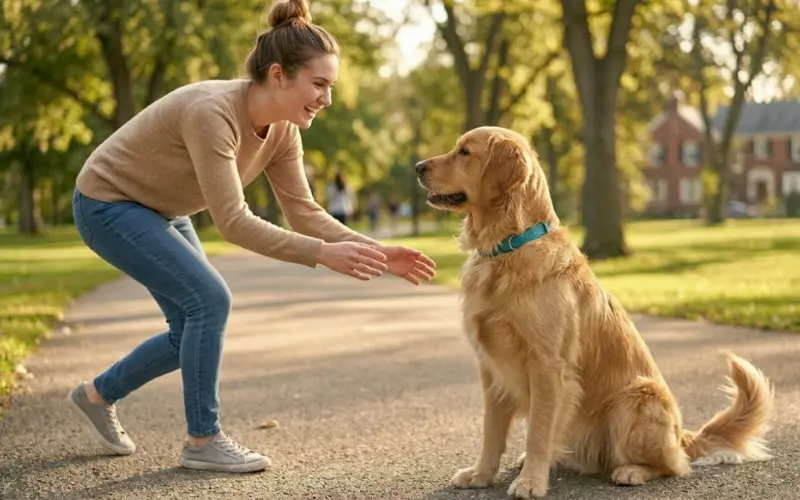
Stay Training Timeline — What to Realistically Expect
Knowing how to train a dog to stay with distractions takes time — and having a realistic timeline prevents the frustration that makes owners give up right before progress appears.
Week by Week Progress Guide
Week 1
Focus: Duration at home
Goal by End of Week: Solid 60-second stay at your feet.
Week 2
Focus: Distance at home
Goal by End of Week: Reliable stay at 10 feet for 30 seconds.
Week 3
Focus: Level 1 to 2 distractions
Goal by End of Week: Stay holds with toys and mild movement nearby.
Week 4
Focus: Level 3 to 4 distractions
Goal by End of Week: Stay holds with people walking past indoors.
Month 2
Focus: Outdoor environments
Goal by End of Week: Reliable stay on quiet streets.
Month 2 to 3
Focus: Park-level distractions
Goal by End of Week: Stay holds with people and dogs at a distance.
Month 3 to 4
Focus: Full real-world reliability
Goal by End of Week: Reliable stay in most everyday situations.
Signs Stay Training Is Working
Your dog has a genuinely reliable stay when:
- They hold position without creeping or shifting weight
- They maintain eye contact or calm attention during the stay
- They wait for your release word rather than self-releasing
- They rebuild quickly in new environments after 2 to 3 easy repetitions
- They hold the stay when distractions appear without looking panicked
Signs More Foundation Work Is Needed
Go back to basics if:
- Stay breaks every time you turn your back
- Dog breaks within 10 seconds regardless of environment
- Dog releases themselves consistently without your cue
- Dog shows anxiety or stress during stay practice
According to the American Kennel Club, a reliable stay command built on the three Ds — duration, distance, and distraction — in that specific order is one of the most valuable safety behaviors any dog can have and is the correct foundation for all advanced obedience training.
According to the ASPCA, rewarding the dog while still in the stay position is the most critical timing element in building a reliable stay.”
Reduce the difficulty significantly and rebuild more gradually.
Some dogs benefit from working with a certified professional trainer who can determine whether anxiety is affecting training performance and confidence.
The training methods in this guide are based on widely accepted positive reinforcement principles endorsed by the AKC and ASPCA.
Every dog is different — if your dog shows anxiety, fear, or extreme difficulty with stay training, please consult a certified professional trainer.
Frequently Asked Questions (FAQ)
How long does it take to train a reliable stay with distractions?
Building a solid stay at home takes most dogs 1 to 2 weeks of consistent daily practice.
Adding reliable distraction resistance takes an additional 4 to 8 weeks of systematic work.
Full real-world reliability in high-distraction environments like parks typically takes 3 to 4 months of regular practice in progressively challenging situations.
The dogs that build the most reliable stay are those whose owners never skip the distraction training phase — it is not optional, it is the whole point.
At what distance should I practice stay with distractions?
When introducing a new distraction, go back to a shorter distance than your current best — even if your dog holds stay at 20 feet at home, start at 5 feet when adding a new distraction.
Make success easy at first.
As your dog handles the distraction reliably at 5 feet, build the distance back up to 10 feet, then 20 feet.
Adding distance and a new distraction at the same time is too many variables at once and almost always produces failure.
My dog holds stay perfectly at home but breaks in public — why?
Because a home stay and a public stay are essentially different behaviors from your dog’s perspective.
Each new environment reduces effective training performance significantly.
A dog that holds stay perfectly at home typically performs at 20 to 40% of that level on their first visit to a busy environment.
This is not disobedience — it is a generalization gap that requires specific practice in each new location.
Take your training to the new place, rebuild at an easier level, and build back up.
Within 3 to 5 sessions in a new location, most dogs begin performing close to their home level.
How do I stop my dog from breaking stay when I return to reward them?
This is called anticipation breaking — your dog has learned that you walking back toward them means the stay is about to end, so they start moving toward you.
Fix it by varying your return pattern — sometimes return and reward, then ask for another stay.
Sometimes walk back toward your dog and then turn around and walk away again.
Make your return unpredictable so your dog learns that you approaching does not always mean the stay is finished.
Can I train stay without treats?
You can, but it takes significantly longer and the initial motivation for holding position is much lower.
Treats are the most efficient communication tool for the learning phase.
Once stay is reliably built with treats, you can gradually shift to intermittent rewards — treating randomly rather than every repetition.
Intermittent rewards strengthen behavior over time because their unpredictability keeps dogs engaged.
After a few months of solid stay training, most dogs will hold position for praise and the satisfaction of a job well done — but treats during the learning phase make the process dramatically faster.
What do I do when my dog breaks the stay?
When your dog breaks the stay before you release them — do not reward, do not scold.
Calmly and quietly take them back to the original spot, ask for stay again, and make the next repetition easier — shorter duration, shorter distance, less distraction.
Reward the easier successful stay generously.
Breaking means the last repetition was too hard — your job is to find the level where success happens and reward it.
Success at an easier level is always better than repeated failure at a hard one.
How many times a day should I practice stay?
Two to three short sessions per day of 5 to 10 minutes each produces significantly better results than one long session.
Each short session ends before your dog loses focus, which means every session ends on success.
Dogs retain learning better from multiple short sessions than from one long one.
For distraction training specifically, one real-world session per day of 5 to 8 minutes in a gradually challenging environment is enough — quality of practice matters more than volume.
Is the hand signal for stay important?
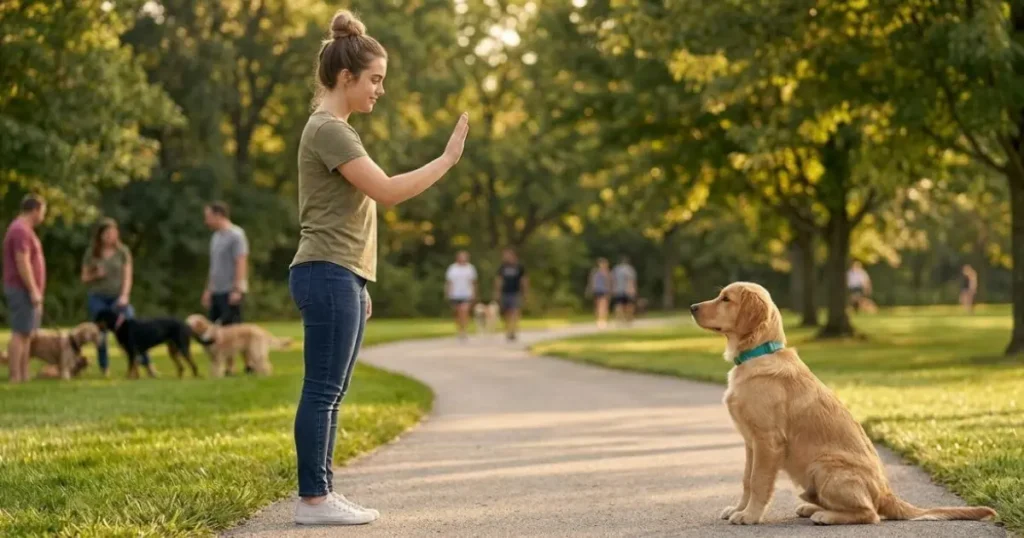
Yes — a hand signal paired with the verbal stay cue is worth training from the very beginning.
Hold your flat palm toward your dog — like a stop signal — every time you say “stay.”
Over time the hand signal becomes as meaningful as the word, which is enormously useful in loud environments where your dog cannot hear you clearly.
At a distance in a busy park, a clear hand signal communicates stay when your voice might not.
The Stay That Goes Everywhere — Final Thoughts
The first time my dog held his stay for a full minute in the park — kids running past, another dog going by on a leash, pigeons doing whatever pigeons do — I stood there for a moment before releasing him and just appreciated it.
Six weeks earlier he had broken the same stay when a leaf blew past him in the backyard.
That gap was not luck.
It was systematic distraction training — the phase most people skip because they think “they’ve already trained stay.”
They hadn’t.
Neither had I, until I learned that knowing how to train a dog to stay with distractions is a completely different project from training basic stay.
Here are your three key takeaways:
- Duration, then distance, then distraction — always in this order, never skipped. Adding all three at once produces failure, not training.
- Every new environment is a new training level — rebuild at a lower level in every new location rather than expecting home performance. The dog that works in 20 locations has a reliable stay. The dog that only worked at home does not.
- Return to reward — always return to your dog to deliver the reward. Never call them out of the stay. This single habit protects both stay and recall simultaneously.
For the complete positive reinforcement foundation that everything in this guide builds on — read our complete positive reinforcement dog training for beginners guide.
And if your dog has already learned sit but needs to hold it longer before advancing — read our guide on how to teach a dog to sit step by step for the full foundation method.