

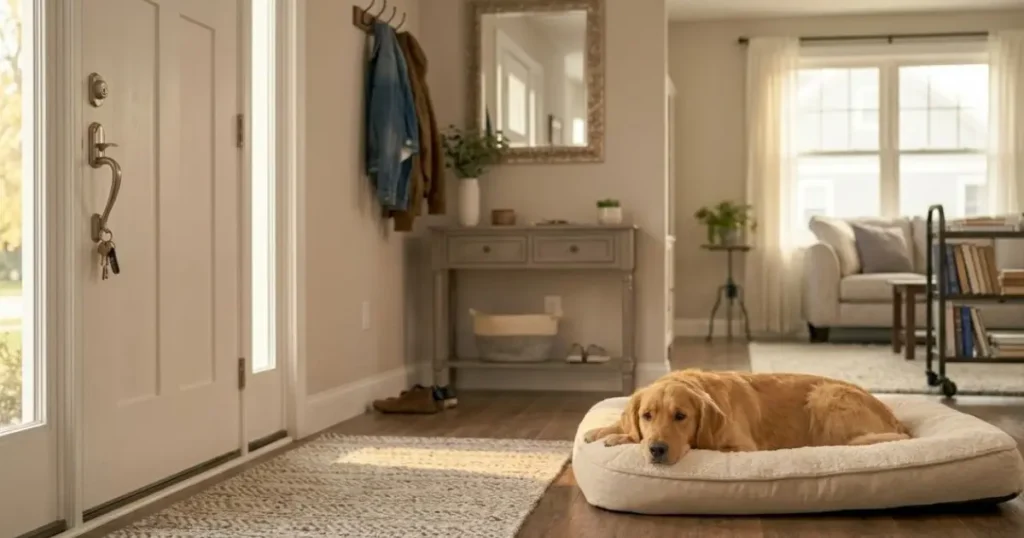
My neighbor called me at work on day three.
She said she could hear my dog crying through the wall.
Not occasional whining.
Continuous crying — from the moment I left until the moment I came home.
Three hours.
Every single day.
I felt awful. I rushed home, convinced something was physically wrong.
He was fine.
But the moment I walked in the door, he shook for ten minutes straight — that full-body trembling that dogs do when they have been genuinely terrified for hours.
That was the day I understood what how to stop dog separation anxiety when left alone actually means.
It is not about a dog that misses you. It is about a dog that genuinely panics — whose nervous system goes into crisis — every single time you walk out the door.
This guide covers everything.
The difference between mild separation anxiety and severe cases, the exact step-by-step method that rebuilds your dog’s confidence being alone, and the common mistakes that make anxiety significantly worse.
It takes patience and consistency — but it works.
Your dog can learn to be okay alone.
Let’s get there.
Never leave your dog alone for longer than they can handle calmly at their current training stage.
Most dogs with mild to moderate separation anxiety show clear improvement within 4 to 8 weeks of consistent daily practice.
What Is Dog Separation Anxiety — and Is That What Your Dog Has
Not every dog that cries when left alone has true separation anxiety.
Understanding the difference matters because the training approach for each is quite different.
True separation anxiety is a panic response — not attention-seeking behavior. A dog with genuine separation anxiety experiences real physiological distress when left alone, not just mild unhappiness.
For puppy-specific nighttime crying that can be confused with early separation anxiety, read our guide on why does my puppy cry at night. And if you’re still working out a realistic alone-time schedule by age, our age-based alone-time chart is a useful starting point.
True Separation Anxiety vs Normal Distress
Signs Your Dog Has Separation Anxiety
These are the behaviors that indicate genuine anxiety rather than simple boredom or attention-seeking:
- Intense distress begins immediately when you prepare to leave — not after you are gone
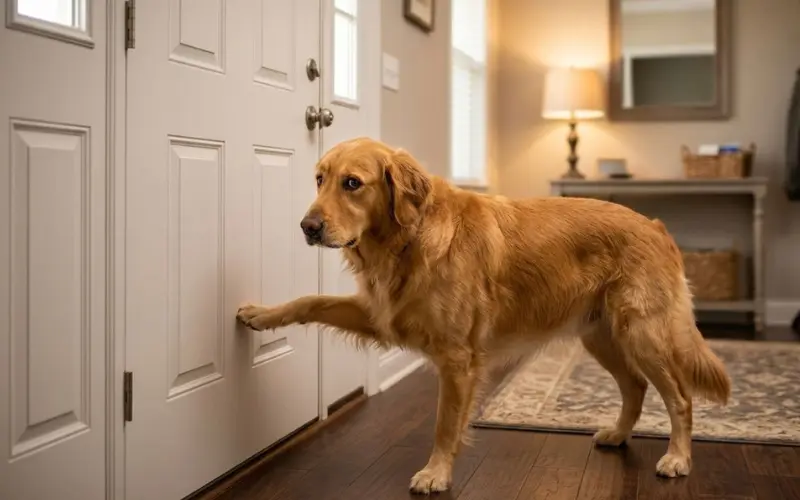
- Destructive behavior focused on exit points — doors, windows, door frames
- Howling, barking, or whining that continues for the entire absence with no settling period
- House-soiling that only happens when left alone — despite being fully house-trained
- Excessive salivation, panting, or trembling at departure cues — seeing the leash, picking up keys
- Full-body trembling or clinging when you return
Signs It Is Boredom or Mild Distress — Not Anxiety
- Dog settles within 15 to 20 minutes of your departure
- Destructive behavior is scattered rather than exit-focused
- Dog eats, drinks, and sleeps normally when alone
- Behavior is the same whether you are gone 30 minutes or 3 hours
The distinction matters.
Boredom responds to enrichment — longer walks, puzzle feeders, more stimulation.
True separation anxiety requires the systematic desensitization approach described in this guide.
According to the ASPCA, separation anxiety is one of the most common behavioral issues in dogs and the leading reason dogs are surrendered to shelters in the United States — making early intervention critically important.
Why Separation Anxiety Happens — Understanding the Root
You cannot fix something you do not understand.
Knowing why dog separation anxiety when left alone develops in the first place helps you avoid making the common mistakes that accidentally reinforce it.
The Most Common Causes
- Under-socialization to being alone during puppyhood — puppies that were never taught to be comfortable alone during the critical period develop the strongest anxiety as adults
- A significant change in routine — moving house, a new job, a family member leaving
- Rehoming or adoption — rescue dogs frequently develop separation anxiety after being abandoned once already
- Post-pandemic adjustment — dogs that bonded intensely to always-home owners during lockdown years
- Over-attachment — dogs that are never separated from their owner, even briefly, throughout the day
What Makes It Worse Over Time
Separation anxiety worsens over time when dogs are repeatedly exposed to the full panic experience — every unmanaged absence reinforces that being alone means something terrible is happening.
Every time your dog experiences full-blown panic while alone, the anxiety gets stronger — not weaker.
The brain learns: being alone equals danger.
More repetitions of panic equals deeper fear response.
This is why management — never leaving your dog alone for longer than they can currently handle calmly — is not optional during treatment.
It is the foundation.
How to Stop Dog Separation Anxiety When Left Alone — Step by Step
This method is called systematic desensitization.
It means exposing your dog to being alone in very small, completely manageable doses — doses so small that anxiety never gets triggered — and building very gradually from there.
The key principle: your dog must never panic during treatment.
Every session that goes over threshold sets the training back.
Stage 1 — Micro-Departures — The Most Important Stage
This stage feels ridiculous. I know.
Five seconds? Ten seconds?
You are not going anywhere.
But this stage is the entire foundation of how to stop dog separation anxiety when left alone.
You are teaching your dog’s nervous system that you leaving through that door does not mean something terrible is about to happen.
How to do Stage 1:
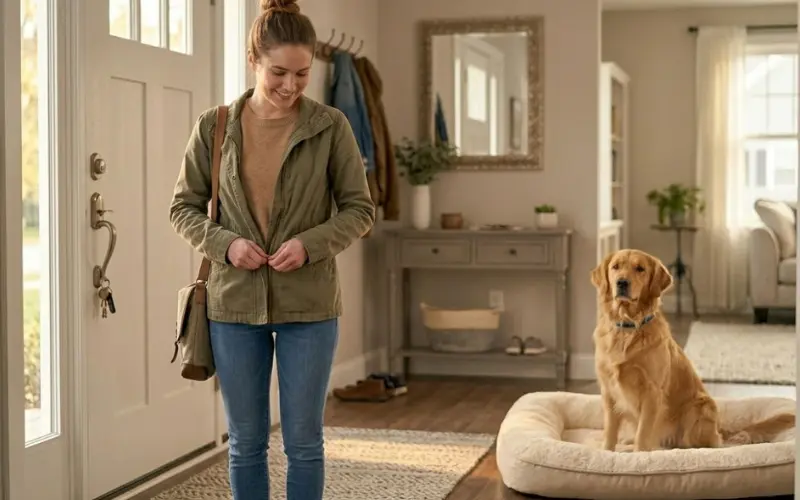
- Pick up your keys, put on your shoes, act normally
- Walk to the front door, open it, step outside
- Close the door behind you
- Count to 5 — literally five seconds
- Come back inside
- Greet your dog calmly — no big emotional reunion
- Repeat 5 to 10 times in one session
Your dog may still whine for those 5 seconds at first.
That is okay.
What you are watching for is whether they settle faster in repetition 5 than they did in repetition 1.
That improvement — even small — is the training working.
Stage 2 — Building Duration
The progression that works:
Week 1
Target Departure Length: 5 to 30 seconds
Sessions Per Day: 3 to 5 sessions
Move Forward When: Your dog remains calm at 30 seconds consistently.
Week 1 to 2
Target Departure Length: 1 to 5 minutes
Sessions Per Day: 2 to 3 sessions
Move Forward When: Your dog settles within 60 seconds of departure.
Week 2 to 3
Target Departure Length: 5 to 15 minutes
Sessions Per Day: 2 sessions
Move Forward When: Your dog remains calm for the entire duration.
Week 3 to 4
Target Departure Length: 15 to 30 minutes
Sessions Per Day: 1 to 2 sessions
Move Forward When: Your dog stays calm across 3 consecutive sessions.
Month 2
Target Departure Length: 30 to 90 minutes
Sessions Per Day: Daily practice
Move Forward When: Your dog is consistently building toward normal work-hour absences.
Never jump steps. A dog that panics at 10 minutes is not ready for 30 minutes. Go back one step and rebuild.
Stage 3 — Desensitize Departure Cues
Many dogs begin panicking before their owner even leaves — at the sound of keys, at shoes being put on, at a bag being picked up.
These cues have become triggers in their own right.
Desensitize them separately:
- Pick up your keys → give a treat → put keys down → carry on normally. Repeat 10 times.
- Put on your shoes → give a treat → take shoes off → sit back down. Repeat 10 times.
- Put on your jacket → give a treat → take it off. Repeat 10 times.
Over several days of this practice, the keys and shoes stop predicting your absence and start predicting treats instead.
Stage 4 — Building Independence at Home
A dog that cannot be in a separate room from you during the day will struggle enormously with true alone time.
Independence training during the day is a critical parallel process.
How to build it:
- Ask your dog to go on their mat or in their crate
- Close the door between you — even just the bathroom door while you shower
- Start with 2 minutes, build to 10, then 20, then 30
- No dramatic departure or return — matter-of-fact and calm both ways
This parallel work significantly accelerates the main departure training because it teaches that separation from you, in general, is completely normal.
Stage 5 — Managing Real-Life Absences
While training is in progress, your dog should never be left alone for longer than they can handle without panicking.
Every panic episode resets the training.
Management options during treatment:
- Dog walker for midday visits during work hours
- Doggy daycare 2 to 3 days per week
- Trusted neighbor or friend for short check-ins
- Work from home where possible during early stages
- Pet camera to monitor — Furbo and similar allow two-way communication
This is not permanent.
It is temporary scaffolding while the real training builds the foundation.
Watching what actually happens while you’re away gives you accurate information about your dog’s true threshold — the point where calm behavior starts turning into anxiety or panic.
Most owners either underestimate or overestimate this threshold without video evidence.
A Furbo or similar pet camera can provide valuable insights that make your training sessions far more effective and data-driven.
Tools That Help During Separation Anxiety Treatment
These tools do not replace the training — nothing does.
But they can reduce anxiety enough to make the training sessions more productive, especially in the early weeks.
The Kong — Most Effective Single Tool
A frozen Kong stuffed with your dog’s favorite food and frozen overnight is one of the most powerful separation anxiety management tools available.
Why it works:
- The act of licking is naturally calming for dogs — it activates the parasympathetic nervous system
- The Kong only comes out when you leave — making your departure predict the best thing of the day
- A dog focused on a Kong is a dog not watching the door
How to use it:
- Stuff the Kong with peanut butter, wet food, or kibble soaked in broth
- Freeze overnight
- Give only at departure — never at other times
- Remove when you return to maintain the departure association
According to the American Kennel Club, food-dispensing toys like the Kong significantly reduce anxiety-related behaviors during owner absences when used consistently as a departure-only reward.
Common Mistakes That Make Separation Anxiety Worse
Mistake Reference Table
❌ Dramatic Departures and Returns
Why It Makes Things Worse: It increases the emotional significance of coming and going.
What to Do Instead: Keep exits and entries calm, predictable, and low-energy.
❌ Leaving Too Long Too Soon
Why It Makes Things Worse: Every panic episode reinforces the anxiety.
What to Do Instead: Never exceed your dog’s current training level. Use management strategies when needed.
❌ Getting Another Dog to Fix Anxiety
Why It Makes Things Worse: Separation anxiety is usually about the owner’s absence, not simply being alone.
What to Do Instead: Address the anxiety directly. A second dog should be a separate decision.
❌ Punishing Anxiety Behaviors
Why It Makes Things Worse: It adds fear of punishment to an already fearful situation.
What to Do Instead: Remember that destruction and accidents are symptoms of distress, not defiance.
❌ Skipping Management During Training
Why It Makes Things Worse: Panic episodes can undo weeks of careful progress.
What to Do Instead: Use a dog walker, daycare, or trusted caregiver for absences beyond your dog’s current ability.
❌ Inconsistent Training Schedule
Why It Makes Things Worse: Long gaps between sessions slow progress and reduce consistency.
What to Do Instead: Practice daily. Even five minutes of training can make a meaningful difference.
The Big Mistake — Dramatic Hellos and Goodbyes
This one is genuinely hard to stop doing.
You feel terrible leaving a distressed dog.
You come home to a dog that is visibly relieved to see you.
The instinct is to make a big emotional moment of both events.
Long goodbye with lots of reassurance.
Enormous excited greeting when you return.
This actually makes anxiety worse — not better.
Every big emotional goodbye communicates: this is a significant event that requires a significant response.
Every enormous return greeting confirms: your absence was a crisis and this reunion is the resolution.
The fix is counterintuitive but essential:
- Departure: quiet, calm, no eye contact, no lengthy goodbye. Just leave.
- Return: equally calm. No big greeting until the dog has settled for at least 5 minutes. Then calm affection.
Within 2 to 3 weeks of this consistency, most dogs begin to show visibly less distress at departure — because departure has stopped being an emotionally charged event.
When to Get Professional Help
Separation anxiety exists on a spectrum.
This guide covers mild to moderate cases.
Some dogs need more.
Signs You Need a Professional Trainer Now
Seek a certified professional trainer immediately if:
- Your dog injures themselves trying to escape — broken nails, bloody paws, injured mouth from chewing
- Anxiety has not improved after 8 weeks of consistent training
- Your dog cannot be left alone for even 30 seconds without full panic
- Barking or destruction is affecting neighbors or your housing situation
Signs You Also Need Your Veterinarian
Some dogs benefit significantly from anti-anxiety medication alongside behavioral training.
Consult your veterinarian if:
- Your dog’s anxiety is so severe they cannot engage with training at all
- Physical symptoms of extreme stress — vomiting, diarrhea, significant weight loss
- Nothing reduces the panic response, even at very short durations
According to the American Veterinary Medical Association, the combination of behavioral modification and appropriate medication produces significantly better outcomes for severe separation anxiety than behavioral training alone.
These medications are not sedatives. Their purpose is to lower the dog’s baseline anxiety level so that behavioral training becomes more effective.
Medication alone rarely resolves separation anxiety, and training alone can be significantly more difficult in severe cases.
For many dogs with severe separation anxiety, the combination of medication and structured behavior modification is considered the most effective approach.
Many medications that are safe for humans can be toxic to dogs, even at relatively small doses.
Always consult your veterinarian before giving any supplement, medication, calming treat, or anxiety product to a dog with separation anxiety.
Proper diagnosis and treatment planning are essential, especially in moderate to severe cases.
The methods described in this guide are based on widely accepted positive reinforcement and desensitization principles endorsed by organizations such as the ASPCA and AVMA.
Separation anxiety varies significantly from one dog to another, and results can differ based on the dog’s temperament, history, and anxiety severity.
If your dog shows moderate to severe separation anxiety, self-injury, escape attempts, or persistent distress when left alone, consult a certified professional trainer or your veterinarian before attempting treatment independently.
Frequently Asked Questions (FAQ)
How long does it take to fix separation anxiety in dogs?
Mild separation anxiety typically responds well within 4 to 8 weeks of consistent daily desensitization training.u003cbru003eModerate cases usually take 3 to 4 months of daily work.u003cbru003eSevere cases — those involving self-injury or complete inability to settle — can take 6 to 12 months and usually require professional guidance and potentially veterinary support.u003cbru003eThe speed depends entirely on how consistently the training is applied and how carefully absences are managed to prevent panic episodes during treatment.
Does getting a second dog help with separation anxiety?
Sometimes — but less often than most people hope.u003cbru003eTrue separation anxiety is usually attachment to a specific person, not simply a fear of being alone.u003cbru003eA second dog can reduce boredom and provide some comfort for mild cases, but it rarely resolves genuine separation anxiety on its own.u003cbru003eGet a second dog if you genuinely want one — not as a separation anxiety fix.u003cbru003eTreat the anxiety with the methods in this guide regardless.
Why does my dog destroy things only when I’m gone?
Destruction during your absence is almost always a symptom of anxiety — not boredom, not revenge, not spite.u003cbru003eYour dog is not punishing you for leaving.u003cbru003eThey are in a state of genuine distress and the physical activity of chewing or scratching provides a temporary reduction in that distress.u003cbru003eThe destruction will stop when the anxiety is treated — management like crating or confinement to a safe room helps prevent damage during treatment.
Should I crate my dog with separation anxiety?
It depends entirely on the dog’s relationship with the crate.u003cbru003eA dog that loves their crate and finds it genuinely comforting may benefit from crating during absences — the enclosed space feels safer and reduces the territory they need to guard.u003cbru003eA dog that fears the crate will have their anxiety significantly worsened by confinement.u003cbru003eNever crate a dog with separation anxiety who has not been positively introduced to the crate.u003cbru003eRead our complete crate training guide for the correct introduction method.
My dog is fine at the kennel or doggy daycare but has anxiety at home — why?
This is actually common and tells you the anxiety is specifically about your absence rather than being alone in general.u003cbru003eAt the kennel there are people present, activity, and stimulation — no absence trigger.u003cbru003eThis is good news for treatment because it confirms the anxiety is attachment-based and will respond well to the desensitization approach in this guide.
Can I train away separation anxiety without professional help?
Yes — for mild to moderate cases.u003cbru003eThe systematic desensitization method in this guide is the same approach certified trainers use and has a strong evidence base.u003cbru003eThe key requirements are consistency, patience, and managing absences carefully during treatment.u003cbru003eSevere cases — those involving self-injury, non-stop howling for hours, or complete inability to settle — benefit significantly from professional assessment and potentially veterinary support.
How do I know if my training is working?
Signs that treatment is progressing in the right direction include shorter settling time after departure, calmer body language at pre-departure cues like keys and shoes, more relaxed greetings when you return, and gradual reduction in anxiety behaviors during your absences as monitored by camera.u003cbru003eProgress is slow and sometimes feels invisible — which is why a pet camera and a simple log of daily departure duration and behavior are enormously useful for tracking real improvement.
Is separation anxiety my fault?
No — and I want to say this directly because many owners carry genuine guilt about their dog’s anxiety.u003cbru003eSeparation anxiety develops from a combination of temperament, early experience, and life changes — most of which are not within an owner’s control.u003cbru003eRescue dogs frequently come with anxiety already established.u003cbru003ePandemic dogs developed it through no fault of their owners.u003cbru003eYour job now is not to feel guilty — it is to follow the treatment consistently and give your dog the time they need to heal.
Your Dog Can Learn to Be Okay — Final Thoughts
I think about my neighbor’s phone call sometimes.
The three hours of crying.
The ten minutes of trembling when I got home.
That same dog now settles on his bed when I leave, sleeps for most of my absence based on what the camera shows, and greets me calmly when I return — tail wagging, but not the desperate, relieved trembling that used to break my heart.
It took eleven weeks.
It required a dog walker three days a week during treatment.
It required me to do five-second departures in my own hallway for days before I could see any difference.
It was completely worth it.
Now that you know exactly how to stop dog separation anxiety when left alone — here are your three key takeaways:
- Never exceed your dog’s current threshold — every panic episode sets the training back. Management during treatment is not optional, it is the foundation.
- Micro-departures first — five seconds feels meaningless but it is everything. You are rebuilding your dog’s emotional response to you leaving from the ground up.
- Calm departures and returns — the emotional significance you give to coming and going directly shapes how much emotional significance your dog gives it. Match the energy you want your dog to have.
For the complete positive training foundation that everything in this guide builds on — read our complete positive reinforcement dog training for beginners guide.
And if crate training is part of your separation anxiety management plan — read our complete guide on how to crate train a dog that hates the crate for the full positive introduction method.

Pingback: Best Dog Bed for Aggressive Chewers 2026 - PawWellCare
Pingback: How Long Can You Leave a Puppy Alone? Age Chart (2026)