


It was 2 am on my first night with my puppy.
I was sitting on the kitchen floor in my pajamas, back against the wall, listening to the most heartbreaking sound I’d ever heard.
That tiny little cry coming from the crate felt like an accusation. Like he was asking me, “Why did you bring me here? Why did you leave me alone?”
If you’re reading this right now, there’s a good chance you’re in that same place. Maybe it’s late. Maybe you haven’t slept. Maybe you’re wondering if you made a mistake or if something is seriously wrong.
You didn’t make a mistake. Nothing is seriously wrong.
Here’s what I wish someone had told me that night: why does my puppy cry at night is one of the most searched questions by new dog owners — because almost every single one of us goes through exactly this.
The crying is normal. And more importantly, it stops.
But there are things you can do right now to help your puppy settle faster — and that’s exactly what this guide covers.
Let’s get you both some sleep.
The fastest fix is placing the crate next to your bed so your puppy can smell and hear you.
Most puppies show major improvement by night 3 to 5 and stop significant nighttime crying within 2 to 4 weeks of consistent crate training.
Why Does My Puppy Cry at Night — The Real Reasons
Before you can fix the crying, you need to understand what’s actually causing it.
And here’s the thing — it’s rarely one single reason.
Most puppies cry at night for a combination of these, especially in that first week home.
Puppies cry at night primarily because they have never slept alone — from birth they have always slept in a warm pile with their littermates.
🐶 They Just Lost Everything Familiar
Think about what your puppy’s life looked like 48 hours ago.
They were surrounded by their mom and littermates:
- Sleeping in a warm pile
- Hearing familiar heartbeats
- Smelling scents they’d known since birth
And then — overnight — all of that was gone.
Your home, however warm and loving it is, smells completely foreign to them.
The sounds are different.
The temperature feels different.
The silence where their siblings used to be feels enormous.
That crying isn’t bad behavior.
It’s grief.
It’s a tiny creature telling you they’re scared, confused, and alone.
Puppies cry at night primarily because they have never slept alone before — from birth they always slept in a warm pile with their littermates and the sudden isolation of a crate in an unfamiliar home triggers a stress response that the only tool they have — crying — is designed to resolve.
Understanding that changes everything about how you respond.
🐾 They’re Not Used to Being Alone
Before coming home with you, your puppy has never — not once in their short life — slept alone.
They’ve always had warm bodies pressed against them.
The concept of sleeping solo in a quiet room is genuinely foreign to them.
This is the single biggest reason why my puppy cries at night is such a universal experience for new owners.
It’s not that your puppy is difficult or needy.
It’s that they’re doing exactly what any social creature does when suddenly left completely alone for the first time.
🍽️ They’re Hungry or Need the Bathroom
Young puppies — especially under 12 weeks — have tiny bladders and fast metabolisms.
At 8 weeks old, most puppies can only hold their bladder for 2 to 3 hours overnight.
So some of that nighttime crying isn’t emotional at all — it’s physical.
They genuinely need to go outside.
Same with hunger.
A puppy that didn’t eat enough at their last meal before bed will wake up crying from an empty stomach.
Always make sure the last meal of the day is full and satisfying.
🏠 The Crate Feels Like Punishment
If your puppy hasn’t been introduced to crate training the right way, they’ll resist it with everything they have.
If the crate feels like punishment rather than a safe, cozy den, they’ll resist it with everything they have.
And crying is the only tool they have.
This is one of the most fixable reasons, and I’ll cover exactly how to change their association with the crate in the next section.
They’re Overtired or Overstimulated
This one surprises most new owners.
An overtired puppy doesn’t just fall asleep — they get wired, anxious, and vocal.
If your puppy had an extremely exciting day full of new people, new smells, and new experiences, their little nervous system can stay activated well into the night.
Think of it like a toddler who missed their nap — more tired doesn’t mean easier to settle.
It usually means the opposite.

Is It Normal for Puppies to Cry at Night — How Long Does It Last?
Real talk — yes, it is completely normal.
And no, it doesn’t last forever.
But knowing that doesn’t make 2 am any easier.
So let me give you the honest timeline.
Most puppies stop significant nighttime crying within 2 to 4 weeks when owners remain consistent with crate placement and bedtime routine.
Understanding why does my puppy cry at night and what timeline to expect makes the hard nights genuinely more manageable.
The First 3 Nights — The Hardest Part
These are the toughest nights, and I won’t sugarcoat that.
Your puppy is at peak disorientation.
Everything is new, nothing is familiar, and their coping mechanisms are limited to one thing: calling out and hoping someone responds.
Most puppies cry the most on nights one and two.
Most puppies show significant improvement in nighttime crying by night 3 to 5 and stop crying almost entirely within 2 to 4 weeks when owners remain consistent with placing the crate beside the bed and maintaining a calm bedtime routine.
By night three, if you stay consistent, you’ll usually notice the crying starts to ease — maybe not disappear completely, but noticeably less intense and shorter in duration.
Week One — Getting Better Gradually
By the end of the first week, most puppies start to settle into the routine.
They start to recognize the smells of your home.
They start to trust that you’ll come back.
The crate starts to feel less like isolation and more like their space.
You’ll still have rough nights — especially if the routine gets disrupted — but the trend will clearly be improving.
For the complete first week schedule including nap times, feeding schedule, and night routine, read our puppy sleep schedule for the first week at home.
By 2 to 4 Weeks — Usually Resolved
The vast majority of puppies stop significant nighttime crying within 2 to 4 weeks when their owners stay consistent with the crate routine.
Some settle even faster — within 7 to 10 days.
If your puppy is still crying intensely at night past the 4-week mark with no improvement at all, that’s worth a conversation with your vet to rule out any underlying anxiety or health issue.
When you’re exhausted and it feels like nothing is improving — looking back at “night one: cried 6 times for 20 mins each” vs “night ten: cried once for 3 minutes” gives you genuine perspective and keeps you going.
Progress feels invisible when you’re in the middle of it.
What to Do When Your Puppy Cries at Night — Step by Step
Okay — this is the section you actually came for. Here is exactly what I did, what worked, and what I wish I’d known from night one.
Follow these 6 battle-tested steps to stop nighttime crying, create a comforting crate environment, and help your new puppy sleep peacefully through the night.
🏠 Step 1 — Set the Crate Up the Right Way Before Bedtime
Essential Den SetupThe crate environment matters more than most people realize. A cold, bare wire crate feels nothing like a safe den. A properly set up crate feels warm, enclosed, and secure.
Here’s the setup that works:
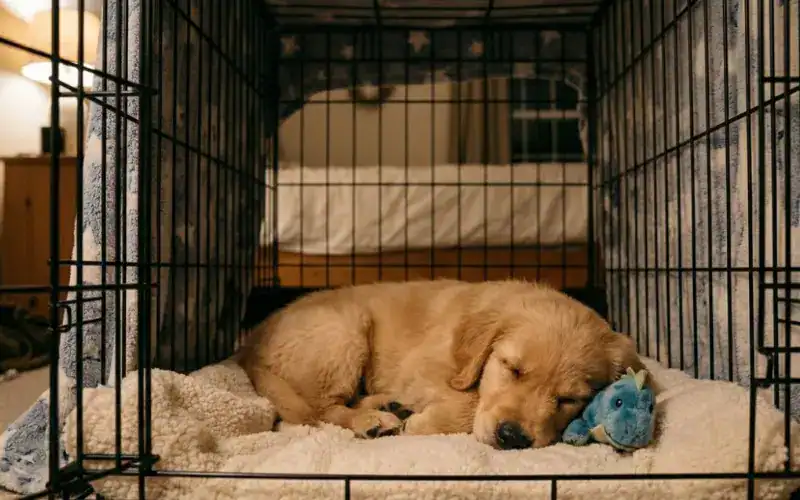
- Cover three sides: Use a blanket or crate cover — this creates that enclosed den feeling dogs naturally seek. Leave the front uncovered so air flows smoothly.
- Add soft bedding: Put a soft, washable pad or small blanket inside. Not expensive — just comfortable.
- Add your scent: Add a worn piece of your clothing — a t-shirt you’ve worn recently. Your scent is the most calming thing in your puppy’s world right now.
- Litter scent secret: If possible — and this is a game-changer — ask your breeder or shelter for a small piece of bedding that smells like the litter. That familiar scent can dramatically reduce first-night crying.
The crate itself matters too. A crate that is too large gives the puppy room to toilet at one end and sleep at the other — which undermines potty training. A crate with a divider panel solves this.
- Includes a divider panel: Allows you to reduce interior size for a young puppy and expand as they grow.
- Double door design: Offers flexible placement anywhere in your room.
- Easy storage & cleaning: Folds flat for travel and includes a leak-proof pan.
🛌 Step 2 — Place the Crate Next to Your Bed
Crate PlacementThis is the single biggest change you can make, and it costs nothing.
When the crate is across the room or in another room entirely, your puppy feels completely alone. When the crate is right next to your bed — close enough that they can hear you breathe and smell you — the whole dynamic shifts. Many puppies settle within minutes of this change.
You can gradually move the crate further away over several weeks once they’re sleeping confidently. But for those first critical nights — right next to the bed. Always.
🎾 Step 3 — Tire Them Out Before Bed
Energy BurnAbout 30 to 45 minutes before their last bathroom trip and bedtime, have a proper play session. Not wild, overstimulating play — focused, engaging play that burns physical and mental energy. A short training session with treats is perfect.
- Natural teething rubber formula: Specially customized for soft puppy teeth and gums.
- Freeze for crate engagement: Stuff and freeze with treats to keep your puppy happily occupied while settling in the crate.
- Trainer recommended: One of the most vet and trainer recommended puppy tools available worldwide.
A puppy that goes to bed genuinely tired settles faster and sleeps longer. A puppy that goes to bed with energy still to burn will find a way to use that energy — usually with their voice.
🚽 Step 4 — Last Bathroom Trip Right Before Crate Time
Potty TimingDon’t skip this. Take your puppy out for a bathroom break as close to crate time as possible — within 10 minutes. An empty bladder means a longer stretch of sleep before that physical need wakes them up crying.
And when you take them out, keep it boring. No play, no excitement, no extra stimulation. Out, bathroom, back to crate. The more low-key the better.
🧸 Step 5 — The Snuggle Puppy Trick
Calming ComfortThis is one of those things that sounds gimmicky until you try it and it actually works.
The Snuggle Puppy is a stuffed toy with a battery-powered heartbeat inside — designed to replicate the feeling of sleeping next to a littermate. The rhythmic heartbeat has a genuinely calming effect on most puppies.
- Real-feel heartbeat & warmth: Soft comfort toy with a Real-Feel heartbeat unit and removable heat pack to mimic mother-like warmth.
- Eases nighttime anxiety: Extremely helpful for first nights, crate training, sleeping alone, travel, and separation anxiety.
- Machine washable: #1 Best Seller in Plush Toys for Dogs. Batteries included; heartbeat unit and heat pack remove easily for plush washing.
🎵 Step 6 — White Noise or Soft Music
Sound MaskingSilence can actually make crying worse for some puppies — especially if your home makes sudden sounds (a car outside, a creak in the floor) that startle them awake.
A white noise machine, a fan, or even a YouTube channel playing soft classical music or “dog calming music” can help significantly.
Keep the volume low — just enough to create a consistent background sound that masks sudden noises.
The rhythmic ticking mimics a heartbeat and has been used by breeders for decades to calm new puppies.
It sounds old-fashioned — it genuinely works.
Should You Let a Puppy Cry It Out — or Go to Them?
This is the most debated question among new puppy owners — and honestly, the one that causes the most guilt.
Let me give you a straight answer based on what actually works.
Pure cry-it-out is not recommended for puppies under 10 weeks — they are not developmentally ready to self-soothe.
The Case Against Pure “Cry It Out”
The traditional “just let them cry, they’ll figure it out” approach can work — but it often takes much longer and causes more stress for both the puppy and the owner than it needs to.
More importantly, very young puppies — under 10 weeks — are not developmentally ready to self-soothe.
Letting an 8-week-old cry for extended periods without any response can actually increase their anxiety rather than reduce it.
According to the ASPCA, puppies that experience high levels of early stress can develop lasting anxiety issues.
The Case Against Responding to Every Whimper
On the other hand, rushing to pick your puppy up every single time they make a sound teaches them something very clearly: crying gets results.
And once that lesson is learned, it’s very hard to unlearn.
I made this mistake in week one.
Every whimper, I’d reach into the crate.
By day four, my puppy had figured out the system and was using it with impressive efficiency.
The Middle Ground — What Actually Works
Here’s the approach that works for most puppies:
- Wait and listen. A short burst of crying that stops on its own — 3 to 5 minutes — let it pass. Don’t rush in.
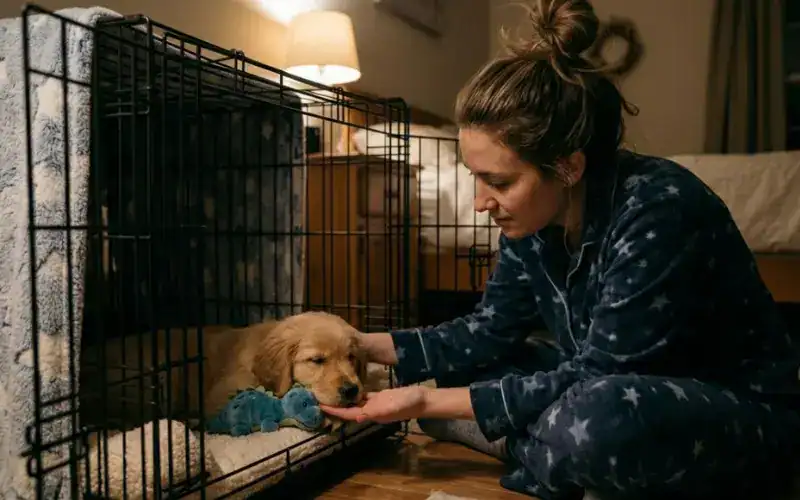
- Crying that escalates or has a different, more urgent quality — check on them. Don’t take them out unless they need to go to the bathroom. Just put a hand near the crate and speak calmly. Let them see and smell you, then step back.
- Middle of the night crying after a stretch of sleep — take them out for a bathroom break calmly and quietly, then straight back to the crate — no play, no extra cuddles, no turning the lights on if you can avoid it.
The goal is teaching your puppy two things simultaneously: you will always be there when they genuinely need you, but crying is not a guaranteed ticket out of the crate. come when they truly need you, AND sleeping quietly in the crate is the normal, expected thing to do.
Call your vet. Young puppies can’t tell you when something hurts.
Trust your instincts.
Common Mistakes That Make Nighttime Crying Worse
These are the mistakes that make why does my puppy cry at night last longer than it has to — and I made most of them in the first week.
Moving the Crate to Another Room
The instinct to put the crate in the laundry room or spare bedroom so the crying “doesn’t disturb your sleep” makes the problem significantly worse.
Your scent and presence are what your puppy needs most right now.
Distance makes the anxiety worse, not better.
Crate next to the bed — always for those first weeks.
Taking the Puppy Into the Bed After They Cry
This is the one that gets most people — including me on night two, if I’m being honest.
It feels like the kind thing to do.
The crying stops immediately.
Everyone sleeps.
But what you’ve just taught your puppy is: if I cry long enough and hard enough, I get exactly what I want.
That lesson gets reinforced every single time it happens.
Starting the crate habit again after bed-sharing has begun is significantly harder than starting it from the beginning.
Inconsistent Responses
Some nights you go to them, some nights you don’t.
Some nights they end up in bed, some nights they don’t.
This inconsistency is genuinely confusing for puppies and often makes crying worse because they never know what the rule is.
Pick your approach and stick to it — even on the hardest nights.
Consistency is everything here.
Not Enough Exercise During the Day
A puppy that spent most of the day in a crate or quiet house has energy to burn at night.
Physical and mental stimulation during the day directly affects how quickly and deeply your puppy sleeps at night.
Short play sessions, brief training sessions, supervised exploration — these all matter more than most people realize.
How to Know If the Crying Is Something More Serious
Most nighttime crying in puppies is completely behavioral — the adjustment period, loneliness, and a new environment. But occasionally, crying at night can signal a need for attention.
Signs the Crying Might Be Medical
Call your vet if the nighttime crying is paired with any of these:
- No interest in food or water for more than 24 hours
- Vomiting or diarrhea more than once or twice
- Visible bloating or a hard stomach
- Lethargy beyond normal puppy tiredness
- Limping or reluctance to move
- Crying that sounds more like yelping or screaming
Signs It’s Behavioral — Normal Adjustment
Crying is behavioral and normal when your puppy:
- Eats well during the day and is active during playtime
- Settles down within a few minutes when you go to them
- Shows improvement night over night, even gradually
- Cries at night but seems completely fine during the day
The guidance in this post is based on widely accepted puppy care practices endorsed by the AKC and ASPCA.
If your puppy shows signs of illness, persistent crying beyond 4 weeks, or extreme anxiety, always consult your veterinarian for personalized guidance.
Frequently Asked Questions (FAQ)
Is it okay to let my puppy cry it out at night?
For very young puppies under u003cstrongu003e10 weeksu003c/strongu003e, pure cry-it-out is not recommended.u003cbru003eThey’re not developmentally ready to self-soothe, and extended crying can increase anxiety.u003cbru003eA better approach is to respond to genuine distress while not reinforcing crying as a way to get out of the crate.u003cbru003ePlace the crate next to your bed so your presence provides comfort without having to pick them up every time they whimper.
How long will my puppy cry at night?
Most puppies cry the most in the first u003cstrongu003e2 to 3 nightsu003c/strongu003e.u003cbru003eWith consistent crate training and the right setup, most puppies show clear improvement within a u003cstrongu003eweeku003c/strongu003e and stop significant nighttime crying within u003cstrongu003e2 to 4 weeksu003c/strongu003e.u003cbru003eSome settle even faster.u003cbru003eThe keyword is u003cstrongu003econsistentu003c/strongu003e — every night needs to follow the same routine for this timeline to hold.
Should I ignore my crying puppy at night?
Not completely.u003cbru003eThere’s a middle ground between ignoring every sound and responding to every whimper.u003cbru003eLet short bursts of crying pass on their own.u003cbru003eFor escalating or urgent-sounding crying, calmly check on your puppy without taking them out of the crate unless they genuinely need a bathroom break.u003cbru003eYour goal is to be a reassuring presence — not a reward for crying.
Why does my puppy only cry at night and not during the day?
Because during the day, they can see you, hear you, and know they’re not alone.u003cbru003eThe nighttime is when the aloneness becomes real to them.u003cbru003eThis is why u003cstrongu003ewhy does my puppy cry at nightu003c/strongu003e is so much more intense than daytime separation — the dark, the quiet, and the absence of visual reassurance all amplify the anxiety.
Will my puppy ever sleep through the night?
Yes — absolutely.u003cbru003eMost puppies between u003cstrongu003e3 and 4 months oldu003c/strongu003e can sleep through the night without a bathroom break or significant crying.u003cbru003eSome do it even sooner.u003cbru003eIt feels impossibly far away when you’re on night three of no sleep, but it genuinely does come.u003cbru003eStay consistent, and it will.
My puppy cries even when I’m in the room — why?
Some puppies aren’t just crying because they’re alone — they’re crying because they want to be with you specifically, not just near you.u003cbru003eIf your puppy cries even with you in the room, the crate may need more positive association-building.u003cbru003eTry feeding meals inside the crate with the door open, tossing treats in randomly throughout the day, and letting them explore it freely before ever closing the door.u003cbru003eThe goal is for the crate to become their favorite spot — not a place they’re put when the day is over.
Is it normal for a puppy to cry all night long?
Continuous all-night crying without any breaks is less common and worth paying attention to.u003cbru003eA few stretches of crying with breaks is normal.u003cbru003eNon-stop crying through the entire night — especially after the first two or three nights — could indicate genuine distress, a medical issue, or a crate setup that feels very unsafe to your puppy.u003cbru003eTry the setup adjustments in this guide, and if it persists beyond u003cstrongu003eday threeu003c/strongu003e without improvement, mention it to your vet.
Always monitor your puppy closely when trying anything new. If you notice any unusual symptoms or behaviors, consult your veterinarian immediately.
You’re Going to Get Through This — Final Thoughts
Here’s what I know now that I desperately needed to know on that kitchen floor at 2 am:
The crying feels endless. It isn’t.
Your puppy isn’t broken. They’re not untrainable. They’re not rejecting you or the home you’ve made for them. They’re a tiny creature doing the only thing they know how to do when they’re scared — calling out for connection.
And you’re already doing the right thing by being here, learning, preparing, trying to understand what they need instead of just waiting for it to stop.
Now that you understand why does my puppy cry at night and what you can do about it — here are your three takeaways:
- The crying is normal — it’s grief and adjustment, not bad behavior. Understanding that changes how you respond.
- Crate placement and setup matter more than anything — next to your bed, covered on three sides, your scent inside. These aren’t optional extras, they’re the fix.
- Consistency is everything — pick your approach and hold it every single night. The improvement is coming, even when it doesn’t feel like it.
There is nothing quite like that first morning when your puppy wakes up wagging their tail instead of crying — like they’ve decided: okay. This is home. This is safe. I’ve got this person, and they’ve got me.
That morning comes faster than you think.
You’ve got this. I mean it.
For everything you need to know about those first weeks home, read our complete guide on how to take care of a puppy for the first time — feeding, sleep, potty training, and more, all in one place. And for a full breakdown of healthy sleep habits beyond night one, check out our puppy sleep schedule guide for the first week at home — It covers exactly what to expect night by night.
For the full socialization plan alongside settling your puppy in, read our puppy socialization checklist by age.”




Pingback: How Long Can You Leave a Puppy Alone? Age Chart (2026)