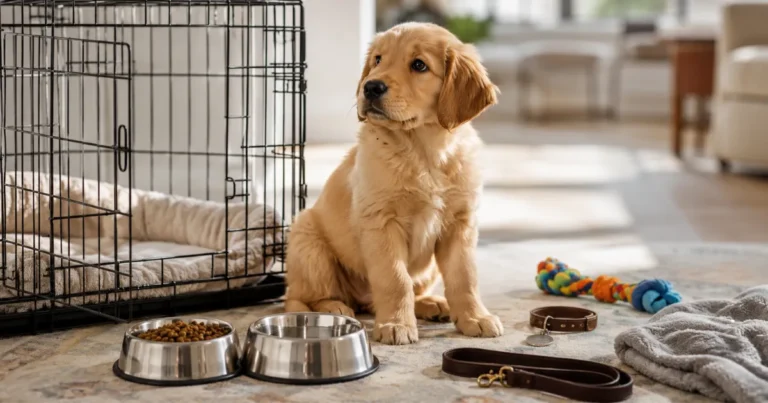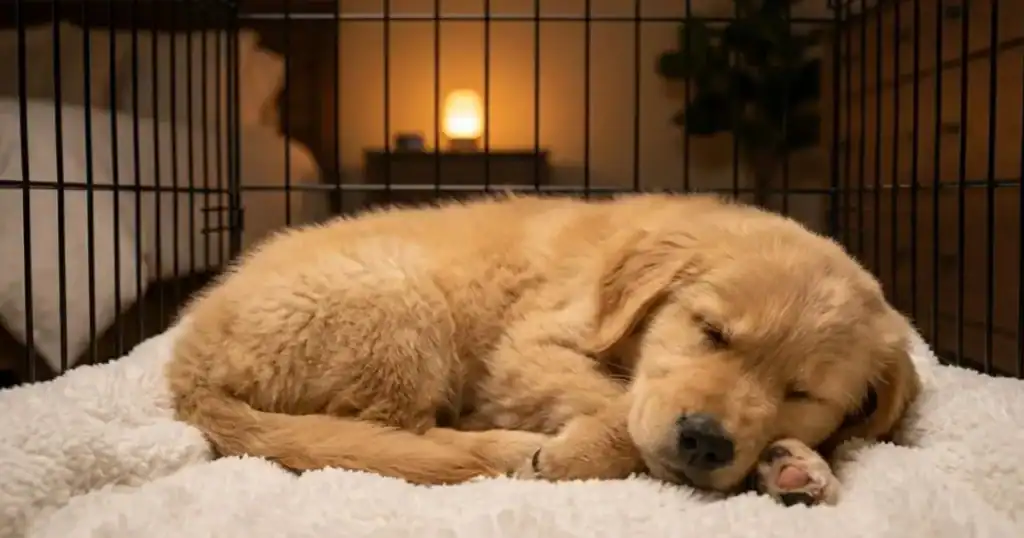
Night three with my puppy — I was convinced something was wrong with me.
Not with him. With me.
Because I was sitting on the floor next to his crate at 1 am, watching him breathe, too anxious to sleep even when he finally was.
Is he sleeping too much? Not enough? Should I wake him?
Is that whimper a bad sign? Why did he just twitch like that?
If you’re in those first few days with a new puppy right now and sleep — yours and theirs — feels like a complete mystery, this guide is exactly what you need.
A proper puppy sleep schedule first week at home takes all the guesswork out of those early days.
You’ll know how much sleep is normal at every age, what a healthy daily routine looks like hour by hour, how to set up the perfect sleep environment, and exactly what to do when things don’t go according to plan.
By the end of this guide, you’ll feel calm, prepared, and ready — instead of anxiously googling puppy sleep facts at 2 am.
Let’s get into it.
Use a crate placed next to your bed from day one. Most puppies sleep through the night by 3 to 4 months with a consistent bedtime routine established in week one.
How Much Do Puppies Sleep — What’s Actually Normal
Before we get into the schedule itself, I want to address the thing that worried me most in week one: my puppy seemed to sleep constantly. Like, an alarming amount.
Puppies sleep between 16 and 20 hours per day — this is completely normal and critical for brain and body development.
Here’s what I wish someone had told me on day one: that is completely normal. In fact, it’s exactly what should be happening.
Puppies Sleep 16 to 20 Hours a Day
Yes. 16 to 20 hours every single day. Not just newborns — your 8-week-old puppy at home genuinely needs this much sleep.
Here’s why: a puppy’s brain and body are developing at a pace that’s almost hard to comprehend. Every experience, every smell, every interaction they have during their waking hours gets processed and consolidated during sleep. Sleep isn’t downtime for puppies — it’s when the actual growing happens.
The puppy sleep schedule first week at home should work to protect this sleep rather than interrupt it.
Sleep Needs by Age — Quick Reference
Signs Your Puppy Is Getting Enough Sleep
● Good energy during awake windows, staying playful and alert
● Falls asleep quickly and easily when put down
● Wakes up naturally without being disturbed
● Grows steadily week by week
● Eats well at every meal
Signs Your Puppy May Be Overtired
● Getting bitey and frantic during play, which is one of the biggest signs most owners miss
● Barking or whining for no clear reason
● Difficulty settling, even when your puppy is clearly tired
● A glazed expression or suddenly losing interest in everything
● Acting “naughty” even though they actually need rest
An overtired puppy is not a misbehaving puppy. It is usually a puppy that needed a nap 20 minutes ago. The fix is simple: crate, quiet, and sleep.
For more on what happens when puppies don’t sleep enough and how it affects nighttime crying, read our guide on why does my puppy cry at night.
The Puppy Sleep Schedule — Day by Day First Week
Here is the truth about the first week: it doesn’t follow a perfect schedule. Your puppy is adjusting to an entirely new world. But having a framework — a rough rhythm to aim for — makes everything significantly more manageable.
This is the puppy sleep schedule first week at home that worked for me, and that most experienced puppy owners
and trainers recommend.
Days 1 and 2 — Survival Mode
Be honest with yourself — these first two days are about keeping your puppy safe, loved, and as calm as possible. Don’t expect a schedule. Expect chaos — and be okay with it.
What to Focus On:
● Let your puppy sleep as much as they want
● Keep the house calm and quiet, with no big gatherings
● Take your puppy outside every 45 to 60 minutes
● Feed at consistent times, even if everything else feels flexible
● Use the crate for all sleep from day one, including naps
Your puppy will likely sleep for long stretches, wake up to explore briefly, then crash again. This is perfect. Don’t wake them to play. Don’t worry if they seem more sleepy than lively. They are adjusting to the biggest change of their short life.
If you are still preparing for those first 24 hours, follow our complete new puppy first day checklist before building your puppy’s sleep routine.
Days 3 and 4 — The Rhythm Starts
By day three, most puppies start to show a natural pattern. They’re still sleeping a lot — but you’ll notice the awake windows becoming slightly more predictable.
Start Anchoring the Schedule Around These Fixed Points:
● Morning wake-up at the same time every day, with 7 am working well for most families
● Last meal around 6 to 7 pm to keep the overnight bathroom schedule manageable
● Bedtime at the same time every night, usually around 9 to 10 pm
Everything else — naps, play, outdoor trips — flows around these three anchor points.
Days 5, 6 and 7 — Building the Routine
By the end of week one, you should start to see a recognizable daily rhythm forming. Not perfect. Not clockwork. But there, which is everything.
A typical day-by-day 5 to 7 might look like this:
For exact meal times and portion sizes to slot into this schedule, check our complete puppy feeding schedule by age guide.
You’ll often find they already have a loose rhythm — and building your schedule around their natural pattern instead of against it makes the whole first week dramatically smoother.

How to Set Up the Perfect Sleep Environment
A puppy that has the right sleep environment settles faster, sleeps longer, and cries less at night. I learned this the hard way — my first crate setup was completely wrong, and night one showed me exactly how much that mattered.
The Crate — Non-Negotiable from Day One
If there is one thing I would tell every new puppy owner before they bring their pup home, it is to use a crate from the very first nap. Not from day three when you’re desperate. Day one, nap one.
The crate gives your puppy a safe, den-like space that mimics the close, enclosed feeling of sleeping in a pile with their littermates.
MidWest Homes for Pets iCrate — 24-inch, Single Door — the most recommended starter crate for puppies by vets and trainers. Includes a free divider panel so you buy one crate and adjust as your puppy grows.
Not ideal for: large breeds over 50 lbs at adult size — size up to 36-inch or 42-inch for Labs, Shepherds, and Golden Retrievers.
Dogs are den animals by nature — a properly set up crate doesn’t feel like a cage to them. It feels like home.
According to the American Kennel Club, crate training from the very beginning is the most effective way to establish healthy sleep habits and support potty training simultaneously — two of the biggest challenges in the first week at home.
Crate Setup That Actually Works
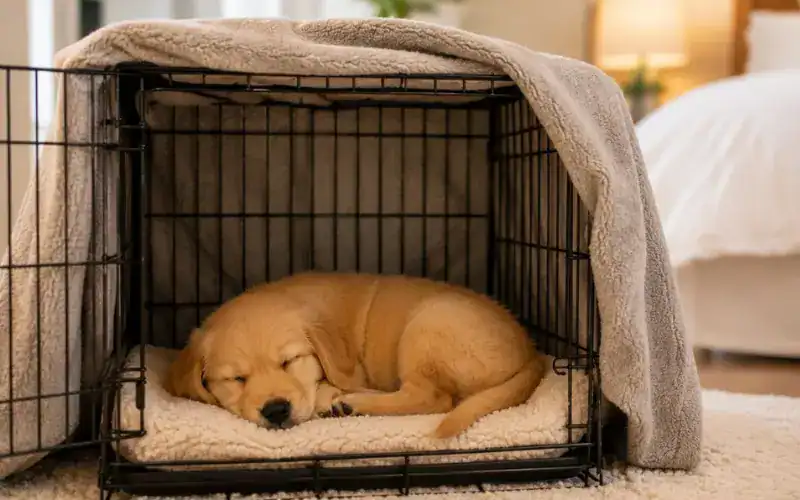
This is the exact setup that made the biggest difference for me on night two compared to night one:
● Placing the crate next to the owner’s bed is the single most effective way to reduce first-night crying — the puppy can smell and hear their owner throughout the night.
● Cover three sides with a blanket — leave the front open for airflow. The enclosed feeling reduces anxiety dramatically.
● Put a soft, washable crate pad inside — not expensive, just comfortable and easy to clean.
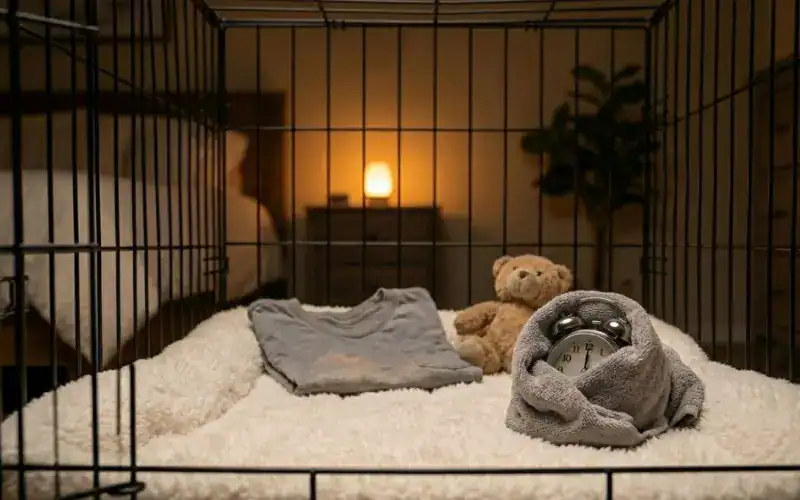
● Add a worn piece of your clothing — a t-shirt you’ve worn for a day works perfectly. Your scent is the single most calming thing in your puppy’s world right now.
● Add a heartbeat toy — the rhythmic pulse mimics a sleeping littermate and has a genuinely calming effect on most puppies in the first week.
MidWest Deluxe Bolster Pet Bed — 24-inch — Plush bolster sides give puppies something to lean against, mimicking the feeling of sleeping against a littermate. Machine washable cover. Non-slip bottom stays in place inside the crate. Fits MidWest 24-inch crates perfectly.
Not ideal for: puppies that chew and destuff bedding — use a flat rubber mat or old towel until the chewing phase passes.
SmartPetLove Snuggle Puppy Heartbeat Toy — Real-Feel pulsing heartbeat plus heat pack that mimics a mother’s warmth. Over 1 million dogs comforted. Consistently Amazon’s Number 1 Best Seller for plush dog toys. Machine washable — heartbeat unit removes for washing. Batteries included.
Not ideal for: puppies that immediately destuff plush toys — supervise during first use and remove if destruction begins.
Temperature and Noise
Puppies regulate temperature less efficiently than adult dogs. The room should be comfortably warm — not hot, not cold. Around 70 to 75 degrees Fahrenheit is ideal for a young puppy.
White noise or a fan running softly in the background helps mask sudden sounds — a car outside, a creak in the floor — that can startle a puppy awake. A consistent background sound helps you sleep more deeply and for longer.
LectroFan Classic White Noise Machine — 10 fan sounds and 10 white noise variations. No looping — continuous, non-repeating sound all night. Small enough to place on a nightstand beside the crate. Used by thousands of pet owners specifically for puppy sleep training.
Not ideal for: very small rooms where any additional sound feels intrusive — a simple box fan on low works just as well for a fraction of the cost.
What to Remove from the Crate
Never leave food or water inside the crate overnight. It creates unnecessary bathroom trips and teaches your puppy the crate is a dining area — not a den.
Avoid fluffy toys with stuffing that can be chewed apart and swallowed. Stick to rubber toys or specifically designed firm plush toys for puppies.
If your puppy cries, resists, or refuses to settle inside the crate, read our step-by-step guide on how to crate train a dog that hates the crate.
A puppy that associates the crate with punishment will resist it, cry more, and lose the one tool that makes sleep training and potty training work simultaneously.
The Nighttime Routine — How to Survive the First Week
Nights are the hardest part. I’m not going to pretend otherwise. But having a clear nighttime routine takes the guesswork out of it — and guesswork at 2 am when you’re exhausted is what breaks people.
The 30-Minute Bedtime Wind-Down
About 30 minutes before you want your puppy in the crate for the night, start winding things down.
No exciting play—keep interactions calm and gentle. Dim the lights slightly if you can. Take them outside for their last bathroom trip of the night — within 10 minutes of crate time.
Put them in the crate calmly, say a simple phrase like “bedtime” or “night night” — in time, this becomes a cue they recognize. Go to bed yourself — don’t sit and watch them.
Overnight Bathroom Trips — The Realistic Schedule
At 8 weeks old,, your puppy cannot physically hold their bladder through the night. Plan for it rather than hoping it doesn’t happen.
Set an alarm — don’t wait for crying to wake you. Proactive trips prevent accidents and build the habit faster than reactive ones.
8 weeks old: set alarm for 2 am and 5 am
10 weeks old: set alarm for 3 am only
12 weeks old: try 4 am — many puppies make it through
3 months old: most puppies sleep 6 to 7 hours straight
When you take them out at night, keep it boring. No lights on if you can avoid it. No talking, no playing, no exciting anything. Out, bathroom, back to crate. The more boring the middle-of-the-night trip, the faster your puppy learns it’s not a fun event worth waking up for.
When Your Puppy Cries at Night
Some crying in the first few nights is completely normal — and expected. Your puppy is adjusting to sleeping alone for the first time in their life.
Short bursts of whimpering — 3 to 5 minutes — let them settle on their own. Don’t rush in.
Escalating crying that doesn’t stop — put your hand near the crate so they can smell you. Speak calmly. Don’t take them out unless they need a bathroom trip.
Crying that has a different, more urgent quality — check if they need to go outside.
The crate next to your bed solves most nighttime crying without you doing anything at all — just your presence and your breathing are enough comfort for most puppies.
Night by Night — What to Expect
Night 1: Probably the hardest. Your puppy may cry multiple times. This is normal. Stay consistent.
Night 2: Usually similar to night one — maybe marginally better. Still hard.
Night 3: Most owners notice a small but real improvement. The routine is starting to register.
Night 4 and 5: Crying starts to reduce in duration and intensity. You’ll start to feel human again.
Night 6 and 7: Most puppies have settled into a recognizable nighttime pattern by the end of week one. Not perfect — but workable.
For the complete potty training system that works alongside this sleep schedule, read our guide on how to potty train a puppy fast at home.
Your scent on something soft in their crate from the very first night gives them comfort before they even know you properly.
It’s one of the simplest and most effective things you can do for night one.
Common Sleep Mistakes New Owners Make in Week One
I made every single one of these. Consider this the section I desperately needed before day one.
Keeping puppies awake during the day to tire them out actually produces worse nighttime sleep — well-rested puppies during the day sleep better and longer at night.
Letting the Puppy Sleep in the Bed from Night One
I completely understand the temptation. The crying stops immediately. Everyone sleeps. It feels like the kind thing to do.
But what you’ve just taught your puppy is: if I cry long enough, I get exactly what I want. And that lesson gets reinforced every single time it happens.
Getting back to crate sleeping after bed-sharing has started is significantly harder than starting the crate habit from the beginning. If the plan is to have your dog sleep independently eventually, start as you mean to go on.
Putting the Crate in a Separate Room
The instinct to put the crate in the laundry room or spare bedroom so the crying doesn’t disturb your sleep makes everything dramatically worse.
Your puppy’s greatest comfort right now is knowing you’re nearby. Your scent, your breathing, the sound of you moving — these are the things that tell a stressed, adjusting puppy that they are safe.
Crate. Next to the bed. Always — for at least the first two to four weeks.
Waking the Puppy to Play
Your puppy is sleeping, and you think — oh, they’ve been asleep for a while, they should be up. So you wake them.
Don’t. Ever.
Let sleeping puppies sleep. Interrupting sleep disrupts the developmental processing during nap time and leaves the puppy overtired for the rest of the day. If your puppy is sleeping, your job is to let them.
Skipping Naps to Tire Them Out
This is the one that seems logical and is completely wrong. Many new owners think: “If I keep them awake during the day, they’ll sleep better at night.”
The opposite is true. An overtired puppy doesn’t sleep well at night. They get wired, anxious, and difficult to settle. Protecting daytime naps actually improves nighttime sleep — not the other way around.
Well-rested during the day equals better sleep at night—every time.
Inconsistent Crate Use
Some naps in the crate. Some naps on the couch. Some nights in the crate. Some nights in bed.
Your puppy cannot build a consistent association with sleep if the setup changes every time. Consistent crate use — for every single sleep — is what makes the training work and what makes sleep feel safe and predictable to your puppy.
How Sleep Changes in the Weeks After the First Week
Week one is the hardest — I promise you that. Here’s what you have to look forward to as your puppy grows.
Weeks 2 and 3 — The Routine Solidifies
Most puppies are significantly more settled by weeks two and three. The routine feels real. Nighttime trips are fewer. You start sleeping in longer stretches.
Month 2 — Real Progress
By 10 to 12 weeks, most puppies can sleep for 4 to 5-hour stretches at night without a bathroom trip. Nap times are slightly longer and more predictable.
Month 3 — Almost There
Most puppies at 3 months can sleep through the night — 6 to 7 hours without waking. This is the milestone most new owners are aiming for, and it comes faster than the first week makes it feel.
6 Months and Beyond — Adult Sleep Pattern Forming
By 6 months, your puppy will sleep 12 to 14 hours per day, with a clear night’s sleep and one or two daytime naps. The schedule that felt impossible in week one is now just… life—your life with your dog.
According to the American Veterinary Medical Association, consistent routines established in the first weeks of a puppy’s life at home have a lasting impact on behavioral health and overall wellbeing into adulthood.
Every puppy is different — if you have concerns about your puppy’s sleep patterns or overall health, always consult your veterinarian.
Frequently Asked Questions About (FAQ)
How much should an 8-week-old puppy sleep?
An 8-week-old puppy should sleep between 16 and 20 hours per day.
This sounds like an enormous amount — and it is — but it’s completely normal and critical for their development.
Their brains and bodies are growing at a remarkable rate, and sleep is when that growth happens.
If your 8-week-old puppy seems to sleep constantly, that’s a good sign, not a cause for concern.
Should I wake my puppy up from a nap?
No — never wake a sleeping puppy unless necessary, like an emergency or a scheduled vet appointment.
Sleep is developmental time for puppies.
Interrupting it creates an overtired, difficult-to-settle puppy for the rest of the day.
Let them wake naturally, and your whole day will go more smoothly.
Is my puppy sleeping too much?
Almost certainly not if they’re under 16 weeks.
16 to 20 hours of sleep per day is the normal range for young puppies.
The question to ask isn’t whether they’re sleeping too much — it’s whether they’re healthy and energetic during their awake windows.
If your puppy is alert, playful, eating well, and growing steadily, they’re sleeping exactly the right amount.
Why does my puppy sleep so much but still cry at night?
Daytime sleep and nighttime sleep are different things for puppies.
Daytime naps are short, light, and frequent.
Nighttime sleep requires learning — specifically, learning that being alone in a crate at night is safe.
A puppy that sleeps all day but cries at night isn’t sleeping too much — they’re anxious about being alone in the dark.
Crate placement next to your bed and a consistent bedtime routine solve this faster than anything else.
What time should a puppy go to bed?
Between 9 and 10 pm works well for most families — it aligns with a human sleep schedule and gives enough evening awake time for a proper wind-down routine.
What matters more than the exact time is consistency.
Whatever time you choose — stick to it every single night.
Puppies thrive on predictability, and a consistent bedtime is one of the fastest ways to establish a healthy sleep routine in the first week.
Should my puppy sleep in my room?
Yes — especially in the first two to four weeks.
Not necessarily in your bed, but in your room.
The crate next to your bed gives your puppy the comfort of your presence without starting a bed-sharing habit that’s hard to break later.
Your scent and the sound of you breathing are genuine sources of comfort for a puppy adjusting to a new home.
Use that to your advantage.
When can I move the crate out of my bedroom?
Most owners start moving the crate gradually after the puppy has been sleeping through the night consistently — usually around 8 to 12 weeks old, depending on the puppy.
Move it one foot further away every few days rather than switching rooms overnight.
Gradual transitions are always easier for puppies than sudden ones.
Always monitor your puppy closely when trying anything new. If you notice any unusual symptoms or behaviors, consult your veterinarian immediately.
You’re Going to Sleep Again — Final Thoughts
I know how week one feels. I know what it’s like to be so tired that making a cup of coffee feels like a complex task. I know the specific kind of exhaustion that comes from middle-of-the-night bathroom trips and lying awake listening for sounds from the crate.
Here’s what I know now, on the other side of it:
That first week is the hardest. And it has an end. By week two, you’ll feel human again. By week three, you’ll start to feel like you’ve got this. By month two, you’ll barely remember how hard it was.
Now that you have a complete puppy sleep schedule first week at home to follow — here are your three big takeaways:
- Crate from day one, next to your bed — this single decision makes more difference than any other in week one. Don’t skip it, don’t delay it.
- Protect the naps — a well-rested puppy during the day is a better sleeper at night. Never wake a sleeping puppy, never skip naps to tire them out.
- Consistent bedtime routine — same time, same steps, every single night. Puppies learn the routine faster than you’d expect and it becomes genuinely comforting to them.
The puppy sleep schedule first week at home that you build this week becomes the foundation for months of good sleep to come. Stay consistent, protect the naps, and trust the process.
You’ve got this. And so does your puppy.
For everything else happening in those first overwhelming weeks, read our complete guide on how to take care of a puppy for the first time — sleep, feeding, potty training, biting, and more all in one place.