

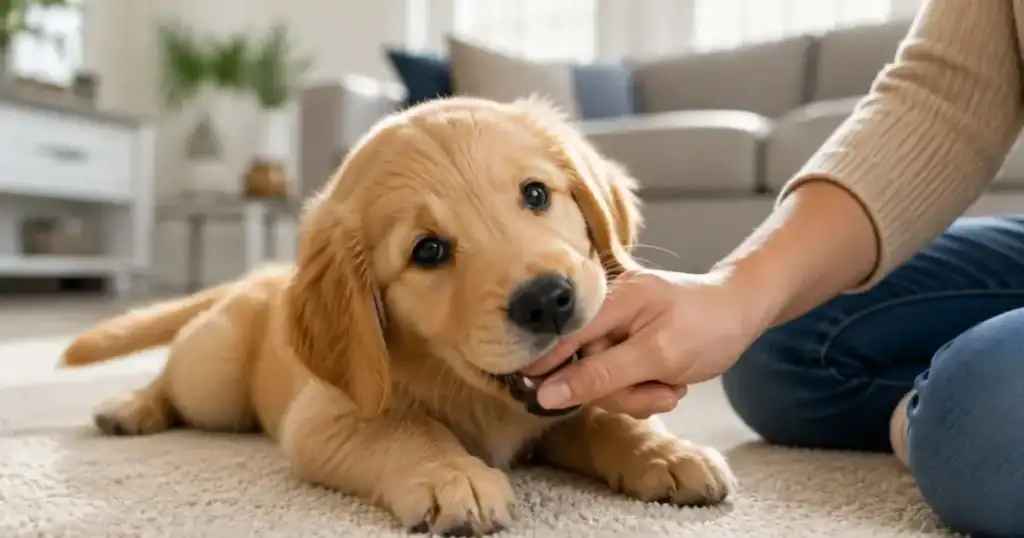
My puppy bit me so hard on the hand one morning that I actually yelped out loud.
He was ten weeks old. Tiny. Adorable. And absolutely relentless with those needle-sharp little teeth.
Every time I reached down to pet him — chomp.
Every play session — chomp.
Every time I tried to pick him up — chomp, chomp, chomp.
I started wearing thick socks on my hands.
Actual socks.
That was my solution for the first four days.
If you’re dealing with a puppy who bites constantly and you’re wondering if it’s ever going to stop — it will.
But you need the right approach, not just time.
And that’s exactly what this guide gives you.
Knowing how to handle puppy biting and nipping the right way from week one makes the difference between a puppy who learns bite inhibition quickly and one who is still biting at six months old.
Every technique in this guide is based on positive reinforcement — nothing scary, nothing harsh, nothing that damages the trust you’re building with your dog.
Let’s sort this out.
Then redirect to a chew toy every single time. Most puppies show significant improvement by 4 to 5 months with consistent training.
Never use punishment — it increases biting, not reduces it.
Why Puppies Bite and Nip — The Real Reason It Happens
Before I give you the fix, I want to explain why this happens — because understanding the why makes the how make so much more sense.
Puppy biting is not aggression — it is normal developmental behavior used to explore the world and learn how hard is too hard, called bite inhibition.
Here’s something most people don’t realize: puppy biting is not aggression.
It’s not bad behavior.
It’s not a sign that your puppy will be a difficult dog.
It’s completely normal puppy development — and it actually serves a very important purpose.
It’s How They Explore the World
Puppies don’t have hands. Their mouth is their primary tool for exploring, playing, and understanding everything around them.
When your puppy bites your hand, they’re doing exactly what they’d do with a littermate — using their mouth to interact with the world.
The difference between a puppy nipping a littermate and nipping you is simple: littermates yelp and stop playing when the bite is too hard. That feedback is how puppies naturally learn bite inhibition — how much pressure is acceptable and how much is too much.
When puppies come home with us, they need to learn this lesson all over again with humans — because our skin is a lot more sensitive than puppy fur.
It’s Part of the Teething Process
Between 3 and 6 months old, puppies lose their baby teeth and their adult teeth come in.
This process is uncomfortable — sometimes painful — and chewing and biting provide relief.
If your puppy’s biting seems to intensify around 12 to 16 weeks, teething is likely playing a role.
This doesn’t mean you accept the biting. It means you understand why it’s happening and channel it appropriately — toward chew toys, not your hands.
They’re Overstimulated or Overtired
One thing I learned the hard way: the worst biting always happened when my puppy was overtired.
An overtired puppy loses the ability to regulate their behavior — they get bitey, frantic, and completely unable to settle.
If your puppy suddenly goes into what owners call “zoomie mode” and starts biting hard and fast — that’s not play anymore. That’s an overtired puppy who needs a nap, not more interaction.
For the complete sleep schedule that prevents overtiredness, read our puppy sleep schedule for the first week at home.
They’re Testing What Gets a Reaction
Puppies learn very quickly which behaviors get their humans’ attention.
If biting gets a big reaction — you yelp, pull away, wave your hands, talk loudly — your puppy may actually find that stimulating and do it more.
This is one of the most common reasons puppy biting escalates rather than getting better in the first few weeks — the human’s reaction accidentally rewards the behavior.
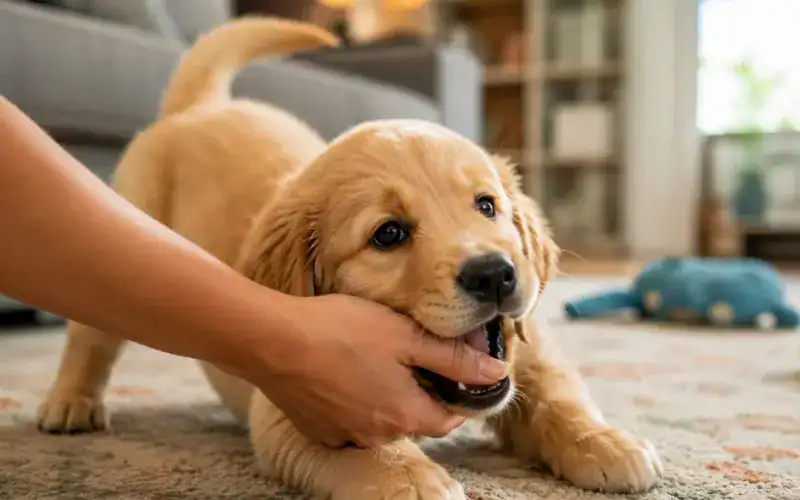
How to Handle Puppy Biting and Nipping — Step by Step
Okay — here is exactly what works. I’m going to give you the complete system, not just one tip.
Because one tip without a system is why most puppy owners stay frustrated for weeks longer than they need to.
How to handle puppy biting and nipping comes down to three things working together: teaching bite inhibition, redirecting to appropriate chewing, and managing the environment so your puppy doesn’t practice biting more than necessary.
Step 1 — Teach Bite Inhibition First
Bite inhibition means teaching your puppy how hard is too hard — before teaching them not to bite at all. This order matters enormously.
A puppy that’s taught “no biting ever” without first learning bite inhibition will bite hard when they do bite — because they never learned to soften their bite.
A puppy that learns bite inhibition first bites softly even when startled — which is much safer long term.
How to do it:
- When your puppy bites and it hurts, make a high-pitched yelp sound. Not angry. Not scolding. Just a single “ouch!” or “yip!” the way a littermate would.
- Immediately stop all interaction. Turn away, go still, ignore them completely for 10 to 20 seconds. Then resume play.
- If they bite hard again — repeat. If they bite three times in a row, get up and leave the room for 30 seconds. Come back calmly and try again.
You are teaching your puppy: hard biting ends the fun. Gentle play continues the fun. That lesson is powerful, and it sticks.
Step 2 — Redirect to a Chew Toy Immediately
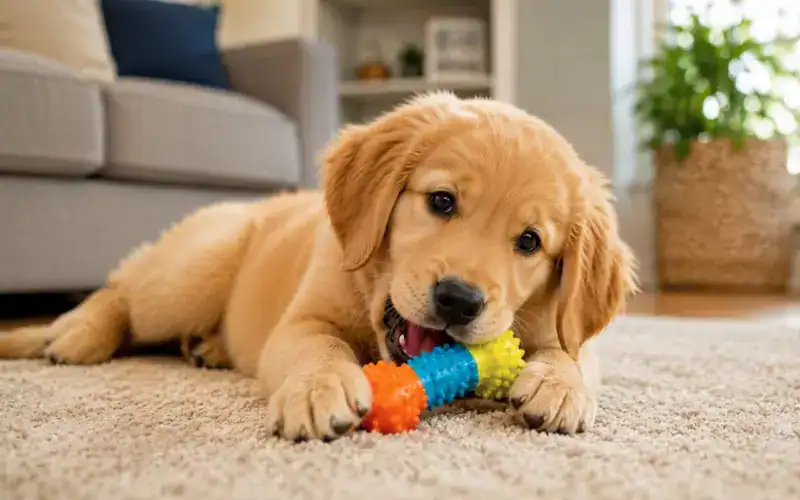
The moment your puppy goes for your hand — redirect.
Before they make contact, if possible, or the moment they do, produce a chew toy and offer it instead.
Keep chew toys literally everywhere:
- One in every room
- One in your pocket when you’re doing training
- One next to wherever you usually sit
The faster you can redirect, the faster your puppy learns — hands are not for biting, toys are for biting.
The best chew toys for biting puppies:
The Best Chew Toys for Biting Puppies
KONG Puppy Toy — Natural Rubber — Natural rubber formula designed specifically for puppy teeth and gums. Stuff with kibble or peanut butter and freeze overnight for extended engagement. The most recommended puppy chew toy by vets and trainers worldwide.
Available in XS to L based on breed size.
Not ideal for: aggressive chewers who destroy rubber quickly — check the size guide and supervise first use.
Bully Sticks by Best Bully Sticks — 6-inch, 25 Count — 100% natural single-ingredient beef pizzle. Long-lasting chew that satisfies the urge to bite without destroying furniture or your hands. Fully digestible unlike rawhide.
Perfect for teething puppies 8 weeks and older.
Not ideal for: puppies under 8 weeks or small toy breeds under 5 lbs — choose thinner bully sticks.
Rope toys and frozen carrots are also excellent, low-cost options for teething relief.
- Rope toys — good texture for teething puppies
- Frozen carrots — soothing on teething gums and free
Step 3 — Never Pull Away Quickly
This is the mistake almost every new owner makes, including me on day one.
When a puppy bites and you pull your hand away fast, that quick movement triggers their prey drive and actually makes them bite harder and faster.
It turns into a game — and a painful one.
Instead, when your puppy bites, go still. Don’t pull away. Say your “ouch” calmly, stop moving, and wait.
Then slowly remove your hand and redirect to a toy.
Still, hands get released faster than moving hands.
Step 4 — Use Time-Outs Consistently
Time-outs are one of the most effective tools for puppy biting when used correctly. The keyword is correct.
A time-out means: the moment your puppy bites too hard, you calmly and immediately remove yourself or your puppy from the situation for 30 to 60 seconds.
No drama. No angry voice. No long lecture. Just a calm, consistent consequence.
You can either:
- Leave the room yourself for 30 seconds — close the door behind you so your puppy is briefly alone
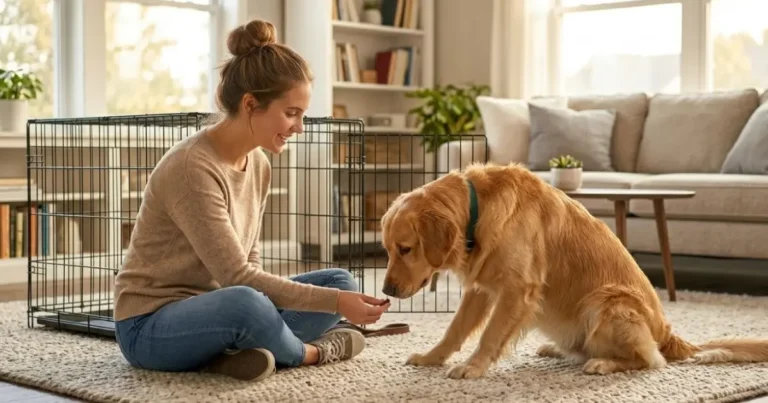
- Or place your puppy in their crate for a short, calm-down break
The message is simple: biting ends the fun. Every. Single. Time.
Step 5 — Reward Gentle Behavior Enthusiastically
Most people skip this step, and it’s one of the most powerful.
When your puppy is playing and keeping their mouth soft — or when they choose a toy over your hand — praise them immediately and enthusiastically.
- Treats
- Verbal praise
- Affection
Zuke’s Mini Naturals Puppy Training Treats — Pea-sized treats with under 3 calories each. Small enough to reward 20+ times per training session without overfeeding. Made with real chicken and DHA for puppy brain development.
One of the most popular training treats among professional dog trainers.
Not ideal for: puppies with chicken allergies — choose the salmon recipe as an alternative.
Make gentle play feel like the most rewarding thing in the world.
You’re not just punishing the wrong behavior.
You’re actively reinforcing the right one.
That combination works dramatically faster than punishment alone.
According to the American Kennel Club, positive reinforcement-based training is the most effective and scientifically supported approach for teaching puppies impulse control and bite inhibition.
Puppies lose interest in toys they see all the time. A “new” toy they haven’t seen in a few days gets their attention much faster than one that’s been sitting on the floor for a week.
This makes redirecting dramatically easier.
The Puppy Biting and Nipping Schedule — When It Gets Better
One of the most common questions new owners ask is: When does the biting actually stop?
Here’s the honest, realistic timeline.
Most puppies trained consistently from 8 weeks show major improvement in biting by 4 to 5 months and are mostly resolved by 6 to 7 months when adult teeth are fully in.
8 to 12 Weeks — Peak Biting Stage
This is the hardest stage and the most important for training.
Your puppy’s bite is sharp and frequent.
They have almost no impulse control.
Every interaction is a training opportunity, whether you want it to be or not.
What to focus on: bite inhibition and redirection — every single time.
Consistency here builds the foundation for everything that follows.
3 to 4 Months — Teething Intensifies
Around 12 to 16 weeks, the biting often gets worse before it gets better — because teething starts in earnest.
Don’t panic.
This is normal.
Double down on frozen chew toys and redirect, redirect, redirect.
4 to 5 Months — Noticeable Improvement
If you’ve been consistent, this is when you start to see real change.
Biting becomes less frequent.
Your puppy is starting to choose toys more often.
Time-outs work faster because the association has been built.
6 to 7 Months — Should Be Mostly Resolved
By 6 months, a consistently trained puppy should rarely bite, and when they do, it should be soft.
Adult teeth are fully in, teething is done, and impulse control has developed significantly.
If your puppy is still biting hard and frequently at 6 months, despite consistent training, that’s worth a conversation with a professional trainer or your vet.
Puppy Biting Timeline — Quick Reference
What NOT to Do — Mistakes That Make Biting Worse
I made most of these mistakes in week one before I figured out what actually works.
If you’ve done any of these, don’t worry.
You can course-correct starting today.
According to the ASPCA, punishment-based methods for puppy biting increase fear and anxiety and often result in more biting, not less.
Rough Play With Your Hands
This one is so common and so counterproductive.
Wrestling with your puppy using your bare hands, letting them chase and bite your fingers, and using your hands as toys during play — all of this teaches your puppy that hands are absolutely acceptable things to bite.
If you want your puppy to stop biting hands, you have to stop using hands as play objects.
Use toys.
Always toys.
Hands are for petting and calm interaction only.
Yelling or Physical Punishment
Yelling at a biting puppy, tapping their nose, holding their muzzle shut, or scruffing — none of these work, and several of them actively make things worse.
According to the ASPCA, punishment-based methods can increase fear and anxiety in puppies, which often leads to more biting — not less — and can damage the bond between puppy and owner permanently.
Inconsistent Responses
One family member does the yelp-and-ignore method. Another laughs when the puppy bites. Another yells. Another just pulls away.
Your puppy cannot learn a rule that isn’t consistent.
Every person who interacts with your puppy needs to respond the same way every single time.
Get the whole household aligned on the approach before day one.
Letting It Go Because “They’re Just a Puppy”
A bite from a 10-week-old puppy is cute and harmless.
A bite from the same dog at 8 months with adult teeth and full strength is a completely different story.
The habits your puppy builds now stay with them.
A puppy that’s allowed to bite freely for the first few months will not magically stop when they grow up.
Address it now — kindly and consistently — and it becomes a non-issue.
Ignore it, and you’ll be dealing with a much harder problem later.
Getting Angry When You’re Tired
I understand this one deeply. 11 pm, your puppy has bitten you for the eighth time today, and your patience is completely gone. It happens to every new owner.
But angry reactions make biting worse — not better.
If you’re at your limit, put your puppy in their crate for a calm break.
Walk away. Regroup. Come back when you can respond calmly.
The crate is not punishment in this situation — it’s a management tool that protects both of you.

Special Situations — Biting in Different Contexts
Puppy Biting Children — Extra Important
Children are at higher risk from puppy biting because their movements are fast and unpredictable — which triggers play drive — and their faces are at puppy level.
Never leave young children and puppies together unsupervised.
Teach children the same rules:
- No rough play with hands
- Go still when bitten
- No running away or screaming, which turns it into a chase game
Children under 6 should always have an adult present during puppy play interactions.
For building the full foundation of good behavior from day one, our guide on how to potty train a puppy fast at home covers the other essential habit to teach alongside biting and Well-socialized puppies bite less — read our complete puppy socialization checklist by age.
Ankle and Feet Biting
If your puppy attacks your feet and ankles every time you walk, it may be herding behavior in some breeds (Border Collies, Australian Shepherds) or just high prey drive in others. The movement of feet triggers them.
Fix: Always have a toy ready when you move around the house. The moment they go for your feet, produce the toy and redirect. Consistent redirection over 2 to 3 weeks breaks the habit.
Grannick’s Bitter Apple Spray for Dogs — 8 oz — Safe, non-toxic bitter taste deterrent that discourages licking and chewing on skin, clothing, and furniture. Spray on ankles, socks, or hands before interaction. Most puppies avoid the bitter taste within 2 to 3 exposures.
Not ideal for: replacing active training — bitter spray is a management tool to use alongside the yelp-and-redirect method, not a standalone solution.
Biting During Grooming or Handling
Some puppies bite during nail trims, ear cleaning, or being picked up. This is different from play biting — it’s a stress- or discomfort-related response.
Start handling your puppy’s paws, ears, and mouth daily from the first week — briefly and gently, with treats. Build positive associations with being touched everywhere.
This prevents grooming biting before it starts.
True aggression in puppies is rare but requires early professional intervention.
How to Know Your Training Is Working
Progress with puppy biting can feel invisible when you’re in the middle of it.
Here are the real signs that your training is actually taking effect.
Signs It’s Working
- Bites are becoming softer, even though they are still frequent
- Your puppy releases your hand faster when you go still
- They redirect to toys more readily when offered
- Time-outs are working faster — 10 seconds of calm instead of 30 before they settle
- Your puppy sometimes chooses a toy over your hand, even without redirection
- Play sessions are ending more calmly than they start
Signs You Need to Adjust
- Biting is getting harder, not softer, after 3 weeks
- Your puppy ignores the yelp completely
- They escalate instead of stopping after time-outs
- Multiple family members are responding differently
If biting isn’t improving after 3 to 4 weeks of consistent training, the most common culprit is inconsistency somewhere in the household — or the puppy is being overstimulated before play sessions.
Review the steps and look for where the consistency is breaking down.
By day 7, comparing the two columns gives you real data instead of just feeling like nothing is working.
Most owners are surprised to see genuine progress they couldn’t feel in the moment.
If your puppy’s biting is severe, shows signs of aggression, or isn’t improving after 4 to 6 weeks of consistent training — please consult a certified professional dog trainer or your veterinarian.
Frequently Asked Questions (FAQ)
At what age do puppies stop biting?
Most puppies show significant improvement in biting behavior between 4 and 5 months old with consistent training.
By 6 to 7 months, most puppies trained from the start are biting rarely and softly.
The teething phase — which often intensifies biting — typically ends around 6 months when all adult teeth are fully in.
Without consistent training, some dogs continue biting well past 6 months.
Should I yelp when my puppy bites?
Yes — for most puppies, the high-pitched yelp followed by stopping play is one of the most effective early techniques.
It mimics how a littermate would respond to a bite that’s too hard.
However, some puppies get more excited by the yelp rather than stopping.
If that’s your puppy — skip the yelp, go straight to going still and ignoring, and use more frequent time-outs instead.
Why does my puppy bite me and not other people?
Usually because you’re the one they’re most comfortable with — which is actually a good sign for bonding, just not fun in practice.
It can also mean you’ve accidentally been less consistent with your response than other people.
Check whether your reactions have been as clear and consistent with your puppy as everyone else’s have been.
Is it okay to use a spray bottle to stop biting?
No — not recommended.
Spray bottles create fear and confusion rather than understanding.
Your puppy doesn’t connect the spray with the bite — they just learn that you’re unpredictable and scary sometimes.
Positive redirection and consistent time-outs work better and don’t damage your relationship with your puppy.
My puppy bites harder when I try to stop them — why?
This usually happens when the puppy is overtired or overstimulated.
An overtired puppy cannot regulate their behavior — the more you interact, the more frantic they get.
The solution isn’t more training at that moment — it’s a crate break.
Put them in their crate calmly for 15 to 30 minutes.
An overtired puppy needs sleep, not correction.
How many times a day should I do biting training?
Every interaction is a training opportunity — you don’t need separate formal sessions for biting.
Apply the yelp-and-ignore or redirect method every single time your puppy bites during normal daily play.
The frequency of natural training moments in a puppy’s day is far higher than any dedicated session you could plan.
Consistency in every moment matters more than intensity in one session.
Will neutering or spaying stop my puppy from biting?
No — puppy biting and nipping is developmental behavior, not hormone-driven.
Spaying or neutering has no meaningful effect on puppy mouthing behavior.
Consistent positive reinforcement training is the only thing that effectively teaches bite inhibition and reduces biting over time.
Always monitor your puppy closely when trying anything new. If you notice any unusual symptoms or behaviors, consult your veterinarian immediately.
You’re Going to Get Through This — Final Thoughts
I still think about those first two weeks with my puppy and those thick socks I wore on my hands.
It felt like it would never get better. Every play session ended with me checking my hands for marks. Every time someone asked, “How’s the puppy?” I’d show them my forearms.
And then — somewhere around week four — I realized we’d gone a whole morning without a hard bite. And then a whole afternoon. And then a whole day.
Now he plays with my hands in his mouth, and I can barely feel any pressure at all. That result didn’t come from time. It came from consistency — from responding the same way every single time until he
understood the rule.
Now that you know exactly how to handle puppy biting and nipping, here are your three takeaways:
- Bite inhibition first — teach them how hard is too hard before teaching them not to bite at all. The order matters.
- Redirect every single time — toys everywhere, always. Make biting a toy the obvious and rewarding choice over biting your hand.
- Be consistent across the whole household — one person laughing while another corrects means your puppy is getting mixed signals and learning nothing.
The biting will stop. And one day you’ll reach down to pet your dog and feel nothing but a soft nose against your hand — and you’ll remember these weeks and be incredibly glad you stayed consistent.
For everything else your puppy is going through right now, read our complete guide on how to take care of a puppy for the first time — it covers sleep, feeding, potty training, and more, all in one place.
And if your puppy is also struggling at night, our guide on why does my puppy cry at night covers exactly what to do to get you both sleeping again.


Pingback: Bully Beds Review, Are They Worth It in 2026? - PawWellCare
Pingback: German Shepherd Puppy Training, Complete Timeline & Commands (2026)