

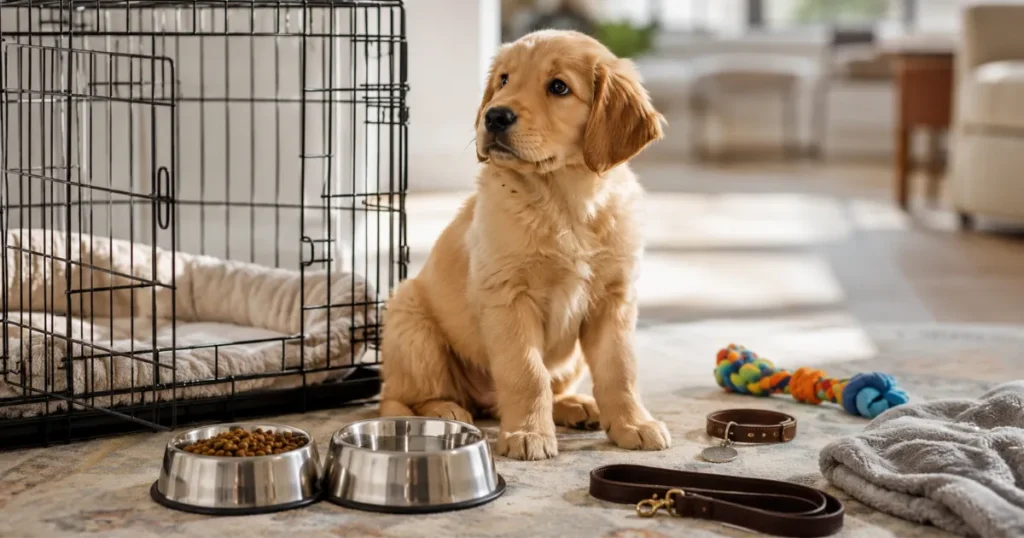
The car ride home was quieter than I expected.
My puppy sat in his crate on the back seat, wide eyes taking in every passing tree and streetlight.
Not crying. Not sleeping. Just watching.
I kept checking the rearview mirror every 30 seconds, convinced something was wrong because he was so still.
Nothing was wrong.
He was just trying to figure out what had happened to his entire world in the last three hours.
That first day, I made every mistake a new owner can make.
Too many people in the house at once. Food change on day one. Forgot the first potty break. Let him roam every room unsupervised while I scrambled to find where I had packed the puppy pads.
By 9pm, I was exhausted and he was overstimulated.
Not exactly the golden-hour first day I had imagined.
If I had followed a simple new puppy first day checklist, all of it was avoidable.
This guide is that checklist.
Every step, in the right order, with the reasons behind each one, so your puppy’s first 24 hours set you both up for the weeks ahead instead of sending you both into survival mode.
That’s why having a simple new puppy first day checklist makes everything easier.
This guide will help you:
- Prepare your home before arrival
- Handle the first few hours without stress
- Avoid common first-day mistakes
- Make bedtime smoother
- Start building trust immediately
As a dog parent, the goal isn’t to control everything. It’s to create a steady, predictable environment where your puppy feels safe.
Let’s walk through exactly what to do step by step , so day one feels calm, structured, and memorable for all the right reasons.
For the complete picture beyond day one, check our guide on how to take care of a puppy for the first time.
Most puppies settle within 2 to 4 days when the first day is calm, structured, and low-stimulation.
Why Your new puppy first day checklist Matters More Than You Think
Most new owners think the first day is about fun, photos, introductions, showing the puppy their new bed.
It is not.
The first day is about one thing: helping your puppy feel safe in an overwhelming situation.
Your puppy just left their mother, their littermates, and the only home they have ever known.
Their nervous system is on full alert.
Every smell, sound, and face is unfamiliar.
The decisions you make in the first 24 hours directly shape:
- How much stimulation your puppy experiences
- How calm or chaotic the environment feels
- Whether their basic needs are met consistently
- Their confidence
- Their stress response
- Their ability to trust you
A calm, structured first day makes potty training easier, crate training faster, and the first night quieter.
An overwhelming first day creates a puppy whose anxiety baseline is already elevated before training has even started.
According to the American Kennel Club, the first day home with a new puppy should be kept calm and predictable.
Limiting exposure to too many new people, smells, and places at once helps the puppy begin building security and confidence rather than shutting down from overstimulation.
Before Your Puppy Arrives (Preparation Checklist)
Preparation reduces stress — for both of you.
According to the American Veterinary Medical Association (AVMA), the first few weeks in a new home strongly influence a puppy’s long-term behavior and confidence. Structure and routine reduce stress and prevent anxiety-based problems later.
This new puppy first day checklist starts before the puppy is even in your car.
Preparation is what makes the first day calm instead of chaotic.
Puppy-Proof Your Home
Get down to puppy level, literally, on your hands and knees, and look at your home from their perspective.
Everything they can reach, they will investigate with their mouth.
Remove or secure:
- Electrical cords: chewing these is a genuine electrocution risk.
- Small objects: coins, buttons, children’s toys that can be swallowed.
- Toxic houseplants: lilies, pothos, aloe, many common indoor plants are toxic to dogs.
- Cleaning supplies: move to locked cabinets.
- Shoes: they will find them, they will chew them.
- Open trash bins: get bins with locking lids.
- Low bookshelves: puppies pull things off shelves.
Use baby gates to block off stairs and rooms that are not part of the initial safe zone.
Too much space too fast leads to accidents and overwhelm.
Set Up the Safe Zone Before They Arrive
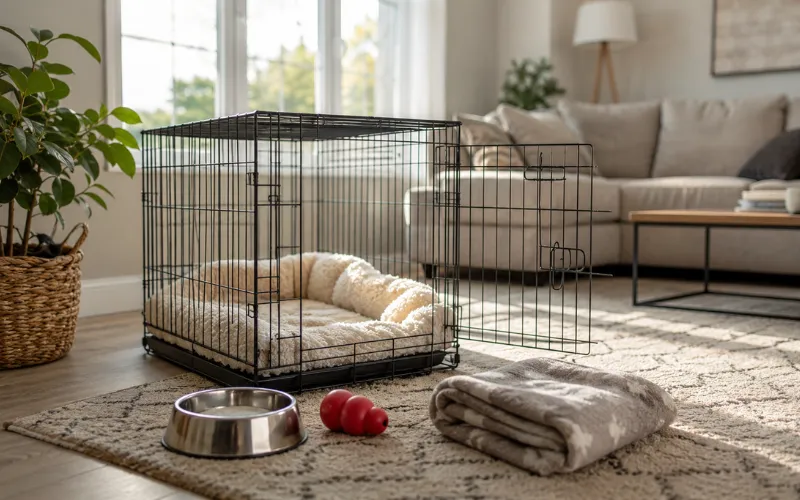
Your puppy needs one small, predictable area for their first days home.
Set this up completely before you leave to pick them up.
The safe zone should include:
- An appropriately sized crate with soft bedding
- A water bowl at ground level
- One safe chew toy
- A blanket, ideally something the breeder sent with the puppy’s scent on it
Place the crate in the room where your family spends the most time, never in an isolated room or garage.
Your presence nearby is the most calming thing available to a new puppy.
Essential Supplies: Have These Ready Before Day One
| Supply Category | Why You Need It | Recommended Product | Action |
|---|---|---|---|
⭐ DAY 1 ESSENTIAL
Crate | Safe space and potty-training foundation | MidWest iCrate Double Door Crate ↗ | Check Deal → |
Food & Water Bowls | Durable, hygienic, and easy to clean | AmazonBasics Stainless Steel Bowls ↗ | Check Deal → |
Puppy Food | Helps avoid stomach upset during transition | Ask your breeder for the exact food used before pickup | 💡 Breeder First |
Collar & ID Tag | Essential safety from day one | Blueberry Pet Puppy Collar ↗ | Check Deal → |
Leash (4–6 ft) | Potty trips and basic control | Standard nylon leash (avoid retractable leashes) | 🐕 Standard Leash |
🔥 TEETHING & CRATE COMFORT
KONG Puppy Toy | Chewing relief and crate comfort | KONG Puppy Toy ↗ | Check Deal → |
Puppy Pads | Backup protection for accidents | Amazon Basics Training Pads ↗ | Check Deal → |
🧼 ODOR REMOVAL MUST-HAVE
Enzymatic Cleaner | Removes accident odors completely | Rocco & Roxie Stain Remover ↗ | Check Deal → |
Place this in the crate on day one.
The familiar scent reduces anxiety dramatically during the first few nights — it is the single most effective comfort tool available and it costs nothing.
ThThe First Hour at Home: Step by Step
The first hour is the most critical part of this new puppy first day checklist.
Everything in this section matters.
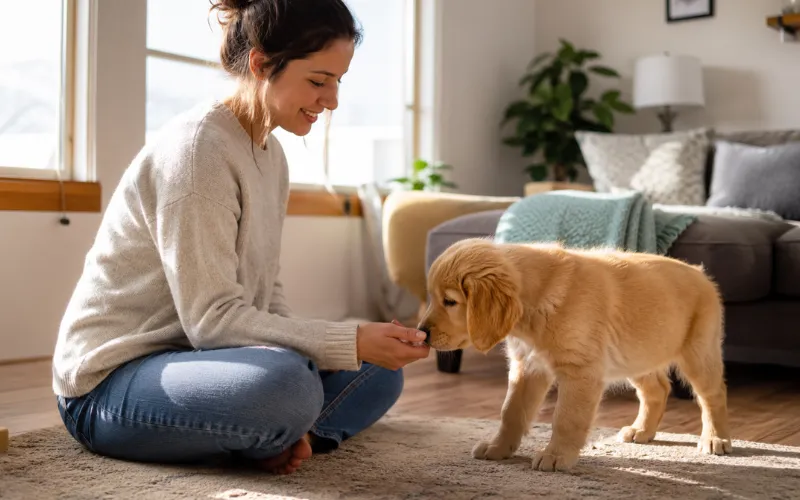
Step 1: Go to the Potty Area Before the House
Before your puppy steps foot inside, take them directly to their designated outdoor potty area.
Why this matters: Most puppies need to eliminate after a car journey due to stress and movement.
If you walk them inside first, that first accident almost always happens indoors, and in their mind, that spot just became an acceptable bathroom.
How to do it:
- Carry them from the car directly to the potty spot
- Set them down on the grass
- Wait quietly, 3 to 5 minutes
- The moment they go, say “good potty” calmly and offer a small treat
- Then, and only then, take them inside
This one habit, done consistently from the first arrival, is the foundation of potty training. For the complete potty training method, read our guide on how to potty train a puppy fast at home.
Step 2: Keep the First Introduction Calm
Once inside, the instinct of everyone in the household is to crowd around the puppy, pick them up, exclaim over how cute they are, and generally create a level of stimulation that would overwhelm most adults.
Resist this completely.
What to do instead:
- Let the puppy explore the safe zone at their own pace, no forcing, no grabbing
- One person at a time for initial interactions
- Speak softly, no high-pitched excited voices yet
- Let the puppy approach people, not the other way around
- No visitors, neighbors, or friends on day one
You are not being boring.
You are building trust.
A puppy that chooses to approach you is a puppy that is beginning to feel safe.
Step 3: Show the Safe Zone
Guide your puppy gently to their crate area.
Toss a treat just inside the crate entrance.
Let them investigate on their own terms.
Do not:
- Push them inside
- Close the door immediately
- Make it a big moment
Just let them sniff, enter if they choose, and exit freely.
The crate introduction on day one should be entirely positive and entirely pressure-free.
First Day Routine: Hour by Hour Timeline
Structure is not about rigidity.
It is about giving your puppy predictability, which is what helps their nervous system settle.
Complete First Day Timeline
Feeding on Day One: What to Know
Feed the same food the breeder or shelter used, at least for the first 5 to 7 days.
Changing food on the first day adds digestive stress on top of emotional stress and almost always causes loose stools.
- Young puppies under 4 months: 3 meals per day
- Puppies 4 to 6 months: 2 to 3 meals per day
- Puppies over 6 months: 2 meals per day
For the complete puppy feeding schedule by age and size, read our puppy feeding schedule by age guide.
The Nap Rule: Most Owners Get This Wrong
Young puppies sleep 18 to 20 hours per day.
That is not an exaggeration.
A puppy that looks overtired, biting harder, zooming around randomly, becoming increasingly frantic, almost always needs a nap, not more play.
Signs your puppy needs to sleep:
- Biting and nipping increases suddenly
- Zoomies with no clear trigger
- Whining without obvious cause
- Cannot settle or focus
When you see these signs, take puppy directly to their crate, close the door, and walk away.
Most overtired puppies fall asleep within 5 minutes.
This is not mean. It is what they need.
For a full first-week rest plan, read our puppy sleep schedule for the first week at home.
Supplies Deep Dive: What to Buy and Why
Beyond the basic checklist, some supplies make an enormous difference in the first weeks and are worth understanding before you buy.
Choosing the Right Crate Size
This is where many owners unknowingly make potty training harder.
A crate that is too large gives the puppy room to toilet at one end and sleep at the other, eliminating the entire purpose.
The crate should allow the puppy to stand, turn around, and lie fully stretched.
Nothing more.
If you buy a larger crate for them to grow into, always use the divider panel to block off the excess space.
Most wire crates include one.
Size guide:
- Small breeds under 25 lbs: 24 to 30 inch crate
- Medium breeds 25 to 50 lbs: 36 inch crate
- Large breeds 50 to 90 lbs: 42 to 48 inch crate
The Enzymatic Cleaner: Non-Negotiable
Regular household cleaners remove the visible stain but leave odor molecules that humans cannot smell but puppies absolutely can.
If a puppy can smell a previous accident, they will return to that spot.
An enzymatic cleaner breaks down the organic compounds completely, removing the smell signal entirely.
This is not optional for a new puppy household.
The KONG Toy: Most Effective Comfort Tool
A KONG Puppy toy stuffed with a small amount of peanut butter, check the label, no xylitol, and frozen overnight is the single most effective crate comfort tool available.
The act of licking is naturally calming for dogs and keeps them occupied long enough to settle.
Give the frozen Kong only at crate time.
This makes the crate predict something wonderful and significantly accelerates crate acceptance.
First Night With Your New Puppy: What to Expect
The first night is where most new owners panic.
Here is the honest truth about what to expect and exactly what to do.
Night Setup
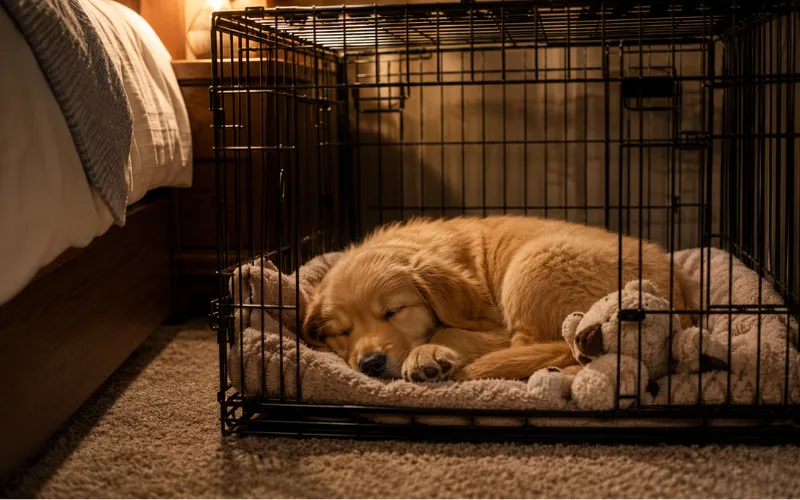
Place the crate beside your bed, close enough that your puppy can smell and hear you.
This single decision reduces crying more than anything else you can do.
Crate setup for night one:
- Soft, washable bedding
- The breeder’s scent cloth or blanket if you have one
- A frozen Kong or small safe chew toy
- Cover three sides of the crate with a blanket, creates den feeling
Do not place the crate in another room.
Distance from you on night one dramatically increases anxiety.
When They Cry: The Honest Answer
They will probably cry.
Most puppies do on night one.
This is completely normal and does not mean anything is wrong.
Wait 2 to 3 minutes before responding.
Many puppies cry, settle briefly, cry again, and then fall asleep.
If you rush in at the first sound, you teach them that crying summons you.
If crying continues past 5 minutes:
- Check if a bathroom trip is needed, young puppies cannot hold it all night
- Take outside calmly and quietly, this is not playtime
- No talking, no lights, straight back to crate
- Reward going outside, then back to sleep
For everything about why puppies cry at night and what to do about it, read our complete guide on why does my puppy cry at night.
Most puppies settle significantly within 2 to 4 nights when the crate is positioned correctly and night trips are handled calmly and without drama.
Health Essentials: What to Do in the First Week
Book the First Vet Visit Within 3 Days
Schedule a vet visit within the first 3 to 5 days of bringing your puppy home, before health concerns arise, not after.
This establishes your puppy’s medical record, confirms vaccination status, and gives you a baseline health assessment.
Bring to the appointment:
- Any vaccination records from the breeder
- The food you are currently feeding
- A fresh stool sample if possible, parasites are common in young puppies and many have no visible symptoms
Vaccinations: What the Schedule Looks Like
Most puppies begin their core vaccination series between 6 and 8 weeks.
The standard schedule includes multiple rounds spaced 3 to 4 weeks apart.
Until the series is complete, typically around 16 weeks, your puppy’s immunity is not fully established.
This means:
- Avoid dog parks and areas with unknown dogs
- Supervised interaction with fully vaccinated, healthy dogs is generally acceptable
- Socialization is still critical, just do it carefully in controlled environments
According to the American Veterinary Medical Association, following your veterinarian’s recommended vaccination schedule is one of the most important preventive health steps in a puppy’s first year.
ID and Safety: Check These on Day One
- Collar fits correctly: two fingers should fit comfortably under the collar
- ID tag includes your phone number, not just the dog’s name
- Yard fencing checked for gaps, puppies fit through surprisingly small spaces
- Microchip confirmed if breeder provided one, register it in your name immediately
Puppies can decline quickly — early intervention matters.
Common First Day Mistakes: And How to Avoid Them
These are the mistakes I made, and the ones every new owner makes at least one of.
- Too many visitors on day one: Every person who wants to meet the puppy is bringing noise, new smells, and stimulation. Your puppy needs calm, not a party. Tell friends and family the first day is family-only. Day three or four is fine for visitors.
- Changing food immediately: The breeder’s food may not be the food you planned to use long-term, but changing on day one adds digestive stress to emotional stress. Keep the same food for at least 5 to 7 days, then transition gradually.
- Letting puppy roam the entire house: Too much freedom too fast means accidents everywhere and a puppy that feels overwhelmed rather than safe. Start with one room, expand gradually over days and weeks.
- Skipping the first potty break: The most common cause of the first indoor accident. Car ride plus stress plus excitement equals full bladder. Straight to the potty area before anything else.
- Forcing crate time too fast: The crate introduction should be entirely positive on day one. Toss treats in, let them enter freely, let them exit freely. Forced confinement on day one creates a dog that fights the crate for weeks.
- Interpreting every cry as distress: Some crying is normal adjustment. Rushing to comfort every sound teaches your puppy that crying produces attention. Wait briefly before responding.
- Overstimulating with play: Puppies look like they want to play constantly. They don’t. They need frequent naps more than frequent play. Watch for overtired behavior and respond with crate rest, not more stimulation.
According to the ASPCA, a calm and structured introduction to a new home, with consistent routines from the very first day, significantly reduces anxiety-based behavior problems in puppies during their first weeks in a new environment.
Frequently Asked Questions (FAQ)
What should I do on the first day of my new puppy?
Keep things calm and structured. Show them their potty area immediately, offer water, feed small scheduled meals, and avoid overwhelming them with too many visitors. The goal is comfort, not training perfection.
How to prepare for a puppy’s first day at home?
Buy essentials in advance, puppy-proof your home, set up a sleeping area, remove hazards, and plan a basic day schedule. Preparation reduces stress for both you and your puppy.
New puppy checklist?
You need Puppy food, Bowls, Crate, Bedding, Collar u0026amp; leash ,Chew toys, Training treats, potty supplies, ID tag, poop bags and scheduled vet appointment.
How long does it take a puppy to adjust to a new home?
Most puppies start feeling comfortable within 3-7 days. Full adjustment takes 2-4 weeks. Keep their routine consistent and give them space — they settle faster than you’d expect.
Should I let my puppy sleep with me on the first night?
It’s tempting, but not recommended. Starting the crate habit from night one is much easier than trying to transition later. Place the crate rightu003cbru003enext to your bed — they can smell and hear you, which is usually enough comfort.
How often should a puppy go outside on the first day?
Every 1-2 hours during the day, plus immediately after every meal, nap, and play session. On the first day, err on the side of too many trips outside rather than too few.
When should I start training my puppy?
Day one. Not obedience training — but basic structure. Where they eat, where they sleep, where they go potty. These habits start forming from the very first hour at home.
Your Puppy’s First Day: Final Thoughts
My dog’s first day was memorable for all the wrong reasons.
Too many people. Too much chaos. A bathroom accident in the hallway I did not find until the next morning. A first night where nobody slept.
None of it was necessary.
This new puppy first day checklist exists because the calm, structured version of day one is genuinely achievable, it just requires knowing what to do and in what order before the puppy is already in your arms.
Three things to remember:
- Potty area before anything else, every single time, from the very first arrival. This one habit done consistently from day one saves weeks of housetraining headache.
- Calm beats exciting, your puppy does not need a party. They need safety, predictability, and the time to figure out that this new place is where they belong.
- Naps are not optional, 18 to 20 hours of sleep per day is normal and necessary. Enforce rest before your puppy reaches the overtired meltdown stage.
For everything your puppy needs in the weeks ahead, read our complete guide on how to take care of a puppy for the first time.
Following a new puppy first day checklist makes the whole process much less overwhelming.
Always monitor your puppy closely when trying anything new. If you notice any unusual symptoms or behaviors, consult your veterinarian immediately.
Starting strong makes everything easier.
If you prefer having a step-by-step printable guide you can follow during the first week, get our free Puppy Starter Care Guide below.
Get Free Puppy Guide


Pingback: How Long Can You Leave a Puppy Alone? Age Chart (2026)