

I left my 9-week-old puppy alone for 20 minutes on day 3. I came back to a puddle, a chewed shoe, and a puppy who’d cried so hard he’d made himself hoarse.
That mistake taught me something no age chart tells you upfront: how long can you leave a puppy alone isn’t really one number, it’s a skill both of you build together, slowly. Age matters. Bladder size matters. But so does whether your puppy has ever practiced being alone at all before you expect them to handle 20 unsupervised minutes.
Figuring out how long should you leave a puppy alone gets confusing fast, since different sources give different numbers, and some of that advice genuinely contradicts itself once you start comparing sources side by side. Knowing how to leave a puppy home alone safely isn’t just about picking the right number of hours, it’s about the buildup before that number matters at all.
This guide gives you the real numbers by age, reconciles 2 different formulas you’ll see floating around online that genuinely don’t match each other, and walks through exactly how to build up alone time without repeating my day-3 mistake.
The American Kennel Club’s own formula estimates bladder capacity after 16 weeks as roughly the puppy’s age in months plus 1 hour, while many trainers use a simpler “1 hour per month of age” rule for younger puppies. Both are estimates. A puppy who has never practiced being alone needs to build up gradually regardless of age.
How long you can leave a puppy alone ranges from 30 to 60 minutes at 8 to 10 weeks old, up to 4 to 6 hours by 6 months, based on age and bladder development, with the American Kennel Club estimating bladder capacity after 16 weeks as the puppy’s age in months plus 1 hour.
How Long Can You Leave a Puppy Alone, by Age
| Age | Time Alone | Bladder Break Needed |
|---|---|---|
| 8-10 weeks | 30-60 minutes | Every 30-45 min while awake |
| 10-12 weeks | 1-2 hours | Every 1-2 hours |
| 3 months | 2-3 hours | Every 2-3 hours |
| 4 months | 4 hours | Every 4 hours |
| 5 months | 5 hours | Every 4-5 hours |
| 6+ months | 4-6 hours | Every 4-6 hours |
This table reflects general guidelines gathered from veterinary and professional-trainer sources. Individual puppies vary based on breed, size, and temperament.
A puppy’s age directly determines safe alone-time limits: 30 to 60 minutes at 8 to 10 weeks old, 2 to 3 hours by 3 months, 4 hours by 4 months, and 4 to 6 hours once a puppy reaches 6 months and has developed reliable bladder control.
Two Formulas You’ll See, and Why They Don’t Quite Match
If you’ve searched this before, you’ve probably noticed the numbers don’t always agree. That’s genuinely true, and worth explaining rather than ignoring.
- The “1 hour per month” rule: widely used by trainers as a simple starting estimate, a 3-month-old puppy handles roughly 3 hours.
- The AKC’s own formula: puppies generally can’t reliably control their bladder until about 16 weeks old. After that point, the AKC estimates capacity as the puppy’s age in months plus 1 hour, so a 4-month-old puppy is estimated at about 5 hours.
According to the American Kennel Club, both formulas are approximations built around the same underlying fact, that bladder control develops gradually and doesn’t fully stabilize until around 16 weeks.
Neither formula is wrong. Use whichever number feels more conservative for your specific puppy, and always err toward shorter if you’re unsure.
Two commonly cited puppy alone-time formulas differ slightly, a simple 1-hour-per-month-of-age rule used by many trainers, and the American Kennel Club’s own formula of age in months plus 1 hour for bladder capacity after 16 weeks, meaning a 4-month-old puppy is estimated at 4 hours under the first formula and 5 hours under the AKC’s.
Can I Leave My 8 Week Old Puppy Home Alone?
This is one of the most common specific questions new owners ask, and it deserves a direct answer rather than a general age range.
Yes, but only for very short periods, typically 30 to 60 minutes at most. An 8-week-old puppy has just left their mother and littermates, has minimal bladder control, and hasn’t yet learned that you reliably come back. This is also the age to start practicing brief separations, not to jump straight into a full workday.
An 8-week-old puppy can be left alone for approximately 30 to 60 minutes at a time, since bladder control is minimal at this age and the puppy has only just been separated from their mother and littermates, making this the right age to begin short separation practice rather than extended absences.
Leaving a Puppy Alone at Home for the First Time
The very first time matters more than people expect, since it sets the tone for how your puppy interprets your departures going forward.
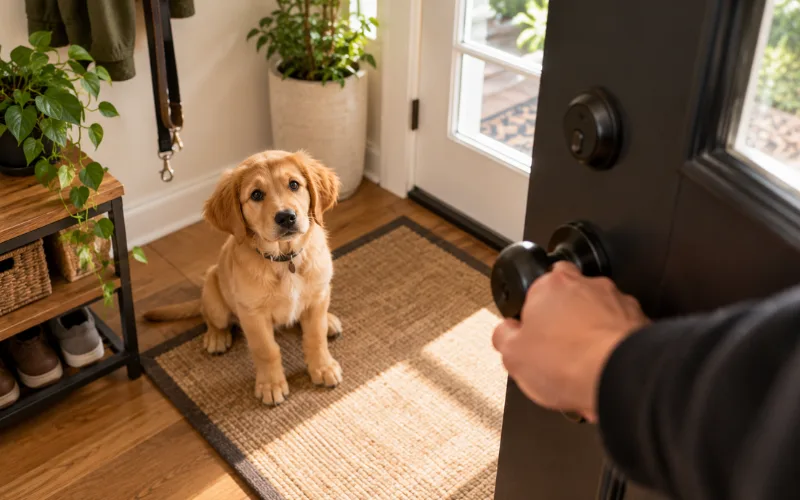
- Practice inside the house first. Step into another room and close the door for 30 seconds before ever leaving the building.
- Build up in seconds, not minutes, initially. Go from 30 seconds to 1 minute to 2 minutes before attempting your first real absence.
- Leave during a calm moment. A puppy who just finished eating or playing settles faster than one who’s wound up.
- Don’t make departures a big event. Skip the long goodbye. A calm, low-key exit and return teaches your puppy that leaving isn’t significant.
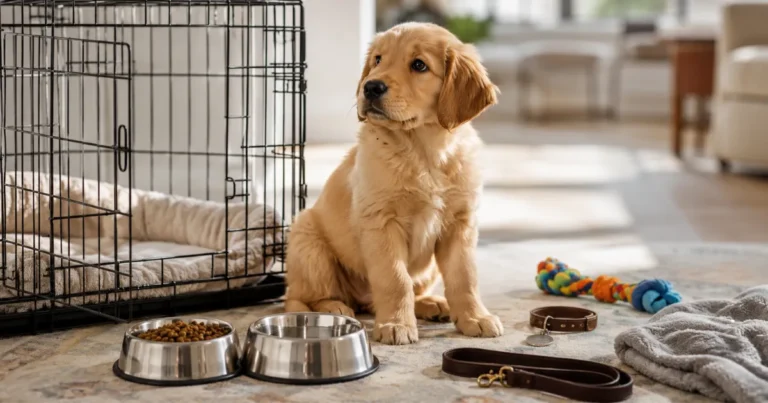
- Use a safe, contained space. A crate or puppy-proofed pen, not free run of the house, for early independent time.
For the complete potty training foundation that pairs with this timeline, read our guide on how to potty train a puppy fast at home.
How to Train a Puppy to Stay Home Alone
Learning how long can you leave a puppy alone is only half the picture, building genuine independence is a gradual training process, not something that happens automatically as your puppy ages.
- Practice “invisible” departures daily. Even a 2-minute trip to check the mail counts as practice.
- Create a consistent pre-departure routine. The same small sequence, like a specific toy or a particular cue word, helps your puppy predict what’s coming.
- Rotate a food puzzle or stuffed toy in during alone time specifically. This creates a positive association unique to being alone, not available at other times.
KONG Classic Stuffable Dog Toy
The most consistently recommended toy for alone-time enrichment
View on Amazon →- Extend time gradually, not in big jumps. Going from 10 minutes to 2 hours in one step is a common mistake that can undo previous progress.
- Vary your departure cues. Picking up keys or putting on shoes shouldn’t always predict leaving, or your puppy may become anxious every time you touch them.
Training a puppy to tolerate being alone works best through short, gradual practice sessions rather than jumping straight to the target duration you eventually want to reach.
According to the AKC, feeding meals inside the confinement area and reserving special toys exclusively for alone time helps a puppy build a positive association with the space, separate from associating it with being left.
For our complete guide to this training approach, read our guide on why does my puppy cry at night and what to do, which covers the same core separation-tolerance principles applied to nighttime specifically.
Crate or Pen, Which Setup Works Better
Part of figuring out how long can you leave a puppy alone comes down to their setup. Both crate and pen work, and the right choice depends on your puppy’s age and temperament more than a universal rule.
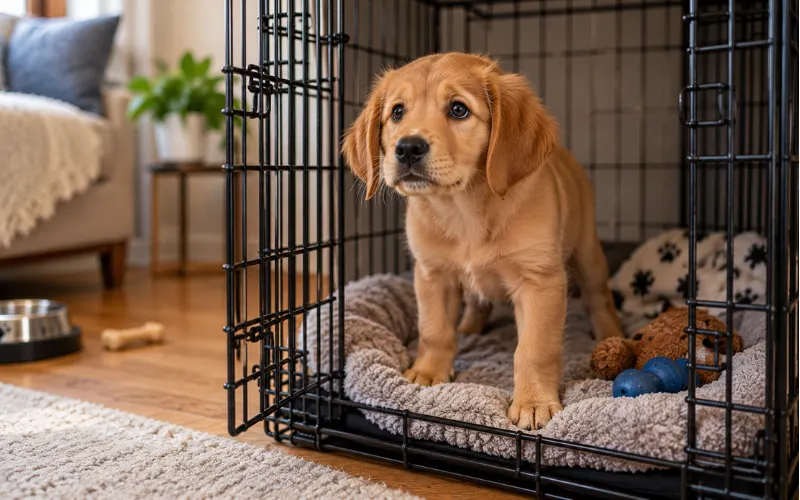
- Crate: better for house-training since most puppies instinctively avoid soiling their immediate sleeping space, and it limits access to chewable hazards completely.
- Playpen or gated room: gives more room to move, which some puppies genuinely need, and allows a separate potty pad area for very young puppies who can’t yet hold it for the full alone-time window.
- Either setup should include water, a safe chew item, and bedding that smells familiar, ideally something with your scent on it for the first few uses.
According to VCA Animal Hospitals, puppies crated during naps or independent play may have a reduced risk of developing overattachment and separation anxiety later, since the crate teaches them to spend time away from their owners in a low-pressure context.
MidWest 30″ Single Door iCrate
111,000+ reviews, includes divider panel for growing puppies
View on Amazon →For the complete crate training method from the very beginning, read our guide on new puppy first day checklist.
Puppy Crying When Left Alone, Normal vs Concerning
Some crying is developmentally normal. Persistent distress is a different situation entirely, and this distinction genuinely matters.
- Normal, early-stage crying typically lasts a few minutes after departure and settles once the puppy realizes nothing bad is happening.
- Concerning signs include crying that continues the entire time you’re gone, destructive behavior focused specifically on exit points (doors, windows), self-injury attempts, or accidents despite adequate bladder capacity for their age.
If your puppy’s separation distress isn’t improving with gradual training over 2 to 3 weeks, or is escalating rather than easing, that’s worth discussing with your veterinarian to rule out underlying anxiety that may benefit from a structured behavior plan beyond general separation training.
Signs You’re Moving Too Fast
These signs tell you whether you’ve correctly judged how long can you leave a puppy alone at their current stage. If your puppy shows these signs consistently, dial back to a shorter duration before trying to extend again.
- Excessive barking, howling, or whining that doesn’t settle within the first few minutes.
- Destructive chewing concentrated around doors or windows specifically, rather than general puppy chewing.
- Attempting to escape the crate or pen.
- Accidents happening well within their demonstrated bladder capacity for their age.
- Excessive panting, pacing, or drooling upon your return.
Signs a puppy is being left alone longer than they can handle include persistent barking, destructive chewing focused on doors or windows, and accidents that occur well within their demonstrated bladder capacity for their age.
According to the ASPCA, destructive behavior linked to separation distress is often concentrated around exit points like doors and windows specifically, distinct from general puppy chewing that can happen anywhere.
Slowing down isn’t a setback. Returning to a shorter, successful duration and rebuilding gradually from there almost always works better than pushing through distress.
I am a dog owner sharing personal research and experience, not a certified veterinary behaviorist. Persistent or worsening separation distress should be evaluated by a veterinarian or certified applied animal behaviorist, since it may indicate separation anxiety requiring a structured treatment plan beyond gradual alone-time training alone.
Frequently Asked Questions
How long can you leave a puppy alone?
How long can you leave a puppy alone depends primarily on age. Guidelines range from 30 to 60 minutes at 8 to 10 weeks old, up to 4 to 6 hours by 6 months and older, based on bladder development and separation training progress.
How long can I leave my puppy alone at night?
Overnight is different from daytime absences since your puppy is sleeping rather than needing entertainment or bathroom breaks as frequently. Most puppies can sleep through 5 to 7 hours overnight by 4 to 5 months old, though very young puppies may still need one nighttime bathroom break.
When can you leave a puppy alone for a full workday?
Most puppies aren’t ready for a full 8-hour workday alone until around 6 months old, and even then, a midday bathroom and enrichment break is genuinely beneficial. Younger puppies need a dog walker, daycare, or a family member’s help during the workday.
Is it normal for a puppy to cry when left alone?
Some crying in the first few minutes after departure is normal and typically settles on its own. Persistent crying for the entire duration, or crying that worsens over time rather than improving, may indicate the puppy isn’t ready for that duration yet or is developing separation anxiety.
Can I leave my 8 week old puppy home alone?
Yes, for very short periods of 30 to 60 minutes. At this age, bladder control is minimal and the puppy has just been separated from their mother and littermates, making this the right time to begin brief separation practice rather than extended absences.
How do I train my puppy to be okay being left alone?
Start with seconds-long practice separations inside the house, gradually building duration over days and weeks. Use a consistent pre-departure routine, keep departures and returns low-key, and provide a safe, enriching activity like a stuffed puzzle toy specifically during alone time.
Building Independence, One Departure at a Time, Final Thoughts
That day-3 mistake with the puddle and the chewed shoe taught me that how long can you leave a puppy alone isn’t a fixed number on a chart, it’s a skill we were both still learning.
Three things to take with you.
- Age gives you a starting range, not a guarantee. Your puppy’s actual demonstrated tolerance matters more than any formula.
- Gradual practice beats jumping straight to the target duration. Seconds, then minutes, then hours, in that order.
- Persistent distress is information, not failure. Slowing down and rebuilding almost always works better than pushing through.
For the complete foundation this training builds on, read our guide on how to take care of a puppy for the first time.
And if separation distress continues beyond typical adjustment, our guide on how to stop dog separation anxiety when left alone covers the deeper behavioral approach.

Pingback: How to Stop Dog Separation Anxiety When Left Alone — Complete Guide