

My dog used to launch himself at anyone who walked through the door, muddy paws and all. I spent 3 weeks yelling “off” before I realized the word meant nothing to him. It was just noise that came with eye contact, which, from his side of things, was still attention.
That’s genuinely the trap most dog jumping training advice misses. Pushing a dog away, shouting a command it was never taught, even looking at it disapprovingly, all of that still counts as a reaction. And reactions are exactly what a jumping dog is after.
Most guides on how to stop a dog from jumping on people tell you the theory (ignore the jump, reward the calm) without giving you a clear, repeatable structure to actually follow at your front door, with your specific family, or with guests who won’t cooperate.
This guide covers real dog jumping training with a clear 7-step protocol, a day-by-day plan you can actually follow, and the specific mistakes that make jumping worse instead of better.
It also covers what changes for puppies, what to do about guests who won’t follow your rules, and when the problem is big enough to call in a professional.
To stop a dog from jumping on people, remove all attention for jumping – no talking, touching, or eye contact – and reward an alternative like four paws on the floor or sitting.
Start with calm people, then practice with family, guests at the door, and finally strangers outside. Consistency from everyone matters most. Many dogs improve within 2 to 4 weeks of daily practice, while established habits may take 4 to 8 weeks.
To stop a dog from jumping on people, remove all reward for the jump, no talking, touching, or eye contact, and teach a specific replacement behavior like four paws on the floor or a sit, practicing with progressively more distracting people until the calm greeting becomes automatic.
Why Do Dogs Jump on People?
Jumping Gets Them Attention
Dogs repeat behaviors that work. Jumping gets a reaction, a touch, a raised voice, eye contact, all of it registers as attention from the dog’s perspective, even when the human intends it as a correction.
Excitement and Overstimulation
High-arousal moments, someone walking through the door, a guest arriving, a walk starting, all spike a dog’s energy quickly. That energy has to go somewhere, and jumping is often the most direct physical outlet available.
Dogs May Have Learned That Jumping Works
A 2018 study published in the journal Applied Animal Behaviour Science found that dogs jumped toward the faces of household members returning home significantly more often than they jumped while those same people were holding food, suggesting the jumping is genuinely about reaching face-level contact, not about the food itself.
Puppies vs. Adult Dogs, Why the Behavior Happens
Puppies jump because they’re mimicking a face-to-face greeting behavior they use with their mother and littermates. Adult dogs jump because the behavior has already been rewarded, sometimes for years, and the habit is more deeply grooved as a result.
Before Training, Stop Rewarding the Jumping
What Counts as a Reward?
This is the part most competing guides skip, and it’s the reason jumping training fails for a lot of owners.
A reward isn’t just a treat or praise. From a dog’s perspective, being pushed away, having its paws grabbed, hearing “no” in an irritated voice, and even a person laughing all count as reward, because all of them are a reaction.
The genuine trap is intermittent reinforcement, meaning the dog gets rewarded sometimes but not every time. This is the same mechanism that makes slot machines addictive to people. If jumping works on Monday with a friend who thinks it’s cute, fails on Tuesday when you ignore it, and works again on Wednesday with your child, the dog learns the behavior is worth trying every single time, since it never knows in advance which attempt will pay off.
What Everyone in the Household Should Do
- Every person in the home needs to use the identical response, full ignore until 4 paws are down.
- One person who occasionally allows jumping, even “just this once,” can undo weeks of consistent work from everyone else.
- Brief guests and visitors on the rule before they arrive, not after the dog has already jumped.
The American Veterinary Society of Animal Behavior’s official position statement recommends reward-based methods over physical corrections for behavior training, consistent with the ignore-and-reward approach used throughout this guide.
The Four-Paws-on-the-Floor Rule
The simplest version of the alternative behavior: your dog gets attention only when all four paws are touching the ground. No sit required, no formal command, just the physical fact of not being airborne.
How to Stop a Dog From Jumping on People in 7 Steps
This is the core protocol. Work through these steps in order, and don’t move to the next one until the current step is reliable in a low-distraction setting.
Step 1, Teach Your Dog That Four Paws on the Floor Get Attention
A real peer-reviewed study on functional analysis of jumping in companion dogs found that a noncontingent, time-based reinforcement strategy reduced jumping in 3 of 4 dogs studied, with statistically significant results in most cases.
- The instant all 4 paws land back on the ground, mark it (a word like “yes” or a clicker) and reward immediately.
- Expect the jumping to briefly get worse before it improves. This is a normal extinction burst, not a sign the method isn’t working.
- Stay physically neutral during the jump itself, cross your arms, turn slightly sideways, say nothing.
The reward window is very short – about 1 second after all four paws land. Keep treats in your hand before you start rather than reaching for them afterward. That small delay can determine whether your dog connects the reward with the behavior you actually want.
Step 2, Teach a Reliable Sit Before Greetings
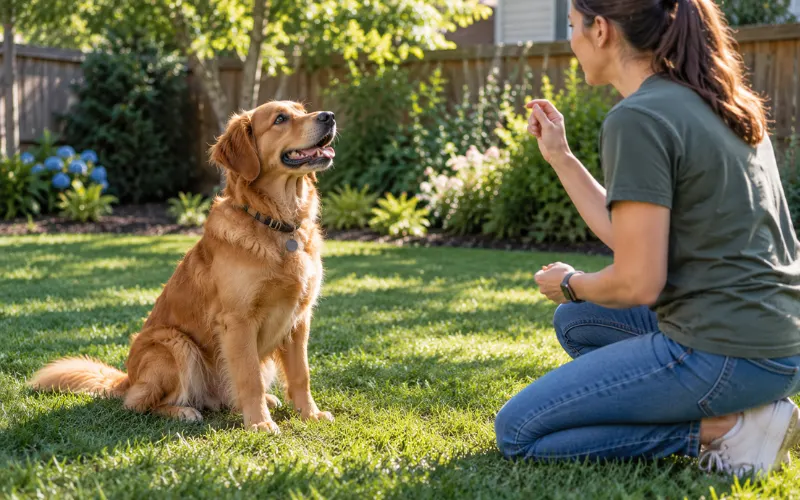
Once 4-paws-down is solid, add a sit as the more polished version of the same idea. A dog that’s sitting is physically unable to jump at the same time.
If your dog struggles specifically with sit under excitement, a “place” command (sending the dog to a mat) or hand-targeting (touching a nose to an open palm) can work as an alternative replacement behavior, since both keep all 4 paws grounded without requiring the same impulse control as a hold-still sit.
For a structured program that builds this exact foundation, our SpiritDog Basic Obedience review covers a full course built around reliable commands like this one.
Build the Foundation First
SpiritDog Basic Obedience
Force-Free | Reliable Sit and Core Commands
See Basic Obedience →Step 3, Add a “Wait” Before Your Dog Gets to Greet Someone
Once sit is solid, add a brief pause, 3 to 5 seconds, before releasing your dog into the greeting. This prevents rewarding the tail-end of a jump-then-sit sequence, and it builds genuine impulse control rather than a rushed compliance.
Step 4, Practice Greetings With Family Members
Family members are lower-stakes practice partners than guests, since you can coach them in real time. Run the same 4-paws or sit protocol with each person in the house, individually, several times a day.
Step 5, Train Your Dog When Guests Come to the Door
This is covered in full detail in its own section below, since the front door is genuinely the highest-stakes environment for most dogs.
Step 6, Practice With Calm Strangers Outside the Home
Ask a calm stranger, or a friend your dog doesn’t see often, to approach slowly while your dog is on leash. Ask for a sit before they get within jumping range. Most strangers are happy to wait a few seconds if you ask directly.
Step 7, Reward Calm Greetings Around Real-Life Distractions
The final step is generalization, practicing the same protocol at the park, at a friend’s house, at the vet’s office. A dog that doesn’t jump at home may still jump in a new environment until that specific context gets practiced too.
What to Do When Your Dog Jumps During Training
If Your Dog Jumps on You
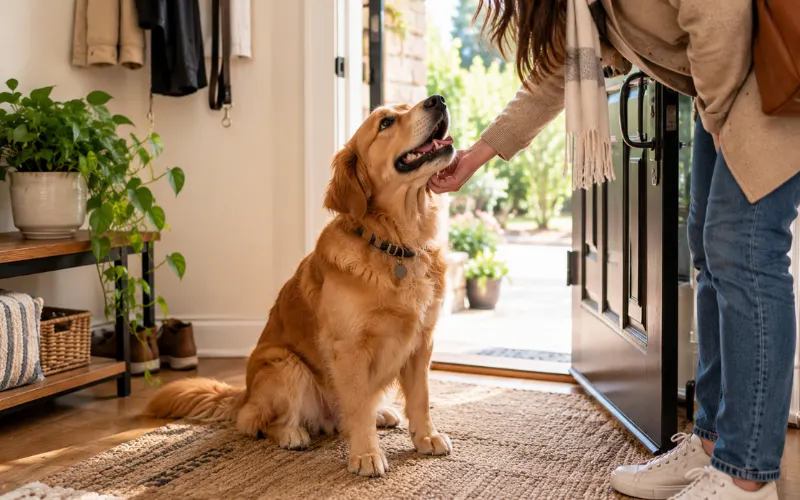
Go still and neutral immediately. No pushing, no talking, no eye contact. The moment all 4 paws are down, mark and reward.
If Your Dog Jumps on Guests
Interrupt calmly using a leash if one’s attached, guide your dog away from the guest, and reset. Don’t scold in front of the guest, since raised voices and tension add arousal rather than reducing it.
If Your Dog Keeps Jumping After Repeated Practice
Check for inconsistency first. A single household member who occasionally allows jumping is the most common reason training stalls. Also check whether sessions are too long, dogs lose focus past 5 to 10 minutes of active training.
If Your Dog Gets Too Excited to Sit
Drop back a step. Practice sit in a lower-arousal moment, then gradually reintroduce the exciting trigger (the door, a guest) only once the sit is genuinely reliable in calm conditions.
How to Stop a Puppy From Jumping on People
Start With Short Training Sessions
Puppies have short attention spans. Keep sessions to 2 to 3 minutes, several times a day, rather than one long session.
What to Do When Your Puppy Jumps
Get down to the puppy’s level for greetings instead of encouraging them to come up to yours. This removes the height-seeking motivation behind the jump entirely.
Why Puppy Training Should Start Early
Puppies haven’t yet built months or years of reinforcement history behind the behavior, which makes early, consistent training genuinely faster than correcting an ingrained adult habit. Letting a puppy jump “because it’s cute” for weeks or months before addressing it is one of the most common reasons the behavior becomes entrenched.
For our complete puppy training foundation, read our guide on positive reinforcement dog training for beginners.
How to Stop a Dog From Jumping on Guests at the Door
Before Opening the Door
Put your dog on leash or behind a gate before the doorbell rings, not after. Ask arriving guests to wait a few seconds while you get your dog into a calm position.
Keep a small container of low-value treats right by the front door. Having them ready saves those few extra seconds after the doorbell rings, when your dog’s excitement can quickly become too high for effective training.
When the Guest Enters
Keep the greeting low-key. A guest who crouches down, makes excited eye contact, or uses a high-pitched voice is unintentionally cranking up your dog’s arousal level right when you need it lowest.
When Your Dog Loses Control
Calmly guide your dog away using the leash, reset to a sit a few feet back, and try the entry again. Repeated resets are normal early on, not a sign of failure.
How Guests Should Respond
Brief every guest the same way: ignore the dog completely until it’s sitting or has all 4 paws down, then offer calm attention. Handing guests a small treat to reward the calm moment gives them a clear, easy role to play.
Not every guest will follow your instructions perfectly. Some may pet your dog anyway, thinking a little jumping is harmless. Consistency from your own household matters most – you can’t control every visitor, but you can control how you respond every time.
A 7-Day Dog Jumping Training Plan
Most competing guides describe the steps without giving a concrete daily structure for genuine dog jumping training. Here’s one to actually follow.
A structured 7-day dog jumping training plan moves from basic four-paws-on-the-floor practice on Day 1 through sit training, family greetings, guest-door practice, and outdoor distractions by Day 7, building difficulty gradually rather than jumping straight to the hardest scenario.
This timeline assumes daily practice and a dog with no significant prior reinforcement history. Adult dogs with years of established jumping habits will likely need to repeat this 7-day structure 2 to 3 times before the behavior feels reliably solid.
Consistent dog jumping training over a full 7-day cycle, repeated 2 to 3 times for adult dogs with established habits, is generally more effective than sporadic practice spread out over a longer period.
Common Mistakes That Make Dog Jumping Worse
Pushing Your Dog Away
Physical contact, even a firm push, registers as engagement. For many dogs, this reads as the opening move of a play fight, not a correction.
Yelling or Repeating “Off”
An untrained “off” is just noise paired with your voice and attention, both rewarding. Some dogs learn a full sequence: jump, hear “off,” get petted for stopping, which still ends in attention for the overall behavior chain.
Giving Attention After Jumping
Petting your dog the moment it stops jumping, without a genuine pause first, risks rewarding the tail end of the jump sequence rather than a truly calm moment.
Letting Some People Allow Jumping
Covered above, but worth repeating here: one exception, consistently applied, maintains the behavior indefinitely.
Training Only When Guests Arrive
Jumping training needs daily practice in low-stakes moments, not just crisis-mode attempts during actual guest arrivals when arousal is already high.
Intermittent Reinforcement, the Reason Jumping Persists
This deserves its own mention as a mistake, not just a mechanism. An owner who ignores jumping 9 times out of 10 but responds on the 10th, out of frustration or forgetting, isn’t training inconsistently by accident. That single response is often enough to maintain the entire behavior at full strength, since the dog only needs the behavior to occasionally work to keep trying it.
Successful dog jumping training depends more on eliminating occasional, accidental rewards for jumping than on any single technique, since even one inconsistent response can undo weeks of otherwise consistent household effort.
How Long Does It Take to Train a Dog Not to Jump?
Genuinely different timelines depending on the dog.
- Puppies with consistent household training: 2 to 4 weeks for noticeable, reliable improvement.
- Adult dogs with an established habit: 4 to 8 weeks of consistent daily work before the new greeting behavior feels automatic.
- Highly excitable or high-energy dogs: may take longer at each step, particularly the guest-door and stranger stages, since arousal recovery time is naturally longer.
- The single biggest factor affecting speed: consistency across every person in the household, not the dog’s intelligence or trainability.
Increase difficulty (moving from family to guests, or from guests to strangers outside) only once the current stage is reliable in at least 8 to 10 consecutive attempts.
What If My Dog Still Jumps on People?
Even after working through the core protocol on how to stop a dog from jumping on people, some specific scenarios need extra troubleshooting.
- Dog jumps only on certain people: likely those specific people have rewarded the behavior, even unintentionally, in the past. Brief them directly on the protocol.
- Dog jumps when excited: drop back to lower-arousal practice and rebuild the behavior at a calmer baseline before reintroducing excitement.
- Dog jumps on children: children’s body language, quick movements, high-pitched voices, and face-level height can all intensify jumping. Practice with children specifically, under close supervision.
- Dog jumps when coming out of the crate: this is often a release-excitement issue separate from greeting-jumping. Practice a calm release cue before opening the crate door.
- Dog jumps despite knowing “sit”: the sit likely isn’t proofed under this specific level of distraction yet. Lower the difficulty and rebuild gradually.
- Dog jumps only outside: outdoor environments add movement, smells, and unpredictability that indoor practice doesn’t cover. Generalize training specifically in outdoor settings.
For dogs whose jumping is tied to broader impulse-control issues rather than greetings specifically, our SpiritDog course comparison includes a dedicated course built around exactly this.
When Should You Get Professional Dog Training Help?
- Jumping paired with genuine fear or aggression signals: growling, stiff body language, not typical loose, wiggly excitement.
- A large dog whose jumping poses a real safety risk: especially around children or elderly family members.
- No meaningful improvement despite several weeks of genuinely consistent training: across the whole household.
- Jumping that intensifies rather than gradually improves over time: which can signal an underlying anxiety component worth a professional assessment.
I am a dog owner sharing personal research and experience, not a certified professional trainer or applied animal behaviorist. If jumping is accompanied by genuine aggression, fear responses, or a bite history, consult a qualified professional before attempting training on your own.
Frequently Asked Questions (FAQ)
How do I stop my dog from jumping on people?
Remove every reward for the jump, no talking, touching, or eyeu003cbru003econtact, and teach a specific replacement behavior like fouru003cbru003epaws on the floor or a sit. Practice with progressively moreu003cbru003edistracting people, from family members to guests to strangers.
How do you train a dog not to jump up?
Consistency is the deciding factor. Every person interactingu003cbru003eYour dog needs to use the identical response, ignoring theu003cbru003ejump completely and rewarding the moment all 4 paws are on theu003cbru003eground.
How do I stop my puppy from jumping?
Start immediately rather than waiting, since puppies haven’t yetu003cbru003ebuilt months of reinforcement behind the behavior. Get down tou003cbru003etheir level for greetings, and keep training sessions short, 2u003cbru003eto 3 minutes at a time.
Should I ignore my dog when he jumps?
Yes, complete ignoring, no words, no touch, no eye contact, isu003cbru003ethe correct response to the jump itself. Reserve attention foru003cbru003ethe moment, all 4 paws return to the ground.
Does saying u0022offu0022 stop a dog from jumping?
Not on its own. u0022Offu0022 is a learned cue, not something dogsu003cbru003eunderstand instinctively. Without dedicated training on what theu003cbru003eword means, it functions as noise paired with your attention,u003cbru003ewhich can still reward the jump.
How long does it take to stop a dog from jumping?
Puppies with consistent household training typically showu003cbru003eimprovement in 2 to 4 weeks. Adult dogs with an establishedu003cbru003ejumping habit often need 4 to 8 weeks of consistent dailyu003cbru003epractice.
Why does my dog keep jumping on me?
Most likely because jumping continues to be rewarded in someu003cbru003eform, attention, touch, or a reaction, even if unintentional.u003cbru003eIntermittent reinforcement, where the behavior works only some of the time, is a particularly strong driver of persistentu003cbru003ejumping.
Should I push my dog down when he jumps?
No. Physical contact, including pushing, registers as engagementu003cbru003eto most dogs and can reinforce the behavior rather than stopping itu003cbru003eit. Going still and neutral is more effective than any physicalu003cbru003ecorrection.
Dog Jumping Training, Final Takeaway
That first 3 weeks of yelling “off” taught me the wrong lesson.
The word wasn’t the problem. The attention wrapped around it was.
Don’t try to punish the jump. Teach the behavior you actually want instead, and make sure every single person your dog meets rewards that behavior the same way, every time. The same redirect-and-reward logic works well for other impulse-control problems too, like our guide on stopping counter surfing.
For the complete comparison of structured training programs that build on these exact principles, read our guide on the best online dog training courses.


Pingback: Dog Counter Surfing Training, How to Stop It for Good (2026)