My dog taught me the scariest parenting lesson I have ever learned — and he did it in about eight minutes.
It was a July afternoon. 91 degrees. I took him out for what I thought would be a quick walk. Twenty minutes in, he stopped moving.
Just stopped.
Sat down on the sidewalk and refused to go any further. His panting was so loud it sounded wrong. His gums, when I checked them, were a dark pink I had never seen before.
I picked him up, carried him to the car, blasted the AC, and drove straight to the vet.
Mild heat exhaustion, they said. Caught early. We were lucky.
The vet told me something I think about every single summer since: a dog’s body temperature can rise from normal to dangerous in under ten minutes in the right heat conditions.
Ten minutes.
Less time than a commercial break.
That day changed how I think about summer entirely.
This guide covers everything I have learned about how to keep dog cool in summer — the warning signs most owners miss, the 7-second pavement test that takes two seconds to do, the cooling products that actually work, and the common mistakes that put dogs at risk every hot day.
Walk before 10 AM or after 6 PM, always bring water, never leave your dog in a parked car, and test the pavement with your hand before every summer walk — if you cannot hold it for 7 seconds, it is too hot for paws.
Why Dogs Overheat So Much Faster Than We Expect
Dogs do not sweat the way humans do. We cool ourselves through millions of sweat glands spread across our entire body surface.
Dogs have sweat glands only in their paw pads — a tiny fraction of total surface area. The rest of their cooling system relies entirely on panting, which moves hot air out and circulates cooler air in through the respiratory tract.
Dogs regulate body temperature almost entirely through panting — unlike humans who sweat across their whole body — which makes them vulnerable to heat exhaustion in as little as 10 to 15 minutes of exposure to temperatures above 80 degrees Fahrenheit combined with high humidity.
When the air around them is already hot and humid, panting becomes far less effective. The incoming air is warm. The moisture in the breath does not evaporate as quickly. The cooling system starts falling behind.
A dog’s normal body temperature sits between 101 and 102.5 degrees Fahrenheit. According to Cornell University College of Veterinary Medicine — Open in new tab, once a dog’s temperature climbs above 104 degrees, heat exhaustion begins.
At 106 degrees or higher, heatstroke becomes a life-threatening emergency that can cause brain damage, organ failure, and death.
Several factors make specific dogs significantly more vulnerable than others:
- Brachycephalic breeds — flat-faced dogs like Bulldogs, Pugs, Boxers, French Bulldogs, Boston Terriers, and Shih Tzus cannot pant as efficiently as longer-nosed dogs because their airways are physically narrower. They overheat faster and recover more slowly. On hot days, these breeds should stay indoors with AC.
- Double-coated breeds — Huskies, German Shepherds, Golden Retrievers, and Labradors carry a dense undercoat that retains body heat. Do NOT shave these dogs in summer — the double coat actually insulates against heat as well as cold. Regular deshedding removes the loose undercoat and significantly improves airflow to the skin.
- Senior dogs, puppies, and overweight dogs — all three groups regulate temperature less efficiently than healthy adult dogs and need extra monitoring in any warm weather above 75 degrees.
Understanding these vulnerabilities is the first step to knowing how to keep dog cool in summer before it becomes an emergency.
Warning Signs Your Dog Is Overheating — Know These Before You Head Outside
This is the section I wish I had known by heart before that July walk. The difference between heat exhaustion and heatstroke is often a matter of recognizing the early signs fast enough to act.
Knowing these warning signs is the most important part of how to keep dog cool in summer — and it costs nothing.
Early Warning Signs — Act Now
These are the signs that your dog is overheating and needs to be moved to a cool area immediately:
- Excessive panting that sounds louder or more labored than normal
- Drooling more than usual, sometimes in strings
- Restlessness — pacing, not settling
- Slowing down significantly on a walk they normally handle fine
- Seeking shade or lying down and refusing to move
- Bright red or dark pink gums. Healthy gums are bubblegum pink.
- Glazed or unfocused eyes
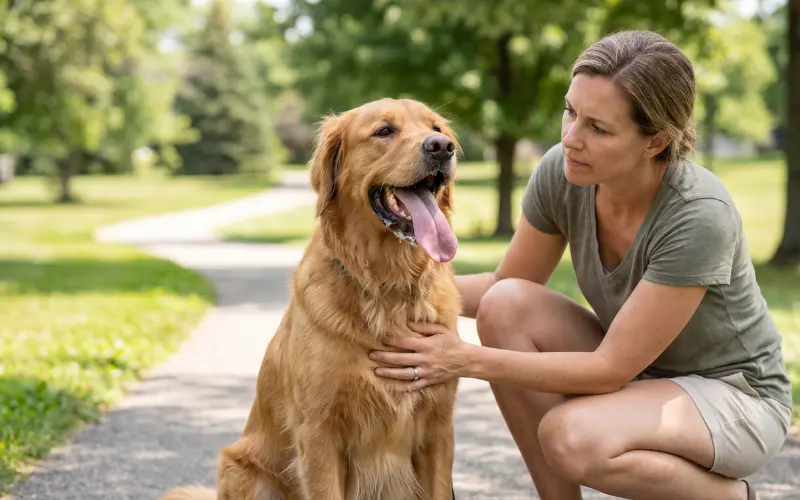
Early signs of dog overheating include excessive loud panting, heavy drooling, restlessness, sudden slowing on walks, and bright red or dark pink gums — any of these signs during summer activity mean your dog needs to be moved to shade or air conditioning immediately.
Advanced Signs — This Is an Emergency
If the early signs are missed and cooling does not happen quickly, heatstroke progresses:
- Vomiting or diarrhea
- Loss of coordination — stumbling or staggering
- Collapse or inability to stand
- Seizure-like muscle tremors
- Pale, white, or bluish gums
- Unconsciousness
If you see any of these advanced signs, do not wait to see if they improve.
Move to the car immediately, blast the AC, apply cool — not ice cold — water to the paws, groin, armpits, and back of neck, and drive directly to the nearest emergency vet. Call ahead so they can prepare.
According to the ASPCA, knowing the early warning signs of heat-related illness and responding within the first few minutes dramatically improves outcomes — waiting for advanced symptoms to appear before acting reduces the window for effective treatment.
Rapid temperature drop causes blood vessels near the skin to constrict, which actually traps heat inside the body and slows cooling.
Use cool or lukewarm water on the paws, neck, and groin area and let the body temperature drop gradually.
This is the safe approach recommended by veterinary professionals.
According to the American Kennel Club — Open in new tab, heatstroke can lead to brain damage or death — and the best treatment is prevention, not emergency intervention.
Once heatstroke becomes severe, even aggressive veterinary treatment does not always save the dog.
How to Keep Dog Cool in Summer — 8 Proven Methods That Actually Work
These are the practical habits that protect dogs from overheating before it starts. Prevention is the entire strategy here.
Every one of these methods helped me figure out how to keep dog cool in summer after that July incident.
1. Time Walks for the Cooler Hours
The single most effective change you can make costs nothing.
Walk your dog before 10 AM or after 6 PM during summer.
The midday period from 10 AM to 3 PM is when direct sunlight and ground surface temperatures peak — and ground surfaces hold heat well after the air temperature drops.
An 85-degree afternoon walk at 2 PM involves pavement that can reach 130 to 150 degrees Fahrenheit in direct sun.
The safest times to walk dogs in summer are before 10 AM and after 6 PM — ground surface temperatures on asphalt at 2 PM can reach 130 to 150 degrees Fahrenheit even when air temperature is only 85 degrees, hot enough to burn paw pads in under 60 seconds.
2. The 7-Second Pavement Test
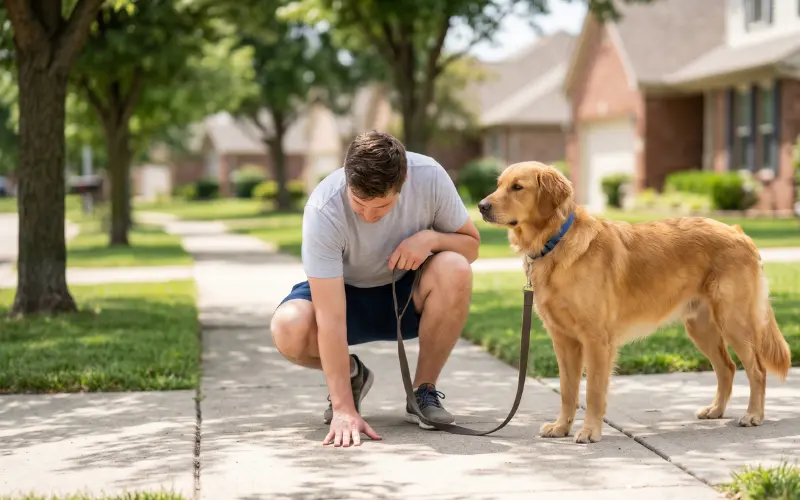
Before any summer walk, place the back of your hand flat on the pavement and hold it there for 7 seconds.
If you cannot keep it there comfortably for the full 7 seconds, the surface is too hot for your dog’s paw pads.
Paw pads look tough but they are sensitive skin. Burns happen faster than most owners realize — some dogs do not show pain in the moment and continue walking on burned pads because adrenaline masks discomfort during activity.
The damage shows up hours later.
If the pavement fails the test, walk on grass, dirt paths, or shaded surfaces only. Or apply paw wax before going out.
Musher’s Secret Dog Paw Wax — 200g — originally developed for Canadian sled dogs who cross ice, sand, and rough terrain.
Creates a breathable semi-permeable wax barrier on paw pads that protects against hot pavement, sand burn, and ice in winter. Made from food-grade natural waxes with Vitamin E. Lick-safe, non-staining.
Apply 2 to 3 times per week — takes seconds to absorb.
Not ideal for: dogs with open paw pad wounds or active infections — those need veterinary treatment first.
Also does not replace the pavement test — balm reduces risk of minor burns but does not make extremely hot asphalt safe to walk on.
3. Always Bring Water on Walks
Dehydration accelerates overheating.
A dog that is already dehydrated overheats faster and recovers more slowly.
Carry water and a portable bowl on every walk above 70 degrees — even short 15-minute walks on warm days.
MalsiPree Portable Dog Water Bottle — 19 oz — one-handed operation: press to fill the built-in bowl, release to send unused water back into the bottle with zero waste.
BPA-free food-grade plastic. Under 6 ounces empty. Fits in a jacket pocket or clips to a dog walking bag. Over 38,000 Amazon reviews. Three sizes available.
Not ideal for: dogs who drink very large amounts at once — the built-in bowl is sized for a typical drink, not a full refill.
For long hikes, carry a second bottle or a larger capacity option.
4. Set Up a Cooling Station at Home
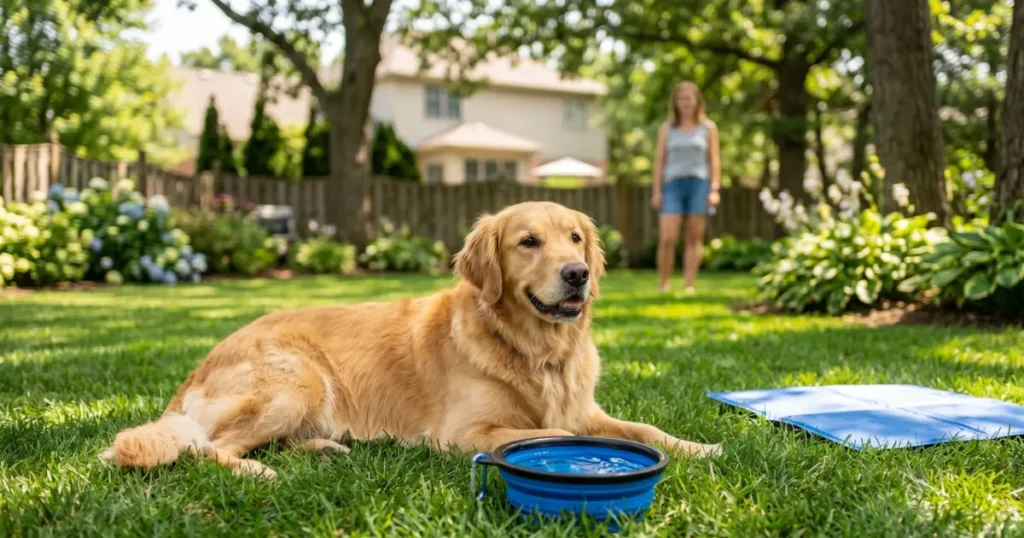
If your dog is indoors without air conditioning, or spends time in a garage or covered patio during summer heat, a cooling mat makes a genuine difference in their comfort and safety.
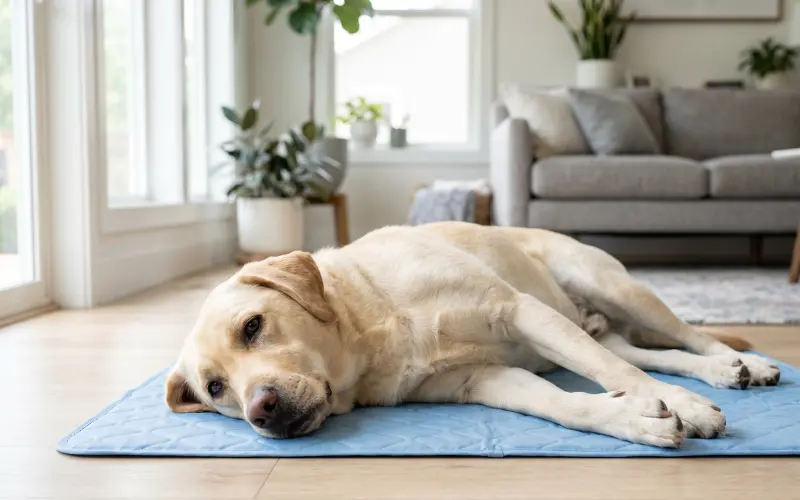
Arf Pets Dog Cooling Mat — 27″ x 43″ — pressure-activated solid gel core.
No water, no electricity, no refrigeration needed. Dog lies on it and the gel absorbs body heat, providing up to 3 hours of cooling before self-recharging after 15 minutes of non-use.
Non-toxic gel. Fits in crates, kennels, car seats, and on the floor.
Not ideal for: replacing air conditioning in extreme heat above 95 degrees — the mat reduces body heat absorption but cannot compensate for dangerously high ambient temperatures alone.
5. Never Leave Your Dog in a Parked Car
This is not a mild caution.
It is a life or death rule with no exceptions.
On a 70-degree day — not even hot by summer standards — the interior of a parked car reaches 99 degrees within 20 minutes and 113 degrees within 40 minutes.
On an 85-degree day, the interior hits 104 degrees within 10 minutes.
There is no “I’ll just be a minute.” The minutes count here.
The crack-in-window approach reduces interior temperature by approximately 2 to 3 degrees — functionally meaningless against a 40-degree interior temperature spike.
6. Provide Shade and Limit Outdoor Time
If your dog spends time outdoors, shade is not a preference — it is a requirement.
Direct sunlight on a 90-degree day pushes effective felt temperature for a dark-coated dog well above what any amount of panting can manage safely.
Doghouses are not adequate shade in summer — they trap heat and can become hotter than the outside air.
Shade from trees, a canopy, or an awning with airflow underneath is what your dog needs.
7. Provide Cool Indoor Spaces
On any day above 85 degrees, dogs should have access to air-conditioned space.
If you do not have AC, a fan directed at the floor, tile floors to lie on, and an open window creates meaningful airflow that helps significantly.
Cool water — not ice water — for drinking should be refreshed multiple times during hot days.
A kiddie pool in a shaded area lets water-loving breeds cool down with their whole body.
8. Know Your Dog’s Specific Limits
A 3-year-old healthy Border Collie can handle morning walks in 80-degree weather that would exhaust a 7-year-old Bulldog.
Knowing your specific dog’s limits — based on breed, age, current health, and fitness level — is more important than any general temperature guideline.
Start summer walking seasons gradually.
Dogs that were not active in cooler months need time to build heat tolerance.
A sudden jump to full summer activity after a winter of minimal exercise is where many heat incidents happen.
Hot Pavement Burns — More Common Than You Think
But burns are one of the biggest risks when you are learning how to keep dog cool in summer.
Most owners do not think about paw pad burns because dogs do not always show pain in the moment.
The adrenaline of being on a walk masks discomfort.
The aftermath: limping that evening or the next morning, paw licking, visible blistering or raw patches on the pads, reluctance to walk on hard surfaces.
On a day with 87-degree air temperature, asphalt in direct sun can reach 143 degrees Fahrenheit — hot enough to cause paw pad burns in 60 seconds of contact, which is why the 7-second pavement hand test is the most reliable pre-walk safety check available.
According to the American Kennel Club — Open in new tab, hot pavement can also increase a dog’s body temperature directly — heat absorbed through the paw pads contributes to overall body temperature elevation, making pavement temperature a significant factor in total heat load, not just a burn risk.
What to Do If Your Dog Burns Their Paws
If you suspect your dog has burned paw pads:
- Move off the hot surface immediately. Carry if necessary.
- Apply cool water to the pads for 10 to 15 minutes. Do not apply ice.
- Check the pads for visible damage — redness, blistering, missing skin, or patches that look rawer than normal.
- If damage is visible or your dog is limping significantly — call your vet the same day. Paw pad burns can become infected quickly.
- Keep the pads clean and protected with paw balm while healing. Do not walk on hard surfaces until fully healed.
How to Cool Down a Dog That Is Overheating
This is the safe method to keep dog cool in summer when things start going wrong.
If you notice early warning signs of overheating, this is the exact sequence to follow.
Speed matters — every minute of continued heat exposure makes the situation worse.
This is the safe and correct way how to keep dog cool in summer emergencies.
To cool down an overheating dog, move them to shade or air conditioning immediately, apply cool — not cold — water to the paw pads, groin, inner armpits, and back of the neck, offer small sips of cool water, and check gum color — if gums are pale, white, or blue, go directly to an emergency vet.
- Get out of the sun and heat immediately. Indoors with AC is best. Shade with a breeze is second best. Hot, humid shade with no airflow is better than direct sun but barely.
- Apply cool water to the high blood vessel areas: paw pads, inner groin, armpits, back of neck. These spots have blood vessels close to the surface — cooling the blood there cools the whole body faster.
- Fan while applying water. Evaporation is the mechanism. Water plus airflow accelerates cooling significantly.
- Offer small sips of cool water. Not a full bowl immediately — that can cause vomiting, which worsens the situation.
- Monitor gums every 2 to 3 minutes. Gums returning to normal bubblegum pink is the sign your dog is stabilizing.
- Call your vet regardless of whether the dog appears to stabilize at home. Internal effects of heat exhaustion are not always visible. A quick call tells you whether a visit is needed.
Common Summer Mistakes Dog Owners Make
These are the mistakes that caused most of the heat incidents I have heard about from other dog owners — and the ones most easily avoided once you know them.
- Walking in the hottest part of the day without testing the pavement. Feels fine to us. Can be burning to them. The 7-second test takes two seconds. No reason to skip it.
- Assuming shade means safe. A dog in shade on a humid, 85-degree day with no airflow is still overheating. Shade reduces radiant heat from the sun but does not address ambient temperature or humidity. Air movement matters as much as sun avoidance.
- Leaving the dog in the car for “just a minute.” Covered in the previous section but worth repeating: there is no safe window. Not in a shaded parking spot. Not with the windows cracked. Not for two minutes.
- Shaving double-coated breeds in summer. Already covered — but this one is worth repeating because it feels logical and is actually harmful. Deshed, do not shave.
- Waiting for obvious distress before acting. By the time a dog vomits, stumbles, or collapses from heat, significant damage has already occurred. The signal to act is behavioral — slowing down, seeking shade, panting harder. Not collapse.
What to Bring on Summer Dog Walks — Checklist
These are the items that belong in every summer walk kit. how to keep dog cool in summer starts before you leave the house:
- Travel water bottle with built-in bowl — always
- Paw wax — applied before leaving if pavement may be a concern
- Phone with vet contact saved and accessible
- A light bandana or cloth that can be wetted and placed on the neck or back
- Awareness of the nearest shaded area or air conditioned space along the route
For cars, keep a spare water bottle, a small towel, and the vet’s emergency contact in the glove compartment year-round.
A summer dog walk kit should always include a portable water bottle, paw balm for hot pavement protection, the vet’s emergency contact number, and awareness of the nearest shaded or air conditioned space along the route.
For complete year-round dog health habits including nutrition, exercise, dental care, and preventive care, read our guide on keeping your dog healthy and happy.
For safe outdoor training sessions during warmer months, read our guide on positive reinforcement dog training for beginners.
And for summer grooming that reduces heat risk in double-coated breeds, read our guide on how to deshed a dog at home.
The information in this guide is based on published guidelines from Cornell University College of Veterinary Medicine and the AKC.
If your dog shows signs of heatstroke or you suspect heat-related illness, contact your veterinarian or an emergency animal hospital immediately.
This guide is for prevention and early response — it does not replace professional veterinary care.
Frequently Asked Questions (FAQ)
At what temperature is it too hot to walk a dog?
Walks become risky for most dogs when the air temperature exceeds 80 degrees Fahrenheit, but ground surface temperature matters more than air temperature in summer.
The 7-second pavement test is more reliable than any air temperature number — if you cannot hold the back of your hand on the pavement for 7 seconds, it is too hot for your dog’s paw pads.
Walk on grass or dirt paths if pavement fails the test, or take time walks for early morning and evening hours.
How do I know if my dog is too hot?
Early signs of overheating include excessive loud panting, heavy drooling, restlessness, sudden slowing or stopping during walks they normally handle easily, and seeking shade.
Check the gums — healthy gums are bubblegum pink.
Gums that are bright red, dark pink, or pale are warning signs that require immediate action. Move your dog to cool shade or air conditioning at the first sign of any of these.
Can dogs get heat stroke indoors?
Yes. Dogs can overheat indoors if the space has poor ventilation, no air conditioning, and temperatures above 80 degrees — particularly in rooms that receive direct sunlight.
Flat-faced breeds, senior dogs, and overweight dogs are especially vulnerable.
A cooling mat, open windows with a fan, or a cool tiled floor in a shaded room all help.
On extreme heat days above 95 degrees, keep vulnerable dogs in air-conditioned spaces.
Should I shave my dog in summer to keep them cool?
No — do not shave double-coated breeds.
Huskies, German Shepherds, Golden Retrievers, and Labradors have a double coat that insulates against both heat and cold.
Shaving removes this insulation, exposes skin to sunburn, and can permanently alter coat texture.
Regular deshedding — removing the loose undercoat with the right tools — improves airflow to the skin without the risks of shaving.
Single-coated breeds with long hair may benefit from a trim, but consult a professional groomer.
How do I cool down a dog quickly?
Move them to shade or air conditioning immediately.
Apply cool — not ice cold — water to the paw pads, inner groin, armpits, and back of the neck. These areas have concentrated blood vessels near the surface.
Offer small sips of cool water if they are conscious.
Do not use ice packs directly on the skin.
If the temperature reaches 104 degrees Fahrenheit or if advanced symptoms appear — vomiting, stumbling, collapse, pale gums — go directly to an emergency vet.
Is a cooling mat actually effective for dogs?
Yes, for indoor or shaded use.
Pressure-activated gel cooling mats absorb body heat when the dog lies on them and self-recharge after 15 minutes of non-use.
They work best in already-shaded environments paired with good ventilation or air conditioning — not as a replacement for AC in extreme heat.
Dogs instinctively seek cool surfaces in summer, and most will choose the cooling mat over a regular bed.
Can I give my dog ice water to cool them down?
You can give your dog cool or cold water to drink in small amounts.
Do not give ice water rapidly in large quantities to an overheated dog — it can cause an upset stomach and vomiting, which worsens dehydration.
Ice cubes as treats in moderate amounts are generally fine.
The main cooling should happen through shade, air conditioning, and cool water applied externally to the paws and high-vessel areas, not through rapid internal cooling.
What breeds are most at risk of heat stroke?
Brachycephalic — flat-faced — breeds are the highest risk group: Bulldogs, Pugs, French Bulldogs, Boston Terriers, Shih Tzus, Boxers, and Pekingese.
They cannot pant as efficiently as longer-nosed dogs because their airways are physically narrower.
Senior dogs over 7, overweight dogs, puppies under 6 months, and dogs with heart or respiratory conditions also face a higher risk.
These dogs need shade, AC, and minimal outdoor activity on any day above 75 degrees.
How much water does a dog need in summer?
Dogs need approximately 1 ounce of water per pound of body weight per day under normal conditions — and significantly more during warm weather, exercise, or outdoor activity.
A 50-pound dog needs at least 50 ounces — roughly 1.5 liters — per day.
Increase this if your dog is active or if temperatures are high.
Fresh cool water should be available at all times.
On summer walks, bring enough water for frequent small drinks rather than one large drink at the end.
Start With One Habit — Final Thoughts
The day my dog overheated on that July walk, I did not know what I was looking for until I almost missed it.
I had been taking summer walks without testing the pavement, without timing the hour, without watching his gums.
I got lucky.
A lot of owners are not.
Three habits that changed how I keep dog cool in summer every single year:
- Learn the 7-second pavement test and do it before every single summer walk. It takes literally two seconds, and it tells you more than any temperature chart. If the pavement fails, find grass or reschedule. That habit alone prevents most paw pad burns.
- Time your walks before 10 AM or after 6 PM and watch the first sign of overheating — which is behavioral, not physical. Your dog slowing down or stopping is the signal, not the moment they collapse. Act on the first sign.
- Always carry water. Not for yourself. For your dog. On a short 20-minute walk in 82-degree weather, a dog can become dehydrated enough to affect their ability to cool themselves efficiently. A travel water bottle is a $12 habit that takes up zero space.
I never take a summer walk without these three things locked in now. My dog has not had another heat incident since that July.
For more on year-round dog health and wellness, read our complete guide on keeping your dog healthy and happy — it covers the preventive habits that add up to a longer, healthier life.
For training in hot weather, including how to keep your dog focused and safe during warm outdoor training sessions, read our guide on positive reinforcement dog training for beginners.