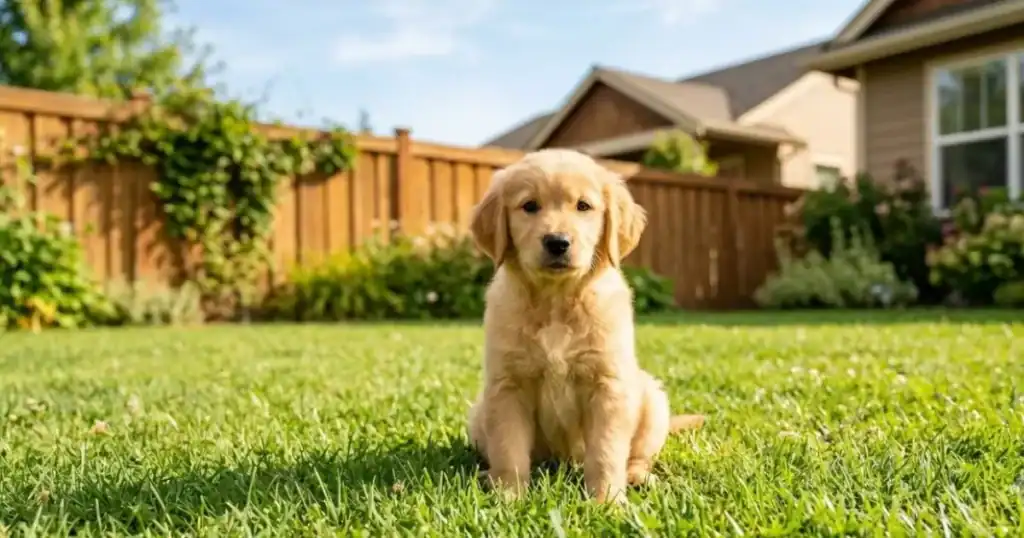
Week one with my puppy — I was convinced I was failing.
He had gone to the bathroom inside the house seven times in a single day. Seven.
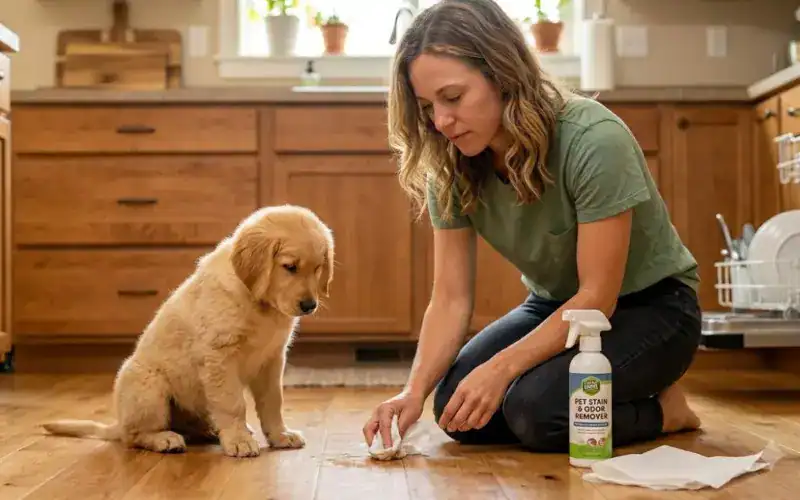
I had cleaned the same corner of my kitchen floor so many times that I started to wonder if that spot would just be his forever.
I was exhausted, frustrated, and quietly questioning every decision I had ever made.
And then I found a system that actually worked.
Within four days of following a real, consistent process, the indoor accidents dropped to almost zero.
By the end of week two, my puppy was walking to the door and waiting.
That same kitchen corner has been clean ever since.
If you’re figuring out how to potty train a puppy fast at home right now — you’re in exactly the right place.
This guide gives you the complete step-by-step process I used, the schedule that makes it work, and every mistake to avoid so you don’t waste days going backwards.
Let’s get into it — because the sooner you start the right way, the faster this works.
Always reward with a treat within 3 seconds of finishing outside.
Most puppies show major improvement in 1 to 2 weeks of consistent training. Full reliability takes 4 to 6 months depending on breed size.
How Long Does It Take to Potty Train Puppy Fast?
If you’re wondering how quickly you can potty train a puppy, the honest answer is: it depends on the puppy.
Some puppies catch on surprisingly fast, while others need several weeks or even months before they can reliably stay accident-free.
A good 7-day potty training plan can give you a strong start, but it shouldn’t be treated as a guarantee that every puppy will be completely house-trained in one week.
What affects how fast a puppy learns?
- Age: Young puppies have small bladders and limited control, so they usually need to go outside more often.
- Consistency: Taking your puppy out at predictable times helps them understand what is expected.
- Supervision: The more closely you watch your puppy, the easier it is to catch their potty signals before an accident happens.
- Previous habits: A puppy that’s already developed a habit of going indoors may take longer to retrain.
- Living situation: Apartment living, long workdays, bad weather, and limited outdoor access can all make the process more challenging.
- Individual personality: Some puppies learn the routine quickly. Others need more repetition before it clicks.
Young puppies need frequent potty breaks
Don’t expect an 8- or 10-week-old puppy to hold it for long periods simply because you’re following a training schedule.
Young puppies often need bathroom breaks:
- After waking up
- After eating or drinking
- After playing
- After a nap
- Before bedtime
- Whenever you notice signs like sniffing, circling, restlessness, or suddenly wandering away
The goal isn’t to make your puppy “hold it” for as long as possible.
The goal is to create enough successful opportunities outside that the right habit becomes easier to repeat.
Routine works better than punishment
Potty training is much easier when your puppy knows what happens next.
Take them to the same potty area, use a consistent cue, and reward them immediately after they go in the right place.
Accidents will happen.
When they do, avoid punishment or yelling.
Clean the area thoroughly, review what happened, and adjust the schedule or supervision if necessary.
So, can you potty train a puppy in 7 days?
You can make a lot of progress in seven days, but reliable house training usually takes longer.
Think of the first seven days as a foundation-building period:
- Day 1-2: Establish the routine
- Day 3-4: Recognize signals and prevent accidents
- Day 5-6: Build consistency and gradually increase freedom
- Day 7: Reinforce the routine and continue practicing
Some puppies may progress faster than this, while others will need additional weeks of consistent training.
The important thing is not hitting an arbitrary deadline.
It’s building a routine your puppy can understand and repeat every day.
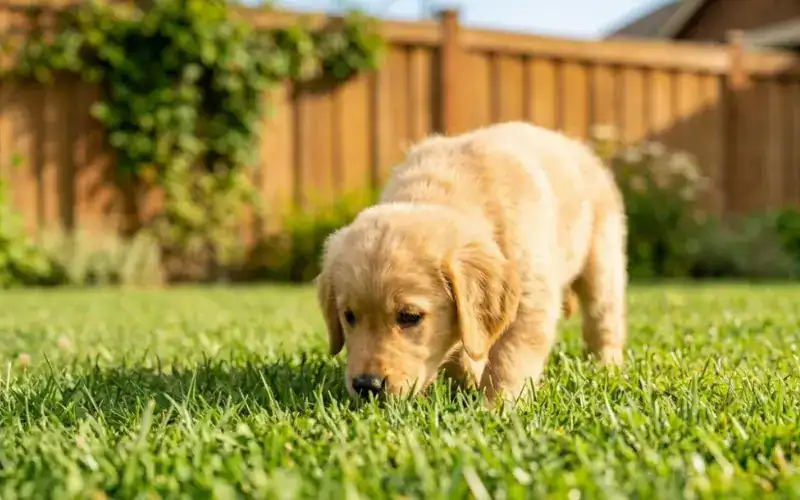
The 7-Day Puppy Potty Training Plan
If you want to potty train a puppy fast, don’t try to rush the puppy. The best way is to make the routine predictable and repeat the same process every day.
📅 Day 1 — Set Up the Routine
Foundation DayStart with a simple, predictable schedule that gives your puppy clear structure from morning to night.
- Feed your puppy at consistent times every single day.
- Take them out at key triggers: immediately after waking up, eating, playing, and right before bed.
- Choose one regular potty spot outside and stick to it strictly.
- Set up a crate or puppy-safe area for supervised management.
- Keep small training treats nearby for instant reward delivery.
- Have an enzymatic cleaner ready for accidental indoor messes.
- Micro Training Size: Pea-sized treats under 3 calories each—perfect for instant outdoor rewards without overfeeding.
📍 Day 2 — Build the Bathroom Habit
Spot AssociationTake your puppy to the exact same potty area each time you go outside.
Keep distractions low and use the same simple cue word, such as “Go potty.”
As soon as your puppy finishes:
Praise → Treat → Back inside.
Rewarding immediately (within 3 seconds) helps your puppy understand exactly what behavior earned the treat.
👀 Day 3 — Learn the Potty Signals
Signal CatchingStart watching for your puppy’s personal warning signs before an accident happens. Common pre-potty signals include:
- Sniffing the floor in tight circles
- Circling or turning in one spot
- Suddenly wandering away from play and going quiet
- Whining or pacing near doors or walls
- Becoming restless suddenly after lying down
When you see a likely signal, pick them up and go outside immediately instead of waiting to see what happens.
🔒 Day 4 — Reduce Indoor Accidents
Active ManagementSupervision is your biggest tool today. Don’t give a young puppy unlimited access to the house. Use a puppy-safe room, playpen, baby gate, or properly sized crate when you can’t watch them closely.
If an accident happens, don’t punish your puppy. Clean it thoroughly with an enzymatic cleaner and reflect on these three questions:
Did I wait too long? Did I miss a signal? Did my puppy have too much freedom?
- Enzyme-Activated Formula: Completely breaks down urine proteins so your puppy won’t be drawn back to the spot.
🏡 Day 5 — Increase Supervised Freedom
Earned FreedomIf your puppy has been doing well without indoor accidents, slowly give them access to another supervised area of the house.
Keep supervising constantly. If accidents increase after expanding their space, simply reduce their freedom again and give them more time to practice successfully in a smaller area.
🧪 Day 6 — Test the Routine
Real-World TestingNow test the routine during normal household activity. Try slightly longer potty intervals, exploring another room, or allowing more supervised play with fewer verbal reminders.
Don’t make everything harder at once. If your puppy has an accident during testing, adjust the schedule, tighten supervision, and try again.
🔄 Day 7 — Build Long-Term Consistency
Long-Term HabitDay 7 isn’t the finish line. Your puppy may be making excellent progress, but reliable house training often takes longer than one week.
Keep repeating the same proven cycle:
Routine → Potty Signal → Outside → Success → Reward → Repeat
Over time, your puppy will have fewer accidents, clearer signals, and earn more freedom around the house.
The moment you have to go back inside to get a treat is the moment the 3-second reward window closes.
Pocket treats — always. This one habit alone speeds up potty training noticeably.
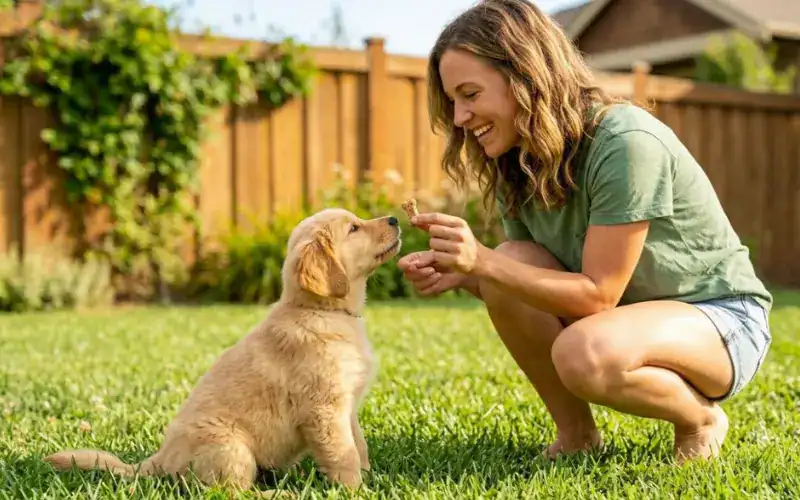
The Potty Training Schedule by Age — What to Expect
Potty training a puppy fast at home looks different at different ages — because your puppy’s bladder capacity changes as they grow. Here’s what to expect at each stage.
A consistent sleep schedule makes potty training dramatically easier — read our complete puppy sleep schedule for the first week at home to see exactly how the two work together.
8 to 10 Weeks — Maximum Supervision Required
This is the hardest stage — and also the most important. At this age, your puppy has almost no bladder control.
They may not even realize they need to go until they’re already on their way.
- Daytime Breaks: Take your puppy outside every 45–60 minutes.
- After Meals: Go outside within 5 minutes of finishing a meal.
- Overnight: Expect 1–2 bathroom trips during the night.
Progress at this stage feels slow — but the habits you’re building right now are the foundation for everything that comes later.
Stay consistent.
10 to 12 Weeks — Small But Noticeable Improvement
Most puppies start to show real improvement around this time. They may start sniffing the door, whining slightly, or moving toward the exit when they need to go. These are huge milestones — celebrate them.
- Daytime Breaks: Take your puppy outside every 60–90 minutes.
- Overnight: Most puppies still need 1 bathroom trip during the night.
3 to 4 Months — Building Real Reliability
At 3 months, most puppies can hold their bladder for about 3 hours during the day.
You’ll start to feel like you can breathe a little. Accidents should be rare now if the training has been consistent.
Daytime: Take your puppy outside every 2–3 hours.
Night: Some puppies may begin sleeping through the night, while others may still need an overnight bathroom break.
4 to 6 Months — Near Full Reliability
By 4 to 5 months, most puppies trained consistently from week one are nearly accident-free inside.
A few occasional slip-ups are still normal — especially with excitement, urination, or new environments.
Daytime: Take your puppy outside every 3–4 hours.
Night: Most puppies can sleep through the night without needing a bathroom break, although individual dogs may still vary.
Potty Training Schedule — Quick Reference Table
Crate Training — The Secret Weapon for Fast Potty Training
If there is one tool that makes potty training a puppy fast at home dramatically easier — it’s the crate.
I resisted using one for the first week because it felt cruel.
That was my biggest mistake.
Here’s the thing: dogs are den animals.
A properly introduced crate doesn’t feel like a cage to a puppy — it feels like a safe, private space.
And because puppies instinctively avoid soiling where they sleep, the crate becomes a powerful potty training tool automatically.
How to Use the Crate for Potty Training
The formula is simple:
- Crate them when you can’t watch them directly.
- Take them outside immediately when they come out of the crate.
- Reward them when they go outside.
- Allow supervised freedom inside after they’ve gone.
- Back to the crate when supervision ends.
Repeat – every single time. No exceptions.
How Long Can a Puppy Be in the Crate
This is important – puppies should never be crated longer than they can hold their bladder, plus one hour.
- 8 to 10 weeks: maximum 1 to 2 hours at a time
- 10 to 12 weeks: maximum 2 to 3 hours at a time
- 3 to 4 months: maximum 3 to 4 hours at a time
Never use the crate as punishment.
Never leave a puppy in a crate all day.
The crate is a tool for safety and training – not a storage unit.
For exact feeding times that sync with your potty schedule, check our puppy feeding schedule by age guide.
According to the American Kennel Club, crate training is one of the most effective and humane ways to housetrain a puppy when used correctly.
What If Your Puppy Pees or Poops in the Crate?
Don’t panic – and don’t punish your puppy.
Crate accidents usually mean something in the routine needs adjusting.
Check these first:
- Crate too large? Your puppy should have room to stand, turn, and lie down, but not enough room for a separate bathroom corner.
- Potty break too late? Take your puppy out after sleeping, eating, playing, and before longer crate periods.
- Crated too long? Young puppies simply may not be able to hold it that long.
- Sudden accidents? If the behavior changes unexpectedly, consider whether a health issue could be involved.
Clean accidents with an enzymatic pet cleaner and adjust the schedule rather than punishing your puppy.
Common Crate Training Mistakes
Avoid these mistakes:
- Using the crate as punishment
- Crating your puppy for too long
- Giving too much freedom too soon
- Skipping the potty trip after crate time
- Ignoring repeated crate accidents
- Expecting your puppy to be fully trained in just seven days
The crate should be a management tool – not a bathroom or punishment zone.
This builds a positive association with the crate faster than any other method.
A puppy that loves eating in their crate will start going in voluntarily within 3 to 4 days — which makes potty training dramatically smoother.
How to Potty Train a Puppy in an Apartment
Apartment potty training is mostly about timing and planning.
You don’t have a backyard two steps away, so your puppy needs a routine that accounts for hallways, elevators, stairs, and bad weather.
Potty Training Without a Backyard
Choose one consistent potty area outside and take your puppy there every time.
Keep the route simple and boring until they finish.
If getting outside takes several minutes, start the trip before your puppy reaches the point of desperation.
What If the Elevator Takes Too Long?
This is where timing matters most.
Take your puppy out:
- Right after waking
- After meals and play
- Before bedtime
- Whenever you notice potty signals
If accidents happen while waiting for the elevator, you may simply need to leave a little earlier.
Puppy Pads vs. Outdoor Potty Training
Puppy pads can be useful when outdoor access is difficult, especially for very young puppies or certain apartment situations.
But if your long-term goal is outdoor potty training, keep the transition consistent rather than constantly switching between indoor and outdoor spots.
Balcony and Grass-Pad Options
A properly set-up balcony grass pad can be an option for some apartment owners, particularly when getting downstairs quickly isn’t realistic.
Keep the potty area clearly separate from your puppy’s sleeping and eating spaces, and clean it regularly.
Apartment Potty Training Schedule
For the first few weeks, consistency matters more than perfection.
Wake up → potty → breakfast → potty → play → potty → nap → repeat
As your puppy gains better control and starts giving clearer signals, you can gradually increase the time between trips.
Apartment rule: Don’t wait for your puppy to urgently ask.
In a high-rise, you need to start the potty trip early enough to beat the elevator.
Need an Apartment-Specific Plan?
Apartment potty training has extra logistical challenges because getting outside isn’t always immediate. The paid program includes an Apartment & Small Space Solutions bonus covering situations such as balconies, grass pads, and high-rise living.
See the complete 7-day systemThis is far better than letting your puppy have an indoor accident while you wait for the elevator at 3am.
Common Potty Training Mistakes That Set You Back Weeks
I made almost every mistake on this list in week one.
Here’s what not to do — and what to do instead.
Waiting Too Long After Meals
Most new owners wait 20 to 30 minutes after a meal before taking their puppy out.
By then, it’s too late.
The digestive reflex in young puppies is fast — some go within 5 minutes of finishing a meal.
Take them out within 10 minutes maximum, every single time.
Giving Too Much Indoor Freedom Too Soon
This was my biggest mistake.
By day three, I felt confident and let my puppy have a free run of the living room.
Two accidents later, I understood why trainers say to earn freedom gradually.
Freedom is a reward for consistent good behavior — not something given automatically as time passes.
Start with one room.
Expand room by room only after two weeks of clean behavior in the current space.
Not Cleaning Accidents Properly
Regular cleaners — even ones that smell clean to you — leave behind urine proteins that your puppy can still detect.
And if they can smell it, they will use that spot again.
According to the ASPCA, enzymatic cleaners are the only type that fully break down pet urine at a molecular level — eliminating the scent signal that draws puppies back to the same spot.
Punishing Accidents After the Fact
Finding an accident 10 minutes after it happened and then scolding your puppy does nothing useful.
Your puppy’s brain cannot connect the punishment to the action — they just learn that you sometimes become scary for no apparent reason.
Regular household cleaners do not fully break down urine scent — only enzymatic cleaners eliminate the odor signal that draws puppies back to the same indoor spot.
The only intervention that works is catching them in the act and redirecting calmly to the outside.
Everything else is just venting your frustration — understandable, but not helpful for the training.
Inconsistent Rules Across the Household
If one person takes the puppy out consistently and another lets things slide, the training will stall.
Every person in the household needs to follow the same rules, schedule, and reward process.
Get everyone on the same page before day one.
How to Know Your Puppy Is Making Real Progress
Potty training progress can feel invisible when you’re in the middle of it. Here are the signs that it’s actually working — even when it doesn’t feel like it.
Signs Your Training Is Working
- Your puppy sniffs near the door before going inside.
- They whine, bark, or paw at the door to signal need.
- They go immediately when you take them to their spot.
- Indoor accidents are decreasing week over week.
- They respond to your cue word and go on command.
Signs You Need to Adjust Something
- Accidents are not decreasing after 2 full weeks of consistent training.
- Your puppy goes outside but then has an accident immediately after coming inside.
- They seem confused about what you want from them outside.
If your puppy goes outside but then accidents happen right after coming inside, they didn’t fully empty outside.
Stay out longer and wait for them to go twice before coming in.
Many puppies need to go twice in one outdoor trip, especially in the morning.
For puppies with persistent accidents past 6 months of age or signs of medical issues, always consult your veterinarian.
Frequently Asked Questions (FAQ)
How long does it take to potty train a puppy?
Most puppies show major improvement within u003cstrongu003e1 to 2 weeksu003c/strongu003e of consistent training.u003cbru003eFull reliability — meaning you can trust them unsupervised — usually takes u003cstrongu003e4 to 6 monthsu003c/strongu003e.u003cbru003eSmall breeds like u003cstrongu003eChihuahuas and Dachshundsu003c/strongu003e often take a little longer due to their smaller bladders.u003cbru003eThe keyword in all of this is u003cstrongu003econsistencyu003c/strongu003e — inconsistent training can stretch the process to u003cstrongu003e6 months or longeru003c/strongu003e, with no reliable results.
At what age should a puppy be fully potty trained?
Most puppies are reliably potty trained between u003cstrongu003e4 and 6 months oldu003c/strongu003e, provided training starts at u003cstrongu003e8 weeksu003c/strongu003e with consistency.u003cbru003eSome puppies — especially u003cstrongu003esmall breedsu003c/strongu003e or those from environments with poor early habits — may take u003cstrongu003e8 to 12 monthsu003c/strongu003e.u003cbru003eIf your puppy is over u003cstrongu003e6 months oldu003c/strongu003e and still having frequent accidents, speak with your vet to rule out medical causes, such as a u003cstrongu003eurinary tract infectionu003c/strongu003e.
Should I wake my puppy up at night to go potty?
Yes — for the first u003cstrongu003e4 to 8 weeksu003c/strongu003e.u003cbru003eSet an alarm for a middle-of-the-night bathroom trip based on your puppy’s age.u003cbru003eA u003cstrongu003e2-month-old puppyu003c/strongu003e needs to go out every u003cstrongu003e2 to 3 hours overnightu003c/strongu003e.u003cbru003eA u003cstrongu003e3-month-oldu003c/strongu003e can usually make it u003cstrongu003e3 to 4 hoursu003c/strongu003e.u003cbru003eDon’t wait for them to cry and wake you — proactive overnight trips prevent accidents and build the habit faster.
What do I do if my puppy keeps having accidents In the same spot?
That spot still smells like urine to your puppy, even if it doesn’t to you.u003cbru003eClean it thoroughly with an u003cstrongu003eenzymatic cleaneru003c/strongu003e like u003cstrongu003eNature’s Miracleu003c/strongu003e — not a regular household cleaner.u003cbru003eApply the cleaner, let it sit for u003cstrongu003e10 minutesu003c/strongu003e, then blot clean.u003cbru003eRepeat u003cstrongu003etwiceu003c/strongu003e.u003cbru003eThen place your puppy’s food bowl or a toy in that spot temporarily — puppies avoid going to the bathroom where their food or belongings are.
Can I potty train a puppy without a crate?
Yes, but it’s significantly harder and takes longer.u003cbru003eThe crate creates a controlled environment that uses your puppy’s instinct to keep their den clean.u003cbru003eWithout a crate, you need to maintain constant, direct supervision every single minute your puppy is indoors — which is exhausting and, realistically, not possible for most people.u003cbru003eIf you truly can’t use a crate, use a small playpen or baby-gated area as an alternative.
Why does my puppy go to the bathroom right after coming inside?
Two reasons.u003cbru003eFirst, they didn’t fully empty outside.u003cbru003eYoung puppies often need to go u003cstrongu003etwice on a single tripu003c/strongu003e.u003cbru003eStay outside longer and wait for a second go before coming inside.u003cbru003eSecond — excitement when coming back inside triggers their bladder.u003cbru003eKeep the return inside calm and low-key for the first few weeks to reduce this reaction.
Is it normal for potty training to feel like it’s going backwards sometimes?
Completely normal — and one of the most frustrating parts of the process.u003cbru003ePuppies often have a great week followed by a rough few days, especially during growth spurts, teething periods, or changes in routine.u003cbru003eThis is not failure — it’s normal developmental regression.u003cbru003eStay consistent, don’t change the system, and the progress will come back.u003cbru003eThe trend over u003cstrongu003e3 to 4 weeksu003c/strongu003e should be clearly improving, even if individual days aren’t always perfect.
Always monitor your puppy closely when trying anything new. If you notice any unusual symptoms or behaviors, consult your veterinarian immediately.
You’re Closer Than You Think — Final Thoughts
Here’s what I know now — two years past that awful First week with seven indoor accidents in a single day:
That corner of my kitchen floor has been perfectly clean ever since week two. My dog now goes to the door, sits, and waits every single time without fail. That result felt impossibly far away when I was on my knees cleaning up accident number five on a Tuesday afternoon.
It wasn’t far away. It just required staying consistent long enough for the training actually to work.
Now that you know exactly how to potty train a puppy fast at home, here are your three takeaways:
- The schedule is everything — take them out at every meal, every nap, every play session, and every hour—no gaps, no exceptions, especially in week one.
- Reward within 3 seconds — always. Treats in your pocket every time you go outside. That timing is where the learning actually happens.
- Clean accidents with an enzymatic cleaner and never punish after the fact. Your job is to prevent opportunities for accidents — not to react to them.
You’re going to get there. Every consistent day gets you closer.
For the full picture of everything your puppy needs in those first weeks home, read our complete guide on how to take care of a puppy for the first time — it covers feeding, sleep, why does my puppy cry at night, and more, all in one place.
For a complete night by night breakdown of what to expect in week one, read our puppy sleep schedule for the first week at home.