
🐾 Dog Age Calculator
Free, instant, no sign-up. Estimates only.
Enter your dog's age and pick a size to see the result.
This calculator gives an estimate, not a medical age. Your vet knows your dog best.
Your dog’s birthday cake has 7 candles on it, and someone at the party says, “That’s 49 in dog years!” It’s a fun line, but it isn’t true. The old “multiply by 7” rule doesn’t match how dogs actually grow up and grow older, and even the expert charts online don’t agree with each other.
The calculator above gives you a clear answer in seconds. Below it, you’ll find:
- A full dog age chart for small, medium, large and giant dogs, from 1 to 16 years
- Why size changes everything, and what a 2020 DNA study found about dog years
- When your dog becomes a senior, and what to do when they get there
There’s no single number for dog years to human years.
A common veterinary rule of thumb counts a dog’s first year as about 15 human years and the second as about 9 more. After that, each year adds about 4 to 7 human years, depending on size. So a 7-year-old small dog is about 44, while a 7-year-old giant dog is about 59.
Dog Age Chart: Dog Years to Human Years by Size
Find your dog’s age on the left, then read across to their adult size. Not sure which size fits? Go by your dog’s adult weight. For a mixed breed, pick the column closest to their weight.
All numbers are rounded human-year estimates from the method explained below. Giant dogs past 12 or so are rarer, so treat those rows as a rough guide.
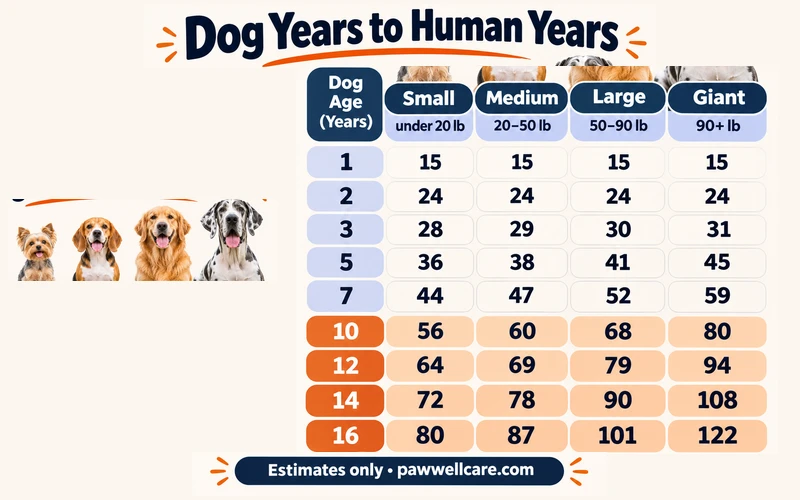
Save the chart for vet visits.
Screenshot or pin it. It’s a handy way to explain to the whole family why your 8-year-old Lab may need the same extra care as a person in their mid-50s.
Why “Multiply by 7” Is Wrong
The “one dog year equals seven human years” rule is easy to remember, which is probably why it stuck. It roughly matches the idea that people live about seven times longer than dogs. But it falls apart as soon as you look at how dogs actually grow.
Dogs grow up very fast in year one. By their first birthday, most dogs are close to their adult size and can have puppies of their own. A 7-year-old child can’t. That’s why most vets count the first year as roughly 15 human years, not 7.
Then aging slows down. After the fast start, each year adds fewer “human years,” usually somewhere between 4 and 7.
Size changes the speed. Big dogs tend to live shorter lives than small dogs, so each year of a Great Dane’s life counts for more than a year of a Chihuahua’s.
The American Veterinary Medical Association says it plainly: dogs don’t age at a rate of 7 human years per dog year. The chart above is a much closer match to how dogs really develop.
How Our Dog Age Calculator Works
Every number on this page, in the calculator, the chart and the FAQ, comes from the same simple method, so nothing contradicts anything else:
- Year 1 = 15 human years.
- Year 2 adds 9 more, for a total of 24.
- Each year after that adds 4 years for small dogs, 4.5 for medium, 5.5 for large and 7 for giant dogs.
This follows the common veterinary rule of thumb (15 for the first year, about 9 for the second, then a few years per year after that). The size groups use the same weight bands the AVMA uses for senior ages: under 20 pounds, 20 to 50, 50 to 90, and over 90.
The calculator also shows your dog’s life stage. That’s based on the life stages in the American Animal Hospital Association’s canine guidelines: puppy, young adult, mature adult and senior. Interestingly, AAHA doesn’t try to convert dog years into human years at all. Its experts prefer to describe where a dog is in life, which is often more useful than a number.
Why puppies don’t get a number. In the first year, puppies change month by month, and different methods give very different answers for the same puppy. Instead of showing a number that could mislead you, the calculator simply tells you your dog is still a growing puppy.
What it can’t know. Breed, genes, body weight and health all affect how a dog ages. Two 10-year-old Labs can be very different. Use the result as a friendly estimate, and lean on your vet for anything that matters for your dog’s care.
The 2020 DNA Study: A New Way to Count Dog Years
In 2020, researchers at UC San Diego and the National Institutes of Health tried a completely different approach. Instead of comparing milestones, they looked at tiny chemical “aging marks” on DNA (called methylation) that build up in a steady pattern over a lifetime.
According to the NIH’s summary of the study, the team took blood samples from 104 dogs, mostly Labrador retrievers, ranging from 4 weeks to 16 years old. They compared those aging marks with data from 320 people aged 1 to 103. From that, they built a formula:
The 2020 DNA formula is human age = 16 × ln(dog age) + 31, where “ln” is the natural logarithm.
By this formula, an 8-week-old puppy matches a roughly 9-month-old baby, and a 12-year-old Labrador matches about 70 human years.
The big surprise is how fast young dogs “age” by this measure. Compare the two methods for a medium-sized dog:
Why the numbers differ. The two methods measure different things. The vet rule of thumb follows milestones you can see, like growth, adulthood and senior changes. The DNA formula follows changes inside the cells, which race ahead early in life and then slow down.
Why we don’t use it as the main number. The study was based mostly on Labradors, and the NIH notes the formula may be different for other breeds. It also doesn’t account for size, which matters a lot for dogs. That’s why our calculator shows the DNA result as a “bonus” comparison, not the headline number.
Why Do Big Dogs Age Faster?
In most animals, bigger species live longer. Elephants outlive mice. Dogs are an odd exception: within the species, big dogs tend to have shorter lives than small ones.
A large 2024 study in Scientific Reports looked at 584,734 dogs in the UK. Among purebreds, the median lifespan was:
- 12.7 years for small breeds
- 12.5 years for medium breeds
- 11.9 years for large breeds
Crossbreeds had a median of 12.0 years. Individual breeds varied a lot more than that, from about 9 years for Mastiffs to about 14 years for Miniature Dachshunds.
Because large and giant dogs reach their senior years sooner, each year of their life covers more ground. That’s why the giant column in the chart climbs fastest. Scientists are still working out exactly why size and lifespan are linked this way.
These are averages, not a prediction for your dog.
The study used UK dogs, and plenty of large dogs live well past these numbers. Good weight control, dental care and regular checkups make a real difference at any size.
When Is a Dog Considered a Senior?
There’s no single “senior” birthday for dogs. The AVMA says experts consider a dog a senior once they reach the last 25% of the expected lifespan for their breed. Using American Kennel Club data, that works out to these average ages:
The American Animal Hospital Association uses a similar idea in its canine life stage guidelines:
- Puppy: birth until rapid growth ends, around 6 to 9 months
- Young adult: until about 3 to 4 years, when a dog is physically and socially mature
- Mature adult: until the last 25% of the expected lifespan
- Senior: the last 25% of the expected lifespan
- End of life: the final stage, which depends on a dog’s health
What changes when your dog becomes a senior? The AVMA recommends that senior pets see a veterinarian twice a year or more, so problems can be found and treated early. Senior exams may include a dental check and bloodwork. Your vet may also suggest:
- A diet that’s easier to digest
- Closer weight control
- Gentle, regular exercise to keep joints moving
- Small changes at home, like a sleeping spot that avoids stairs
Our senior dog care guide walks through each of these.
Signs Your Dog Is Getting Older
The calendar is one clue. Your dog’s body and behavior are another. Common signs of aging include:
- A graying muzzle and a duller coat
- Slowing down: slower to get up, shorter walks, more naps
- Cloudy eyes or bumping into things in dim light
- Hearing loss: not responding to their name as quickly
- Weight changes, up or down
- Dental tartar and bad breath
- Behavior changes: confusion, wandering, accidents in the house, or a changed sleep schedule

Sudden changes aren’t “just old age.”
Limping, a big change in appetite or thirst, new lumps, or sudden confusion can point to pain or illness that’s very treatable. Book a vet visit and describe exactly what you’ve noticed. Our guide to signs your dog is in pain and hiding it can help you spot the quieter clues.
How to Tell a Dog’s Age If You Don’t Know It
Adopted a rescue with no paperwork? You’re not alone. Vets can’t read a dog’s exact birthday, but they can give you a good estimate from a few clues:
- Teeth (the best clue in young dogs). Puppy teeth start coming in at about 3 weeks and are usually all in by 6 weeks. Adult teeth start replacing them at around 3½ to 4 months, and most dogs have all 42 adult teeth by 6 to 7 months, according to VCA Animal Hospitals. After that, vets look at wear, tartar and gum health. These vary a lot with diet and dental care, so they only give a rough range.
- Eyes. A soft, bluish haze in the lenses often shows up in middle-aged and older dogs.
- Coat and muzzle. Gray hairs around the muzzle and eyes usually appear with age, though some dogs gray early.
- Body and energy. Muscle tone, joint stiffness and activity level fill in the rest of the picture.
Your vet will usually give an age range, like “probably 4 to 6 years.” Pick the middle of that range and enter it in the calculator above. If you’ve just adopted a puppy, our guide to taking care of a puppy for the first time covers the first weeks at home.
This calculator and guide are for general information only and are based on independent research, not personal testing.
PawWellCare is not a veterinarian, and these results are estimates, not a medical age or a lifespan prediction. Breed, genes, weight and health all affect how an individual dog ages. Talk to your veterinarian about your dog’s life stage and care.
Frequently Asked Questions (FAQ)
How old is a 7-year-old dog in human years?
About 44 to 59 human years, depending on size. A 7-year-old small dog is about 44, a medium dog about 47, a large dog about 52 and a giant dog about 59.
How old is a 10-year-old dog in human years?
About 56 for a small dog, 60 for a medium dog, 68 for a large dog and 80 for a giant dog. Most 10-year-old dogs are in their senior years, so twice-yearly vet checkups are a good idea.
Is 7 old for a dog?
It depends on size. A 7-year-old Chihuahua is middle-aged, while a 7-year-old Great Dane is already a senior. The AVMA lists giant breeds as seniors from about 6 to 7 years, and most other dogs from about 8 years.
How many dog years are in one human year?
There’s no fixed number. The first year of a dog’s life counts as about 15 human years, the second as about 9, and each year after that as about 4 to 7, depending on size. The “7 dog years” rule is a myth.
Is the dog age calculator accurate?
It’s a good estimate, not an exact age. It follows a common veterinary rule of thumb and the AVMA’s size groups, but every dog ages a little differently. Your vet can tell you more about your own dog’s health and life stage.
Do mixed-breed dogs age differently?
Size matters more than breed mix. In a large UK study, crossbreeds had a median lifespan of 12.0 years, close to purebreds overall. For a mixed breed, choose the size that matches your dog’s adult weight.
How old is a 1-year-old dog in human years?
About 15 human years. By their first birthday, most dogs are close to adult size, like a teenager. Giant breeds may keep filling out until around 2 years old.
The Bottom Line on Dog Years
Converting dog years to human years isn’t about one magic number. It’s about knowing where your dog is in life. Remember these three things:
- Forget “times 7.” The first year counts as about 15 human years, the second as about 9, and later years as 4 to 7 depending on size.
- Size changes the clock. Giant dogs reach their senior years around 6 to 7, most other dogs around 8 or later.
- Senior means more check-ins. The AVMA recommends vet visits twice a year or more for senior pets.
Your next step: pop your dog’s age into the calculator at the top of this page. If they’re in their senior years, book a checkup and read our senior dog care guide. You can also brush up on common dog illnesses and symptoms to watch for.
Whatever the number says, every year with your dog is a good one. Make the next one count.