

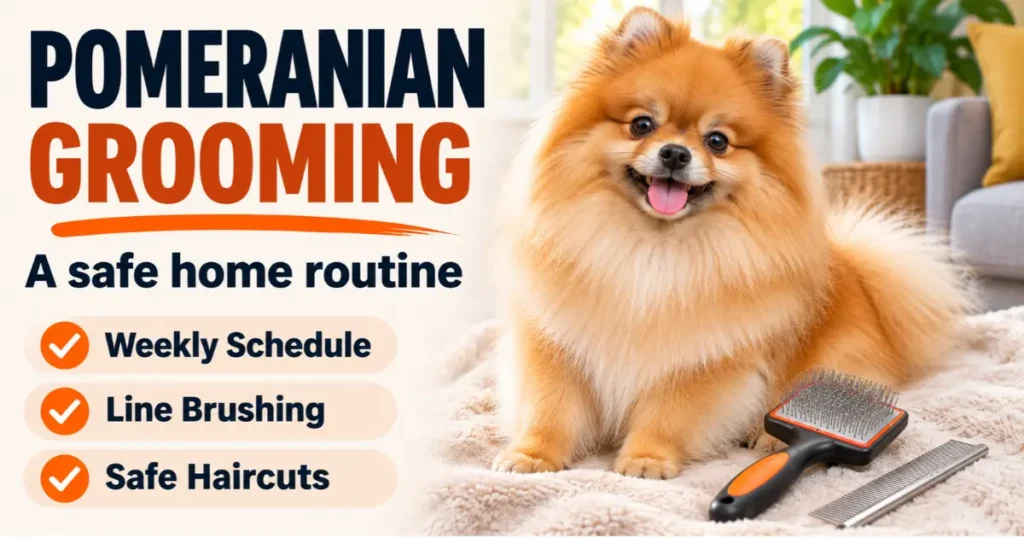
Your Pomeranian looks perfect. Round, fluffy, a little orange cloud with a fox face.
Then you run your fingers behind the ears and hit something that feels like felt. There’s another one in the fluffy “pants” on the back legs. And another under the front legs, right where the harness sits.
That’s the tricky thing about Pomeranian grooming. The top of the coat can look great while the real problems hide down near the skin. Brushing the fluff you can see isn’t the same as brushing the coat.
The good news: a Pom coat isn’t hard to keep healthy once you know how it works. This guide gives you:
- A simple grooming schedule you can actually stick to
- Line brushing, step by step (the one technique that prevents most mats)
- Which haircuts are safe for a Pom, and which can cause lasting coat problems
Pomeranian grooming comes down to brushing the coat all the way to the skin.
Line-brush with a slicker brush and comb 2 to 3 times a week (daily during shedding season), bathe every few weeks, and tidy the feet, ears and rear with round-tip scissors. Don’t shave a Pom’s body. Patchy hair loss with darkening skin is a reason to see your vet.
Why Pomeranian Grooming Is Different
A Pomeranian has a double coat. Underneath is a soft, thick undercoat that works like insulation. On top are longer, coarser guard hairs that give the coat its stand-off, fluffy look and protect the skin.
That combination is what makes a Pom look like a Pom. It’s also why grooming one is different from grooming a short-coated dog.
The undercoat is dense, and loose hair gets trapped in it instead of falling out. Leave it there and it twists into mats, usually in spots that rub or move a lot. Breed experts point to the same trouble areas again and again (Pomeranian.org):
- Behind the ears
- Under the front legs (the “armpits”)
- The britches, or “pants,” on the back legs
- Under the collar or harness
A Pom also “blows” its coat, usually about twice a year. For a few weeks, a lot more undercoat comes loose at once. If you’re brushing the coat properly, that’s a messy couple of weeks. If you’re not, it’s how small tangles turn into big mats.
Brushing only the top of a Pomeranian’s coat leaves loose undercoat trapped near the skin, where mats form.
A Pom coat needs to be brushed in small sections, from the skin outward.
Pomeranian Grooming Schedule
Ask five groomers how often to groom a Pom and you’ll hear five slightly different answers. There’s no single vet-set schedule. The table below pulls together common breed and grooming guidance into one routine you can start with, then adjust to your own dog’s coat.
Bath timing is the one people argue about most. Too often can dry out the skin, and too rarely lets oil and dirt build up. For a closer look at what works for different dogs, see our guide on how often you should bathe your dog.
Short and often beats long and rare.
Ten minutes of brushing three times a week is easier on your Pom (and on you) than one 45-minute battle every Sunday. Pick a regular time, like after the evening walk, so it becomes routine.
The Tools You Actually Need
You don’t need a salon’s worth of gear. For Pomeranian grooming at home, these cover almost everything:
- Soft slicker brush. Your main brush. Look for fine pins with protective tips, since Pom skin is delicate.
- Pin brush. For a quick fluff and finishing touches.
- Steel comb with wide and fine teeth. The tool that tells you whether you actually brushed down to the skin.
- Round-tip grooming scissors. For feet, ears and the hygiene area. The rounded tips matter on a dog this small.
- Nail clippers or a grinder. Small-dog size.
- Dog shampoo and conditioner. Human products aren’t made for dog skin.
- A dryer with a cool or low setting. A Pom’s thick coat takes a long time to air dry.
A couple of things to skip: heavy blade deshedders and rough undercoat rakes are made for big double-coated dogs and can be too harsh on a toy breed’s skin. Human hair clippers aren’t designed for this either.
If you want help picking a slicker and comb, our guide to the best dog brush for shedding compares options by coat type, including long and fluffy coats like a Pom’s.
A brush that’s gentle on a Labrador can scratch a Pomeranian.
Toy breeds have thin, sensitive skin, so use light pressure, choose pins with protective tips, and stop if you see any redness.
How to Groom a Pomeranian at Home, Step by Step
Here’s the full routine. You won’t do every step every time. Brushing happens a few times a week, and the rest happens every few weeks. But this is the order that works best when you do a full groom.
Step 1: Line Brushing (the Right Way)
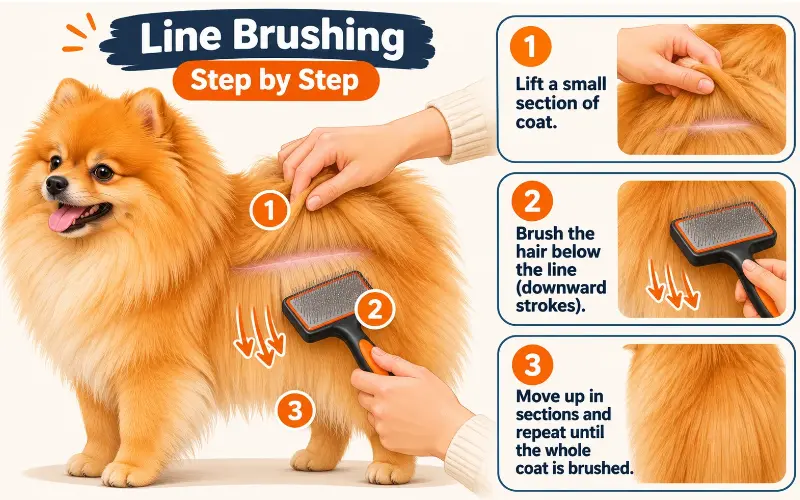
Line brushing is how groomers get through a thick double coat without missing the hair near the skin. Instead of brushing over the top, you work through the coat one thin layer at a time. The same method keeps curly coats mat-free too, as in our Goldendoodle grooming guide.
- Lightly mist the coat with water or a dog coat spray. Brushing a bone-dry coat can break hair, and a soaking-wet one tangles.
- Start at the back legs. With one hand, push the coat up and away from you so you can see a line of skin.
- Brush the hair below that line down and outward with the slicker, in short, gentle strokes.
- Let down a new thin layer from above the line and brush it the same way.
- Work forward, a section at a time, from the back legs up the body, then the chest, neck and ruff.
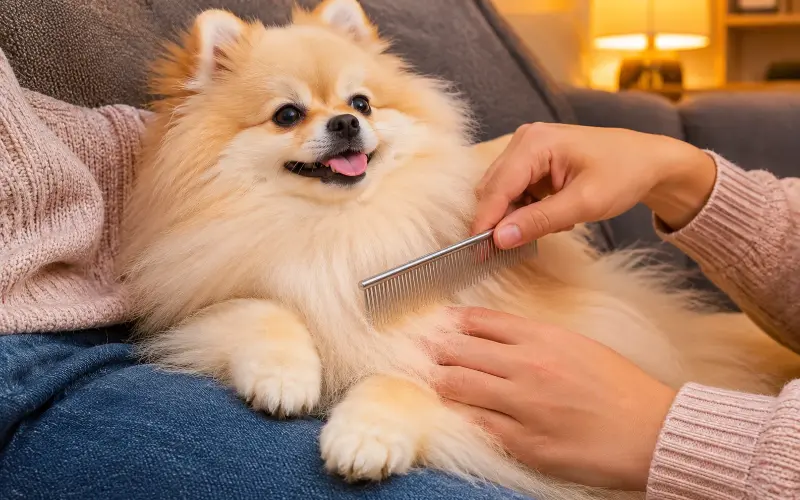
- Finish with the comb. Run it from skin to tip over the whole dog.
It feels slow the first time. After a few sessions it becomes a 10 to 15 minute routine for most Poms.
The comb is your test.
If it glides from skin to tip, that section is done. If it snags, there’s a tangle starting. Go back with the slicker, work the knot loose from the outside edge, and comb again.
Step 2: Bath and Conditioner
Always brush before the bath. Water tightens tangles, so a small knot you could have brushed out dry can turn into a solid mat once it’s wet.
Use a dog shampoo and work it down to the skin, not just over the top layer. Rinse longer than you think you need to. Leftover shampoo in a thick undercoat can irritate the skin. A light conditioner makes the next brushing session easier.
Step 3: Dry Completely
This step matters more on a Pom than on most dogs. The outer coat can feel dry while the undercoat underneath is still damp, and damp hair trapped against the skin isn’t good for it.
Towel off first, pressing instead of rubbing. Then use a dryer on a cool or low setting, held a few inches away, brushing as you go. Brushing while you dry lifts the coat and gives you that full, fluffy finish. Never leave a dog alone with a dryer running.
Step 4: Tidy Trims (Feet, Ears and Rear)
A pet Pom doesn’t need show-style scissoring. A few small tidy-ups keep it clean and comfortable:
- Feet: Trim the hair between the pads level with the pads, so your dog doesn’t slip on hard floors. Then trim around the edge of the foot for a neat, round “cat foot” look.
- Ears: Trim just the fringe around the very tips for a small, neat ear shape.
- Rear (sanitary trim): Trim a small area around the bottom so mess doesn’t stick to the coat.
Take tiny snips. You can always cut more, but you can’t put hair back.
Pomeranians wiggle, and their skin is thin.
Use round-tip scissors, keep the tips pointed away from the body, and slide your fingers between the scissors and the skin when you trim. Never trim near the eyes on a moving dog. If your Pom won’t hold still, get a helper or leave this step to a groomer.
Step 5: Nails, Ears and Teeth
- Nails: Small dogs have small nails and a small quick, so take off just a little at a time. Our step-by-step guide on how to trim dog nails at home covers dark nails and nervous dogs. For a small clipper or a quiet grinder, see our guide to the best dog nail clippers.
- Ears: Look inside once a week. A little light wax is normal. Redness, a bad smell, or a lot of scratching is a reason to call your vet.
- Teeth: Toy breeds have a lot of teeth in a small mouth. Daily brushing with a dog toothpaste is the gold standard, and even a few times a week helps.
Coat Blow Season: When Your Pom Sheds Everywhere
About twice a year, many Pomeranians shed a big part of their undercoat over a few weeks. You’ll notice it when tufts come out on the comb, the coat looks flatter, and there’s suddenly fluff on everything you own.
During coat blow:
- Brush daily, using the same line-brushing method.
- Give a bath once the shedding really starts. Warm water and a good rinse help loosen dead undercoat, and it comes out much more easily on the next brushing.
- Dry completely and brush as you dry.
It’s normal for a Pom to look a little thinner for a while afterward. The undercoat grows back. For the full deshedding routine, see our guide on how to deshed a dog at home.
Pomeranian Haircuts: What’s Safe and What’s Risky
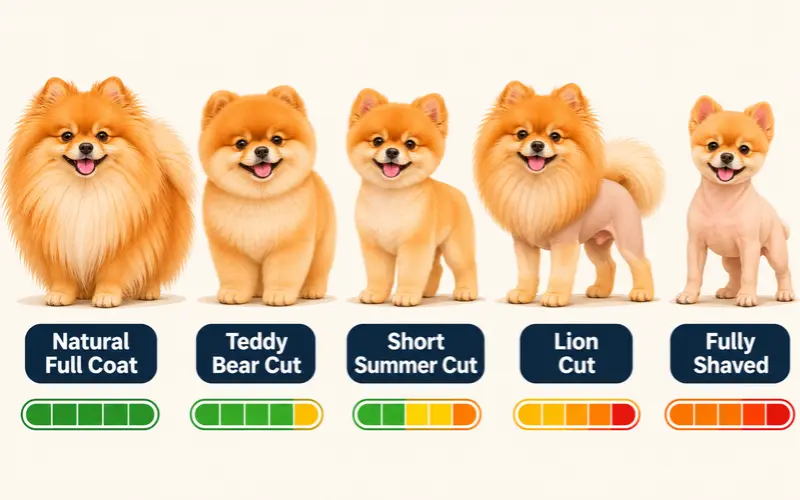
Teddy bear cuts and lion cuts look adorable in photos, and plenty of owners ask for them. But a Pomeranian dog haircut isn’t just about looks. How short you go can affect how the coat grows back.
Why the risk? The double coat is built in layers, and the guard hairs and undercoat don’t always grow back the same way after being clipped short. Long-time breed experts warn that incorrect trimming, puppy cuts or shaving can lead to lasting hair loss problems in Pomeranians (Pomeranian.org). Not every shaved Pom has trouble, but there’s no way to know ahead of time which ones will.
Shaving for summer also doesn’t do what people hope. The coat insulates against heat as well as cold, and it shields the skin from the sun. Shade, water, air conditioning and walks in the cooler hours keep a Pom cooler than a shave does.
Shaving a Pomeranian’s double coat doesn’t stop shedding, and breed experts warn it can lead to patchy or lasting coat problems.
If you want a shorter look, ask your groomer for a scissored teddy bear cut that leaves the undercoat in place.
How to Groom a Pomeranian Puppy (and the “Puppy Uglies”)
Start grooming early, even before your puppy really needs it. The goal at first isn’t a perfect coat. It’s a puppy who’s relaxed about being handled.
- Keep sessions short, 2 to 5 minutes, and end before your puppy gets fussy.
- Touch the paws, ears and mouth gently every day, with a treat each time.
- Use soft tools first, like a soft slicker or a bristle brush, and go very lightly.
- Bathe only when needed, and dry completely.
Somewhere around 4 to 6 months, many Pom puppies go through what owners call the “puppy uglies.” The fluffy puppy coat sheds out, and the coat can look thin, patchy or oddly shaped for a while. The adult coat usually fills in over the following months, though the timing varies a lot from dog to dog.
It’s tempting to shave a patchy puppy to “even it out.” Please don’t. That’s the same coat-damage risk as shaving an adult, at the stage when the adult coat is just coming in. Gentle brushing and patience work better.
For a puppy’s first professional visit, ask for a “puppy intro”: a bath, dry, nails and a light tidy, with no clipping. For more on the early weeks, see our guide on how to take care of a puppy for the first time.
When Hair Loss Isn’t a Grooming Problem: Alopecia X
Sometimes a Pom loses coat, and no amount of brushing fixes it. One condition Pomeranian owners should know about is Alopecia X, often called “black skin disease.”
According to VCA Animal Hospitals, Pomeranians are among the breeds most commonly affected. The signs usually include:
- Hair loss that’s similar on both sides of the body, often starting on the trunk and areas that rub
- Skin in the bald areas turning darker
- Usually no itching or pain
- Typically starting in young adulthood
Alopecia X is a “diagnosis of exclusion.” That means a vet has to rule out other causes first, such as thyroid disease, Cushing’s disease, allergies and parasites, which can look similar. VCA notes it isn’t expected to shorten a dog’s life, but bald skin can be more easily irritated, so it still needs a vet’s attention.
Routine: Seasonal shedding with healthy skin underneath. Mention it at the next checkup.
Soon: Patchy or symmetrical hair loss, darkening skin, or a coat that doesn’t grow back months after a haircut. Book a vet visit.
Right away: Open sores, bleeding, swelling, or hair loss in a dog who’s also lethargic, not eating or clearly unwell.
Don’t try to treat unexplained hair loss with supplements, oils or special shampoos on your own.
Only a vet can find the cause, and the right next step depends on what it is.
DIY vs. Professional Pomeranian Grooming
Most Pomeranian grooming can happen at home: brushing, baths, drying and nails. A professional groomer is worth it for shaping the coat, for mats close to the skin, and for Poms that won’t sit still for scissors.
If you use a groomer, look for one who’s comfortable with double coats and tell them clearly: scissors, no shaving. Prices vary a lot by city and by service, so call a few local groomers for quotes.
This article is for general information only.
PawWellCare is not a veterinarian, and this content doesn’t replace professional veterinary care. If your Pomeranian has hair loss, skin changes or any other health concern, please talk to your veterinarian.
Frequently Asked Questions (FAQ)
How often should a Pomeranian be groomed?
Line-brush 2 to 3 times a week, daily during coat blow. Bathe every 3 to 6 weeks, and trim nails every 3 to 4 weeks. A professional groom every 6 to 8 weeks is optional.
Can I shave my Pomeranian in summer?
It’s best not to. Shaving doesn’t stop shedding, the coat helps protect against heat and sun, and breed experts warn it can lead to patchy or lasting coat problems. Shade, water and cool walks help more.
What brush is best for a Pomeranian?
A soft slicker brush plus a steel comb. Use the slicker for line brushing and the comb to check that you reached the skin. Skip heavy blade deshedders on a toy breed.
When can a Pomeranian puppy get its first groom?
You can start gentle handling and brushing at home right away. For a first professional visit, ask for a bath, dry, nail trim and light tidy, with no clipping.
Why is my Pomeranian losing hair?
Seasonal coat blow and the puppy coat change are normal. Patchy or symmetrical hair loss, darkening skin, or a coat that won’t grow back can point to a health issue such as Alopecia X, thyroid disease or allergies, so see your vet.
Keeping That Pom Coat Healthy: What to Do This Week
Good Pomeranian grooming isn’t about a fancy haircut. It comes down to three habits:
- Brush to the skin, in sections, a few times a week
- Dry completely after every bath
- Skip the shave, and see your vet if hair loss doesn’t make sense
Try one line-brushing session this week, comb included. You’ll know right away where the hidden tangles are. For nails, ears, teeth and more, our complete dog grooming guide for beginners covers the rest.

Pingback: Best Dog Nail Clippers (2026): Picks by Size & Nail Type