


The first time I tried trimming my dog’s nails, I lasted exactly one nail.
One nail. That is all I got through before he yelped, I panicked, and we both stared at each other for a solid ten seconds — him with a look of betrayal, me with a pair of clippers I would not touch again for three months.
I had hit the quick. There was blood. Not a lot — but enough to make my hands shake and enough to teach my dog that nail trimming meant pain. Three months later, he would pull his paw away the moment I reached for his foot.
That was my fault. Not his.
What I did not understand then — and what most new owners do not understand — is that learning how to trim dog nails at home safely is not about courage or a steady hand. It is about understanding the anatomy of the nail, using the right tool for your confidence level, and building trust with your dog before you ever touch a nail.
This guide gives you the complete method — the nail anatomy you need to understand, the grinder vs clipper decision, the step-by-step process for both light and dark nails, what to do if you hit the quick, and how to build a routine where your dog genuinely cooperates instead of fighting.
Nobody taught me this the first time. That is why I am teaching you now.
Cut at a 45-degree angle, just above the quick — on dark nails, trim small amounts and stop when you see a gray or pink circle in the cross-section.
Have styptic powder ready.
Most dogs accept nail trims within 1 to 2 weeks of gradual desensitization with treats.
Why Nail Trimming Actually Matters — It Is Not Cosmetic
Skipping nail trims is not a style choice. It is a health decision with real consequences — and most owners do not realize the damage until it has been happening for months.
Overgrown dog nails that click on hard floors cause joint misalignment and chronic pain within 3 to 6 months — trimming every 2 to 4 weeks prevents permanent structural damage to the paws and legs.
When nails grow too long, they hit the ground with every step. That pushes the nail bed upward into the toe, which forces the toes apart and shifts how the entire paw makes contact with the floor.
Over weeks and months, this changes how your dog walks — creating abnormal pressure on joints, tendons, and ligaments from the toes all the way up to the shoulders.
Dogs with chronically overgrown nails develop splayed toes, reduced traction on smooth floors, increased risk of nail tears and breaks, and eventually arthritis in the feet and legs from the altered gait.
In severe cases, nails curl into the paw pad — causing genuine pain with every step.
The simple test: if you can hear your dog’s nails clicking on hard floors when they walk, the nails are already too long.
A dog’s nails should not touch the ground when the dog is standing on a flat surface — if nails click on hard floors, they are overdue for a trim by at least 1 to 2 weeks.
Knowing how to trim dog nails at home saves you $15 to $25 per vet or groomer visit — and most dogs need trimming every 2 to 4 weeks.
That is $90 to $300 per year in professional trims you can handle yourself in under 10 minutes once you know the technique.
According to the American Kennel Club, keeping nails properly trimmed is essential for maintaining healthy paw structure and preventing the joint problems that develop when long nails force a dog to alter their natural gait.
Understanding the Quick — The One Thing You Must Know
The quick is the reason nail trimming scares people. Understanding it is the reason it does not need to.
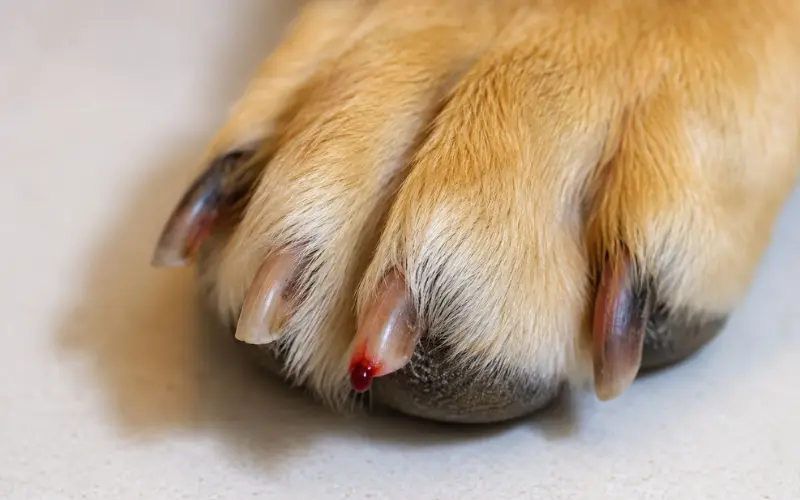
The quick is a blood vessel and nerve that runs through the center of every dog nail. It supplies blood to the nail and makes the nail sensitive.
When you cut into the quick, it hurts, and it bleeds.
On light-colored nails, the quick is visible as a pink area inside the nail. You can see exactly where it ends and trim safely beyond it. Easy.
On dark-colored nails — black, brown, very dark gray — the quick is invisible from the outside. This is where most owners panic and where most accidents happen.
But here is what most guides do not tell you: you can see the quick from the cut end of the nail.
When you trim a small amount off a dark nail and look at the freshly cut cross-section, you will see layers. The outer layer is hard and white or gray.
As you trim closer to the quick, a dark dot or circle appears in the center of the cross-section. When that circle turns pink or looks moist — stop immediately. You are at the edge of the quick.
On dark dog nails where the quick is not visible, trimming small amounts and checking the cross-section for a gray or pink circle is the safest technique — the appearance of this circle means you are 1 to 2 millimeters from the quick.
One more critical fact: the quick grows longer when nails are left untrimmed.
A dog whose nails have been neglected for months has a quick that extends much further than normal. You cannot cut these nails back to a healthy length in one session — the quick must be allowed to recede gradually over 3 to 4 weeks of frequent small trims.
For a complete guide on home grooming beyond just nails, read our step-by-step guide on how to groom a dog at home step by step.
Grinder vs Clipper — Which Is Right for You
This is the first real decision when learning how to trim dog nails at home. Both tools work. But they work very differently — and one is significantly safer for beginners.
A nail clipper cuts through the nail in one motion. It is fast, quiet, and precise in experienced hands.
The risk is that one wrong angle or one millimeter too deep hits the quick instantly — and with dark nails, you are essentially guessing where the quick is.
A nail grinder files the nail gradually using a rotating abrasive tip. It removes thin layers at a time — which means you can approach the quick slowly and stop the moment you see the cross-section change color.
The risk of hitting the quick is dramatically lower.
My honest recommendation for beginners: start with the grinder.
It took my confidence from zero to comfortable within three sessions. The clipper took me six months to trust again after the quick incident.
Casfuy Dog Nail Grinder with LED Light — whisper-quiet 2-speed motor with a built-in LED that illuminates the nail while you grind.
The LED is a genuine game-changer for dark nails — you can actually see the quick as you approach it. Rechargeable, lasts 2+ hours per charge.
Not ideal for: dogs that are terrified of vibration and cannot be desensitized gradually. Some dogs tolerate clippers better than the humming sensation.
Dremel PawControl Nail Grinder Kit — the professional-grade option with 4 speed settings from 8,000 to 25,000 RPM.
Includes a safety guard that prevents over-grinding. More powerful than budget grinders — handles thick nails on large breeds like Rottweilers and Great Danes without stalling.
Not ideal for: small dogs under 15 lbs — the lowest speed is still more aggressive than necessary. The Casfuy is gentler for small breeds.
If you prefer clippers, choose a guillotine-style for small dogs or a scissor-style for medium to large dogs.
Avoid cheap clippers that crush rather than cut — they split the nail and cause pain even without hitting the quick.
gonicc Dog & Cat Nail Clippers — safety guard with razor-sharp stainless steel blades to avoid overcutting. Includes a hidden nail file in the handle. The #1 best seller in Dog Claw Care on Amazon
Not ideal for: beginners with dark-nailed dogs — the single-cut action gives no opportunity to check the cross-section before committing.
Whichever tool you choose, buy styptic powder before your first session.
Not because you will definitely need it — but because knowing it is there removes the panic if you do.
Miracle Care Kwik Stop Styptic Powder — the industry standard for stopping nail bleeding. Apply to a nicked quick and bleeding stops within 30 to 60 seconds. Every groomer and vet clinic has this on their counter. You should too.
Not ideal for: nothing — every dog owner should own this regardless of trimming method.
Here is why: the worst-case scenario with a grinder is grinding slightly too close and causing mild discomfort.
The worst-case with a clipper is cutting into the quick, causing bleeding and pain, and potentially creating a dog that fights nail trims for months.
The grinder’s worst case is manageable.
The clipper’s worst case is a setback.
Start safe.
How to Trim Dog Nails at Home — Step-by-Step Method
This is the complete process for trimming nails safely — whether you are using a grinder or clipper.
Step 1 — Set Up Before You Start
Have everything within reach before touching your dog’s paw.
Standing up to grab styptic powder while holding a nervous dog’s foot is how accidents happen.
Your station needs:
- Grinder or clipper — charged and ready
- Styptic powder — open and accessible
- High-value treats — real chicken, cheese, or freeze-dried liver
- A towel or grooming mat — non-slip surface
- Good lighting — you need to see the nail clearly
Choose a well-lit area. Have your tool, styptic powder, and high-value treats within arm’s reach.
Let your dog sniff the tool. Give a treat.
Turn the grinder on briefly if using one. Give another treat.
Begin only when your dog is calm and relaxed.
This 30-second routine before every session sets the tone for everything that follows.
Step 2 — How to Hold the Paw
Place your thumb on the bottom pad of the toe and your forefinger on top of the toe, on the skin just above the nail.
Push your thumb slightly upward and backward — this naturally extends the nail forward and makes it easier to see and access.
Firm but gentle. Not a death grip.
Never squeeze the toe. A dog that feels trapped will pull away harder than a dog that feels held.
Make sure no fur is caught between your fingers and the nail — this pulls painfully and causes the dog to jerk.
Step 3 — The Actual Trim
If using a clipper:
- Clip at a 45-degree angle from underneath the nail.
- Take only the tip — the hook-like curved portion.
- Never clip straight across.
- Never clip past the curve of the nail.
- Use one clean cut per nail.
If using a grinder:
- Hold the grinder at a slight angle to the nail.
- Grind across the bottom first.
- Then carefully grind around the tip.
- Work in 3 to 5-second bursts.
- Check the cross-section between each pass.
- Stop when you see the color change in the center.
When trimming dark dog nails, remove only 1 to 2 millimeters at a time and check the freshly cut cross-section after each pass.
A chalky white center means safe to continue.
A dark circle or moist appearance means stop immediately.
Step 4 — What to Do If You Hit the Quick
Do not panic.
Your dog will react — possibly yelping, pulling away, or looking at you with confusion. That is normal.
What you do next determines whether this becomes a lasting problem or a minor moment.
Apply styptic powder immediately — press it directly into the bleeding nail tip.
Hold for 10 to 15 seconds. Bleeding should stop within 30 to 60 seconds.
If you do not have styptic powder, cornstarch, or flour pressed into the nail, it works as a temporary alternative.
After the bleeding stops:
- Give the biggest treat of the session — immediately
- Speak calmly and warmly
- Stop the session for today — do not push through the remaining nails
- Resume the next day, starting with a different paw
One quick nick does not have to ruin nail trimming forever.
How you respond in the 30 seconds after it happens is what the dog remembers — not the pain itself.
Step 5 — Reward After Every Single Paw
This is not optional.
After each paw — not after all four, after each one — give a high-value treat and genuine praise.
You are building the association: paw handling + nail trim = best treats of the day.
Over 3 to 5 sessions, most dogs begin tolerating and eventually accepting nail trims because the reward pattern is strong and consistent.
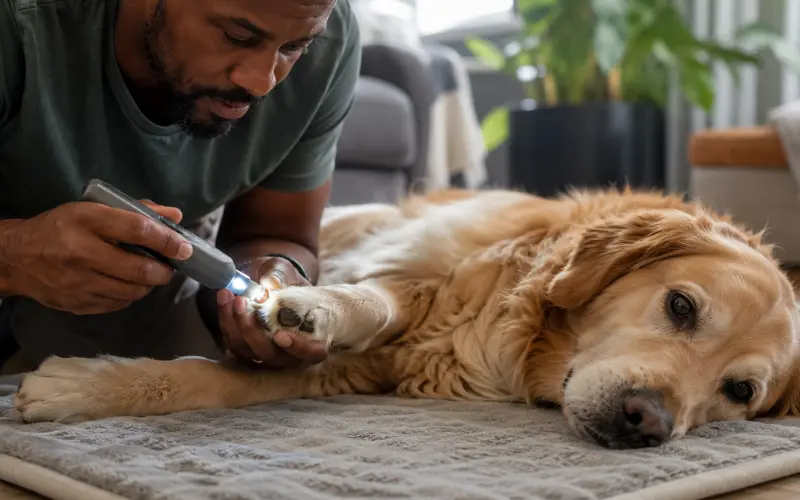
Do one paw today, reward massively, and stop.
Second paw tomorrow.
Third paw the day after.
By the time you reach the fourth paw, your dog has had three positive experiences in a row and is significantly more relaxed than if you had wrestled through all four at once.
Speed comes after trust is built.
How to Trim Dog Nails at Home — Dark Nails Guide
Dark nails are the number one reason owners avoid learning how to trim dog nails at home. The quick is completely invisible from the outside, which makes every cut feel like a gamble.
It does not have to be.
The cross-section method turns dark nail trimming from guesswork into a systematic, safe process.
The Cross-Section Reading Method
Trim a very thin slice — 1 millimeter — off the tip of the nail. Look at the freshly cut cross-section straight on.
What you will see:
- Hard white or gray outer ring — safe, keep going
- A faint dark dot appears in the center — getting close, proceed carefully
- The dark dot becomes larger or appears pink/moist — STOP. You are at the edge of the quick.
This method works with both clippers and grinders.
With a grinder, the cross-section check happens naturally between every 3 to 5-second grinding pass.
With clippers, make thin cuts and check after each one.
The safest way to trim dark dog nails is the cross-section method — trimming 1 millimeter at a time and examining the cut surface for a chalky white ring, which means safe, versus a dark or moist center dot, which means the quick is near and you should stop immediately.
The LED Grinder Advantage for Dark Nails
A nail grinder with a built-in LED light gives you a significant advantage on dark nails.
The light shines through the nail from underneath while you grind — making the quick faintly visible as a shadow inside the nail, even before you reach the cross-section color change.
This is why the Casfuy and Dremel PawControl grinders both include LED lights — and why they are specifically recommended for dogs with dark nails.
Building a Fear-Free Nail Trimming Routine
If your dog already hates nail trimming — from a previous bad experience, from being restrained too aggressively, or simply from never being introduced to the process gently — this section is for you.
The 7-Day Desensitization Method
Rebuilding trust around nail trimming takes about a week of short, positive sessions.
It is not complicated — but it requires patience and consistency.
- Day 1 — Touch your dog’s paw for 3 seconds. Treat. Repeat 5 times. Do not go near the nails.
- Day 2 — Hold each paw for 5 seconds. Touch one toe. Treat. Repeat on all four paws.
- Day 3 — Hold paw, touch one nail with your finger. Treat. Repeat on all paws.
- Day 4 — Let the dog sniff the grinder, turned off, or clipper. Treat. Touch the tool to one paw. Treat. Do not trim.
- Day 5 — Turn the grinder on near the dog, not touching. Treat while it runs. Turn off. Repeat 3 times.
- Day 6 — Touch the running grinder to one nail for 2 seconds. Treat. Repeat on 2 to 3 nails only.
- Day 7 — Grind or clip 1 to 2 nails per paw. Treat per paw. Full session.
This progression works for puppies that have never had nails trimmed and for adult dogs with established fear.
The timeline can be compressed for confident dogs or extended for genuinely anxious ones.
For puppies starting from scratch, early paw handling during the socialization period makes future nail trimming dramatically easier — read our puppy socialization checklist by age for the complete introduction schedule.
Dogs That Cannot Be Trimmed at Home
Some dogs — particularly those with severe prior trauma, aggression during restraint, or extreme anxiety disorders — genuinely cannot be safely trimmed at home.
This is not a failure. It is a safety decision.
For these dogs, professional groomers and veterinarians have sedation options, professional restraint techniques, and experience handling genuinely difficult cases safely.
According to the ASPCA, dogs whose nails click on floors need trimming, and the tool choice — clipper or grinder — should be based on whichever the dog tolerates most comfortably, with gradual desensitization being the key to long-term acceptance.

How Often to Trim — And How to Tell When It Is Time
Most dogs need nail trimming every 2 to 4 weeks. But the actual frequency depends on your dog’s activity level, the surfaces they walk on, and how fast their nails grow.
Dogs that walk frequently on concrete and asphalt naturally file their nails with every step — they may need trimming only once a month.
Dogs that primarily walk on grass, carpet, and soft surfaces get no natural filing and may need trimming every 2 weeks.
The simplest check: when your dog stands on a flat, hard surface, their nails should not touch the ground. If they do — it is time.
The sound check: if you can hear clicking on tile or hardwood when your dog walks — it is past time.
Do not forget the dewclaws — the small nail higher up on the inside of the leg.
Dewclaws never touch the ground and never file naturally. They are the most commonly overgrown nail on any dog and can curl into the pad if neglected.
Severely Overgrown Nails — The Gradual Approach
If your dog’s nails are severely overgrown — long, curved, possibly touching the ground constantly — do not attempt to cut them back to normal length in one session.
The quick has grown longer with the nails. Cutting to normal length means cutting into the quick guaranteed.
Instead, trim a small amount — 1 to 2 millimeters — every 5 to 7 days.
Over 3 to 4 weeks, the quick naturally recedes as the nail shortens. By week 4, you can trim to a healthy length safely.
This patience saves your dog from pain and saves you from creating a dog that fears nail trims permanently.
According to the American Kennel Club, the quick recedes gradually when nails are trimmed frequently in small amounts — but attempting to shorten severely overgrown nails in a single session almost always results in quick exposure, pain, and lasting behavioral resistance to nail care.
Common Nail Trimming Mistakes — What to Avoid
These are the mistakes that cause pain, fear, and the cycle of avoidance that makes learning how to trim dog nails at home feel impossible.
- Cutting too much at once is the most obvious mistake and the one with the most lasting consequences. One quick nick teaches a dog that nail trimming means pain — and they remember that lesson for months. Always take small amounts. Always check the cross-section on dark nails. Always err on the side of leaving nails slightly too long rather than cutting too short.
- Skipping desensitization is why most dogs fight nail trims. Picking up a clipper and grabbing a paw without any preparation puts your dog in a fight-or-flight response before you have even started. The 7-day introduction method takes almost no time and prevents months of struggling.
- Using dull clippers creates pain without hitting the quick. Dull blades crush and split the nail rather than cutting cleanly — causing pain and a ragged edge that can snag and tear later. Replace clipper blades at least once a year, or more frequently if you trim multiple dogs.
- Restraining too aggressively creates the very panic it tries to prevent. A dog pinned down, held in a headlock, or physically forced into position will fight harder with every session. Firm but gentle handling with rewards produces calm cooperation. Force produces escalating resistance.
- Forgetting the dewclaws is the most common oversight. Because they are higher on the leg and out of sight, owners forget they exist — until the dewclaw curls into the pad and requires a veterinary visit to remove. Check dewclaws every trimming session.
Nail Health Beyond Trimming — What to Watch For
While you are handling your dog’s paws during how to trim dog nails at home sessions, check for these issues that indicate something beyond routine trimming is needed.
- Cracked or split nails that extend into the nail bed need veterinary attention — they can become infected and are painful.
- Bleeding from the nail bed without trauma — this can indicate a nail bed tumor, especially in older dogs. See your vet promptly.
- Limping or favoring a paw may mean an ingrown nail, a torn nail, or a foreign object between the toes. Inspect closely.
- Swelling around the nail base — possible infection or abscess. Do not attempt to trim until your vet has examined and cleared the nail.
- Discoloration of a single nail — a nail that changes color compared to the others warrants a vet check, especially in older dogs.
Most quick nicks are minor and resolve within minutes, but persistent bleeding or nail bed abnormalities need professional evaluation.
The nail trimming techniques in this guide are based on widely accepted grooming practices endorsed by the AKC and ASPCA.
If your dog has nail abnormalities, extreme anxiety during trimming, or any medical paw conditions, consult your veterinarian or a certified professional groomer.
Frequently Asked Questions (FAQ)
How often should I trim my dog’s nails?
Every 2 to 4 weeks for most dogs.
Dogs that walk frequently on concrete and asphalt may only need trimming monthly because the hard surfaces naturally file the nails.
Dogs that walk primarily on grass and soft surfaces need trimming every 2 weeks.
The simplest test is sound — if nails click on hard floors, they are already overdue for a trim.
Dewclaws should be checked at every session since they never file naturally.
What happens if I cut the quick?
Apply styptic powder immediately to the bleeding nail tip — bleeding stops within 30 to 60 seconds in most cases.
If you do not have styptic powder, press cornstarch or flour into the nail as a temporary alternative.
Give your dog a high-value treat immediately after to maintain a positive association.
Stop the session and resume the next day on a different paw.
One quick nick is not the end of nail trimming — how you respond determines whether your dog develops lasting fear.
Is a nail grinder or a clipper better for beginners?
A nail grinder is significantly safer for beginners because it removes nail gradually rather than cutting in one motion.
This gives you time to check the cross-section and stop before reaching the quick.
Grinders are especially valuable for dark-nailed dogs, where the quick is invisible from the outside.
The main drawback is noise — some dogs need a gradual introduction to vibrations and sounds over several days before accepting them.
How do I safely trim black or dark nails?
Use the cross-section method.
Trim 1 millimeter at a time and look at the freshly cut surface straight on.
A chalky white or gray center means it is safe to continue.
A dark dot appearing in the center means you are getting close to the quick.
A pink or moist center means stop immediately.
A grinder with a built-in LED light makes this significantly easier by illuminating the nail during grinding.
My dog pulls away when I try to touch their paws — what do I do?
Start with the 7-day desensitization method in this guide.
Day 1 is simply touching the paw for 3 seconds and giving a treat — no trimming at all.
Build up gradually over a week until your dog associates paw handling with high-value rewards.
Most dogs that pull away are responding to previous negative experiences or simply a lack of positive association — both are fixable with patience and consistency.
Can I use human nail clippers on my dog?
No, human nail clippers are not designed for the cylindrical shape of dog nails.
They crush the nail rather than cutting it cleanly, causing splitting and pain.
Dog-specific clippers and grinders are shaped to match canine nail anatomy and produce a clean, safe cut or grind.
The investment in a proper tool costs less than $15 and prevents the pain and damage caused by human clippers.
How do I trim nails on a puppy for the first time?
Start handling your puppy’s paws from the first day you bring them home — gently touching, holding, and spreading the toes during calm moments with treats.
Begin actual trimming at 8 to 10 weeks of age, taking only the very tip of each nail.
Use a grinder on the lowest setting or small puppy-sized clippers.
One paw per session is enough for the first week.
Early positive experiences with nail trimming during puppyhood prevent the fear and resistance that make adult nail care difficult.
What is the best nail grinder for dogs in 2026?
The Casfuy Dog Nail Grinder with LED Light is the best value option for most home groomers — quiet motor, built-in LED for dark nails, rechargeable, and costs under $15.
For large breed dogs with thick nails, the Dremel PawControl 7760-PGK offers more power with 4 speed settings and a safety guard.
Both are widely recommended by groomers and veterinarians and consistently rank as the top two nail grinders on Amazon.
Your Dog’s Paws Are Worth the Practice — Final Thoughts
That first nail — the one where I hit the quick and watched my dog’s trust in me visibly crack — taught me more about how to trim dog nails at home than any video I watched before or after.
It taught me that the tool matters. A grinder would have prevented that moment entirely.
It taught me that the approach matters more than the technique. Three days of paw handling with treats before attempting a single nail would have made the first session calm instead of traumatic.
And it taught me that recovery is possible.
My dog — the same one who pulled his paw away for three months after that first experience — now lies on his side while I grind all four paws in under 8 minutes.
Not because he loves it. Because the trust was rebuilt, one treat at a time, one nail at a time, one calm session at a time.
Three things to take with you:
- Start with the grinder — especially if you are nervous. The gradual removal of nail gives you control that clippers do not. One less thing to worry about makes the entire experience calmer for both of you.
- Small amounts, dark nails, always check the cross-section. White or gray center means safe. Dark dot means close. Pink means stop. Three colors. That is the entire system.
- One paw at a time when building trust. There is no rule that says all four paws must be done in one session. One paw today with a massive reward builds more long-term cooperation than four paws done under stress.
For the complete home grooming routine beyond nails — brushing, bathing, ears, and teeth — read our complete guide on how to groom a dog at home step by step.
And if your puppy is still getting used to being handled, gentle paw touching during the first weeks builds the foundation for stress-free grooming forever — read our guide on how to take care of a puppy for the first time.




Pingback: Best Dog Grooming Kit for Home Use — 6 Kits Compared 2026