

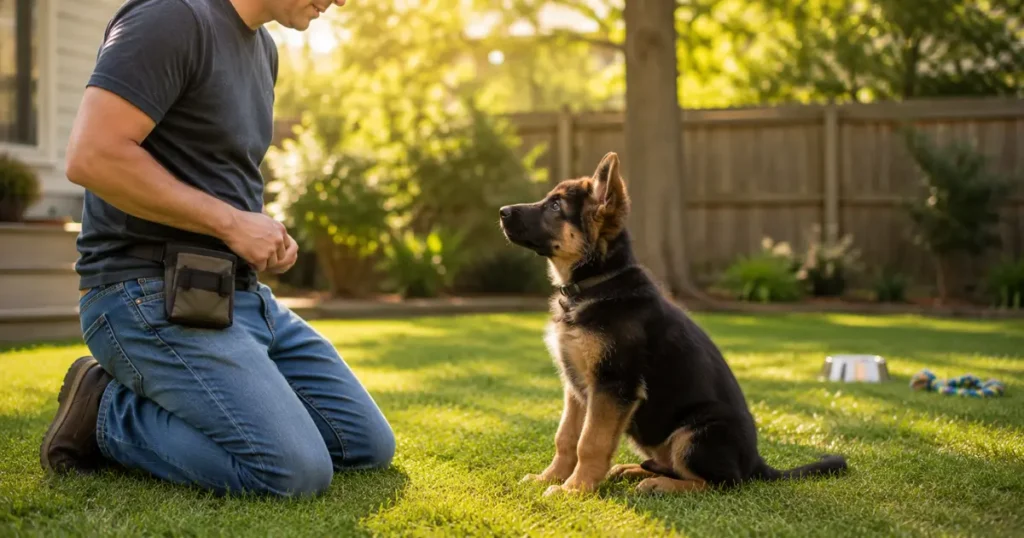
My first German Shepherd puppy trained faster than any dog I’d owned before, and also caused more damage in one week than any dog I’d owned before.
That’s not a contradiction.
It’s the central reality of german shepherd puppy training that most generic guides skip right past.
GSDs learn faster because they’re smarter, which also means they get bored faster, test boundaries harder, and bite with more force during teething than a Beagle or a Cavalier ever would.
The same intelligence that makes them pick up “sit” in 3 repetitions makes them figure out how to open the treat pouch by day two, and then teach themselves how to open the pantry door the following week.
Most breed-agnostic puppy guides treat a GSD like any other puppy with a slightly bigger adult size.
That approach misses what actually matters, this breed’s working-dog history shapes everything from bite pressure to how they respond to boredom.
This guide is built specifically around what makes GSD puppies different:
- The 3-drive system that shapes their behavior
- The exact commands to teach at each age
- A genuine bite-inhibition protocol for a breed that bites harder than most
- The adolescence phase every GSD owner hits around 4 to 6 months when their perfectly trained puppy suddenly pretends they’ve never heard the word “come” before.
Timeline, Key Milestones & Critical Socialization Rules
Training should start the day you bring your puppy home, typically at 8 weeks. Focus on name recognition and house rules first, then add one new command per week. GSDs have a critical socialization window between 3 and 14 weeks that, if missed, significantly increases the risk of fear-based reactivity in adulthood. Bite inhibition must be addressed early and specifically, since GSD puppies bite harder than most breeds due to their working-dog jaw strength. Most GSD puppies know 6 to 8 commands reliably by 16 weeks with consistent daily sessions of 5 to 10 minutes.
A German Shepherd puppy training routine should begin at 8 weeks with name recognition and house rules, adding one new command per week, with most GSD puppies learning 6 to 8 commands reliably by 16 weeks through consistent 5-to-10-minute daily sessions.
Address mouthiness immediately. GSD puppies possess greater jaw strength than average breeds, making early soft-mouth training essential.
Why German Shepherd Puppy Training Is Different
Intelligence, Drive, and Why Generic Advice Fails
According to the American Kennel Club, a well-bred German Shepherd Dog is “highly intelligent, thriving on praise and wanting to please the owner,” a combination that makes them “very trainable” but also means they require “consistent and ongoing training from an early age.”
That intelligence is what separates german shepherd puppy training from generic puppy training.
A Lab puppy might chew a shoe out of boredom.
A GSD puppy will figure out which closet has the shoes, how to open it, and prioritize the most expensive pair.
The same mental power that makes them exceptional working dogs means they need more structured engagement, not just more repetition.
The 3 Drives Every GSD Owner Needs to Understand
- Prey drive, the instinct to chase, grab, and shake moving objects. This is why your GSD puppy chases leaves, ankles, and other dogs’ tails, not defiance.
- Play drive, the desire for interactive engagement with you specifically. GSD puppies with high play drive learn fastest through tug and fetch-based reward systems.
- Food drive, responsiveness to treats as a training reward. Some GSDs have lower food drive than Labs or Goldens, which means treat-only training sometimes stalls.
Understanding which drive is strongest in your specific puppy shapes which reward system will actually work, not every GSD responds to the same motivation.
For a structured program built specifically around channeling high-intelligence breeds through brain games, read our Brain Training for Dogs review.
German Shepherd Puppy Training Timeline, 8 Weeks to 12 Months
| Age Stage | Primary Focus | Target Commands |
|---|---|---|
⭐ DAY 1 FOUNDATION
8 – 10 Weeks | Name recognition, house rules, crate comfort |
🏷️ Name
🪑 Sit
🐾 Come (informal) |
🔥 CRITICAL SOCIALIZATION
10 – 16 Weeks | Socialization, bite inhibition, impulse control |
Down
Stay
Leave It
Drop It |
4 – 6 Months | Adolescence management, impulse control |
Wait
Place
Heel (intro) |
6 – 12 Months | Proofing commands, real-world distraction work |
🎯 Recall (distance)
🦮 Heel (formal) |
8 to 10 Weeks, Foundation and Trust
The first 2 weeks home are about building trust, not drilling commands.
- Teach your puppy their name by saying it, waiting for eye contact, then rewarding immediately.
- Establish house rules from day one, if the couch is off limits at 80 pounds, it should be off limits at 12 pounds.
- Keep sessions to 3 to 5 minutes maximum, GSD puppies at this age have genuine focus windows measured in seconds, not minutes.
For a ready-made puppy foundation covering potty training, crate training, and biting in one package, read our DIYK9 Puppy Essentials review.
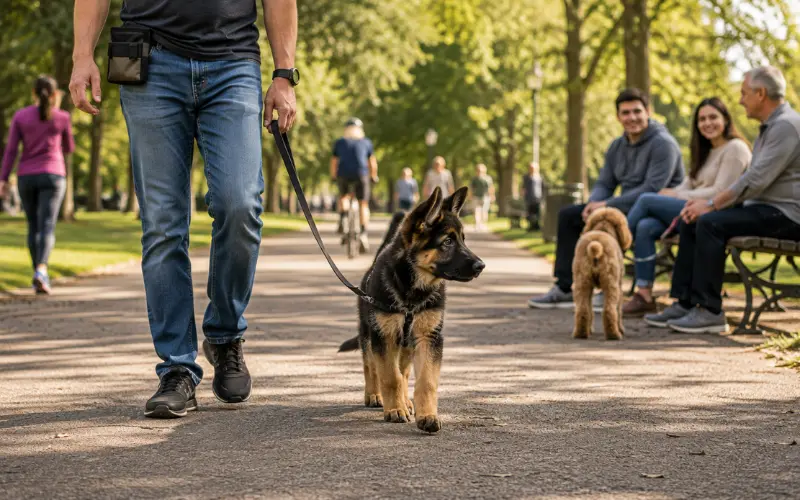
10 to 16 Weeks, The Critical Socialization Window
This is the most time-sensitive phase in german shepherd puppy training and the one with the highest long-term consequences if skipped.
According to the AKC, the critical socialization period runs from approximately 3 to 14 weeks of age, and “puppies that are allowed to have a wide variety of social experiences are more likely to be well-adjusted adults.”
- Expose your GSD puppy to at least 7 new people per week during this window, varying in age, appearance, and clothing.
- Introduce new surfaces (metal grates, tile, grass, gravel), sounds (traffic, vacuum, thunder recordings), and environments (pet stores, parking lots, friend’s houses).
- Never force an interaction. If your puppy shows fear, increase distance and let them observe from a comfortable range.
4 to 6 Months, Adolescence Hits
The puppy that sat on command reliably at 14 weeks may suddenly act like they’ve never heard the word before.
This is normal GSD adolescence, not a training failure.
6 to 12 Months, Proofing and Real-World Practice
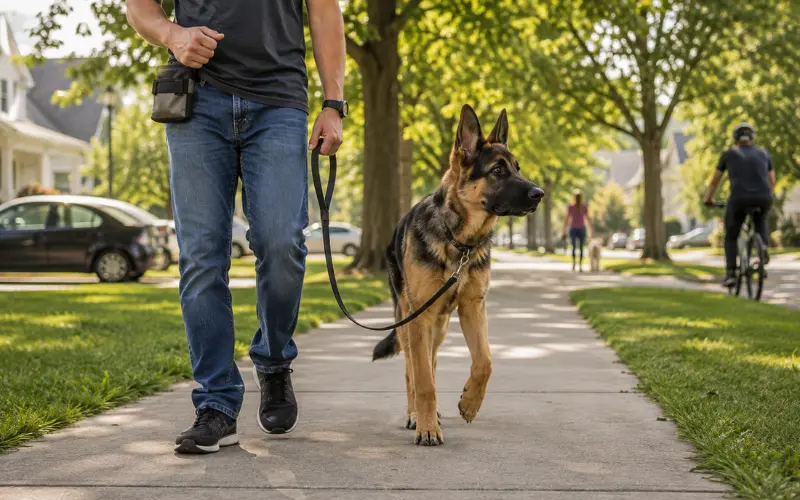
Proofing means your dog responds to commands in real environments, not just your living room.
Start in low-distraction settings and gradually increase difficulty.
Bite Inhibition, the GSD-Specific Challenge
This is the section most generic puppy guides skim past, and it’s the one GSD owners need most.
Why German Shepherds Bite Harder Than Most Puppies
GSDs were bred to manage and control livestock, which required a confident mouth and strong jaw.
That same jaw shows up in puppyhood as harder, more persistent mouthing than smaller or softer-mouthed breeds.
This isn’t aggression.
It’s a breed-specific trait that needs breed-specific management.
The 4-Step Pressure Training Method
- Step 1: Let the hardest bites land, then yelp and withdraw. Not every bite, just the hardest ones. This teaches the puppy that pressure above a certain threshold ends the game.
- Step 2: Gradually lower the threshold. Once the hardest bites stop, the next-hardest bites become the new “too hard.”
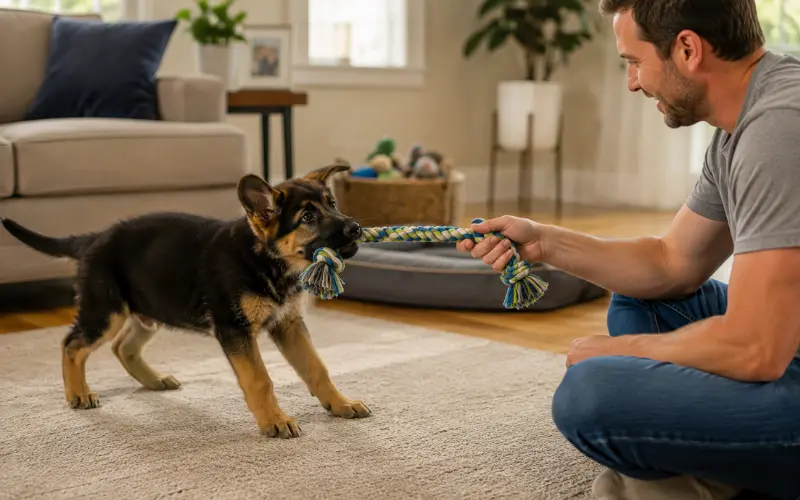
- Step 3: Redirect to appropriate objects. Offer a tug toy or chew the instant you withdraw, so the puppy learns what is acceptable to bite.
- Step 4: Reward soft mouth contact. When your puppy mouths gently without pressure, that’s the behavior to reinforce, not just the absence of biting.
For our foundational approach to this issue, read our guide on how to handle puppy biting and nipping.
Essential Commands by Age (Reference Chart)
| Command | Teach At | Expected Timeline |
|---|---|---|
| 🏷️ Name Recognition | 8 weeks | ⏱️ 2–3 days |
| 🪑 Sit | 8–9 weeks | ⏱️ 1–3 days |
| 🐾 Come (informal) | 9–10 weeks | ⏱️ 1–2 weeks |
| ⬇️ Down | 10–12 weeks | ⏱️ 1–2 weeks |
| ✋ Stay (short) | 12–14 weeks | ⏱️ 2–3 weeks |
| 🚫 Leave It | 12–14 weeks | ⏱️ 2–4 weeks |
| 🎁 Drop It | 14–16 weeks | ⏱️ 2–3 weeks |
| ⏳ Wait | 4–5 months | ⏱️ 2–4 weeks |
| 🛌 Place | 4–5 months | ⏱️ 2–4 weeks |
| 🦮 Heel (intro) | 5–6 months | ⏱️ 4–8 weeks |
| 🎯 Recall (distance) | 6+ months | 🔄 Ongoing |
A German Shepherd puppy can learn name recognition in 2 to 3 days at 8 weeks old, progressing to 6 to 8 reliable commands by 16 weeks, with more complex commands like formal heel and distance recall introduced after 5 months when impulse control has developed.
Socialization Window Warning, Why GSDs Are Higher Risk
German Shepherds are genetically predisposed to wariness of unfamiliar stimuli more than retrievers or spaniels.
This is a feature of their guarding heritage, not a flaw, but it means the socialization window carries higher stakes for this breed specifically.
What Happens If You Miss the 3-to-14-Week Window
According to the AKC, puppies that miss positive socialization experiences during the critical 3-to-14-week window are significantly more likely to develop fear-based behavior problems in adulthood.
For GSDs specifically, this often shows up as leash reactivity toward other dogs, barking at strangers, and avoidance of new environments, patterns that are dramatically harder to address once they’re established versus preventing them during the socialization window.
Safe Socialization Checklist for GSD Puppies
- 7 new people per week (different ages, appearances, hats, sunglasses, uniforms)
- 3 new surfaces per week (metal grates, wet grass, tile, gravel)
- 2 new environments per week (pet store, parking lot, friend’s house)
- 1 new sound exposure per day (traffic, vacuum, fireworks recording at low volume)
- Supervised puppy playtime with vaccinated, calm adult dogs
For shy or anxious GSD puppies needing confidence-building without pressure, SpiritDog’s Confidence Booster course is built specifically for this problem.
Surviving GSD Adolescence (4 to 8 Months)
Why Your Trained Puppy Suddenly Ignores You
Around 4 to 6 months, your GSD’s drives intensify, impulse control drops, and the recall you thought you had disappears.
This isn’t a training failure.
It’s normal canine adolescence, amplified by the GSD’s high intelligence and strong drives.
According to the AKC’s breed-specific training timeline, German Shepherds don’t mentally mature until 2 to 3 years of age, meaning this adolescent phase is genuinely longer than most owners expect.
3 Things That Actually Help During This Phase
- Shorten sessions, don’t lengthen them. 5-minute focused sessions beat 20-minute battles of willpower during adolescence.
- Increase exercise before training. A tired adolescent GSD is a more focused GSD. A 20-minute fetch session before a 5-minute training session produces better results than jumping straight into commands.
- Go back to basics without frustration. If “stay” has fallen apart, reteach it at the easiest level and rebuild. Your puppy’s brain is reorganizing, not deleting what it learned.
For GSDs that genuinely can’t settle or focus during adolescence, SpiritDog’s Calm Down course targets exactly this problem with 24 lessons built for hyperactive, easily excited dogs.
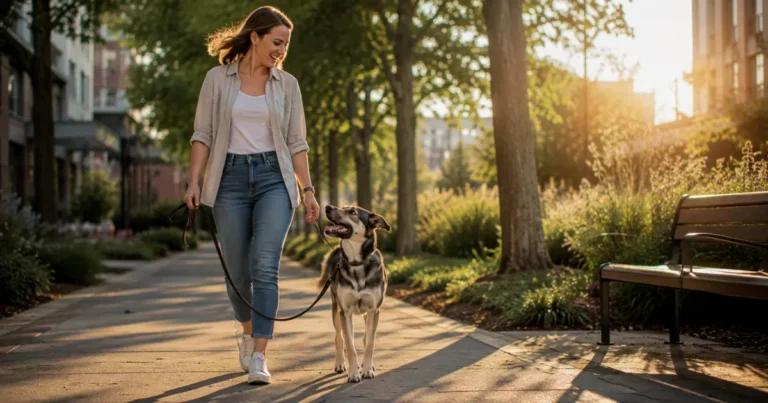
Leash Training a German Shepherd Puppy
Why Harness Matters More for This Breed
GSDs grow from 15 pounds to 65-plus pounds within their first year.
A flat collar that fits at 10 weeks becomes a pressure point at 6 months when your adolescent GSD starts pulling with real strength.
A properly fitted no-pull harness distributes force across the chest rather than concentrating it on the neck, reducing the risk of tracheal damage during the pulling phase most GSD adolescents go through.
For our detailed approach to stopping leash pulling, read our guide on leash training a puppy that pulls on walks.
Crate Training a German Shepherd Puppy
| Age Stage | Recommended Crate Size | Action |
|---|---|---|
⭐ PUPPY FOUNDATION
8 – 12 Weeks | 📦 30″ with divider | 🛒 Check Price → |
🔥 RAPID GROWTH
3 – 6 Months | 📦 36″ with divider | 🛒 Check Price → |
6 – 12 Months | 📦 42″ (Most GSDs) | 🛒 Check Price → |
Adult | 📦 42″ to 48″ (Depending on size) | 🛒 Check Price → |
For our complete crate-training method, read our guide on how to crate train a dog that hates the crate.
Common German Shepherd Puppy Training Mistakes
- Waiting until 6 months to start training. GSDs are learning from day one whether you’re teaching them or not. Delay means they’re learning habits you’ll spend months correcting.
- Using physical corrections on a GSD puppy. This breed bonds deeply and remembers. Physical punishment erodes trust and often creates the exact fear-based reactivity owners are trying to prevent.
- Skipping socialization because “my yard is big enough.” Space is not socialization. A GSD that never leaves its property during the critical window is at genuine risk of developing reactivity regardless of yard size.
- Treating adolescent regression as permanent failure. The 4-to-8-month phase is temporary. Owners who give up during this stage miss the breakthrough that typically follows with consistent work.
- Over-training in long sessions. GSDs learn fast but burn out fast too. Three 5-minute sessions spread through the day outperform one 30-minute marathon session.
When to Get Professional Help
GSD-Specific Red Flags That Need a Trainer
- Biting that draws blood consistently after 14 weeks, not occasional accidental nicks, but repeated hard bites despite consistent bite-inhibition work.
- Growling or stiffening around food, toys, or resting spots before 6 months. Early resource guarding in a breed this strong needs professional assessment, not YouTube solutions.
- Extreme fear reactions (cowering, trembling, refusing to move) to normal stimuli like traffic sounds or strangers after consistent socialization efforts.
- Aggression toward other dogs that goes beyond normal puppy play-fighting, especially if it’s directed at specific sizes or types of dogs consistently.
Online Training Programs Worth Comparing for GSD Puppies
| Program | Price | Best For GSD | Action |
|---|---|---|---|
⭐ SMART BREED MENTAL STIMULATION
🧠 Brain Training for Dogs
|
$67 | Channeling GSD intelligence through brain games | Explore Course → |
⭐ POLICE K9 FOUNDATION
🐕 DIYK9 Puppy Essentials
|
$297 | Potty, crate, and biting foundations | Explore Course → |
🛡️ SpiritDog Confidence Booster
|
$35 | Shy or anxious GSD puppies | Explore Course → |
🧘 SpiritDog Calm Down
|
$49 | Hyperactive adolescent GSDs | Explore Course → |
Each of these has been individually reviewed on this site.
For our complete comparison of all reviewed training programs, read our guide on the best online dog training courses.
Brain Training for Dogs
Channel intelligence, fix boredom-driven behaviors, and stimulate mental health.

Frequently Asked Questions (FAQ)
When should I start training my German Shepherd puppy?
Start the day you bring your puppy home, typically at 8 weeks.u003cbru003eBegin with name recognition, house rules, and short 3- to 5-minute sessions.u003cbru003eGSDs are learning from day one, whether you’re intentionally teaching them or not.
How long does it take to train a German Shepherd puppy?
Most GSD puppies learn 6 to 8 basic commands reliably by 16 weeks with consistent daily sessions.u003cbru003eFull household manners, including leash walking, crate training, and reliable recall, typically take 6 to 12 months to develop.u003cbru003eMental maturity doesn’t arrive until 2 to 3 years of age.
Why does my German Shepherd puppy bite so hard?
GSDs were bred for livestock work that requires a confident mouth and a strong jaw.u003cbru003ePuppy biting is a breed-specific trait, not aggression, and should be managed through graduated pressure training rather than punishment, which can create fear-based reactivity in this breed.
What is the hardest age to train a German Shepherd?
The 4- to 8-month adolescent phase is typically the hardest.u003cbru003eYour puppy’s drives intensify, impulse control drops, and previously learned commands may seem to disappear.u003cbru003eThis is temporary and normal, not a sign of permanent failure.
Are German Shepherds easy to train?
Yes, GSDs are among the most trainable breeds due to their intelligence and willingness to work.u003cbru003eHowever, u0022easy to trainu0022 doesn’t mean u0022low maintenance.u0022u003cbru003eTheir intelligence requires more structured engagement and consistency than that of less-driven breeds.
How do I socialize my German Shepherd puppy safely?
Expose your puppy to:u003cbru003eu003cstrongu003e7 new peopleu003c/strongu003eu003cbru003eu003cstrongu003e3 new surfacesu003c/strongu003eu003cbru003eu003cstrongu003e2 new environmentsu003c/strongu003eu003cbru003eu003cstrongu003e1 new soundu003c/strongu003eu003cbru003eper week during the 3- to 14-week socialization window.u003cbru003eNever force interactions.u003cbru003eIf your puppy shows fear, increase distance and let them observe from a comfortable range first.
The Puppy That Trains You Back, Final Thoughts
My German Shepherd didn’t just learn “sit” in 3 repetitions.
He learned that I reached into my pocket before giving the cue, so he’d sit the moment my hand moved, no word needed.
That’s german shepherd puppy training in a sentence: a breed so smart it’s always one step ahead, which makes training them both easier and harder than anything a generic puppy guide prepares you for.
Three things to take with you.
- Start at 8 weeks, not 6 months. Every day you wait is a day your GSD is learning habits you haven’t chosen.
- The socialization window is genuinely time-sensitive. Missing the 3-to-14-week period has measurable long-term consequences for this breed specifically.
- Adolescence is temporary. The 4-to-8-month regression feels permanent, but consistent 5-minute sessions through it produce a genuinely well-trained adult on the other side.
For the complete positive-reinforcement foundation this entire guide builds on, read our guide on positive reinforcement dog training for beginners. And if you’re weighing breeds, our Golden Retriever training guide shows how differently the approach shifts for a food-driven, softer temperament.


Pingback: Golden Retriever Puppy Training, Step-by-Step Guide (2026)