


I almost missed it completely.
My dog had been “a little off” for about two weeks.
Nothing dramatic. He was still eating. Still wagging his tail when I came home. Still walking to the door when I grabbed the leash. But something was different in a way I could not name.
He was getting up slower. His walks were shorter — not because I cut them short, but because he would sit down after 15 minutes instead of his usual 30.
And one morning I noticed he flinched — just barely — when I scratched behind his right ear the way I had done every morning for six years.
The vet found a severe ear infection that had been building for weeks.
“He’s been in pain for a while,” she said. “Dogs are incredibly good at hiding it.”
That sentence stuck with me.
My dog was in genuine pain for two weeks and I — the person who feeds him, walks him, sleeps three feet from him every night — almost did not notice.
Learning the signs your dog is in pain changed how I look at him every single day.
Not with anxiety. With attention.
Because dogs are genetically wired to mask pain, and the signs are so subtle that most owners miss them until the problem is advanced.
This guide covers every signal — physical, behavioral, and situational.
The 15 signs your dog is in pain that are easy to miss, the home assessment method to check safely, and the clear line between “monitor at home” and “call the vet today.
Dogs instinctively hide pain — subtle changes in routine behavior are often the earliest and most reliable indicators.
Any sudden behavior change warrants a vet call within 24 to 48 hours.
Why Dogs Hide Pain — The Instinct That Works Against Them
This is the most important concept in understanding the signs your dog is in pain.
Dogs do not hide pain because they are tough. They hide it because thousands of years of evolution taught them that showing weakness gets you killed.
Dogs are genetically hardwired to mask pain and discomfort — a survival instinct inherited from their wild ancestors, where showing vulnerability made an animal a target for predators and rivals, which means owners must actively look for subtle behavioral changes rather than waiting for obvious signs of distress.
In the wild, a limping wolf falls behind the pack. A dog showing weakness becomes a target.
So dogs developed the ability to suppress outward signs of pain — continuing to eat, walk, and interact even when they are genuinely suffering.
This instinct does not go away because your dog lives on a couch instead of in the wild.
Your Golden Retriever has the same pain-masking instincts as a wolf. The difference is that a wolf needs that instinct to survive. Your dog needs you to see through it.
According to the American Kennel Club, most dogs downplay their pain because showing signs of weakness is an inherited vulnerability — which means owners need to watch for subtle signals and truly know their dog’s baseline behavior to catch pain early.
The practical implication: do not wait for your dog to cry, whimper, or limp dramatically before suspecting pain.
By the time the signs are obvious, the pain has usually been present for days or weeks.
The earliest indicators are behavioral — changes in routine, energy, and interaction patterns that only someone who knows the dog well would notice.
Physical Signs Your Dog Is in Pain — What to Watch
Physical signs are the ones most owners think of first — limping, crying, refusing to move.
But the reality is that the physical signs your dog is in pain are often far more subtle than a limp.
Physical signs of pain in dogs range from obvious indicators like limping and trembling to subtle cues like changes in posture, excessive panting while at rest, and reluctance to use stairs or jump onto furniture they previously accessed easily.
Mobility Changes — The Most Reliable Early Sign
- Limping or favoring one leg — even intermittently
- Reluctance to jump onto furniture or into the car when they previously did so easily
- Slower on stairs — going up, coming down, or both
- Walking shorter distances than usual before wanting to stop or turn around
- Stiffness after resting — taking longer to stand up after lying down, especially in the morning
- Shifting weight — leaning away from the painful area while standing
Postural Changes
- Hunched or arched back — indicates spinal or abdominal pain
- Head held low — can indicate neck or shoulder pain
- “Prayer position” — front legs and chest on the ground, hindquarters raised — classic sign of abdominal pain
- Standing or sitting in unusual positions — trying to take weight off the painful area
Other Physical Signs
- Panting at rest — when the dog has not exercised and the room is not hot, heavy panting is a pain indicator
- Trembling or shaking — not from cold or excitement
- Changes in facial expression — a tighter face, less relaxed jaw, eyes that look “harder” or more half-closed than usual
- Excessive licking or chewing at one spot on the body — dogs lick where it hurts
- Swelling, heat, or tenderness in a specific area
According to the AKC, physical signs can be as subtle as simply not going as far as usual on daily walks — a change so gradual that owners often attribute it to age or laziness rather than recognizing it as pain.
Behavioral Signs Your Dog Is in Pain — The Ones Most Owners Miss
Behavioral changes are the earliest and most reliable signs your dog is in pain — and the ones most commonly missed because they do not look like “pain” to most people.
Behavioral changes are the earliest indicators of pain in dogs — withdrawal from family interaction, loss of interest in favorite activities, sudden clinginess, uncharacteristic aggression when touched, and changes in sleep patterns all signal that a dog is experiencing discomfort they are actively trying to hide.
Withdrawal and Hiding
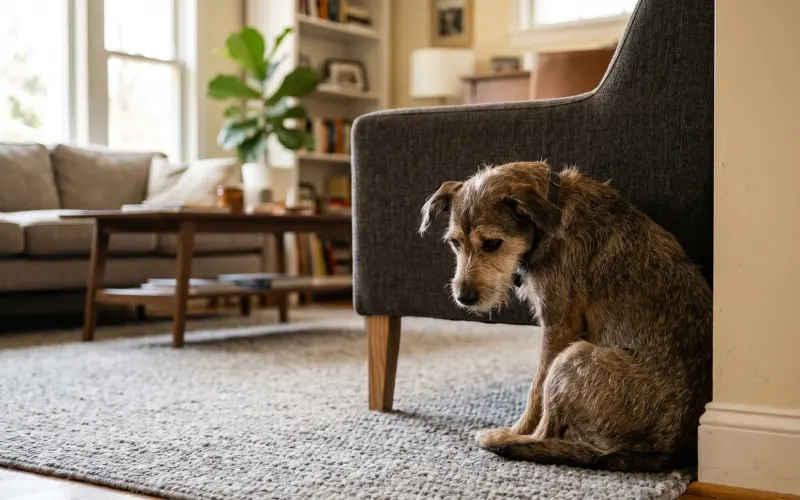
A dog that used to greet you at the door but now stays on their bed. A dog that used to follow you from room to room but now stays in one spot. A dog that actively seeks out small, enclosed spaces — behind furniture, under beds, in closets.
Dogs in pain withdraw. They do not want to be touched, bumped, or jostled. They reduce interaction because interaction risks contact with the painful area.
This is the sign I missed with my dog.
He was not hiding dramatically. He was just slightly less present. Slightly less engaged.
It was so gradual that I normalized it for two weeks.
Changes in Temperament
- A normally gentle dog that growls, snaps, or flinches when touched in a specific area
- A normally social dog that avoids interaction
- A calm dog that becomes restless — pacing, unable to settle, repositioning constantly
- A normally independent dog that becomes clingy — following you everywhere, not wanting to be alone
Pain changes personality.
A dog that has never growled at you and suddenly does when you touch their hip is not becoming aggressive. They are telling you something hurts.
Changes in Daily Patterns
- Loss of interest in favorite activities — toys they used to love, games they used to initiate
- Appetite changes — eating less, eating more slowly, or refusing food entirely
- Sleep changes — sleeping significantly more than usual, or unable to sleep and repositioning constantly through the night
- Reluctance to be groomed — pulling away during brushing, handling, or nail trimming that they previously tolerated
Vocalization Changes
- Whimpering or whining — especially when changing positions or being touched
- Yelping when picked up or when a specific area is contacted
- Unusual silence — some dogs in chronic pain become quieter than normal, which is the opposite of what owners expect

Chronic Pain vs Acute Pain — Why Chronic Is Harder to Catch
Acute pain is easy to recognize.
Your dog yelps when they step on something. They hold up a paw after a fall. They cry when you touch a wound.
The cause is clear and the reaction is immediate.
Chronic pain is the dangerous one.
Chronic pain in dogs develops gradually over weeks or months — often from conditions like arthritis, dental disease, or hip dysplasia — and because the onset is so slow, owners unconsciously adjust to the behavioral changes without recognizing them as pain signals.
Chronic pain from arthritis, dental disease, hip dysplasia, or internal conditions builds slowly.
The dog adapts. The owner adapts.
The behavioral changes are so gradual — slightly shorter walks this week, a little slower on stairs this month, a little less interested in playing over the past few weeks — that both dog and owner normalize them.
“He’s just getting older.”
“She’s always been a calm dog.”
“He never liked stairs that much.”
These explanations feel reasonable.
And sometimes they are accurate.
But when multiple subtle changes happen over the same period, chronic pain is far more likely than aging alone.
According to the American Kennel Club, chronic pain in dogs can cause owners to see a gradual disappearance of the brightness and engagement they recognize in their dog’s face — replaced by a disconnected, glazed look that develops so slowly it goes unnoticed.
The key question to ask yourself: is my dog doing less than they did 3 months ago?
Not compared to a puppy. Compared to 3 months ago.
If the answer is yes and you cannot identify a specific reason — pain should be investigated.
The Home Pain Assessment — How to Check Your Dog Safely
Before calling the vet, you can do a gentle assessment at home to help identify where the pain might be coming from.
This gives your vet useful information and helps you communicate what you are observing.
The Gentle Touch Test
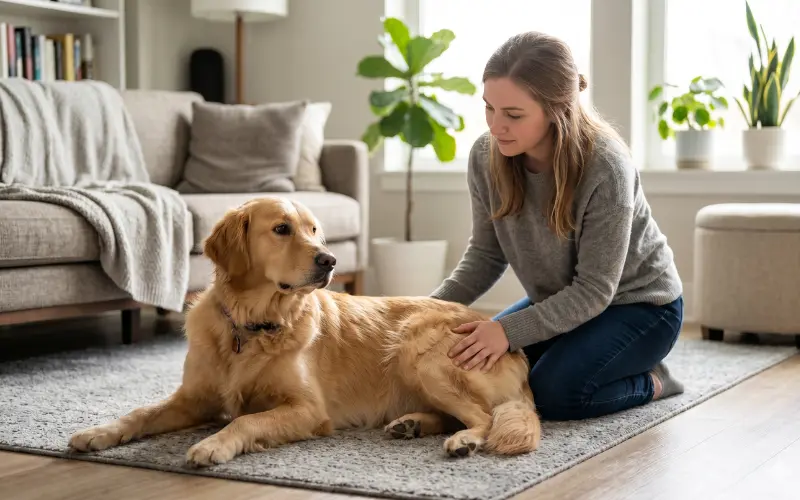
With your dog lying calmly, run your hands slowly and gently along their entire body — head to tail, down each leg, across the belly.
You are feeling for two things:
- Physical changes (swelling, heat, lumps)
- Behavioral reactions (flinching, tensing, pulling away, turning to look at your hand)
Start at the head and work your way through the body:
- Gently press around the ears, jaw, and neck
- Move across the shoulders and down each front leg, pressing gently on each joint
- Run your hands along the spine from shoulders to tail base
- Gently press on each side of the ribcage
- Move to the hips and down each back leg
A dog in pain will react when you reach the painful area — they may flinch, tense their muscles, turn their head to watch your hand, pull the limb away, or vocalize.
Note the exact area where the reaction happened.
The Mobility Watch
Watch your dog do these 5 things and note any difficulty:
- Stand up from lying down — does it take longer than usual or require multiple attempts?
- Walk across a room — is there any unevenness in the gait, any slight favoring of one side?
- Climb stairs or jump onto the couch — is there hesitation, reluctance, or refusal?
- Turn around in a small space — is the movement fluid or stiff?
- Lie back down — do they lower themselves carefully rather than flopping down like they used to?
For a complete year-round health monitoring approach, read our How to Keep Dog Cool in Summer — Heat Stroke Prevention Guide complete guide to keeping your dog healthy and happy.
Show the video to your vet at the appointment.
Veterinary behaviorists say that dogs often behave differently in clinic environments — they may mask pain more effectively due to adrenaline from the stress of the visit.
A video of your dog at home, moving naturally, gives the vet a far more accurate picture of the actual mobility issues than what they observe in a 15-minute exam room visit.
When to Call the Vet — The Decision Line
Not every pain signal means an emergency.
But some do.
Knowing the signs your dog is in pain that require immediate veterinary attention versus those that can wait 24 to 48 hours is critical.
Call Today — Do Not Wait
- Sudden severe limping — non-weight-bearing on a limb
- Yelping or crying when touched or moved
- Trembling combined with panting at rest
- Visible swelling that appeared rapidly
- Refusal to eat for more than 24 hours
- Vomiting or diarrhea combined with any pain sign
- “Prayer position” — could indicate bloat or pancreatitis, both emergencies
- Sudden aggression in a normally gentle dog
- Collapse or inability to stand
Schedule Within 48 Hours
- Subtle limping that comes and goes
- Gradual decrease in activity over days
- Mild stiffness in the morning that improves with movement
- Appetite slightly reduced but still eating
- Increased sleeping but still responsive and alert
- Mild behavior changes — slightly less engaged
Monitor at Home and Mention at Next Vet Visit
- Very mild stiffness after vigorous exercise that resolves within a few hours
- Occasional reluctance on stairs but no consistent pattern
- Slightly slower walks with no other symptoms
According to the ASPCA, excessive panting, gasping for breath, reclusiveness, reluctance to move, and food pickiness are all signs that a pet may be experiencing pain that requires veterinary evaluation.
Each day, write one line: date, what you observed, and severity on a 1 to 5 scale.
“June 12 — slow getting up from bed, slight limp on left hind, 2/5.”
After 5 to 7 days, this diary gives your vet a timeline that is dramatically more useful than “he’s been a little off lately.”
Patterns that are invisible day-to-day become obvious on paper.
Common Conditions That Cause Hidden Pain in Dogs
Understanding which conditions most commonly cause the hidden pain that produces the signs your dog is in pain helps you know what your vet may be looking for.
Arthritis — The Most Common Cause
Arthritis affects up to 80% of dogs over 8 years old and is the leading cause of chronic hidden pain.
Symptoms develop so gradually that most owners attribute the changes to normal aging.
Signs specific to arthritis:
- Morning stiffness that improves with movement
- Difficulty with stairs
- Slower to rise after resting
- Reluctance to jump
- Shorter walks
Dental Disease
Dental pain is one of the most underdiagnosed sources of chronic pain in dogs.
By age 3, most dogs show signs of periodontal disease — but because dogs continue to eat even with significant mouth pain, owners rarely suspect dental issues until the disease is advanced.
Signs specific to dental pain:
- Dropping food while eating
- Chewing on one side
- Bad breath that worsens suddenly
- Blood on chew toys
- Reluctance to eat hard food
For dental care that prevents these problems, read our guide on how to clean puppy teeth at home.
If you can also see a raw or ulcerated spot inside the mouth, read our guide on dog mouth sores and ulcers.
Hip Dysplasia
A genetic condition most common in large breeds — German Shepherds, Labrador Retrievers, Golden Retrievers, Rottweilers.
The hip joint does not develop properly, causing progressive pain and mobility loss.
Signs specific to hip dysplasia:
- “Bunny hopping” gait (both hind legs move together)
- Difficulty rising
- Reluctance to run or climb
- Loss of muscle mass in the hind legs
Back and Spinal Pain
Intervertebral disc disease (IVDD) is particularly common in long-backed breeds — Dachshunds, Basset Hounds, Corgis, Beagles.
A disc presses on the spinal cord, causing pain that ranges from mild stiffness to complete paralysis.
Signs specific to back pain:
- Hunched posture
- Crying when picked up
- Reluctance to lower head to eat or drink
- Muscle spasms along the spine
- Dragging hind legs in severe cases
Internal Pain — Abdominal Conditions
Pancreatitis, bloat, kidney disease, and other internal conditions cause pain that has no visible external sign — making them the hardest to detect without veterinary diagnostics.
Signs of internal pain:
- “Prayer position”
- Panting at rest
- Reluctance to lie flat
- Pressing abdomen against cool surfaces
- Restlessness
According to the AKC, arthritis is one of the leading sources of chronic pain in dogs, particularly in seniors, and maintaining a healthy weight combined with early veterinary intervention significantly improves quality of life.
What NOT to Do When You Suspect Pain
These mistakes make the situation worse or more dangerous.
Never give human pain medication.
Ibuprofen, acetaminophen, naproxen, and aspirin are all potentially toxic to dogs — even in small doses.
Ibuprofen and naproxen cause kidney failure. Acetaminophen causes liver damage.
These are emergency poisoning situations, not pain relief.
Never ignore persistent behavior changes.
“He’ll get over it” is not a diagnosis.
Behavior changes that last more than 3 to 5 days without obvious cause warrant a vet conversation at minimum.
Never force a painful dog to exercise.
“Walking it off” does not apply to dogs.
A dog in pain that is forced to walk, run, or play is at risk of worsening the underlying injury and associating the handler with increased pain.
Never assume a dog that is eating is not in pain.
Dogs eat through remarkable levels of discomfort.
Appetite loss is a late-stage pain indicator, not an early one.
A dog that is eating normally can still be in significant pain.
Never diagnose at home.
The home assessment and pain diary are communication tools for your vet — not diagnostic tools for you.
Only a veterinarian can determine the cause and appropriate treatment.
According to the ASPCA, undiagnosed health issues can cause significant discomfort and rapid deterioration in dogs — making early veterinary consultation essential when any behavioral changes are observed.
Do not wait.
Do not try home remedies.
Call your emergency vet or drive directly to the nearest emergency animal hospital immediately.
The information in this guide is based on published veterinary research from the AKC, ASPCA, and veterinary pain specialists.
This guide helps you identify potential pain signals — it does not replace professional veterinary diagnosis.
If you suspect your dog is in pain, always consult your veterinarian for proper examination, diagnosis, and treatment.
Frequently Asked Questions
How do I know if my dog is in pain?
The most reliable indicators are behavioral changes — withdrawal from family interaction, loss of interest in favorite activities, changes in sleep patterns, reluctance to be touched, and any change in mobility like limping or hesitating on stairs.
Physical signs include panting at rest, trembling, changes in posture, and excessive licking at one area.
Dogs instinctively hide pain, so subtle changes in routine behavior are often the earliest signal.
Do dogs cry when they are in pain?
Some dogs vocalize — whimpering, whining, or yelping — but many dogs in significant pain remain completely silent.
Vocalization is breed-dependent and personality-dependent.
Stoic breeds like Labrador Retrievers and Mastiffs may show almost no vocal response to pain, while smaller breeds like Chihuahuas and Maltese tend to vocalize more readily.
Never assume that silence means absence of pain.
Can a dog be in pain but still wag its tail?
Yes.
Tail wagging indicates emotional arousal — not necessarily happiness or comfort.
A dog can wag their tail while greeting their owner and still be experiencing significant chronic pain from arthritis, dental disease, or other conditions.
Tail wagging is a social response, not a pain indicator.
Never use tail wagging as evidence that a dog is not hurting.
Why is my dog limping but not crying?
Because dogs are genetically wired to suppress outward signs of pain.
Limping indicates that bearing weight on the affected limb is uncomfortable enough to alter their gait — which means genuine pain is present.
The absence of crying does not reduce the significance of limping.
Any limp that persists for more than 24 hours or that appears suddenly without obvious cause warrants a veterinary examination.
How do dogs act when they are in pain at night?
Dogs in pain at night often cannot settle — they pace, reposition frequently, pant in the dark, and may whimper.
Some dogs with chronic pain sleep significantly more than usual because sleep is the only escape from discomfort.
Others develop nighttime restlessness because lying in one position for extended periods puts pressure on painful joints.
What are the signs of abdominal pain in dogs?
The “prayer position” — front legs flat on the ground with hindquarters raised — is the most distinctive sign of abdominal pain.
Other signs include a tense or distended abdomen, restlessness and inability to settle, panting at rest, reluctance to lie flat, and pressing the belly against cool surfaces.
Abdominal pain combined with vomiting, diarrhea, or a visibly swollen belly is a potential emergency and requires immediate veterinary attention.
At what age do dogs start showing pain from arthritis?
Most dogs begin showing subtle signs of arthritis-related pain between 7 and 10 years of age, though large and giant breeds can show signs as early as 4 to 5 years.
Approximately 80% of dogs over 8 years old have some degree of arthritis.
Early signs include morning stiffness that improves with movement, reluctance to use stairs, and slightly shorter walks — all of which are commonly mistaken for normal aging.
Should I give my dog aspirin or ibuprofen for pain?
Never give human pain medication to your dog without explicit veterinary guidance.
Ibuprofen and naproxen cause kidney failure in dogs. Acetaminophen causes liver damage. Aspirin can cause gastrointestinal bleeding.
These are genuine poisoning risks, not minor side effects.
Your veterinarian can prescribe dog-safe pain medications — NSAIDs formulated specifically for canine physiology — that are both effective and safe.
You Know Your Dog Best — Final Thoughts
Two weeks. That is how long my dog was in pain before I noticed something was genuinely wrong.
Two weeks of subtle changes I almost normalized away.
He was still eating. Still wagging his tail. Still walking to the door when I picked up the leash.
The ear infection was invisible from the outside.
The only thing that gave it away was a flinch — one brief flinch when I scratched behind his ear on a Tuesday morning.
That flinch saved us weeks of worsening infection, potential hearing damage, and significantly more pain.
The signs your dog is in pain are rarely dramatic.
They are quiet. They are gradual.
And they rely on one thing that no veterinarian, no article, and no checklist can replace — you knowing your dog well enough to notice when something shifts.
Three things to carry with you:
Compare to 3 months ago, not to a puppy.
The question is not whether your dog is as active as they were at 2 years old.
The question is whether they are doing less than they did 3 months ago.
If the answer is yes and you do not know why — investigate.
Behavior changes are pain signals.
A dog that stops greeting you at the door, stops playing with their favorite toy, or starts sleeping more than usual is not being lazy.
They may be telling you the only way they know how.
Film it and show your vet.
Dogs mask pain more effectively in stressful environments like vet clinics.
A 30-second video of your dog getting up slowly at home is worth more diagnostic information than a 15-minute clinical observation where adrenaline masks the very symptoms you brought them in for.
For the complete approach to preventive health that catches problems before they become painful — nutrition, exercise, dental care, and regular vet visits — read our guide on keeping your dog healthy and happy.
For the nutrition foundation that supports joint health and reduces inflammation throughout your dog’s life — read our complete dog nutrition guide for beginners.




Pingback: Dog First Aid Kit Essentials — What Every Owner Must Have at Home
Pingback: Senior Dog Care Guide: Health and Happiness (2026)
Pingback: Dog Tooth Decay Stages: What Your Vet's PD Chart Means
Pingback: Dog Mouth Sores and Ulcers: Causes and When to Worry