

Standing in the pet aisle, I genuinely couldn’t decide. My dog hates swallowing pills, hides them in his cheek like a squirrel, but a spot-on treatment meant keeping him away from the kids for a few hours. I ended up asking three different people at the store and got three different answers, and none of them agreed with each other.
That’s the problem with oral vs topical flea and tick prevention for dogs. Everyone has an opinion. Almost nobody points you to the actual data behind either option, and fewer still mention the safety details that actually matter once you get past the marketing on the box.
This guide does. Not which brand to buy, but what the research says about how each format actually performs, plus a safety alert from the FDA that most flea-and-tick articles never mention. By the end, oral vs topical flea and tick prevention for dogs should feel like a decision you can actually make with confidence, not a coin flip in a crowded aisle while your dog stares up at you, completely unaware he’s the one being debated over.
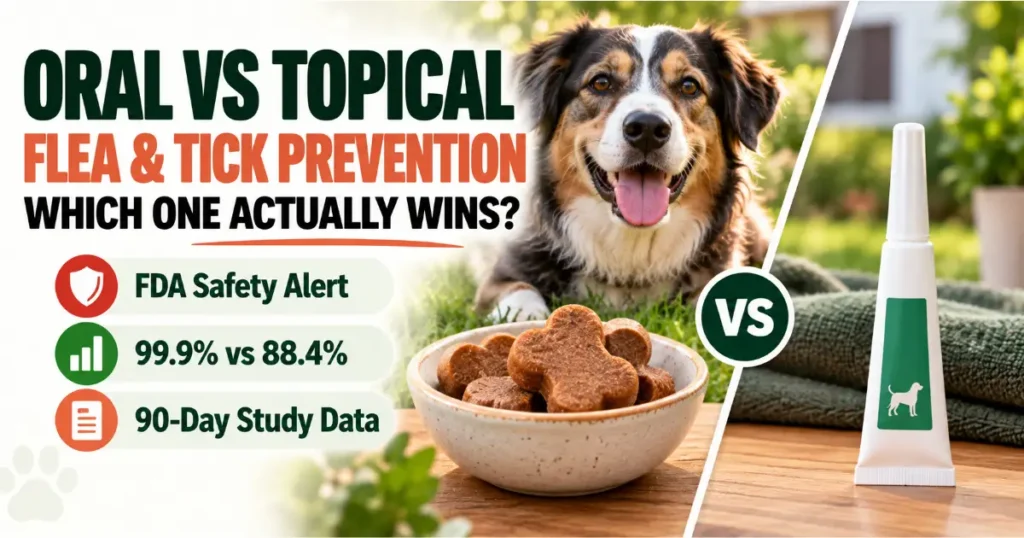
In a controlled 90-day study of 128 dogs, oral flea and tick treatments were 99.9% effective compared to 88.4% for topical treatments. Orals work systemically and can’t wash off, while topicals spread through the skin’s oils but can be reduced by bathing or swimming.
Oral vs topical flea and tick prevention for dogs ultimately comes down to your dog’s tolerance for pills, water exposure, and any seizure history, since most oral options belong to a drug class with an FDA safety alert.
Neither format is universally “better” for oral vs topical flea and tick prevention for dogs — the right choice depends on your specific dog’s health history and lifestyle.
The Real Difference Between Oral and Topical
Oral vs topical flea and tick prevention for dogs isn’t just a matter of pill versus liquid. The two formats work in fundamentally different ways inside your dog’s body, and understanding that difference is the foundation for every other decision in this guide.
Oral chewables are swallowed and absorbed into the bloodstream. The active drug circulates systemically, and fleas or ticks are killed when they bite your dog and ingest the medication along with their meal. That mechanism means nothing needs to touch your dog’s skin or coat at all, which also means there’s no residue for kids or other pets to accidentally contact.
Topical spot-ons work differently. Applied between the shoulder blades, the liquid spreads across your dog’s body through the skin’s natural oils, typically reaching full coverage within a day or two. Many topicals kill fleas and ticks on contact, meaning the parasite doesn’t need to bite your dog first to be affected, which some owners see as an advantage since it stops a bite before it happens rather than after.
That single difference, bloodstream versus skin surface, shapes almost everything else about oral vs topical flea and tick prevention for dogs: how water-resistant each option is, how fast it acts, and even how it’s regulated. Understanding this mechanical difference upfront makes every other comparison in oral vs topical flea and tick prevention for dogs easier to evaluate, since most of the trade-offs trace directly back to this one structural difference.

Oral flea and tick medications work by circulating through a dog’s bloodstream, killing parasites only after they bite, while topical treatments spread through the skin’s oils and can kill on contact without requiring a bite.
What the Research Actually Shows on Effectiveness
Most oral vs topical flea and tick prevention for dogs debates run on anecdote, brand loyalty, or whatever a store clerk happened to recommend that day. There’s actual data, and it’s worth knowing before you commit to either format.
A study cited by Hill’s Pet Nutrition, published in the journal Veterinary Parasitology, followed 128 dogs across five states over 90 days, directly comparing topical and oral flea treatments. The results were not close, and they held up consistently enough across five different states to rule out the gap being a fluke of one region’s flea population.
The 90-day study found topical flea treatments were 88.4% effective, while oral treatments reached 99.9% effectiveness, based on data from 128 dogs across five states.
That gap matters, but context matters too. Topicals can lose effectiveness from bathing, swimming, or heavy rain before the skin fully absorbs the product, typically within 24 to 48 hours of application. Orals don’t have that vulnerability once swallowed and digested.
None of this means topicals are a poor choice. A consistently applied topical on a dog that isn’t frequently wet can perform well. The study result reflects real-world conditions, including owners who occasionally miss the water-exposure window, not a lab-perfect scenario. Staying on top of regular grooming and brushing also makes it easier to spot fleas or ticks early, no matter which preventive you end up choosing.
Effectiveness numbers like these come from controlled studies. Individual results vary based on application technique, your dog’s activity level, and how strictly the product schedule is followed.

The FDA Safety Alert Most Owners Don’t Know About
Here’s the part most oral vs topical flea and tick prevention for dogs comparisons skip entirely, and it’s arguably the most important safety detail in the whole decision.
Most oral flea and tick chewables belong to a drug class called isoxazolines, which includes Bravecto, Credelio, NexGard, and Simparica. According to the FDA, these products are considered safe and effective for the vast majority of dogs and cats, but the agency has issued a fact sheet alerting pet owners to a potential risk.
The FDA has alerted pet owners that isoxazoline flea and tick products, including Bravecto, Credelio, NexGard, and Simparica, have been associated with neurologic adverse reactions such as muscle tremors, ataxia, and seizures in some dogs and cats.
The FDA is direct about the fact that most dogs and cats never experience these reactions. But it also notes something worth taking seriously: seizures may occur in animals with no prior seizure history at all. That’s not a reason to avoid oral flea and tick prevention. It is a reason to have a specific conversation with your vet before starting one, especially if your dog has any neurological history, however minor it seemed at the time.
If your dog has ever had a seizure, even once, mention it before choosing an oral isoxazoline product. Your vet may still recommend one, but they’ll want that history on record either way, since it directly shapes how closely they’ll want to monitor your dog afterward.
Topicals carry their own safety considerations, just different ones. Some contain permethrin, an ingredient that’s safe for dogs but can be lethal to cats, making topicals a bigger household risk in multi-pet homes with both dogs and cats. That risk isn’t about the dog wearing the product at all; it’s about a cat grooming itself after brushing against a treated dog’s coat before the application site is fully dry.
EPA vs FDA – Reading the Label Right
This is a detail almost nobody explains, and it changes how you should read a flea and tick product label when comparing oral vs topical flea and tick prevention for dogs side by side, long before you ever get to comparing prices or brand names.
Flea and tick products for dogs fall under two different regulatory systems, and the label tells you which one applies, even though most owners never think to check.
Flea and tick products for dogs are regulated by either the EPA, as pesticides, or the FDA, as animal drugs, and checking which regulatory number appears on the label can tell you which review process the product went through.
Neither regulatory path is inherently safer than the other. Both require safety and efficacy data before approval, just through different agencies and different review standards. But if a product shows neither number, that’s worth a direct question to your vet before buying, since it may not have gone through either review process, and that gap in oversight is exactly the kind of detail a flashy label won’t volunteer on its own, no matter how confident the packaging sounds.
Which Format Fits Which Dog
There’s no single winner in oral vs topical flea and tick prevention for dogs. The right format depends on specifics.
A dog who loves the water is a straightforward case for oral prevention, since nothing about swimming affects a medication that’s already been digested. A dog who treats every pill like a personal insult might do better with a topical, even with the water caveat, simply because a treatment that’s actually applied correctly beats a pill spit out under the couch.
Working through oral vs topical flea and tick prevention for dogs this way, situation by situation, tends to produce a better outcome than starting from “which one is best” in the abstract.
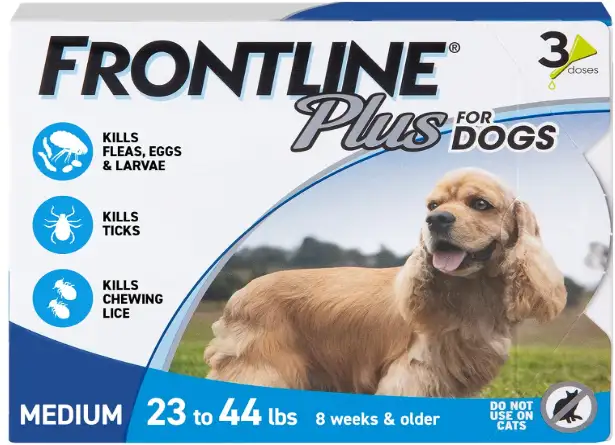
Frontline Plus for Dogs
A widely used monthly topical that kills fleas and ticks on contact. Not ideal for dogs who swim or bathe frequently, since effectiveness can drop with heavy water exposure before the product fully absorbs.
View on Amazon →⚠️ NOT FOR: Households with cats that may come into skin contact with a freshly treated dog before the application site is fully dry.
If your dog is regularly exposed to mosquitoes or biting flies in addition to fleas and ticks, K9 Advantix II covers a broader spectrum than Frontline. It combines imidacloprid, permethrin, and pyriproxyfen to kill on contact, kills fleas within 12 hours, and repels mosquitoes and biting flies for up to four weeks, on top of the usual flea and tick coverage.
K9 Advantix II
A monthly topical with a broader spectrum than most competitors, covering fleas, ticks, mosquitoes, biting flies, and lice through contact-kill action. A reasonable pick for dogs facing heavier pest exposure beyond just fleas and ticks.
View on Amazon →⚠️ NOT FOR: Any household with cats. K9 Advantix II contains permethrin, which the label explicitly warns can be fatal to cats. Cats must be kept away from a treated dog until the application site is completely dry, and this product should never touch a cat directly.
Where Collars Fit Into the Oral vs Topical Decision
Collars are technically a third format, but they’re worth mentioning here because owners often compare them against both options in oral vs topical flea and tick prevention for dogs before deciding.
A product like Seresto releases a low, steady dose of active ingredient over several months rather than requiring monthly reapplication. That convenience appeals to owners who struggle to remember a monthly schedule for either oral vs topical flea and tick prevention for dogs, and it’s worth weighing against a full collar comparison before deciding.
The trade-off is fit and monitoring: a collar has to stay properly fitted through growth spurts, swimming, and normal wear, and it needs periodic checking to confirm it hasn’t loosened or been chewed.
Whichever format you choose, mark the reapplication date on a calendar or phone reminder immediately after treating your dog. A missed month is one of the most common reasons prevention fails, and it has nothing to do with which format is objectively better.
Cost and Practicality Add Up Differently
Effectiveness and safety aren’t the only factors that decide oral vs topical flea and tick prevention for dogs in real households. Cost and convenience shape whether a good plan actually gets followed, and that follow-through matters more than any efficacy percentage on paper.
Prescription oral chewables in the isoxazoline class typically cost more per dose than over-the-counter topicals, but they usually require fewer applications per year for the longer-acting options like Bravecto. Topicals tend to have a lower per-dose price but demand monthly consistency, and a missed or delayed application creates a coverage gap that a 12-week oral simply doesn’t.
For multi-dog households, this math compounds quickly. A family with three dogs choosing between three monthly topicals and three 12-week orals is really comparing very different annual costs and different numbers of chances to forget a dose, which is worth factoring in alongside whatever else goes into your essential dog supplies budget each year.
Why Tick Removal Timing Still Matters
Even the best prevention product doesn’t make tick checks optional in oral vs topical flea and tick prevention for dogs, and the timing here is more specific than most people realize, specific enough that it changes how urgently you should act after finding one.
According to AKC Chief Veterinarian Dr. Jerry Klein, a tick bite can transmit the bacteria that causes anaplasmosis in about 12 hours, and Lyme disease in 24 to 36 hours.
A tick attached to a dog can transmit anaplasmosis in approximately 12 hours and Lyme disease in 24 to 36 hours, which is why prompt removal matters even when a preventive product is in use.
That window is exactly why daily tick checks remain part of a complete prevention routine, regardless of which format you choose. A preventive product reduces risk significantly, but it doesn’t guarantee an attached tick won’t transmit disease before the product takes effect on that specific parasite, since even fast-acting formats need some window of contact time to work, and that window is exactly when transmission risk is highest.
No flea or tick product offers a 100% guarantee against every bite. Daily physical checks, especially around ears, armpits, and between toes, catch what prevention alone sometimes misses, particularly in thick-coated breeds where a small tick can hide for days.

Don’t Forget – Flea and Tick Isn’t Heartworm
This is a genuinely common and genuinely costly misunderstanding in the oral vs topical flea and tick prevention for dogs conversation, and it trips up even careful, well-meaning owners.
A standalone flea-and-tick product, oral or topical, does not protect against heartworm. Heartworm is transmitted by mosquitoes and requires a separate preventive, typically a prescription drug like moxidectin or ivermectin, after a heartworm test confirms your dog is negative.
Some newer combination products fold heartworm coverage into a flea-and-tick chewable. Simparica Trio adds moxidectin to sarolaner. NexGard Plus adds moxidectin and pyrantel to afoxolaner. Without that second ingredient, a flea-and-tick product leaves heartworm completely uncovered, no matter how well it handles fleas and ticks.
Before choosing between oral vs topical flea and tick prevention for dogs, decide separately whether you want a single-parasite product paired with its own heartworm preventive, or a combination product that handles both. And whichever format you land on, keeping a dog first aid kit stocked with the right tick-removal tools means you’re never scrambling when you actually find one attached.
Common Mistakes That Undermine Either Format
A lot of oral vs topical flea and tick prevention for dogs disappointment traces back to application mistakes rather than the product itself.
- Bathing too soon after a topical application. Most topicals need 24 to 48 hours to fully absorb into the skin’s oils. A bath the same evening can wash away a meaningful portion of the dose.
- Skipping months during winter. Fleas survive indoors year-round, and many tick species stay active whenever temperatures climb above freezing for a few days. A seasonal gap in either oral vs topical flea and tick prevention for dogs still leaves a real window of exposure.
- Guessing at the weight band. Both formats are dosed by weight range, and a dose meant for a 60-pound dog isn’t simply “extra protection” for a 15-pound one. It’s a different, potentially unsafe amount of active ingredient.
- Applying a topical incorrectly. Parting the fur down to the skin matters. A topical applied on top of a thick coat rather than directly to skin doesn’t spread the same way.
- Assuming one dose covers multiple pets. Products are formulated per animal, and splitting a large-dog dose across two smaller dogs isn’t a safe substitute for buying the correct size for each pet.
None of these mistakes are about oral being better than topical or vice versa. They’re about whichever format you pick in oral vs topical flea and tick prevention for dogs actually working the way the research behind it assumes it will.
I’m a dog owner sharing personal experience and research, not a veterinarian. This guide draws on published sources including the FDA, AKC, and peer-reviewed veterinary research, but it doesn’t replace professional veterinary care. Always consult your vet before starting, changing, or combining any flea, tick, or heartworm preventive.
Frequently Asked Questions (FAQ)
Is oral or topical flea and tick prevention more effective for dogs?
A 90-day study of 128 dogs found oral treatments were 99.9% effective compared to 88.4% for topical treatments. However, topicals can perform well when applied consistently and when water exposure is limited during the absorption window, so the real-world gap often depends more on application habits than the product itself.
Are oral flea and tick medications safe for dogs?
The FDA considers isoxazoline oral flea and tick products, including Bravecto, NexGard, Credelio, and Simparica, safe and effective for the majority of dogs, but has issued an alert about potential neurologic adverse reactions in some animals, including dogs with no prior seizure history. Discussing your dog’s full medical history with your vet before starting one is the best way to make an informed decision.
Can topical flea and tick treatments wash off?
Yes, topical treatments can lose effectiveness if a dog is bathed or goes swimming before the product fully absorbs into the skin’s oils, which typically takes 24 to 48 hours after application. Scheduling baths and swim time around that window helps the product work as intended.
Do flea and tick products also prevent heartworm?
Most standalone flea and tick products do not prevent heartworm, which requires a separate preventive. Combination products like Simparica Trio or NexGard Plus add an ingredient like moxidectin specifically to cover heartworm as well, so it’s worth checking the active ingredient list rather than assuming based on the product name alone.
How quickly can a tick transmit disease to a dog?
According to the AKC, a tick bite can transmit anaplasmosis in about 12 hours and Lyme disease in 24 to 36 hours, which is why daily tick checks remain important even with a preventive product in use.
Is it safe to use a dog’s topical flea treatment if I also have a cat?
Not necessarily. Some dog topicals contain permethrin, which is safe for dogs but can be lethal to cats. Keep cats away from a freshly treated dog until the application site is completely dry, and never apply a dog product directly to a cat.
What does an EPA or FDA number on a flea and tick label mean?
An EPA registration number means the product is regulated as a pesticide, common for many topicals and collars. An FDA approval number, often shown as NADA or ANADA, means the product went through drug-approval review, which applies to most prescription oral chewables.
Making the Right Call for Your Dog
My dog eventually got a topical, mostly because the sight of him trying to bury a pill in his food bowl like buried treasure made the decision for me. Your situation might point the opposite direction entirely, and that’s exactly the point of walking through oral vs topical flea and tick prevention for dogs this carefully instead of picking whichever one a store display pushes hardest.
Three things worth carrying forward from this guide.
Oral treatments edge out topicals on raw effectiveness in controlled research, but that gap narrows considerably with consistent, correct topical application. The FDA’s isoxazoline alert isn’t a reason to avoid oral products, but it is a reason to disclose any seizure history to your vet first. If fleas or ticks have already gotten a foothold despite prevention, our guide on how to get rid of fleas on dogs fast covers what to do next.
And no format replaces the basics: daily tick checks still matter, because disease transmission can start within hours of an attached tick, well before any product finishes doing its job, especially if you’d rather lean on natural flea and tick prevention methods alongside whatever conventional option you choose.



Pingback: How to Get Rid of Fleas on Dogs Fast (2026 Guide) - PawWellCare
Pingback: Natural Flea and Tick Prevention for Dogs: What Vets Actually Say (2026)
Pingback: Best Flea and Tick Collars for Dogs Compared (2026)