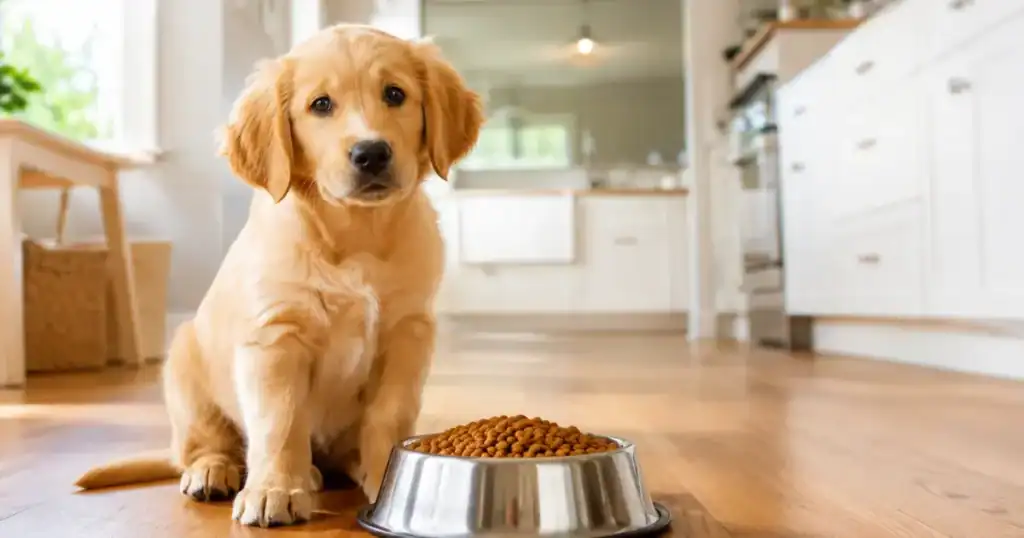
I still remember the first time I brought my puppy home.
He was so tiny he could fit in both my hands. I set his little food bowl down, filled it up, and just… stared at it. Was that too much? Too little? Was I already messing this up on day one?
If you’re feeling that same mix of excitement and total panic right now — I get it. Every new puppy owner does.
Here’s what I wish someone had handed me on that first day: a clear, simple puppy feeding schedule by age that told me exactly what to do, when to do it, and how much to give.
That’s exactly what this guide is.
Whether your puppy is 6 weeks old or already hitting the rowdy 3-month stage, this guide walks you through each feeding phase: meal frequency, portion guidance by breed size, a quick-reference chart, and the common mistakes to avoid.
For everything else about bringing your puppy home, I’ve put together a complete guide on how to take care of a puppy for the first time — It covers the full picture from day one
And For details on the weaning process before regular feeding starts, read our guide on when do puppies start eating solid food.
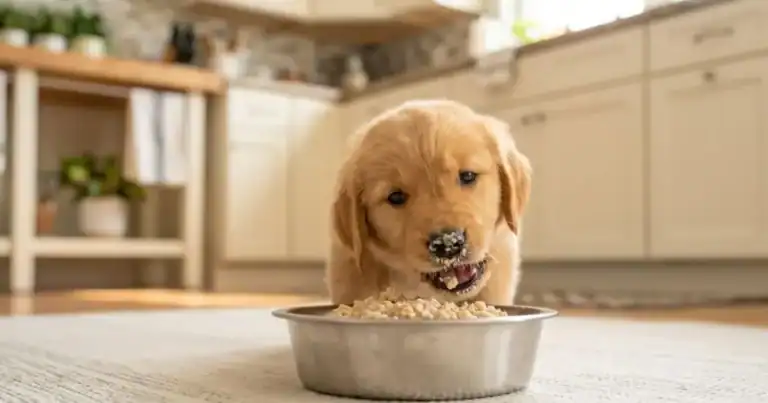
At 8 weeks, most small breeds eat about 1/4 cup per meal. Always follow the feeding guide on your specific puppy food bag and confirm exact portions with your vet at the first visit.
Why a Puppy Feeding Schedule by Age Actually Matters
Let me be real with you — I thought feeding a puppy was the easy part.
Just fill the bowl, right?
How hard could it be?
Turns out, it’s pretty hard if you don’t know what you’re doing.
Free feeding — leaving food out all day — makes potty training significantly harder because scheduled meals allow owners to predict when their puppy needs to go outside.
A proper puppy feeding schedule by age isn’t just about keeping your puppy from being hungry.
It’s about fueling a tiny body that’s growing faster than almost any living creature on the planet.
In their first year, puppies go through more developmental changes than humans do in their first five years.
Get the feeding wrong — in either direction — and you can cause real, lasting harm.
I know that sounds scary.
It’s not meant to be.
It’s meant to show you why this stuff actually matters — and why getting it right from the start is one of the best things you can do for your dog.
🥣 What Happens If You Overfeed a Puppy
I made this mistake.
My puppy always looked hungry.
Those eyes, man — you know the look.
So I’d sneak a little extra into his bowl, thinking more food meant a healthier, happier pup.
Wrong.
Overfeeding can:
- Put serious stress on a puppy’s developing joints and bones — especially in larger breeds.
- Cause loose stools that make potty training feel impossible.
- Set up bad habits and weight problems that follow your dog for life.
According to the American Kennel Club, obesity in puppies can lead to long-term conditions, including hip dysplasia and diabetes — conditions that are painful for your dog and expensive for you.
Those extra scoops aren’t love. I learned that the hard way.
🍽️ What Happens If You Underfeed a Puppy
On the other end — and this is less common but just as serious — underfeeding leaves your puppy without the calories, protein, and fat they need for brain and body development.
Signs to watch for include:
- Your puppy crying a lot.
- Constantly searching for food.
- Gaining weight slowly.
- Having low energy during playtime.
If you notice any of these signs — call your vet immediately.
Don’t wait and see.
⏰ Why Scheduled Meals Beat Free Feeding Every Single Time
Free feeding sounds amazing in theory.
- Just leave food out and let them eat whenever.
- No stress, no timing, no measuring.
Here’s the problem — and this one genuinely surprised me.
When you control when food goes in, you can predict when it needs to come out.
That is the single most underrated potty training trick there is.
The moment I switched my puppy to scheduled meals, the accidents inside the house dropped by half within a week.
Scheduled meals also let you notice immediately when something’s off.
You’d never catch that with a free-feeding setup.
If your puppy suddenly stops eating — that’s a sign.
Complete Puppy Feeding Schedule by Age — Every Stage Covered
Okay — here’s the part you came for. This is the complete puppy feeding schedule by age from 6 weeks all the way to 12 months. Print it out, screenshot it, stick it on your fridge — whatever works for you.
Okay — here’s the part you came for. This is the complete puppy feeding schedule by age from 6 weeks all the way to 12 months. Print it out, screenshot it, stick it on your fridge — whatever works for you.
🍼 6 to 8 Weeks — 4 Meals a Day
4 Meals / DayThis is such a tender stage.
Your puppy has just left their mom, and their whole world has changed overnight.
The last thing you want to do is also change their food.
Whatever the breeder or shelter was feeding them — stick with that for the first week, even if you plan to switch later.
Their stomach is about the size of your fist right now.
Small and frequent is the name of the game.
🏡 8 Weeks to 3 Months — Still 4 Meals a Day
4 Meals / DayThis is the stage when most puppies come home for the first time — and it’s also the most overwhelming stage for new owners.
Four meals a day feels like a lot when you’re also managing potty training, sleep schedules, and the fact that your puppy just chewed through your favorite pair of shoes.
At this age, meals can get messy quickly, so a washable puppy feeding mat can make cleanup much easier after every feeding.
But don’t rush to cut meals too early.
I promise — you’ll get into a rhythm faster than you think.
🐕 3 to 6 Months — 3 Meals a Day
3 Meals / DayAround the 3-month mark, something clicks.
Your puppy starts looking less like a wobbly little potato and more like an actual dog.
Their stomachs have grown, their appetite has absolutely exploded, and you can drop down to 3 meals a day.
This stage is honestly one of my favorites to watch.
The growth is visible week to week — it’s remarkable.
🦮 6 to 12 Months — 2 Meals a Day
2 Meals / DayBy 6 months, your puppy is starting to look like the dog they’re going to be.
The baby fluff is fading, the paws are still slightly too big for their body, and you’re finally settling into a real routine together.
Two meals a day from here on.
This is the schedule most dogs stay on for life — so you’re building something that lasts.
Many large breeds may continue growing well beyond their first birthday, while giant breeds can take even longer to reach full maturity.
Transitioning to adult food too early may not provide the nutrition needed during these later growth stages.
If you have a large or giant breed puppy, ask your veterinarian when it is appropriate to transition from puppy food to an adult formula based on your dog’s breed, size, and growth rate.
Complete Feeding Schedule — Quick Reference Table
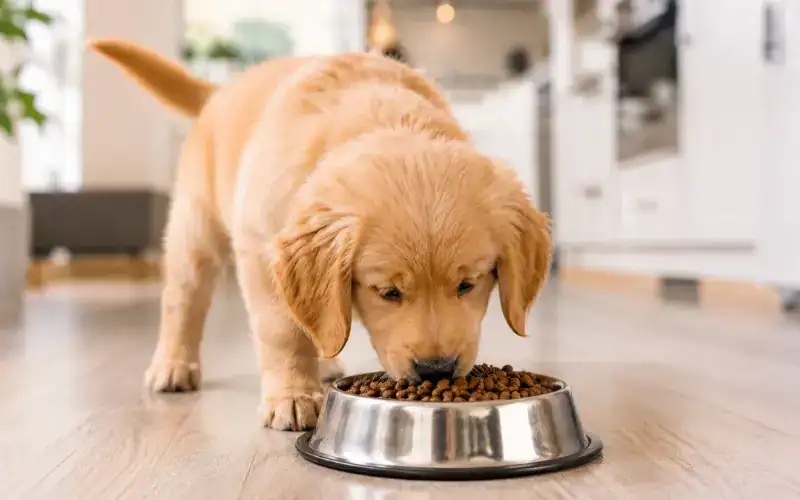
Using Automatic Feeders for Busy Schedules
How Much to Feed a Puppy — Portions by Breed Size
🥣 Portion Sizes: Where to Start
Here’s the thing about portion sizes that nobody really tells you upfront: the feeding guide on the back of the bag is a starting point, not a final answer.
Your puppy’s actual needs depend on:
- Their breed
- Their activity level
- How fast they’re growing right now
Guessing portions by eye is easy, but using a collapsible dog food measuring scoop makes it much easier to keep meals consistent as your puppy grows.
Small breed puppies are at high risk for hypoglycemia if they skip meals — never let a small breed puppy go more than 4 hours without food during the day.
This is where following the puppy feeding schedule by age closely — and actually weighing your puppy weekly — makes a real difference.
🐕 Small Breed Puppies — Chihuahua, Yorkie, Maltese, Pomeranian
Small breed puppies are deceptively high-maintenance eaters.
They look like they eat nothing — and then you find out they actually need more calories per pound of body weight than a Great Dane.
Their metabolism runs hot and fast.
The one thing that scared me most about small breeds: they’re prone to hypoglycemia — low blood sugar — if they skip meals.
Don’t let a small breed puppy go more than 4 hours without food during the day. It’s more serious than it sounds.
Starting portion at 8 weeks: around 1/4 cup per meal, 4x daily
Watch for:
- Excessive shaking
- Weakness
- Disorientation
These can be signs of low blood sugar. Call your vet.
🐶 Medium Breed Puppies — Beagle, Cocker Spaniel, Bulldog
Medium breeds are the most forgiving to feed — and honestly, the most fun at mealtime.
They’re enthusiastic without being obsessive about food the way some large breeds are.
Most puppy food bag guidelines are written with medium breeds in mind, so the label is actually pretty reliable here.
Starting portion at 8 weeks: 1/3 to 1/2 cup per meal, 4x daily
Watch for:
- Bloating
- Gulping — if your pup inhales their food in 10 seconds flat, a slow-feeder bowl can help slow them down and make mealtime more controlled.
game-changer and costs about ten bucks.
🐕 Large Breed Puppies — Labrador, Golden Retriever, German Shepherd
This is where overfeeding causes the most damage — and where I see new owners make the most mistakes.
Large breed puppies that grow too fast develop joint problems that are painful and permanent.
The goal isn’t to get them big quickly.
The goal is to get them big slowly and steadily, on their body’s own timeline.
Look specifically for food labeled “large breed puppy formula.”
These have carefully controlled calcium and phosphorus levels designed to support slower, healthier bone development.
It matters more than most people realize.
Starting portion at 8 weeks: 1/2 to 3/4 cup per meal, 4x daily
Do NOT give extra food to “help them grow.” It does the opposite.
Always choose food specifically labeled “large breed puppy formula.”
Giant Breed Puppies — Great Dane, Mastiff, Saint Bernard
If you have a giant breed puppy, you already know they’re in a category of their own. These dogs grow from a handful of fur to 100+ pounds — and how you feed them in that first year shapes their joints for life.
Stay on giant breed puppy formula until at least 18 months.
No exceptions. No rushing. Your vet is your best friend here.
Starting portion at 8 weeks: 3/4 to 1 cup per meal, 4x daily
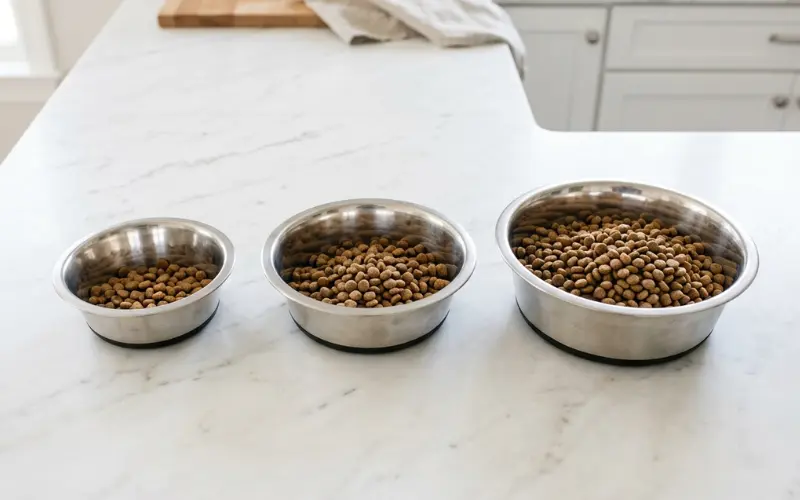
Quick Portion Reference by Breed Size
These are starting guidelines — adjust weekly based on your puppy’s actual weight and your vet’s recommendation.
What to Look for in a Good Puppy Food
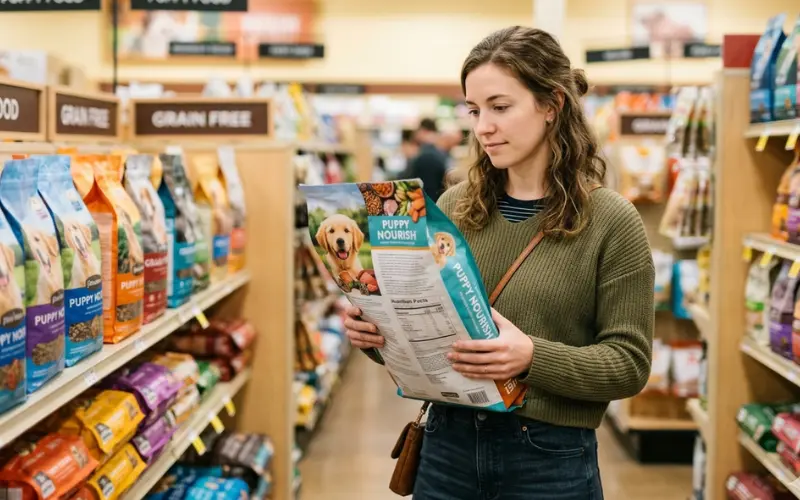
I spent way too long in the pet store aisle the first time, completely overwhelmed by the options. Every bag claimed to be the best. Every bag had a happy dog on the front.
Here’s what actually matters when you pick up that bag:
First Ingredient Has to Be a Real Protein
Flip the bag over and look at the ingredient list. The very first ingredient should be a named animal protein — chicken, beef, salmon, lamb, or turkey. Not “poultry meal.” Not “meat by-products.” A real, named protein.
If the first ingredient is corn, wheat, or soy — put it back.
Your puppy deserves better than that.
Find the AAFCO Statement
Every quality puppy food will have a small statement on the packaging from the Association of American Feed Control Officials (AAFCO).
It should say something close to:
“Formulated to meet nutritional levels established by AAFCO for growth and reproduction.”
That statement means the food has passed minimum standards for puppy nutrition.
No statement — no deal.
For a broader breakdown of food labels, nutrients, and feeding basics, read our complete dog nutrition guide for beginners.
Ingredients to Avoid Completely
- Artificial colors — Red 40, Yellow 5, Blue 2
- Artificial preservatives — BHA, BHT, Ethoxyquin
- Corn syrup or any added sugar
- Vague protein sources — “meat meal” or “animal digest.”
- Corn and wheat as the first or second ingredient
Dry Kibble vs Wet Food — What I Actually Use
Dry kibble is my go-to — it’s easier to portion, better for dental health, and much easier to store.
Since dry kibble is used daily, keeping it in an airtight dog food storage container helps protect freshness and keeps the feeding area cleaner.
I mix in a small spoonful of wet food as a topper a few times a week.
My dog goes absolutely crazy for it, and it adds a little extra moisture to his diet.
An 80% dry, 20% wet mix works beautifully for picky eaters who turn their nose up at plain kibble.
Puppy Feeding Mistakes I Made — So You Don’t Have To
Real talk — I made almost every single mistake on this list. Consider this the section I wish had existed when I was starting.
Switching Food Too Fast
This was my biggest mistake in week one. I wanted to switch my puppy to a “better” food immediately. What I got was three days of stomach upset and accidents everywhere.
Always transition over 7 full days:
Your puppy’s gut bacteria need time to adjust. Respect that timeline, and you’ll avoid a lot of unnecessary mess.
For a deeper step-by-step transition plan, read our guide on how to switch dog food without upset stomach.
Rushing the switch is the number one cause of digestive problems in new puppies.
Giving Table Scraps “Just This Once”
There is no “just this once” with puppies.
The moment they figure out that begging at the table works, it works forever.
More importantly, some human foods are genuinely dangerous.
Toxic foods include:
- Grapes
- Raisins
- Onions
- Garlic
- Chocolate
- Xylitol
- Macadamia nuts
The ASPCA reports that food toxicity is one of the most common causes of emergency vet visits for dogs.
My rule for the first 6 months: no human food.
After that, I introduce safe foods slowly and intentionally.
If you want to make meals more interesting without table scraps, a puppy lick mat can give your pup something to focus on using only puppy-safe food.
Not Adjusting Portions as They Grow
A portion that was perfect at 8 weeks is too small at 12 weeks.
Your puppy is growing every single week — their food needs to reflect that.
I weigh my dog every Sunday morning and adjust portions accordingly.
Takes two minutes and makes a real difference.
Using the Wrong Bowl
This one sounds small, but it genuinely matters.
Deep, narrow bowls are uncomfortable for puppies — especially floppy-eared breeds like Beagles and Basset Hounds who drag their ears through the food.
Wide, shallow stainless steel bowls work best for almost every breed.
For young puppies, a small non-slip stainless-steel puppy bowl works well because it stays steadier during meals and is easy to clean after frequent feedings.
And please — avoid plastic bowls.
They scratch over time, harbor bacteria, and can cause skin reactions around the mouth in some dogs — stainless steel or ceramic, always.
How to Know If Your Puppy Is Eating the Right Amount
Numbers and charts are helpful — but at the end of the day, your puppy’s body tells you everything you need to know.
Here’s how to read it.
The Rib Check — Do This Every Week
Place both hands on your puppy’s ribcage and gently run your fingers along their ribs.
You should feel each rib clearly without pressing hard — but you should NOT be able to see the ribs clearly from across the room.
That’s your sweet spot.
- Can feel ribs easily, waist visible from above = perfect weight.
- Cannot feel ribs at all, no visible waist = time to cut back.
- Ribs and spine clearly visible = time to increase food and call your vet.
Signs Your Puppy Is Eating the Right Amount
- Steady, consistent weight gain week over week
- Good energy during play — not lethargic, not manic
- Shiny coat with no dry patches or dullness
- Firm stools — not runny, not rock hard
- Finishes their meal without frantically licking the bowl clean and searching for more
Signs Something Needs to Adjust
Ribs very visible or impossible to feel: call your vet — don’t guess on this one.
Always leaving food in the bowl: Reduce portions by about 10%.
Finishing instantly and crying for more: increase by 10%.
Loose stools consistently: may be overfed, or the food doesn’t suit.
Always consult your vet for advice specific to your puppy’s breed, weight, and health condition.
Frequently Asked Questions (FAQ)
How often should an 8-week-old puppy eat?
Four times a day — every single day, on a consistent schedule.u003cbru003eAt u003cstrongu003e8 weeksu003c/strongu003e, their stomach is tiny, and their blood sugar can drop quickly if they go too long between meals.u003cbru003eI stuck to u003cstrongu003e7 am, 12 pm, 5 pm, and 9 pmu003c/strongu003e, and it worked beautifully.u003cbru003eThe consistency also helped enormously with potty training — I always knew when to take him outside.
How much should I feed my 8-week-old puppy?
Start with the feeding guide on your food bag based on your puppy’s u003cstrongu003ecurrent weightu003c/strongu003e — not their expected adult weight.u003cbru003eAs a rough starting point, small breeds eat about u003cstrongu003e1/4 cup per mealu003c/strongu003e and medium breeds eat about u003cstrongu003e1/3 to 1/2 cup per mealu003c/strongu003e at u003cstrongu003e8 weeksu003c/strongu003e.u003cbru003eBut every puppy is different.u003cbru003eWeigh them weekly and adjust.u003cbru003eYour vet will give you the most accurate guidance at your first visit.
When do puppies switch from 3 meals to 2 meals a day?
Most puppies make this transition somewhere between u003cstrongu003e6 and 12 monthsu003c/strongu003e, depending on breed size.u003cbru003eSmall breeds can often switch at u003cstrongu003e6 monthsu003c/strongu003e.u003cbru003eMedium breeds usually mature around u003cstrongu003e6 to 9 monthsu003c/strongu003e.u003cbru003eLarge and giant breeds may remain on u003cstrongu003e3 mealsu003c/strongu003e until u003cstrongu003e12 months oldu003c/strongu003e.u003cbru003eThere’s no exact universal date — watch your puppy’s appetite and follow your vet’s advice for your specific breed.
Is free feeding okay for puppies?
Honestly — no.u003cbru003eI know it sounds convenient, but free feeding makes it nearly impossible to monitor how much your puppy is actually eating.u003cbru003eYou lose one of the most underrated potty training tools you have.u003cbru003eScheduled meals changed everything for me.u003cbru003eI could predict almost to the minute when my puppy needed to go outside.u003cbru003eThat kind of control is worth every bit of the extra effort.
What if my puppy skips a meal?
One skipped meal in an otherwise healthy, happy puppy is usually nothing to worry about.u003cbru003ePick up the bowl after u003cstrongu003e15 minutesu003c/strongu003e and try again at the next scheduled meal.u003cbru003eBut if your puppy skips more than u003cstrongu003etwo meals in a rowu003c/strongu003e, seems lethargic, or is acting unwell in any way — u003cstrongu003ecall your vet immediatelyu003c/strongu003e.u003cbru003eDon’t wait and see. u003cstrongu003eSmall puppiesu003c/strongu003e, especially, can go downhill fast.
Should I add water to dry puppy food?
For puppies under u003cstrongu003e10 weeksu003c/strongu003e — yes, softening kibble with a little warm water makes it much easier to chew.u003cbru003eUse just enough to soften it, not so much that it becomes soup.u003cbru003eBy u003cstrongu003e10 to 12 weeksu003c/strongu003e, most puppies handle dry kibble just fine on their own.u003cbru003eIf yours is still struggling past u003cstrongu003e12 weeksu003c/strongu003e, mention it to your vet.
When should my puppy switch to adult food?
u003cstrongu003eSmall breeds:u003c/strongu003e 9 to 12 monthsu003cbru003eu003cstrongu003eMedium breeds:u003c/strongu003e around 12 monthsu003cbru003eu003cstrongu003eLarge breeds:u003c/strongu003e 12 to 18 monthsu003cbru003eu003cstrongu003eGiant breeds:u003c/strongu003e 18 to 24 monthsu003cbru003eSwitching too early means cutting off nutrients your puppy still needs.u003cbru003eSwitching too late can lead to weight gain since puppy food is calorie-dense.u003cbru003eYour vet knows your specific breed best — always check before making the switch.
Always monitor your puppy closely when trying anything new. If you notice any unusual symptoms or behaviors, consult your veterinarian immediately.
Final Thoughts — Feed Them Right and Watch Them Thrive
Here’s what I know after going through this myself: the puppy feeding schedule by age stuff that feels overwhelming right now becomes second nature faster than you’d expect. Within a few weeks, you won’t even think about it — you’ll just know.
And there is nothing quite like watching your puppy grow from that tiny wobbly creature into a healthy, energetic, thriving dog — knowing that the way you fed them in those early months played a huge part in that.
Your three big takeaways:
- Match meals to age — 4 times a day for young puppies, dropping to 2 by 6 to 12 months, depending on breed.
- Adjust portions every single week as your puppy grows — not once a month, every week.
- Scheduled meals beat free feeding every time — for their health, for potty training, and for your sanity.
The puppy feeding schedule by age gets easier and more natural every single week. Trust the process, trust your vet, and trust yourself. You’re doing better than you think.
For the full picture on raising a happy, healthy pup from day one, head over to our complete guide on how to take care of a puppy for the first time – everything you need in one place.