


From across the room, your Goldendoodle looks like a perfect teddy bear. Then you scratch behind the ears and find a tight little knot. There’s another one under the collar. And the armpits feel like felt.
That’s the thing about Goldendoodle grooming. The fluffy top layer hides what’s happening down near the skin, and by the time you can see a mat, it’s usually been building for a while.
The good news is that a doodle coat is very manageable once you know your dog’s coat type and use the right brushing method. This guide gives you:
- A quick way to tell if your doodle’s coat is curly, wavy or straight, and why it matters
- A simple grooming schedule and a step-by-step home routine that prevents mats
- Safe haircut choices, ear care tips, and when it’s time to call a groomer
Goldendoodle grooming is mostly about stopping mats.
Brush down to the skin with a slicker brush several times a week (daily for curly coats), then check with a metal comb. Bathe about once a month and dry completely. Most doodles also need a professional groom every 6 to 8 weeks. Never cut mats out with scissors, and keep the hair at the ear openings trimmed.
Why Goldendoodle Grooming Is Different
A Goldendoodle is a mix of a Golden Retriever and a Poodle, and its coat can borrow from both sides. Many doodles end up with soft, wavy or curly hair that sheds less than a Golden’s coat. That’s a big reason people choose them.
But hair that doesn’t fall out has to go somewhere. Instead of dropping onto your floor, loose hair stays tangled in the coat. Add friction from a collar, a harness or just lying down, and those tangles quickly tighten into mats close to the skin.
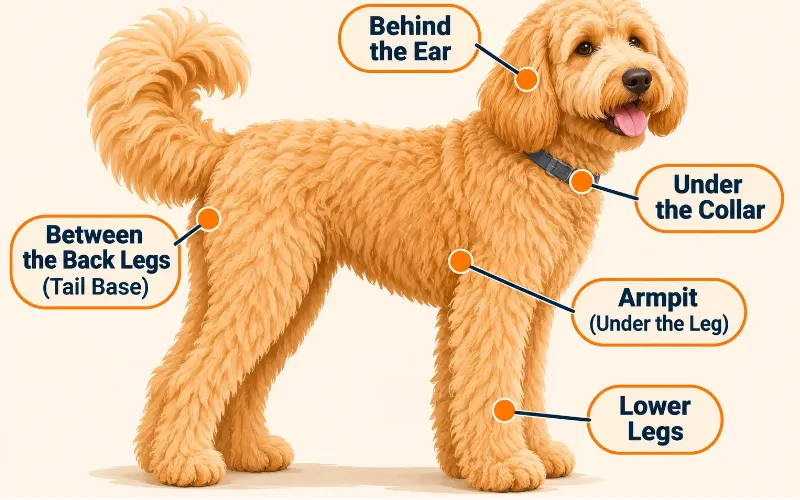
Mats tend to form in the same places on almost every doodle:
- Behind the ears
- Under the collar or harness
- In the armpits and on the chest
- Between the back legs and around the tail base
- On the legs and paws, especially after wet walks
Goldendoodle coats tend to mat because loose hair stays trapped in the coat instead of shedding out.
Brushing only the surface can leave mats hidden near the skin, so a metal comb check after brushing is the best way to find them early.
What Coat Does Your Goldendoodle Have?
Not all Goldendoodles have the same coat, even in one litter. Your dog’s coat type changes how often you need to brush and how much it will shed. Here’s a simple check you can do at home:
- Curly coat: tight ringlets or spirals, a lot like a Poodle. Usually the lowest-shedding type, but it mats the fastest and needs the most brushing.
- Wavy coat: loose waves with a shaggy “teddy bear” look. The most common doodle coat. It sheds lightly and mats in friction spots if you skip brushing.
- Straight coat: flat, smoother hair, closer to a Golden Retriever. It tends to shed more, often doesn’t have the full beard and eyebrows, and is usually the easiest to brush.

Coat type mostly comes down to genetics, and puppies can change as their adult coat grows in. If you’re unsure, look at the hair along the back and on the face once your dog is about a year old.
So, do Goldendoodles shed? Most shed less than a Golden Retriever, but very few shed zero, and straight-coated doodles can shed quite a bit. No doodle is truly hypoallergenic, so if allergies are a concern, spend time with the specific dog before you commit. For which coats and generations shed least, and what the allergy research says, see do Goldendoodles shed?
Goldendoodle Grooming Schedule
There’s no single vet-set schedule for doodles. The table below pulls together common guidance from the Goldendoodle Association of North America and experienced doodle groomers into a starting point. Adjust it to your dog’s coat and lifestyle.
A shorter haircut lowers how often you need to brush. A long, fluffy teddy bear cut on a curly coat raises it. Bath timing is flexible too: the Goldendoodle Association suggests about once a month or when the dog is dirty, and warns that bathing too often can dry out the coat (GANA). For more on bath timing, see how often you should bathe your dog.
Book your next groomer appointment before you leave the salon.
Doodle groomers often fill up weeks ahead, and missing a cycle by even a few weeks is often when a manageable coat turns into a matted one.
How to Groom a Goldendoodle at Home, Step by Step
You don’t need to do a full haircut at home. Most owners handle brushing, baths, drying and small tidy-ups, and leave the full clip to a groomer. Here’s the routine in the order that works best.
Step 1: Line Brush Down to the Skin
Surface brushing is the most common doodle grooming mistake. The top looks smooth, but mats keep building underneath. Line brushing fixes that.
- Lightly mist the coat with water or a detangling spray. Don’t brush a bone-dry coat.
- Start at a back leg. Push the hair up with one hand until you can see a line of skin.
- Brush the hair below the line down and out with a slicker brush, in short, gentle strokes.
- Let down a thin new layer and repeat, working up the leg, then along the body, chest, neck and head.
- Comb check. Run a metal comb from the skin to the tips everywhere you brushed. Where it catches, there’s a tangle to work on.
We use the same method for other fluffy coats in our Pomeranian grooming guide. If you need help choosing a slicker and comb, see our guide to the best dog brush for shedding, which covers curly and long coats.
Do a quick 2-minute “hotspot pass” every day, even when you skip a full brush.
Check behind the ears, under the collar and in the armpits with a comb. Catching a tangle the day it starts takes seconds. Catching it a week later can take half an hour.
Step 2: Bathe (Brush First)
Always brush and comb out tangles before a bath. Water tightens small tangles into tighter mats, so a knot you could have combed out dry can be much harder to remove wet.
Use a gentle dog shampoo and work it down to the skin, then follow with a conditioner to make the next brushing easier. Rinse very well. Leftover product in a thick doodle coat can irritate the skin.
Step 3: Dry Completely
A doodle coat holds a lot of water. Towel off by pressing, not rubbing, then use a dryer on a cool or low setting, brushing as you go. Brushing while drying straightens the hair, helps you find tangles, and gives that fluffy finish.
Don’t let your doodle air-dry in a thick coat. Damp hair packed against the skin can cause problems, and a half-dry coat tangles easily.
Step 4: Trim the Face, Feet and “Fanny”
Between full grooms, a light tidy-up keeps your doodle clean and comfortable. The Goldendoodle Association calls this the “face, feet and fanny” trim and notes it can be done even before a puppy’s first full haircut (GANA).
- Eyes: Carefully trim hair that pokes into the eyes so your dog can see.
- Feet: Trim hair between the paw pads level with the pads, and tidy the edges.
- Rear: A small hygiene trim keeps mess from sticking to the coat.
Use round-tip scissors near the face, keep the tips pointed away from the eyes, and put a comb between the scissors and the skin.
If your doodle won’t hold still, leave the face to a groomer.
Step 5: Nails, Ears and Teeth
- Nails: Trim every 3 to 4 weeks. Our guide to the best dog nail clippers helps you pick the right tool for your doodle’s size.
- Ears: Check every week, and see the ear care section below. Doodle ears need a little extra attention.
- Teeth: Brush daily if you can, with a dog toothpaste.
Dealing With Mats Safely
Mats aren’t just a cosmetic problem. They pull on the skin every time your dog moves, and they can trap moisture and dirt against it. Veterinarian Dr. Brittany Kleszynski writes that untreated matting can lead to pain, skin infections, overheating and trouble moving, and that matted fur can hide fleas, ticks and mites (Chewy).
For a small mat:
- Spray it with a detangler and loosen it a little with your fingers.
- Hold the base of the mat firmly against the skin so the brushing doesn’t pull.
- Work from the outer edge inward in small sections with a slicker brush or a comb, rather than ripping through from the skin (Preventive Vet).
- Comb check the spot when you’re done.
For large or tight mats, stop and call a groomer. When a doodle’s coat is matted close to the skin all over (called “pelted”), the kindest option is often a short clip to remove the mats and a fresh start, rather than hours of painful brushing. Your groomer can talk you through it.
Never cut mats out with scissors.
Skin gets pulled up into the mat, and it’s very easy to cut your dog. Don’t shave a matted coat yourself either, and avoid bathing a dog whose whole coat is matted, because water makes it worse. See a vet if mats are limiting movement or the skin underneath looks red or sore.
Goldendoodle Haircuts: What to Ask For
The right cut depends on how much brushing you can do. Longer and fluffier looks adorable, but it needs more upkeep. Shorter cuts are easier to live with, especially in summer or for dogs that swim.
Lengths and names vary between salons. One doodle salon describes its teddy bear style at about 1 to 2 inches on the body and its kennel cut at about half an inch or shorter, and notes that curly coats often do better a little shorter than wavy ones (Designer Paws Salon). Bring a photo to your groomer, and tell them honestly how often you brush. A good groomer will suggest a length you can keep up with.
Goldendoodle Ear Care
Doodles often have floppy ears and hair growing in and around the ear canal, thanks to their Poodle side. Floppy, hairy ears can stay warm and damp, which is the kind of environment where yeast and bacteria can grow.
Here’s a simple, safe routine:
- Check the ears weekly. A little light-brown wax is normal.
- Trim the hair around the ear opening so air can get in. A groomer can do this at every visit.
- Dry the ears after baths and swims. Gently wipe the outer ear with a cotton pad.
- Clean only when needed, with a dog ear cleaner your vet recommends. Never push anything deep into the canal.
What about plucking ear hair? It’s often done by groomers, but it isn’t right for every dog. The MSD Veterinary Manual notes that trimming or plucking hair near the ear canal can improve airflow in some cases, but advises asking your vet before removing it (MSD Veterinary Manual). The UK veterinary charity PDSA gives the same advice (PDSA).
Call your vet if you notice a bad smell, redness, dark or yellow discharge, head shaking, or your dog flinching when you touch an ear. Don’t try to clean or pluck an ear that already looks infected. For a step-by-step cleaning method, see our guide on how to clean dog ears at home.
The Puppy Coat Change and Your Doodle’s First Groom
Goldendoodle puppies start out with a soft, easy puppy coat. Somewhere around 6 to 12 months, the adult coat starts growing in underneath. During this change the two coats tangle together, and many owners are surprised by how quickly mats appear. It’s normal, and it’s exactly when daily brushing matters most.
A few tips for doodle puppies:
- Start handling right away. Touch paws, ears and the face every day, with treats.
- Brush for a few minutes daily, even when the coat doesn’t need it yet, so brushing becomes routine.
- Plan the first groom early. The Goldendoodle Association suggests the first haircut around 4 to 6 months, with a gentle “face, feet and fanny” tidy-up possible before that (GANA).
- Ask for a short, easy first visit. A bath, dry, nails and a light tidy help your puppy learn that the salon is a safe place.
For the bigger picture on raising a new puppy, see our guide on how to take care of a puppy for the first time.
DIY vs. Professional Goldendoodle Grooming
Most doodle owners use both. Home grooming keeps mats away between visits, and a groomer handles the full haircut.
At home: brushing and comb checks, baths, drying, nails, ear checks, and small face, feet and fanny trims.
At the groomer: full haircuts, clipping, severe mats, and anything your dog won’t sit still for.
The Goldendoodle Association puts a professional clip at roughly $75 to $200, depending on your location, the cut and the coat’s condition, with appointments often taking 2 to 4 hours (GANA). A well-brushed coat usually costs less and takes less time, so your home routine can save money too.
When you choose a groomer, look for one who’s comfortable with doodle coats. Tell them your dog’s coat type and how often you brush, and ask how they handle mats.

This article is for general information only.
PawWellCare is not a veterinarian, and this content doesn’t replace professional veterinary care. If your Goldendoodle has skin problems under mats, ear trouble or any other health concern, please talk to your veterinarian.
Frequently Asked Questions (FAQ)
How often should a Goldendoodle be groomed?
Most Goldendoodles need brushing several times a week (daily for curly coats) and a professional groom every 6 to 8 weeks. Curly coats often need a groomer every 4 to 6 weeks, while straight coats can go 8 to 12 weeks.
How much does it cost to groom a Goldendoodle?
The Goldendoodle Association estimates about $75 to $200 for a professional clip, depending on where you live, the haircut and the coat’s condition. Matted coats usually cost more.
Do Goldendoodles shed?
Most shed less than a Golden Retriever, but very few shed zero. Curly-coated doodles usually shed the least, and straight-coated doodles shed the most. No Goldendoodle is completely hypoallergenic.
How do I groom a mini Goldendoodle?
The same way as a standard Goldendoodle: line brush to the skin, comb check, bathe about monthly and dry fully. Mini doodles just take less time. Use smaller tools and smaller nail clippers.
Can I shave my Goldendoodle?
A short clip is common for doodles and is often the kindest option for a badly matted coat. Leave it to a groomer, though, and never shave mats yourself. The skin under mats is easy to cut.
What is the best brush for a Goldendoodle?
A slicker brush paired with a metal comb works for most doodles. Use the slicker to brush down to the skin and the comb to check for hidden tangles.
Keeping Your Doodle Soft, Fluffy and Mat-Free
Good Goldendoodle grooming comes down to a few steady habits, not a perfect haircut. A balanced diet helps the coat from the inside, too (here are our picks for the best dog food for goldendoodles).
- Brush to the skin on a schedule that fits your doodle’s coat type, and always finish with a comb check
- Never scissor out mats. Work small ones loose, and leave big ones to a groomer
- Stay on top of ears and groomer visits so small problems don’t become big ones
This week, try one full line-brushing session with a comb check and see where the tangles are hiding. For the rest of the routine, including nails, teeth and baths, our complete dog grooming guide for beginners has you covered.




Pingback: Pomeranian Grooming: A Safe Home Routine for That Fluffy Double Coat
Pingback: Best Dog Brush for Shedding (2026): Deshedding Tools by Coat Type
Pingback: Do Goldendoodles Shed? How Much & Are They Hypoallergenic?