You picked a Goldendoodle partly because someone said “they don’t shed.” Maybe someone in your home has mild dog allergies, or maybe you just didn’t want fur on everything.
Then, somewhere around eight months, you notice hair on the couch. A few strands on your sweater. A little tumbleweed in the hallway.
So, do goldendoodles shed? Yes, most do, but how much varies a lot from dog to dog. Some barely drop a hair. Others shed almost like a Golden Retriever. The difference comes down to coat genes, not just the label on the puppy listing. Here’s what you’ll find below:
- Which Goldendoodles shed the least, and how to tell by looking at the coat
- What F1, F1B and coat DNA tests really tell you (and what they don’t)
- Whether any doodle is truly hypoallergenic, based on actual allergy research
Yes, most Goldendoodles shed, usually less than a Golden Retriever and more than a Poodle.
Doodles with curly coats and a full beard and eyebrows tend to shed the least, while smooth-faced, straight-coated doodles can shed a lot. Genes matter more than the F1 or F1B label. No Goldendoodle is truly hypoallergenic, so allergic owners should meet the actual dog first.
How Much Do Goldendoodles Shed?
It depends on which parent your doodle takes after. The two breeds sit at opposite ends of the shedding scale:
- Golden Retriever: a heavy shedder, with a thick double coat that drops hair all year and sheds hard in spring and fall. (We cover that side in do golden retrievers shed.)
- Poodle: a very low shedder, with a curly coat that keeps growing.
- Goldendoodle: anywhere in between. Many shed lightly, a few hardly at all, and some shed a moderate amount.
So, do goldendoodles shed a lot? Most don’t. But “less shedding” isn’t the same as “no hair to deal with.”
In curly and wavy coats, loose hair often gets caught in the coat instead of falling on the floor. You see less fur around the house, but that trapped hair twists into tangles. That’s why low-shedding doodles need more brushing, not less.
A Goldendoodle can shed very little, a moderate amount or almost as much as a Golden Retriever.
A low-shedding coat doesn’t mean less grooming. Hair that stays in the coat turns into mats unless it’s brushed out.
Why Some Goldendoodles Shed and Others Don’t (It’s the Genes)
Two puppies from the same litter can have very different coats. That’s because shedding is controlled by genes, and each puppy gets its own mix from the Golden side and the Poodle side.
Researchers have found that two genes seem to have the biggest effect on shedding, according to the UC Davis Veterinary Genetics Laboratory:
- The furnishings gene (RSPO2). This is the gene behind the doodle “beard,” mustache and eyebrows. Dogs with furnishings tend to shed less.
- The shedding gene (MC5R). A variant of this gene is linked to lower shedding in several breeds.
The effects add up. A dog that carries the low-shedding versions of both genes is predicted to shed the least. A dog with neither is predicted to shed the most. A mix of the two lands in the middle.
There’s one honest catch. In the original research (Hayward and colleagues, 2016), breeds were rated as minimal, average or heavy shedders based on published breed information. The amount of hair each dog actually dropped wasn’t measured. So these genes predict a tendency, not an exact amount.
Can you test for it? Yes. A coat DNA test uses a cheek swab and checks both genes. At UC Davis, the shedding and furnishings test costs about $79, results take at least 15 business days, and puppies can be tested from about 3 weeks old. Some consumer dog DNA kits include similar coat markers.
Ask the breeder for coat test results, not just the generation.
A good breeder can show you the furnishings and shedding results for both parents (or the puppy). That tells you far more about future shedding than “F1B” on a listing.
Goldendoodle Coat Types and Shedding
You can usually guess how much a doodle will shed just by looking at the coat and the face. There are three main Goldendoodle coat types, plus one face detail that matters a lot.
Curly Coat
Tight curls or ringlets, a lot like a Poodle. Curly doodles usually shed the least. They also tangle and mat the fastest, so they need the most brushing.
Wavy Coat
Loose waves and a shaggy “teddy bear” look. It’s one of the most common doodle coats. Wavy doodles usually shed lightly and mat in friction spots like behind the ears, under the collar and in the armpits.
Straight or Flat Coat (and the “Open Face”)
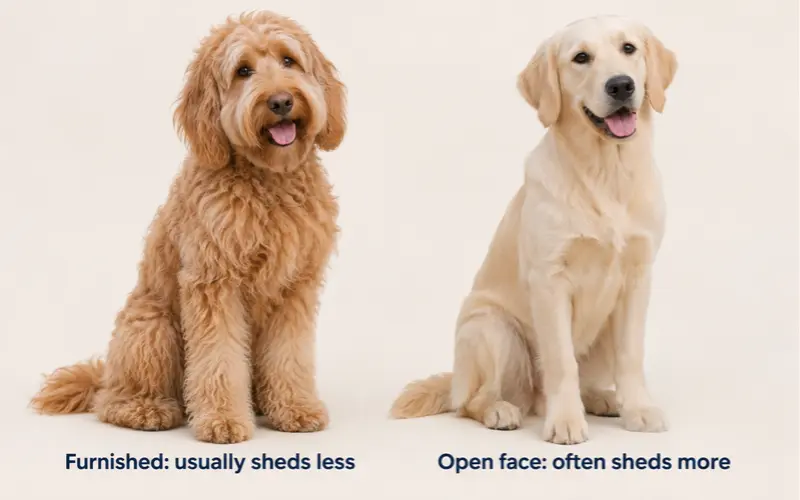
A straight coat looks smoother and closer to a Golden Retriever’s. Some straight-coated doodles still have a beard and eyebrows. Others have a smooth, Golden-like face with no beard at all. This is often called a flat coat, an open face or an “improper coat.”
The open face is the big clue. It usually means the dog didn’t inherit the furnishings gene, and these doodles are the most likely to shed like a Golden.
Use this as a quick guide:
These are typical patterns, not guarantees. Puppies can be hard to read until the adult coat comes in (more on that below), and genes can surprise you. For the full brushing routine for each coat, see our Goldendoodle grooming guide.
Does Generation Matter? F1 vs. F1B and Beyond
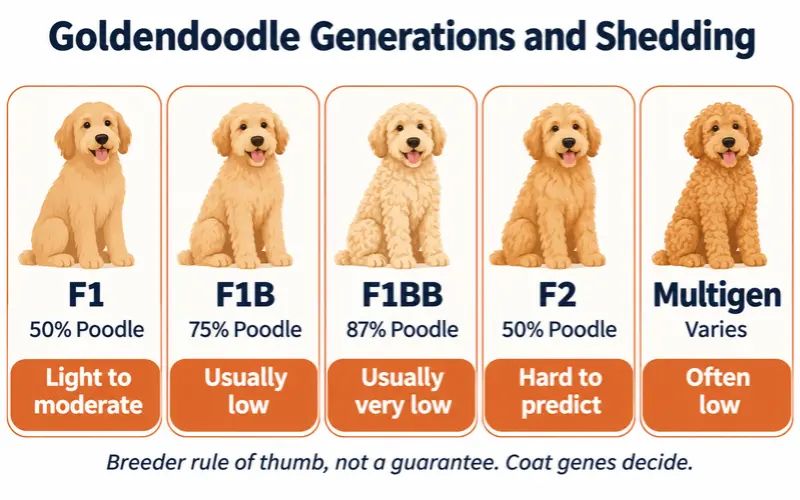
Doodle listings often say “F1,” “F1B” or “multigen.” These labels describe the parents, not the coat. Here’s what they mean and how breeders usually rate shedding for each:
Notice the label on the last column. These ratings come from breeder experience, not from studies that measured shedding by generation. They’re reasonable odds, but they aren’t promises.
Here’s why. A generation tells you roughly how much Poodle is in the family tree. It doesn’t tell you which genes this puppy inherited. Two F1B littermates can end up with different coats and shed different amounts. An F2 or a poorly planned multigen puppy can miss the furnishings gene and end up with an open face. And an F1 can turn out wavy and light-shedding.
So if low shedding really matters to you, the coat DNA results we covered above are a better guide than the letters on the listing.
Are Goldendoodles Hypoallergenic?
No. No Goldendoodle, and no dog breed or mix, is truly hypoallergenic. The American Kennel Club says the same, and notes that Poodle mixes have unpredictable genes and aren’t reliably non-shedding.
The reason is simple. Dog allergies aren’t caused by hair itself. The main allergens come from dander (skin flakes), saliva and urine. Hair just carries them around the house. Every dog makes these allergens, whether it sheds a lot or a little.
The research backs this up:
- A 2012 study in the Journal of Allergy and Clinical Immunology tested hair and homes of so-called hypoallergenic dogs, including Labradoodles and Poodles, against Labrador Retrievers and other dogs. The “hypoallergenic” dogs actually had higher levels of the main dog allergen in their coats. Airborne allergen levels in the homes didn’t differ between breeds, and differences between individual dogs within a breed were bigger than differences between breeds. Labradoodle homes did have less allergen in floor dust. (Vredegoor et al., 2012)
- A 2011 study in the American Journal of Rhinology & Allergy found no significant difference in allergen levels between homes with “hypoallergenic” dogs and homes with other breeds. (PMC study)
In a 2012 study that included Labradoodles and Poodles, so-called hypoallergenic dogs had higher allergen levels in their coats than other dogs, and airborne allergen levels in their homes were no different.
The researchers found no evidence for calling any breed hypoallergenic.
That doesn’t mean a doodle can never work for an allergic family. Some people do react less to certain individual dogs. But it’s about the dog and the person, not the breed name. If someone in your home has allergies:
- Spend time with the actual puppy and, if you can, its parents before you commit. A short visit won’t tell you everything, so go more than once if possible.
- Talk to an allergist, especially if anyone has asthma. Ask about testing and allergy treatment options.
- Keep the dog out of the bedroom of the allergic person.
- Use a HEPA air filter and vacuum often (ideally with a HEPA vacuum).
- Choose hard floors or low-pile rugs where you can, since carpets hold more allergen.
Do Mini Goldendoodles Shed?
Yes, mini Goldendoodles shed by the same rules as standard ones. The same coat genes decide how much hair they drop, so a mini with an open face can shed more than a standard with a curly, furnished coat.
The main difference is size. A smaller dog simply has less coat, so there’s less hair overall to find on your floors and furniture. But less hair isn’t the same as no shedding.
Are mini goldendoodles hypoallergenic? No, for the same reasons as above. Smaller dogs still produce dander and saliva. Fewer allergens may end up spread around the house, but that’s not something you can count on for an allergic household.
Do Goldendoodle Puppies Shed? The Puppy Coat Change
Goldendoodle puppies usually shed very little. Their soft, fluffy puppy coat stays put for the first several months.
Then the adult coat starts growing in, usually somewhere between about 6 and 12 months, sometimes a bit later. During this change:
- The puppy coat loosens and some of it comes out, so you may see more hair than before.
- The old and new coats tangle together, and mats show up fast.
- The coat may change texture, getting wavier, curlier or straighter than the puppy fluff suggested.
This is the moment a lot of owners search “why is my goldendoodle suddenly shedding?” In most cases it’s this normal coat change, not a problem. Daily brushing gets you through it. Our Goldendoodle grooming guide covers what to do during the puppy coat change and when to book the first groom.
Can you tell early which coat a puppy will have? Partly. Watch the face. A puppy that’s growing a fuzzy beard, mustache and eyebrows likely has furnishings. A puppy whose face stays smooth and short-haired like a Golden’s may turn out to be open-faced. The surest answer is still a coat DNA test.
How to Keep Goldendoodle Shedding Under Control
Whether your doodle sheds a little or a lot, the same habits keep loose hair (and mats) in check:
- Line brush down to the skin. Use a slicker brush in small sections, then run a metal comb through. If the comb snags, there’s a tangle the brush missed.
- Bathe about once a month and dry fully. A damp coat mats fast, so blow-dry before brushing.
- Keep a regular groomer schedule. A shorter clip every 6 to 8 weeks makes brushing easier for most doodles.
- Don’t count on shaving to stop shedding. A shaved doodle still sheds, just shorter hairs. And never cut out mats with scissors at home. The skin underneath is easy to nick, so leave badly matted coats to a groomer.
For the full step-by-step routine by coat type, see our Goldendoodle grooming guide. If your doodle is on the heavier-shedding side, our guide to the best dog brush for shedding explains which tools work for which coat. A complete diet supports healthy skin and coat as well, so see our picks for the best dog food for goldendoodles.
Want a Low-Shedding Goldendoodle? Questions to Ask a Breeder
If low shedding is a must for your family, ask these questions before you put down a deposit:
- What coats do both parents have? Ask for photos of them as adults, not just as puppies.
- Have the parents (or puppies) had a coat DNA test? Ask for the furnishings and shedding results.
- What generation is the litter? Useful to know, but remember it’s odds, not a guarantee.
- Have any puppies from past litters turned out open-faced?
- Can we visit and spend time with the parents? This matters most if someone in your home has allergies.
- What happens if the dog doesn’t work out for our family? Good breeders have a clear return or rehoming policy.
Red flag: a breeder who promises a “100% non-shedding” or “fully hypoallergenic” puppy. As the research above shows, nobody can honestly promise that.
When Shedding Isn’t Normal
Some shedding is normal for any doodle. Here’s how to tell when it’s worth a call to your vet.
Normal:
- More hair during the puppy coat change
- A little extra shedding with the seasons, especially for straight or open-faced doodles
Call your vet soon:
- Thinning patches or a coat that suddenly looks dull or patchy
- Constant scratching, licking or chewing at the skin
- Flaky, red or greasy skin, or a bad smell from the coat
See a vet promptly:
- Bald spots, open sores, scabs or swelling
- Heavy hair loss along with other signs of illness, like low energy or not eating
The AKC’s guide to hair loss in dogs explains common causes, from allergies and parasites to hormone problems. Only your vet can tell which one it is.
This article is for general information only.
PawWellCare is not a veterinarian, and this content doesn’t replace professional veterinary or medical care. If your Goldendoodle has hair loss, skin changes or other health concerns, talk to your veterinarian. If you or someone in your home has allergies or asthma, talk to your doctor or an allergist before bringing a dog home.
Frequently Asked Questions (FAQ)
Do F1B Goldendoodles shed?
Usually only a little. F1B doodles are about 75% Poodle, so many have wavy or curly, low-shedding coats. Individual puppies still vary, so ask about coat DNA results if low shedding matters to you.
Do Goldendoodles shed more than Golden Retrievers?
Usually less. Golden Retrievers are heavy shedders with a double coat. Most Goldendoodles shed much less, though an open-faced, straight-coated doodle can shed close to a Golden.
Labradoodle vs. Goldendoodle: which sheds less?
Neither is the clear winner. Both can range from very low to moderate shedding, and the same coat genes decide it. Compare the individual dog’s coat and parents, not the breed name.
Are Goldendoodles double coated?
Some are. Doodles that take after the Golden side, especially straight or flat-coated ones, can have a denser undercoat and shed more. Curly doodles are more like Poodles, with a single coat that keeps growing.
Why is my Goldendoodle shedding so much?
Most often it’s the puppy coat change, usually between about 6 and 12 months. Straight or open-faced doodles also shed more in general. If you see bald spots, sores or constant itching, see your vet.
Does shaving a Goldendoodle stop shedding?
No. A shaved doodle still sheds, just shorter hairs. A short clip does make loose hair and mats easier to manage, so ask your groomer for a length that suits your dog.
Is a Goldendoodle Right for a Low-Shedding Home?
A Goldendoodle can be a great fit if you want less fur around the house. Just go in with the right expectations. Here’s what to remember:
- Genes matter more than the label. A curly, furnished coat is your best bet for low shedding.
- No doodle is truly hypoallergenic. Allergic families should meet the actual dog and talk to an allergist first.
- Low shedding still means real grooming. Trapped hair becomes mats unless you brush it out.
Your next step: if you’re still choosing a puppy, take the breeder questions above to your next call. If your doodle is already home, set up a weekly brushing routine with our Goldendoodle grooming guide, and see our list of the best dog grooming kit for home use for the tools.
Less fur on the couch, a happy, mat-free doodle on the cushion. That’s a trade most owners are glad to make.