

My first dog made me realize something embarrassing about myself. I was giving him a great life on the surface — good food, daily walks, lots of attention — but I had absolutely no system. No schedule. No real plan.
I was just doing whatever felt right in the moment and hoping it was enough.
Then he started limping on his front left leg. I watched it for a few days, told myself he probably just stepped on something.
By the time I took him to the vet, he had been living with significant pain in his joint for what the vet estimated was several weeks.
Caught later than it should have been.
That appointment changed how I approach dog care entirely. The vet did not lecture me. She just said something simple:
“Most of the bad stuff we see could have been caught much earlier with consistent home monitoring and regular check-ins.”
That sentence has stayed with me.
keeping your dog healthy and happy is not about knowing everything. It is about building six consistent habits — and sticking to them even when nothing seems wrong.
Most of the serious health problems I have seen dogs suffer could have been caught earlier, cost less, and caused less suffering if a basic routine had been in place.
This guide covers those six habits, the warning signs that matter most, and how to build a routine that actually holds.
Prevention costs a fraction of treatment.
Why Keeping Your Dog Healthy and Happy Starts With Prevention
Here is a number that changed how I think about this entirely: the cost of treating most common dog health problems caught in their early stages is roughly 30 to 70 percent less than treating the same problems once they have progressed.
Keeping your dog healthy and happy long-term is not about reacting to problems. Routine habits catch what good intentions miss.
A dental cleaning caught at stage one periodontal disease costs far less than the extractions needed at stage three.
A joint issue caught during a routine exam at age four responds far better to management than the same issue identified at eight.
According to the AVMA, preventive dog healthcare — which includes annual exams, vaccinations, dental care, nutrition guidance, and parasite prevention — costs a fraction of treating advanced disease and significantly improves a dog’s quality of life and lifespan.
The AVMA describes preventive care as a multi-faceted approach that covers veterinary evaluation, nutrition, dental care, vaccinations, and heartworm and parasite prevention — all working together to catch problems early and keep them from becoming serious.
The reason most people skip preventive care is the same reason most people skip things that matter: nothing seems wrong right now.
Dogs are expert hiders of pain and discomfort — it is an evolutionary trait from their ancestors, who would have been vulnerable to predators if they showed weakness.
Your dog can have a developing ear infection, early dental disease, a small lump, or an emerging joint problem and still greet you at the door every single day like nothing is wrong.
Routine habits catch what good intentions miss.
Date, weight (weigh them on a bathroom scale holding your dog, then subtract your own weight), and any changes you noticed that month — new lumps, changes in appetite, changes in how they walk or move, any scratching or licking that is new.
This takes three minutes and becomes invaluable when you describe changes to your vet.
Vets work from patterns over time.
You are in the best position to notice what has changed.
Vet Visits — The Habit That Catches Everything Else Early
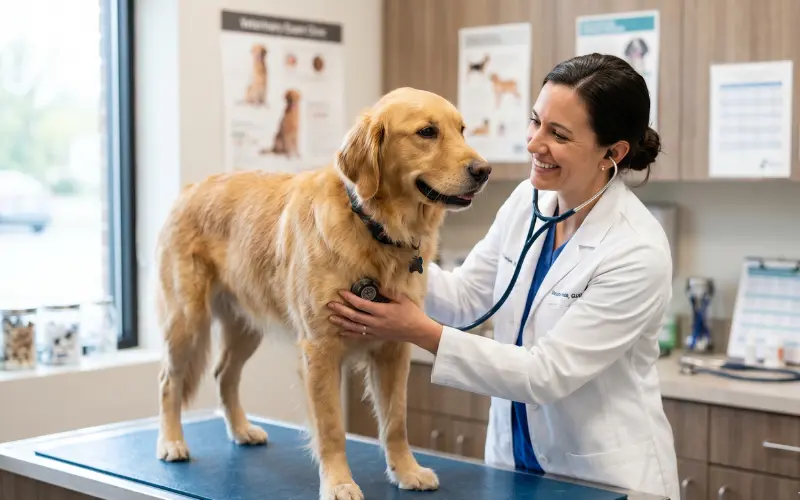
The single highest-leverage habit for keeping your dog healthy and happy is a regular veterinary wellness exam.
Not a sick visit when something goes wrong.
A scheduled wellness exam when nothing seems wrong — because that is exactly when it matters most.
How Often Your Dog Actually Needs to See the Vet
- Adult dogs (1 to 7 years) — once per year minimum. The AVMA and AAHA (American Animal Hospital Association) both recommend annual wellness exams as the baseline for healthy adult dogs.
- Senior dogs (7 years and older) — twice per year. Aging dogs have faster-changing health status and benefit significantly from the additional check-in. Seven years in a medium-to-large breed is roughly comparable to a human in their mid-40s to early 50s — an age when regular health monitoring becomes more valuable, not less.
- Puppies — more frequently in the first year, typically at 8, 12, and 16 weeks for core vaccinations, then again at one year. This schedule will vary slightly by vet and region.
Healthy adult dogs should have a veterinary wellness exam at least once per year — senior dogs over 7 years benefit from twice-yearly exams because health status changes more rapidly as dogs age and early detection significantly improves treatment outcomes.
What a Wellness Exam Actually Covers
A wellness exam is not just vaccinations.
According to VCA Animal Hospitals, a comprehensive wellness exam covers:
- Physical examination from nose to tail — eyes, ears, teeth, coat, skin, lymph nodes, abdomen, joints, and movement
- Dental assessment including signs of gum disease or tooth damage
- Body condition scoring — is your dog at a healthy weight for their frame?
- Parasite screening — fecal test for intestinal parasites, heartworm test
- Vaccination review and updates
- A discussion of any behavioral or physical changes you have noticed since the last visit
How to Get More From Every Vet Appointment
Come prepared.
Write down three to five observations before you go — changes in appetite, new behaviors, any limping or stiffness, changes in thirst or urination.
Vets see many patients in a day. Your observations are data they cannot get any other way.
Do not wait until the appointment to notice things.
The monthly health notes mentioned above make this much easier. You walk in with context.
That context changes what gets caught.
Nutrition — Feeding for Health, Not Just Hunger
I spent the first year of dog ownership buying whatever dog food had the nicest packaging.
No research. No understanding of what I was actually feeding.
A vet eventually asked me what I was feeding and I realized I could not describe the ingredients beyond “it says premium on the bag.”
Nutrition is not complicated. But it does require more than picking the most expensive bag in the store.
The Basics of What Your Dog Actually Needs
Nutrition is the foundation of keeping your dog healthy and happy at every life stage.
The key phrase is life stage — a puppy’s nutritional needs are meaningfully different from an adult dog’s, which are different again from a senior dog’s.
Look for dog food that carries the AAFCO (Association of American Feed Control Officials) statement on the label.
It will say something like “formulated to meet the nutritional levels established by the AAFCO Dog Food Nutrient Profiles for [life stage].”
This statement means the food has been formulated to meet the established nutritional standards for your dog’s stage of life.
It is the most reliable single indicator of basic nutritional adequacy on a dog food label.
Look for the AAFCO nutritional adequacy statement on any dog food label — it confirms the food meets established nutritional standards for your dog’s specific life stage (puppy, adult, or senior) and is the most reliable baseline quality indicator on the packaging.
Feeding the Right Amount — The Part Most Owners Get Wrong
Overfeeding is the most common nutrition mistake.
The Association for Pet Obesity Prevention estimates that over 50 percent of dogs in the United States are overweight or obese — and most of their owners do not know it.
Excess weight accelerates joint degeneration, stresses the heart and organs, reduces lifespan, and makes every existing health problem worse.
The feeding guidelines on dog food bags are starting points, not exact prescriptions. They are typically calibrated for active dogs.
If your dog is more sedentary, you likely need to feed toward the lower end of the range.
Body condition scoring is more reliable than portion charts — you should be able to feel your dog’s ribs easily with light pressure, but not see them prominently.
A visible waist when viewed from above is a good sign.
Measure every meal.
Eyeballing portions is the leading cause of gradual unintentional overfeeding.
A measuring cup costs two dollars. Use it.
For specific guidance on switching dog foods without causing stomach upset, read our guide on how to switch dog food without upset stomach.
For a complete breakdown of ingredients, reading labels, and what to avoid, check our complete dog nutrition guide for beginners.
Exercise — The Daily Habit Most Owners Underestimate
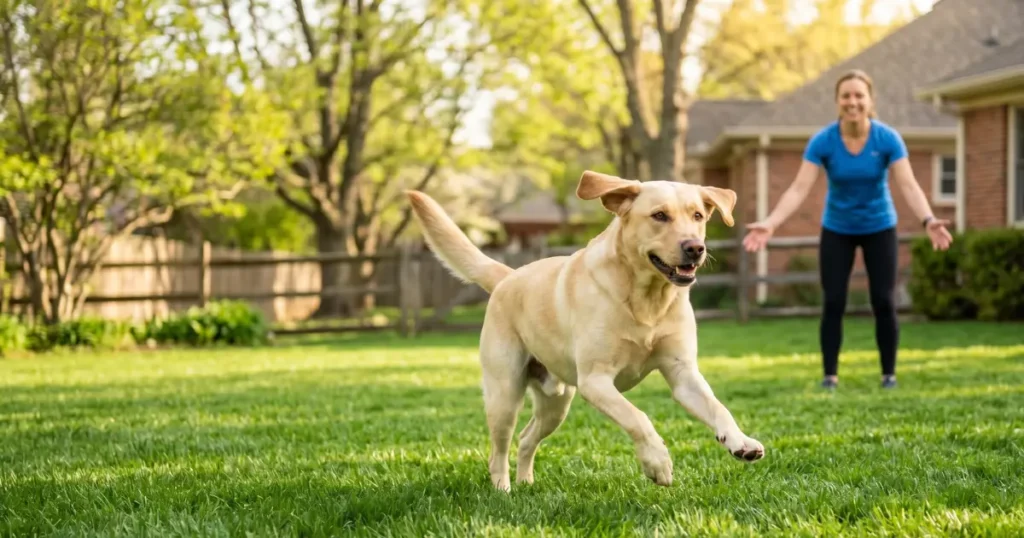
Exercise is not optional maintenance — it is a core part of keeping your dog healthy and happy that most owners underestimate.
A dog that does not get adequate daily exercise develops behavioral problems, gains weight, loses muscle tone, and is at higher risk for joint and cardiovascular issues.
The problem is that most owners vastly underestimate how much their specific dog actually needs.
How Much Exercise Your Dog Needs by Breed Type
There is no universal number. The correct amount depends on breed, age, and current health status.
These are guidelines, not exact prescriptions:
- Low energy breeds (Basset Hounds, Bulldogs, Shih Tzus, Great Danes) — 20 to 40 minutes per day. Short walks, gentle play, nothing high-impact.
- Medium energy breeds (Beagles, Labrador Retrievers, Golden Retrievers, Spaniels) — 45 to 90 minutes per day. Mix of walks and active play. Labs and Goldens, despite being medium-listed, often prefer being toward the higher end.
- High energy breeds (Border Collies, Australian Shepherds, Vizslas, Siberian Huskies, Jack Russell Terriers) — 90 minutes to 2+ hours per day, with mental stimulation in addition to physical exercise. These are working breeds whose brains need engagement as much as their bodies.
Most adult dogs need 30 minutes to 2 hours of daily exercise depending on breed and energy level — high-energy working breeds like Border Collies and Huskies need 90 minutes or more per day plus mental stimulation, while low-energy breeds like Bulldogs and Basset Hounds do well on 20 to 40 minutes of gentle daily activity.
According to the American Kennel Club, matching your dog’s daily exercise to their breed’s energy level is essential for preventing the behavioral problems, weight gain, and joint issues that develop when exercise needs go unmet.
Mental Exercise Matters Too
Physical exercise tires the body. Mental exercise tires the brain — and for many breeds, particularly intelligent working dogs, a tired brain is just as important as a tired body for calm, settled behavior.
Puzzle feeders, training sessions, scent games (hiding treats around the house and letting your dog find them), and new walking routes that expose your dog to novel smells all count as mental exercise.
A 15-minute training session can tire a Border Collie more effectively than a 30-minute walk.
Signs your dog is not getting enough exercise:
- Destructive behavior
- Excessive barking
- Restlessness at night
- Hyperactivity
- Weight gain without any change in diet

Dental Health — The Most Skipped Habit With the Biggest Consequences
Dental disease is the most prevalent health condition in adult dogs — and the most consistently overlooked by owners.
The AVMA reports that most dogs show signs of periodontal disease by age 3. That is a young adult dog problem, not a senior dog problem.
Periodontal disease does not stay in the mouth. Oral bacteria enter the bloodstream and have been linked to heart, kidney, and liver disease in dogs.
A mouth problem becomes a whole-body problem if left long enough.
What Dental Disease Actually Looks Like
- Stage 1 (reversible) — mild redness at the gum line, slight plaque buildup. Brushing and professional cleaning can reverse this.
- Stage 2 (early disease) — visible tartar, gum inflammation, slight recession. Professional cleaning required. Some permanent damage begins.
- Stage 3-4 (advanced disease) — significant bone loss, exposed roots, pain, possible tooth loss. Extractions required. Expensive. Painful for the dog.
The difference between catching it at stage one and finding it at stage three is almost entirely about home brushing habits and annual professional assessment.
Building a Dental Routine That Sticks
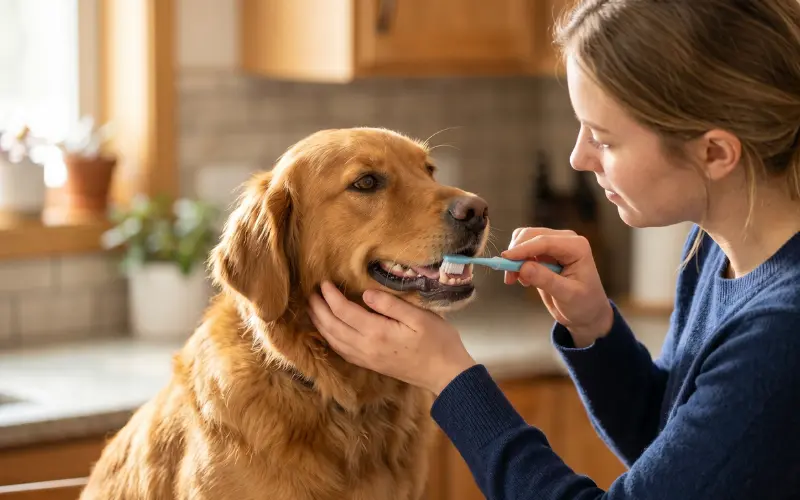
Brush your dog’s teeth 2 to 3 times per week with enzymatic toothpaste designed for dogs.
Never use human toothpaste — fluoride is toxic to dogs and they cannot spit.
Enzymatic toothpaste works even without perfect brushing technique because the enzymes break down plaque chemically.
If your dog resists the brush, start smaller.
Let them lick the toothpaste off your finger for a week. Then introduce the brush. Then gradually work toward all teeth.
Most dogs accept this routine within 2 to 3 weeks when introduced slowly.
Dental chews look for the VOHC — Veterinary Oral Health Council — seal provide supplemental plaque reduction but do not replace brushing.
For our full dental care recommendation including the specific toothpaste we use, check our guide on dog grooming tips for beginners.
Grooming and Monthly Body Checks — Your Eyes and Hands Are the Best Diagnostic Tools You Own
I found my dog’s tick during a brushing session.
I found the small lump behind his ear the same way.
I noticed he was licking his left paw excessively during a routine brushing check — which led me to discover a small cut that had started to get infected.
Grooming is not just about appearance.
Regular physical contact with your dog — hands moving systematically over their body — is how you catch things between vet appointments.
The Monthly Full-Body Check
Regular grooming and body checks are one of the most underrated parts of keeping your dog healthy and happy:
- Coat and skin — part the fur and look at the skin directly. Any redness, flaking, bumps, hot spots, or bald patches?
- Ears — look inside. Pale pink with minimal wax is normal. Redness, dark discharge, or smell means a vet visit.
- Eyes — clear and bright. Any cloudiness, discharge, or redness?
- Teeth and gums — lift the lips and look. Gums should be bubblegum pink. Pale, white, yellow, or bright red gums are all warning signs.
- Lumps — run both hands firmly across the entire body. Under the chin, along the neck, armpits, chest, belly, groin, and legs. Any new lump gets noted and monitored. Any lump that grows quickly or changes texture gets a vet visit.
- Paws — check between every toe. Mats, debris, small cuts, and ticks all hide here.
- Movement — watch your dog walk away from you and toward you. Any limping, stiffness, or reluctance to put weight on a leg?
A monthly full-body check during grooming — examining the coat, skin, ears, eyes, teeth, gums, lumps, paws, and movement — is one of the most effective ways to detect early health problems in dogs between annual veterinary exams.
Grooming Frequency by Coat Type
- Short coats (Beagles, Boxers) — weekly brushing, monthly bath.
- Medium coats (Labs, Goldens, Spaniels) — 2 to 3 times per week brushing, bath every 4 to 6 weeks.
- Long coats (Yorkies, Maltese, Shih Tzus) — daily brushing, bath every 3 to 4 weeks.
- Double coats (Huskies, German Shepherds) — 2 to 3 times per week, daily during shedding season.
For a complete guide covering every grooming task with correct technique, read our step-by-step guide on how to groom a dog at home.
Parasite Prevention — Year-Round, Not Just Summer
This is the preventive habit most US dog owners partially follow — they do flea and tick prevention in summer and skip it in winter.
The problem is that parasites in warmer US climates are active year-round, and even in colder climates, a single warm spell in winter can reactivate flea and tick populations.
The Three Parasites That Matter Most
- Heartworm — spread by mosquito bites. Lives in the heart and blood vessels. Treatment is expensive, difficult, and hard on the dog. Prevention costs roughly $6 to $12 per month. The math is not close. The American Heartworm Society recommends year-round prevention for all dogs in the United States.
- Fleas — survive indoors in carpet and furniture even in cold weather. One flea on your dog can become a home infestation in weeks because fleas lay hundreds of eggs per day. Year-round prevention is the only reliable approach.
- Ticks — active whenever temperature is above freezing. Carry Lyme disease, anaplasmosis, ehrlichiosis, and other serious illnesses. Check your dog after every outdoor trip during warmer months. A tick must be attached for 24 to 48 hours to transmit most diseases — prompt removal matters.
Heartworm prevention medication should be given year-round to all dogs in the United States — the American Heartworm Society recommends this because mosquitoes can be active during warm spells in any season and heartworm treatment costs significantly more than prevention.
What Your Vet Recommends vs. Over-the-Counter
Ask your vet about prescription parasite prevention options — they tend to be more effective and broader in coverage than over-the-counter alternatives.
Many prescription options cover heartworm, intestinal parasites, fleas, and ticks in a single monthly dose.
The cost difference is often smaller than it appears once you factor in what is being covered.
At minimum, discuss parasite prevention at every annual wellness exam and make sure your prevention protocol is appropriate for where you live and what environments your dog is exposed to.
Missing a dose breaks the protection window.
A calendar reminder takes 30 seconds to set up and eliminates the most common prevention failure.
Warning Signs You Should Never Wait On
Keeping your dog healthy and happy also means knowing which signs should never be ignored.
It is about knowing which observations mean “I should call the vet today” rather than “I’ll keep an eye on it.”
These signs always warrant a prompt vet call — do not wait to see if they resolve on their own:
- Sudden unexplained limping or reluctance to bear weight on a leg. Especially if it appears suddenly and does not improve with rest.
- Vomiting or diarrhea that continues beyond 24 hours, or any single episode that includes blood.
- Excessive water consumption paired with frequent urination. This combination can indicate diabetes, kidney disease, or Cushing’s disease — all of which are significantly more manageable when caught early.
- Persistent coughing — especially a wet cough, or one that wakes the dog at night. Can indicate kennel cough, heart disease, or respiratory issues.
- Any lump that appears rapidly, doubles in size within a few weeks, or feels attached to deeper tissue rather than freely movable under the skin.
- Loss of appetite lasting more than 24 to 48 hours in an otherwise healthy adult dog.
- Pale, white, or yellow gums at any time. Gum color is one of the fastest indicators of serious cardiovascular or internal problems.
- Sudden behavioral changes — unusual aggression, hiding, refusing activities they normally enjoy. Pain often presents as behavior change in dogs before it shows up as obvious physical symptoms.
According to the ASPCA, recognizing these warning signs early and seeking prompt veterinary care is one of the most important things an owner can do — delayed treatment for serious symptoms consistently leads to worse outcomes and higher costs.
If your dog is showing any of the warning signs listed above, contact your veterinarian directly.
This guide is intended to help you build the habits that reduce the likelihood of serious problems — not to replace professional veterinary care when problems arise.
All information in this guide is based on published guidelines from the AVMA, VCA Animal Hospitals, and AKC.
For any specific health concern about your dog, please consult your veterinarian directly.
This guide covers preventive habits and general wellness — it is not medical advice.
Frequently Asked Questions (FAQ)
How do I keep my dog healthy on a budget?
The habits that matter most for keeping your dog healthy and happy — daily exercise, regular brushing, teeth brushing, monthly body checks, and measuring food portions — cost almost nothing.u003cbru003eThe biggest budget item is the annual vet visit, which averages $50 to $250 depending on region and what is included.u003cbru003ePet insurance can make this more predictable. Many low-cost veterinary clinics and humane societies offer reduced-cost wellness exams and vaccinations.u003cbru003ePreventive care consistently costs less than treating the conditions it prevents.
How often should I take my dog to the vet?
Healthy adult dogs need a wellness exam at least once per year.u003cbru003eSenior dogs over 7 years benefit from twice-yearly visits because health changes more rapidly as dogs age.u003cbru003ePuppies need more frequent visits in their first year for the vaccination schedule — typically at 8, 12, and 16 weeks plus a one-year visit.u003cbru003eAny time your dog shows changes in behavior, appetite, movement, or any of the warning signs above, schedule a visit promptly rather than waiting for the annual appointment.
What should I feed my dog for optimal health?
Choose a dog food with the AAFCO nutritional adequacy statement on the label, formulated for your dog’s current life stage (puppy, adult, or senior).u003cbru003eLook for a named protein source as the first ingredient.u003cbru003eMeasure portions using a measuring cup — do not estimate by eye.u003cbru003eAvoid table scraps and human food that can be toxic to dogs. Grapes, raisins, onions, xylitol, macadamia nuts, and chocolate are among the most dangerous.u003cbru003eConsult your vet if your dog has specific health conditions that require a therapeutic or restricted diet.
How do I know if my dog is overweight?
The body condition score is more reliable than looking at the scale.u003cbru003eStand over your dog and look down — you should see a visible waist.u003cbru003eWhen you run your hands along their sides with light pressure, you should feel the ribs without needing to press hard — but you should not see them prominently.u003cbru003eIf you cannot feel ribs without significant pressure, your dog is likely overweight.u003cbru003eAsk your vet to body condition score your dog at the next visit and recommend an appropriate caloric intake.
How much exercise does my dog need?
It depends on breed, age, and health status.u003cbru003eLow-energy breeds like Bulldogs and Basset Hounds do well on 20 to 40 minutes of gentle daily activity.u003cbru003eMedium-energy breeds like Labs and Golden Retrievers need 45 to 90 minutes.u003cbru003eHigh-energy working breeds like Border Collies and Huskies need 90 minutes or more plus mental stimulation.u003cbru003ePuppies need shorter, more frequent sessions — about 5 minutes of exercise per month of age, twice daily.u003cbru003eSenior dogs benefit from daily gentle exercise, but should not be pushed to the levels they managed at their peak.
Is dental care really that important for dogs?
Yes — it is one of the highest-impact preventive habits available to dog owners.u003cbru003eThe AVMA reports that most dogs show early periodontal disease by age 3.u003cbru003eLeft untreated, oral bacteria enter the bloodstream and can affect the heart, kidneys, and liver.u003cbru003eBrushing 2 to 3 times per week with enzymatic toothpaste and having a professional dental cleaning when your vet recommends it are the two most effective preventive measures.u003cbru003eDental chews with the VOHC seal provide supplemental benefit.
How do I check my dog for ticks?
After any outdoor time in wooded, grassy, or brushy areas, run your hands through your dog’s entire coat with firm pressure.u003cbru003eFocus on the areas where ticks prefer to hide — behind the ears, between the toes, around the tail, in the groin area, under the armpits, and around the collar.u003cbru003eA tick must be attached for 24 to 48 hours to transmit most tick-borne diseases, so prompt daily checking and removal significantly reduces risk.u003cbru003eUse a fine-tipped tick removal tool to remove any found ticks — do not twist, crush, or use heat.
What are the most important preventive habits for dogs?
In order of impact: regular vet wellness exams annually for adults, twice yearly for seniors, year-round heartworm and parasite prevention, proper nutrition with measured portions, daily breed-appropriate exercise, dental brushing 2 to 3 times per week, and regular grooming with monthly full-body checks.u003cbru003eThese six habits address the causes of the vast majority of preventable dog health problems.
When should I call the vet between appointments?
Call promptly — same day or next day — for sudden unexplained limping, vomiting, or diarrhea lasting more than 24 hours or containing blood, persistent coughing, rapid or unexplained weight change, excessive thirst paired with frequent urination, any new lump that grows quickly, pale or yellow gums, or significant behavioral changes.u003cbru003eThese are the signs that should not wait for the next scheduled appointment.u003cbru003eWhen in doubt, call your vet’s office and describe what you are seeing — most practices can advise you by phone whether it needs a same-day visit.
Six Habits, One Healthy Dog — Final Thoughts
The six habits in this guide are not complicated. Keeping your dog healthy and happy requires consistency.
My dog’s limp taught me that good intentions without a system are not enough.
I loved him completely. I was still missing things that mattered.
The six habits in this guide are not complicated. They do not require special equipment or veterinary knowledge.
They require consistency — which is the only thing that genuinely separates the dogs who live long, comfortable lives from the ones who do not.
Annual vet visits catch what daily observation misses.
Consistent nutrition maintains the weight that protects every joint and organ.
Daily exercise keeps the body and brain functioning at their best.
Dental care prevents a mouth problem from becoming a body-wide problem.
Monthly body checks give you information that lets you act early rather than late.
Parasite prevention handles threats your dog cannot protect themselves from.
None of this requires perfection. It requires showing up consistently.
Pick one habit from this guide that you are not currently doing consistently and build it in this week. Then add the next one.
Six months from now you will have a completely different relationship with your dog’s health — and so will they.
For the full breakdown on summer heat safety, which is one of the most important seasonal health habits for US dog owners, read our complete guide on how to keep your dog cool in summer.
For new dog owners still building their puppy’s health foundation, our complete guide on how to take care of a puppy for the first time covers the first-year habits in detail.




Pingback: Senior Dog Care Guide: Health and Happiness (2026)
Pingback: Natural Flea and Tick Prevention for Dogs: What Vets Actually Say (2026)