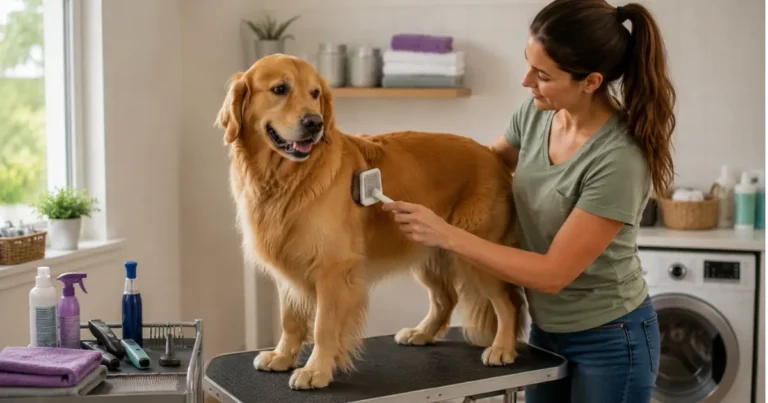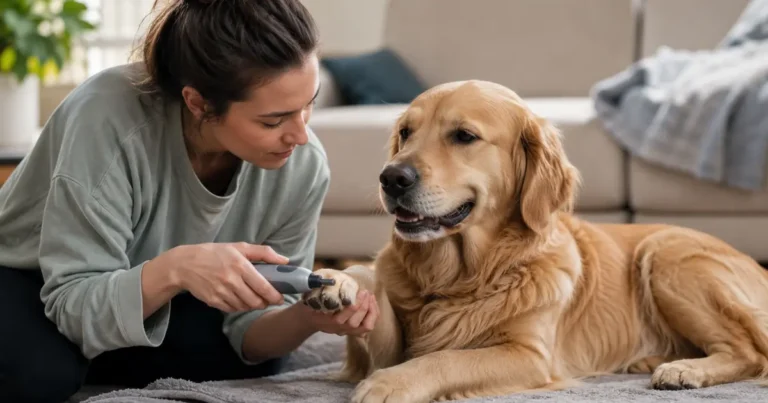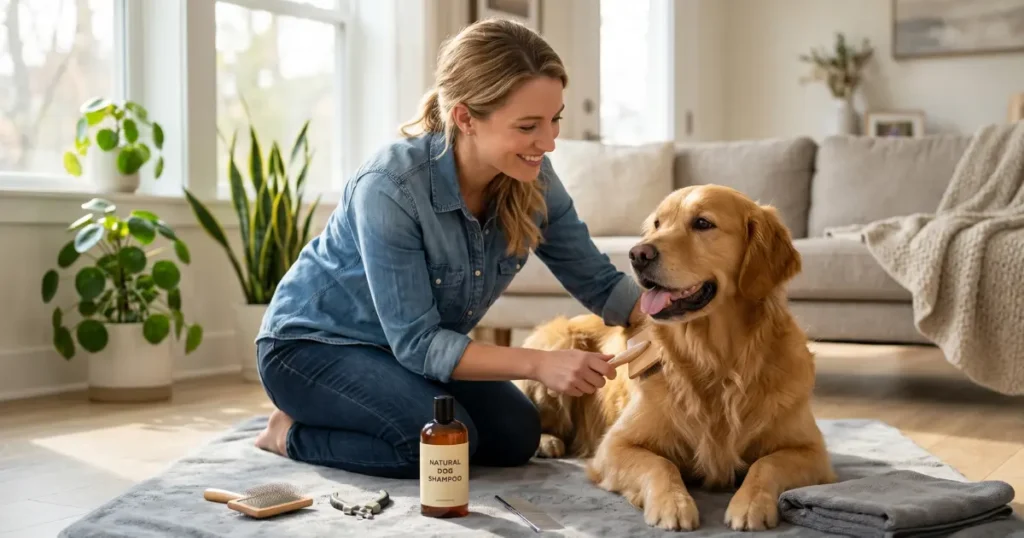
The first time I tried grooming my dog at home, I ended up with more fur on me than on him.
I grabbed the wrong brush — a bristle brush meant for short coats — and used it on a medium double coat.
Then I used human shampoo because the dog kind ran out.
Then I tried blow drying on high heat while he panicked and bolted across the bathroom, trailing soap suds behind him.
Twenty minutes of actual grooming. Two hours of cleanup. One very unhappy dog.
Nobody warns first-time owners what dog grooming actually involves.
The wrong brush damages the coat. The wrong shampoo strips natural oils. The wrong approach creates a dog who dreads grooming for years afterward.
Dog grooming tips for beginners are not about buying expensive equipment or watching one YouTube video.
They are about understanding the basics — which tools match your dog’s coat, what the real costs look like, and the handful of mistakes that genuinely matter.
Once I stopped overcomplicating it, grooming became a 15-minute weekly routine.
This guide covers the tools, the real cost breakdown, and everything a first-time groomer needs to get it right from the start.
Most dogs need brushing 2 to 3 times per week and bathing every 4 to 8 weeks depending on coat type.
Why Dog Grooming Tips for Beginners Actually Matter
I used to think grooming was cosmetic. Keep the dog looking nice.
That mindset lasted three weeks — until I found a small hard lump behind my dog’s ear during a brushing session that I would have completely missed any other way.
The lump was a tick. Caught early. Not a problem.
That is what grooming actually is. A full-body health check built into a maintenance routine.
Regular dog grooming sessions allow owners to detect skin infections, parasites, lumps, and coat abnormalities early — according to the AKC, routine grooming is one of the most effective preventive health practices a dog owner can build.
When you brush your dog, you distribute natural oils through the coat and stimulate blood circulation to the skin.
When you check the ears weekly, you catch the early warning signs of infection before they become painful.
When you trim the nails, you prevent gait changes that slowly damage joints over time.
According to VCA Animal Hospitals, the condition of a dog’s skin and coat is one of the best indicators of their overall health — and regular grooming with a breed-appropriate brush keeps the coat clean, free of tangles, and allows owners to catch skin problems early.
What consistent home grooming prevents:
- Painful matting that pulls skin and creates infections underneath
- Overgrown nails that change gait and damage joints
- Ear infections from trapped moisture — especially in floppy-eared breeds like Cocker Spaniels and Basset Hounds
- Periodontal disease — according to the AVMA, most dogs show early gum disease by age 3
- Undetected parasites, hot spots, and skin conditions between vet visits
Grooming is preventive care disguised as a routine.
The earlier you start, the easier it stays.
The Essential Dog Grooming Tools — What You Actually Need (and What to Skip)
I spent over $200 on grooming tools before touching my dog’s coat.
A grooming table I never used. Electric clippers for a breed that does not need haircuts. Four brushes when I needed one.
Save yourself the mistake.
Here is what you actually need and what can wait.
Tool 1 — The Right Brush for Your Coat Type
This is the single most important grooming purchase.
There is no universal best brush — coat type determines everything:
- Slicker brush — works for medium to long-haired and curly-coated breeds like Golden Retrievers, Poodles, and Doodles. Removes tangles, loose fur, and surface mats. The most versatile option for beginners.
- Bristle brush — best for short-coated breeds like Beagles, Boxers, and Bulldogs. Distributes natural oils without irritating short hair.
- Undercoat rake — essential for heavy-shedding double-coated breeds like Huskies, German Shepherds, and Samoyeds. Gets into the dense undercoat that surface brushes cannot reach.
Hertzko Self-Cleaning Slicker Brush (Blue)
Price: ~$16
Why: Push-button retractable bristle design — press once and collected fur releases instantly for quick cleanup.
Soft angled bristles detangle and remove loose hair without scratching skin.
Comfort-grip anti-slip handle reduces hand strain during longer sessions.
Over 91,000 Amazon reviews at 4.5 stars and ranked in the top 15 pet brushes on Amazon.
Not ideal for: Double-coated breeds during heavy shedding season — the soft bristles handle surface tangles and loose fur well but cannot penetrate a dense undercoat the way an undercoat rake or deshedding tool can.
Also not the right pick for very short smooth coats like Boxers or Pit Bulls where a rubber curry brush is gentler and more effective.
Tool 2 — Nail Clippers and Styptic Powder
Overgrown nails change how a dog walks.
If you can hear clicking on the floor, they are already too long.
gonicc Dog Nail Clippers and Trimmer
Why: Ultra-sharp 3.5mm heavy-duty stainless steel blades cut clean in one snip without splitting or crushing the nail.
Built-in safety guard blocks over-cutting and protects the quick — genuinely beginner-friendly.
Hidden mini nail file integrated in the handle lets you smooth rough edges right after trimming.
Ergonomic non-slip comfort grip reduces hand fatigue and prevents slipping mid-cut.
Vet and groomer recommended for at-home use.
Not ideal for: Toy breeds and very small dogs under 10 lbs — these are sized for medium to large dogs.
For tiny nails, a smaller scissor-style or guillotine clipper gives better precision.
Miracle Care Kwik Stop Styptic Powder (6 oz)
Why: The original styptic powder trusted by vets and professional groomers for over 40 years.
Contains Benzocaine — stops bleeding and blocks pain at the same time.
The 6 oz resealable tub lasts well over a year of regular home nail trimming.
Ranked number 1 Best Seller in Pet Styptic Powders on Amazon.
Made in the USA.
Apply with a moistened cotton applicator and hold with moderate pressure for 5 to 10 seconds.
Not ideal for: Deep wounds or body cavities — this is designed for minor superficial bleeding from nail trims and small nicks only.
If bleeding does not stop quickly, contact your vet.
Tool 3 — Dog-Specific Shampoo
Never use human shampoo on a dog.
Dog skin has a pH of 6.2 to 7.4 — more neutral than human skin at 5.5.
Human products strip natural oils, disrupt the skin barrier, and cause dryness.
earthbath Oatmeal & Aloe Dog Shampoo — Vanilla & Almond (16 oz)
Why: Soap-free and pH-balanced formula with colloidal oatmeal (3%) and organic aloe vera — recommended by veterinarians to relieve itching, promote skin healing, and re-moisturize dry sensitive skin.
Contains vitamins A, B, D, and E plus panthenol.
No sulfates, parabens, synthetic dyes, DEA, or phthalates.
Won’t wash off topical flea treatments.
Safe for dogs 6 weeks and older.
Leaves coat soft, clean, and lightly scented with vanilla and almond.
Cruelty-free since 1995, made in the USA.
A 90-second leave-on time gives the oatmeal and aloe time to actually work.
Not ideal for: Dogs with active skin conditions, allergies, or chronic itching — those need a vet-recommended medicated or prescription formula.
For specific recommendations, read our guide on the best dog shampoo for itchy sensitive skin.
Tool 4 — Ear Cleaning Solution
Dog ears — especially floppy ones — trap moisture and debris that lead to painful infections.
Weekly checks and routine cleaning prevent most ear problems.
Virbac EPIOTIC Advanced Ear Cleanser (4 oz)
Why: Developed in collaboration with veterinary dermatologists and ranked number 1 in Dog Ear Care on Amazon.
Contains 0.2% salicylic acid plus a monosaccharide complex that actively limits bacteria bonding to the ear canal surface — it does not just flush wax out, it inhibits the microorganisms that cause infections from taking hold.
No alcohol, no chlorhexidine.
Low pH of 2.2 makes it gentle enough for weekly use on sensitive ears.
Light citrus scent.
The same product vets charge a premium for at the clinic — significantly cheaper to buy directly.
Ideal for dogs prone to ear infections, swimmers, and dogs with allergies or floppy ears.
Not ideal for: Active ear infections with redness, swelling, discharge, or strong odor — that needs veterinary diagnosis and prescription treatment, not more cleaning.
This is a maintenance and prevention tool, not an infection treatment.
Tool 5 — Dental Kit
Dental care is the most skipped grooming task.
The AVMA reports that most dogs show early periodontal disease by age 3.
That is a young adult dog problem, not a senior dog problem.
Virbac C.E.T. Enzymatic Toothpaste — Poultry Flavor (2.5 oz)
Why: The number 1 vet-recommended pet dental brand in the USA.
Uses a dual-enzyme system that works with your dog’s own saliva to actively inhibit plaque formation — meaning it keeps working even between brushing sessions.
100% safe to swallow, no foaming agents, no rinsing needed.
Poultry flavor most dogs genuinely love — owners consistently report dogs lining up for teeth brushing once introduced to this paste.
Over 17,000 Amazon reviews at 4.6 stars. Made in the USA.
Pair with a soft-bristled toothbrush — the Virbac CET Dual-Ended Toothbrush works well and is sold separately on Amazon for around $5.
Not ideal for: Replacing professional dental cleanings when disease is already present.
Home brushing is prevention, not treatment.
Also not suitable if your dog has a known poultry sensitivity — Virbac makes this same formula in beef, malt, seafood, and vanilla mint flavors if you need an alternative.
A beginner dog grooming kit should include 5 essential tools — a breed-appropriate brush, nail clippers with styptic powder, dog-specific shampoo, enzymatic ear cleaner, and a dog toothbrush with enzymatic toothpaste — and can be assembled for under $75 total.
What You Can Skip as a Beginner
- Electric clippers — only if your breed needs regular haircuts (Poodles, Schnauzers, Bichons)
- Grooming table — your kitchen floor with a non-slip mat works fine
- Force dryer — towel drying or a household dryer on cool/low setting does the job
- Dematting combs — prevention beats treatment. Consistent brushing prevents mats from forming
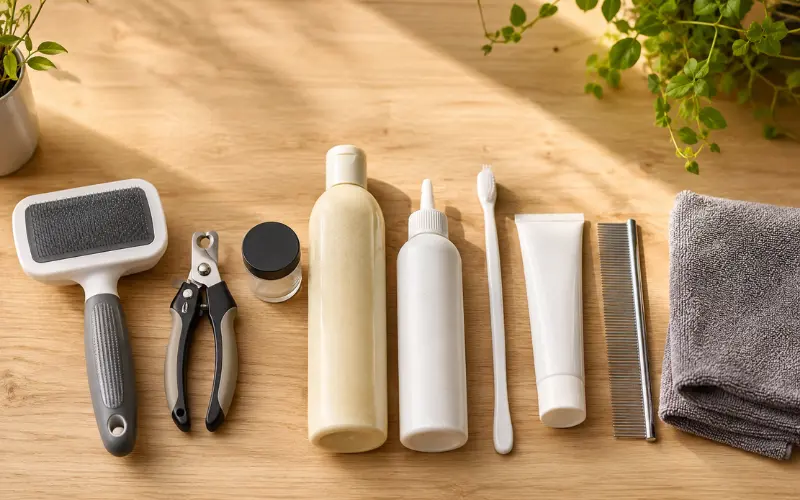
Use it for a week.
Then add nail clippers.
Then shampoo.
Building your kit one tool at a time lets your dog adjust gradually — and prevents you from spending $200 upfront on tools you may not need.
The slicker brush is the single tool that makes the most immediate difference for the most breeds.
How Much Does Dog Grooming Cost — The Real Breakdown
This is the section I wish someone had shown me before my first grooming appointment.
The math is straightforward — and it clearly favors home grooming for most owners.
Professional dog grooming costs $40 to $100 per session for an average dog — totaling $480 to $1,200 per year with visits every 6 weeks — while a complete home grooming kit costs $50 to $150 upfront with $50 to $100 per year in ongoing supplies.
Professional Grooming Cost by Dog Size (2026)
Add-on surcharges most owners do not know about: matted coats add $15 to $50 depending on severity.
Curly-coated breeds like Poodles and Doodles cost 20 to 40 percent more because they require 60 to 90 minutes of clipper work compared to 30 to 45 minutes for a Labrador.
Major-metro areas — NYC, San Francisco, LA — run 20 to 40 percent above national averages.
DIY Grooming Cost — The Year 1 vs Year 2 Math
Here is the math that changed my decision:
Year 1 home grooming cost — building the kit from scratch: slicker brush ($15), nail clippers ($10), styptic powder ($8), dog shampoo ($14), ear cleaner ($12), dental kit ($12), towels and cotton balls ($10).
Total: roughly $80 to $120.
Year 2 onward — only replenishing consumables: shampoo refill ($14), ear cleaner ($12), toothpaste ($8), occasional cotton balls and styptic powder ($10).
Total: roughly $45 to $65 per year.
Compare that to a medium-sized dog groomed professionally every 6 weeks at $75 per session.
That is $650 per year.
Even with the Year 1 kit investment, home grooming saves roughly $530 in the first year and $585 or more every year after that.
The Hybrid Approach — Best of Both
Full DIY is not right for every dog.
If your breed needs styled haircuts — Poodles, Bichon Frises, Goldendoodles, Schnauzers — you still need a professional for that specific work.
Those cuts require training and specialized equipment that takes time to develop.
The approach that saves the most money while keeping quality high: handle all maintenance at home — brushing, bathing, nail trims, ears, dental care — and see a professional groomer every 8 to 12 weeks for the haircuts only.
This hybrid approach cuts annual grooming costs by 30 to 40 percent for most owners.
Many salons also offer “bath and brush” packages for $25 to $40 that skip the haircut entirely.
If your breed does not need regular trims — Labs, Beagles, Boxers — this is an effective middle ground between full DIY and full professional.
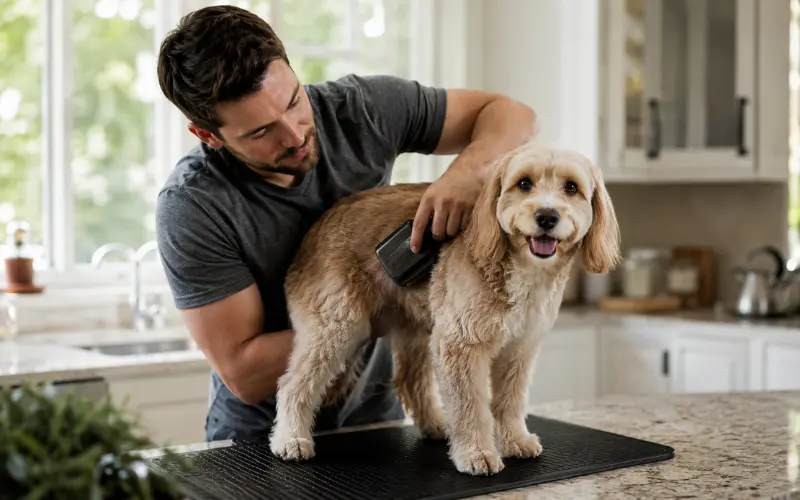
Brushing, Bathing, and Beyond — The Basics Done Right
This section covers the core technique for the five maintenance tasks you will handle at home.
Each task has a dedicated deep guide linked below — here I am giving you the essential version so you can start this week.
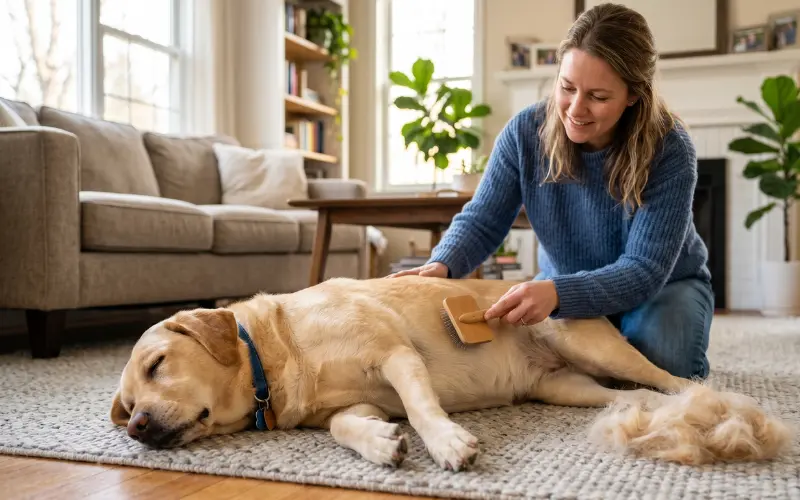
Brushing — The Most Important Habit
According to the AKC, effective brushing reaches all the way down to the skin — the massaging action stimulates blood circulation and loosens debris at the root, not just at the surface.
Work section by section, not in random sweeps.
One side of the body, then the other, then belly, legs, chest, neck.
Pay extra attention to mat zones — behind the ears, under the armpits, around the collar, and at the base of the tail.
Use short, gentle strokes in these areas and never pull through a tangle.
Dogs should be brushed a minimum of 2 to 3 times per week — daily brushing is recommended for long-haired and curly-coated breeds like Poodles, Shih Tzus, and Doodles to prevent mat formation that can progress to painful skin infections.
Short coats (Beagles, Boxers) — once a week.
Medium coats (Golden Retrievers, Spaniels) — 2 to 3 times per week.
Long coats (Maltese, Yorkies) — daily.
Double coats (Huskies, German Shepherds) — 2 to 3 times, daily during shedding season.
Curly coats (Poodles, Doodles) — daily without exception.
One mistake I made early: I skipped brushing during winter because shedding seemed lighter.
Mats quietly formed behind my dog’s armpits over six weeks.
By the time I noticed, they were tight against the skin and had to be carefully cut out.
Brush year-round.
For dogs that shed heavily, our guide on how to deshed a dog at home covers specialized undercoat removal technique and tools in detail.
Bathing — Less Often Than You Think
The ASPCA recommends bathing at least once every three months — more frequently for active outdoor dogs.
Over-bathing strips natural oils and causes dry, irritated skin.
Most dogs need bathing every 4 to 8 weeks — over-bathing strips natural skin oils and causes dryness, while under-bathing allows dirt and bacteria to build up in the coat and on the skin.
The critical rules:
- Always brush out mats before bathing because water tightens them.
- Use lukewarm water only.
- Place cotton balls in ears to block moisture.
- Rinse until the water shows zero bubbles.
- Then rinse once more.
Shampoo residue causes itching that looks like a skin condition but is entirely caused by incomplete rinsing.
For complete bathing and drying technique, read our step-by-step guide on how to groom a dog at home.
Nails, Ears, and Teeth — Do Not Skip These
These three tasks get skipped most and cause the most preventable problems.
Nails: Trim every 2 to 4 weeks.
If nails click on the floor, they are overdue.
For full technique — including how to find the quick on dark nails — read our guide on how to trim dog nails at home.
Ears: Check weekly.
Healthy ears are pale pink with no smell.
Apply ear solution to a cotton ball and wipe the visible inner surface.
Any redness, swelling, or yeasty smell means a vet visit.
For the full safe technique, read our guide on how to clean dog ears at home safely.
Teeth: Brush 2 to 3 times per week with enzymatic toothpaste.
Start by letting your dog lick the paste off your finger before introducing the brush.
Dental chews help but do not replace brushing.
Dog nails should be trimmed every 2 to 4 weeks — nails that touch the floor when the dog stands need trimming immediately to prevent gait problems and joint strain over time.
7 Mistakes Beginners Make (I Made Most of These)
- Using human shampoo. Dog skin pH is different. Human products strip oils, irritate skin, cause dryness. Always use dog-specific shampoo.
- Bathing a matted dog. Water tightens mats into dense, painful knots. Always brush out tangles completely before any bath.
- Cutting nails too short in one clip. The quick bleeds and your dog remembers. Trim small amounts. Keep styptic powder ready.
- Skipping dental care. Periodontal disease develops silently. The fix is expensive. The prevention is $12 and a few minutes twice a week.
- Rushing sessions when the dog is anxious. Dogs read your energy. Keep sessions under 15 minutes at first. End every session with a high-value treat. No exceptions.
- Shaving a double-coated breed for summer. Never shave a Husky, German Shepherd, Golden Retriever, or Labrador. The double coat insulates against both heat and cold. Shaving removes insulation, risks permanent coat damage, and actually makes overheating more likely. Deshedding is the correct solution.
- Ignoring the paws. Mats form between toes. Ticks hide between paw pads. Small cuts go unnoticed. Check between each toe during every grooming session.
Set it on the floor and let your dog sniff it.
Pick it up without using it.
Turn it on briefly and reward calm behavior.
Repeat over several days before attempting the real thing.
Dogs introduced to equipment gradually become dramatically easier to handle than dogs who encounter it suddenly during an actual grooming session.
Your First 30 Days — A Realistic Beginner Plan
Do not try to do everything at once.
That is how beginners burn out and dogs learn to dread grooming.
Here is the gradual approach that works.
Week 1 — Brushing Only
Buy the brush that matches your coat type.
Brush for 5 to 10 minutes, 3 sessions across the week.
Let your dog get used to being handled and brushed systematically.
End every session with a treat.
That is all.
Nothing else this week.
Week 2 — Add the Ear Check
Continue brushing sessions.
During one session, check both ears — look inside, smell them, feel for warmth.
If they are clean and normal, you have your baseline for comparison.
If anything looks unusual, note it and monitor next week.
Week 3 — Add Nail Trimming
Continue brushing.
This week, try trimming 1 to 2 nails after one brushing session.
Not all nails at once.
Trim a small amount, treat, stop.
Next session, do another 2 to 3 nails.
By the end of the week, all nails are done across multiple short sessions.
Week 4 — First Bath and Dental Introduction
Give the first bath following the rules above — brush first, lukewarm water, cotton balls in ears, rinse completely.
After the bath, introduce the toothpaste by letting your dog lick it off your finger.
Do not attempt brushing teeth yet.
Just let them taste it and associate it with a positive experience.
By the end of 30 days, you have a working routine covering brushing, ear checks, nail trims, bathing, and the start of dental care.
Each task was introduced gradually — your dog is acclimated, not traumatized.
That foundation makes everything easier from month 2 onward.
When You Still Need a Professional Groomer
Home grooming covers the maintenance.
It does not cover everything.
See a professional groomer for:
- Breed-specific haircuts — Poodles, Bichon Frises, Schnauzers, and breeds with continuously growing hair need styled cuts that require training and specialized equipment. Not beginner territory.
- Severe matting — If mats are tight against the skin, attempting to remove them at home risks cutting skin. A professional handles de-matting safely.
- Anal gland expression — Most groomers and vets handle this during routine appointments.
- Dogs with high anxiety — Some dogs need professional-level handling in a controlled environment. That is not a failure.
- Senior dogs with mobility issues — Older dogs with arthritis need careful positioning that an experienced groomer manages more safely.
The effective approach for most beginners: handle daily and weekly maintenance at home, schedule a professional every 8 to 12 weeks for specialized work.
These signs need prompt evaluation.
Grooming sessions exist partly to catch these things early.
If you find something, act on it.
The information in this guide is based on published guidelines from the AKC, ASPCA, AVMA, and VCA.
For medical decisions or any health concerns found during grooming, always consult your veterinarian.
Frequently Asked Questions (FAQ)
How much does a beginner dog grooming kit cost?
A complete beginner grooming kit costs $50 to $150 upfront, depending on the quality of the tools and your dog’s coat type.
This includes a brush ($10–$25), nail clippers ($8–$15), styptic powder ($7–$10), shampoo ($12–$18), ear cleaner ($10–$15), and a dental kit ($10–$15).
The kit pays for itself within 2 professional grooming sessions at $40 to $100 each.
What is the most important grooming tool for beginners?
A breed-appropriate brush is the single most important tool.
A slicker brush works for medium to long-haired and curly-coated breeds.
A bristle brush suits short coats.
An undercoat rake is essential for double-coated breeds like Huskies and German Shepherds.
Using the wrong brush is ineffective or uncomfortable — matching the tool to the coat makes every other grooming task easier.
How often should I groom my dog at home?
Brush 2 to 3 times per week for most coat types and daily for long and curly coats.
Bathe every 4 to 8 weeks.
Trim nails every 2 to 4 weeks.
Check ears weekly.
Brush teeth 2 to 3 times per week.
Break tasks across the week — everything does not need to happen in one session.
Can I use human shampoo on my dog?
No.
Dog skin has a pH of 6.2 to 7.4, more neutral than human skin at 5.5.
Human shampoos disrupt the skin barrier, strip natural oils, and cause dryness and irritation.
Always use a pH-balanced shampoo formulated specifically for dogs.
How much does professional dog grooming cost in 2026?
Professional grooming costs $40 to $80 for small dogs, $70 to $110 for medium dogs, and $90 to $140 or more for large dogs.
Mobile groomers charge $75 to $150 per visit.
Annual costs range from $480 to $1,200 or more, depending on breed, coat condition, and grooming frequency.
Curly-coated breeds cost 20 to 40 percent more due to the extra time required for clipping.
Should I shave my double-coated dog in summer?
Never shave a double-coated breed.
Huskies, German Shepherds, Golden Retrievers, and Labradors have a two-layer coat that insulates against both heat and cold.
Shaving removes insulation, exposes skin to sunburn, and can permanently alter coat texture.
The undercoat often grows back thicker and denser, creating a rougher coat.
Regular deshedding is the correct approach.
How do I get my dog comfortable with grooming?
Introduce one tool at a time over several days.
Let the dog sniff and investigate the tool before using it.
Keep first sessions under 5 minutes.
End every session with a high-value treat and calm praise.
Never end on a stressful note.
Build positive associations gradually — dogs who are introduced to grooming equipment patiently become dramatically easier to handle over weeks compared to dogs who encounter it all at once.
When should I see a professional groomer instead?
See a professional for breed-specific haircuts, severe matting close to the skin, anal gland expression, and any situation where your dog’s anxiety exceeds what you can manage safely at home.
For daily and weekly maintenance — brushing, bathing, nails, ears, dental — most owners handle these at home with the right tools and consistent routine.
Start Simple — Final Thoughts
I wasted money on tools I did not need.
I made every beginner mistake in this guide within the first month.
Wrong brush. Wrong shampoo. Skipped nails. Skipped teeth.
None of it was irreversible.
The routine got better when I stopped trying to do everything at once.
Three things to take with you:
- Match the brush to the coat — not to the price tag. The right brush used consistently does more than an expensive wrong one used occasionally. This single decision prevents the most common grooming frustrations beginners face.
- Build one habit at a time. Start with brushing only. Add a new task each week. By the end of 30 days, you have a complete routine your dog is already comfortable with. Consistency changes your dog’s coat, behavior, and grooming tolerance faster than any individual technique.
- Use every session as a health check. Run your hands across your dog’s body while you groom. Learn what normal feels like — so you notice immediately when something changes. That awareness catches things a monthly vet appointment might miss.
The complete grooming routine — brushing, bathing, drying, and trimming for every coat type — is covered in our full guide on how to groom a dog at home step by step.