

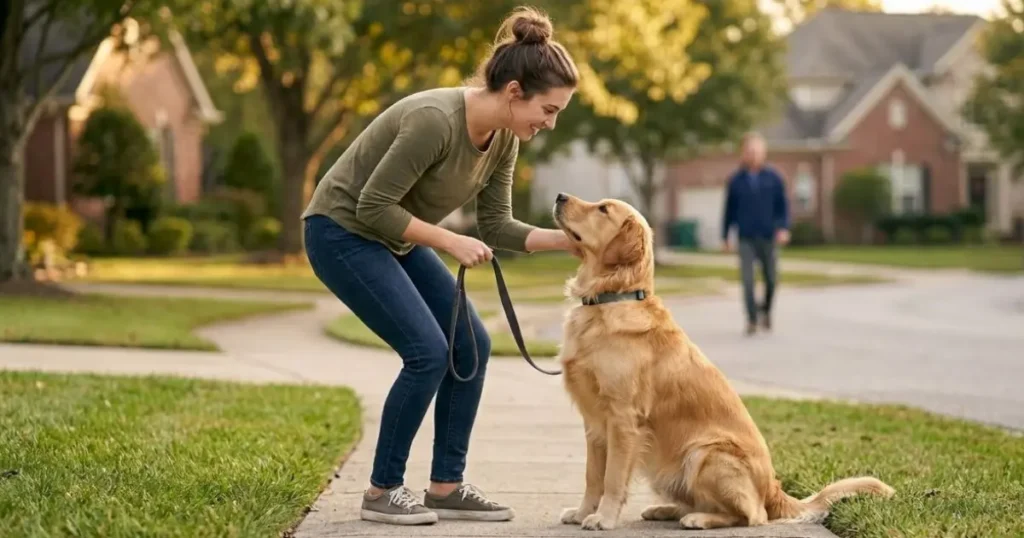
Every single walk was embarrassing.
The moment my dog spotted a stranger — from a hundred feet away, sometimes more — the barking would start. Loud, relentless, completely out of proportion to the situation. Other people would cross the street to avoid us. I started timing our walks to avoid peak hours.
I dreaded every single outing while trying to figure out how to stop a dog from barking at strangers.
The worst part was not knowing why it was happening.
He was friendly at the dog park. He loved our neighbors. But the moment we were on leash and a stranger appeared, total meltdown.
It took a trainer explaining one thing to change everything: my dog wasn’t being aggressive. He was scared.
The leash made him feel trapped, the stranger felt like a threat, and barking was the only tool he had to make the scary thing go away.
If you’re searching for how to stop a dog from barking at stranger — this guide gives you the complete picture why it happens, what the barking is actually communicating, and the exact step-by-step method to replace it with calm, confident behavior.
It’s fixable. And it starts today.
Gradually reduce the distance over weeks. Most dogs show clear improvement within 2 to 4 weeks of consistent daily sessions using desensitization and counter-conditioning.
Why Dogs Bark at Strangers — The 4 Real Causes
Before you fix the barking, you need to identify which type you are dealing with. The training approach for fear-based barking looks completely different from that for excitement-based barking — yet most owners treat both the same way, which is why they stay stuck.
Dogs bark at strangers primarily because of fear or anxiety — the stranger triggers a threat response, and barking is the dog’s attempt to make the threat go away or increase distance.
The 4 Types of Stranger Barking — Quick Reference
Fear and Anxiety — The Most Common Cause
This was my dog’s problem — and it is the most common reason dogs bark at strangers on leash.
When a dog is on a leash, they cannot flee. Their natural fight-or-flight response is blocked. When they feel threatened by an approaching stranger and cannot run away, many dogs escalate to barking — because in their experience, barking often works. The stranger passes. The threat disappears.
The dog’s brain records: barking made the scary thing go away. This is called a self-reinforcing behavior — and it is why dogs that bark at strangers often get worse over time without intervention.
Signs your dog’s barking is fear-based:
- Body is crouched or leaning away from the stranger
- Tail is low or tucked during the bark
- Dog is trying to increase distance, not decrease it
- Barking is paired with backing away or hiding behind you
- Calms quickly once the stranger passes and the distance increases
Territorial Behavior
Some dogs bark at strangers approaching what they perceive as their territory — the house, the yard, the car. This is different from fear-based barking. The dog is confident, not scared.
Signs of territorial barking:
- Body language is forward and confident, not crouched
- Barking starts when a stranger enters the perceived territory
- Stops when the stranger leaves the area completely
- Dog is not trying to flee — they are issuing a warning
Leash Frustration — Barrier Frustration Barking
Some dogs bark at strangers not from fear, but from frustration — they desperately want to greet the person, and the leash is preventing them. This is called barrier frustration or leash frustration.
Signs of frustration barking:
- Tail is wagging while barking
- Dog is pulling toward the stranger, not away
- Calms down immediately when allowed to greet
- Friendly and relaxed off-leash with all strangers
Lack of Socialization
Dogs not adequately socialized to different people before 16 weeks often bark at unfamiliar types of
people. This is not aggression — it is unfamiliarity.
Common triggers for under-socialized dogs:
- People wearing hats, hoods, or sunglasses
- People in uniforms — delivery drivers, postal workers
- Men with beards or very different builds
- Elderly people with walking aids or wheelchairs
- Children running or making sudden movements
According to the ASPCA, most leash reactivity toward strangers stems from fear or under-socialization rather than aggression, and is highly responsive to desensitization and counter-conditioning.
Building broad social exposure early prevents most stranger reactivity — read our complete puppy socialization checklist by age.
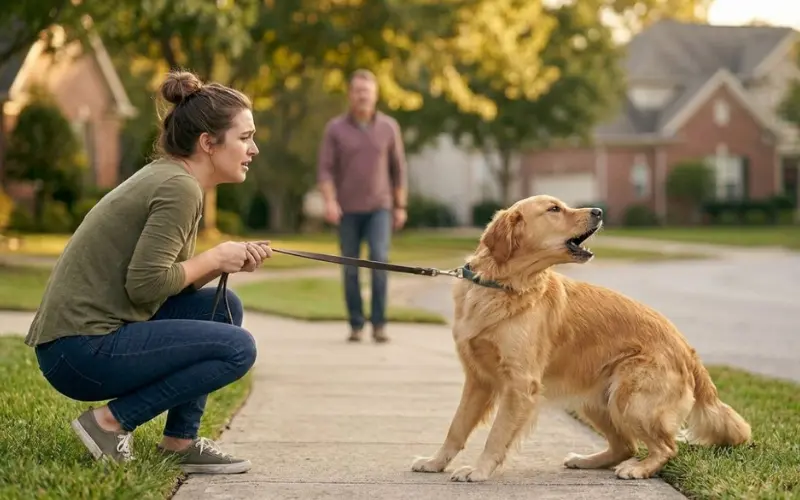
How to Stop a Dog from Barking at Strangers — Step by Step
This method is based on two behavioral science principles: desensitization and counter-conditioning.
Desensitization means exposing your dog to the trigger — strangers — at a level they can handle without reacting. Counter-conditioning means changing the emotional response to strangers from negative to
positive through repeated pairing with high-value rewards.
Desensitization and counter-conditioning are the most evidence-based methods for stopping fear- based barking — it changes the dog’s emotional response to the trigger, not just the surface behavior.
Step 1 — Find Your Dog’s Threshold Distance
The threshold is the distance at which your dog can see a stranger and remain calm. Not relaxed — just not barking or lunging. This is your starting point.
How to find your dog’s threshold:
- Take your dog to a location where strangers pass at a
predictable distance — a park path or sidewalk - Walk at varying distances from the foot traffic
- Watch for the exact moment your dog stiffens, fixates,
or begins to vocalize - The distance just before that reaction point is your
starting threshold
Typical thresholds by reactivity level:
All training begins at your dog’s specific threshold — or slightly beyond it. Never closer to start.
Step 2 — Pair Every Stranger With High-Value Treats
This is the counter-conditioning step — and the most important thing you will do in this entire process.
The rule is simple:
Stranger appears → treats start immediately
Stranger out of sight → treats stop completely
Every single time. Without exception. You are teaching your dog’s brain a new association: strangers predict amazing things. Over hundreds of repetitions, the sight of a stranger begins to trigger anticipation rather than anxiety.
Best treats for this training:
Each piece should be about the size of a pea. You will give many repetitions — you do not want your dog full before the session ends.
Stewart 100% Beef Liver Dog Treats — 2 oz tub, about 45 pieces, freeze-dried raw, single-ingredient beef liver, grain-free and gluten-free — works well here because the article specifically recommends freeze-dried meat as a high-value, no-mess reward for stranger counter-conditioning.
Not for : Not ideal for dogs who need very soft treats only, or dogs with beef sensitivity.
Step 3 — Reward the Check-In Every Single Time
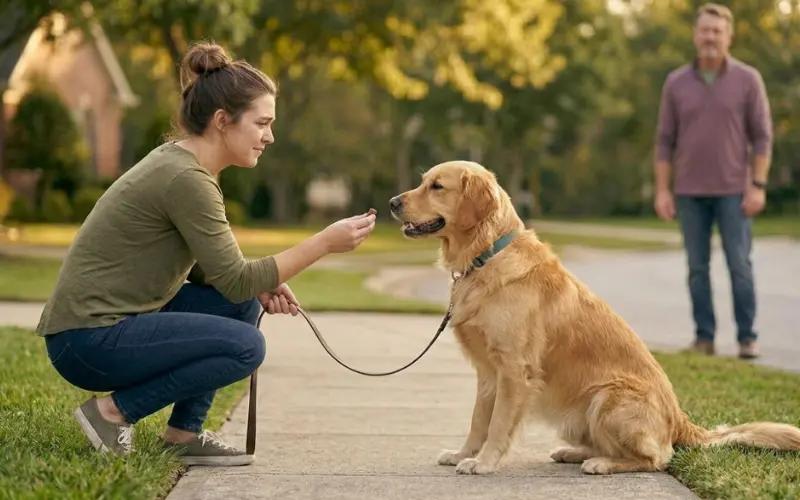
A check-in is when your dog looks at a stranger and then voluntarily looks back at you. This is the exact behavior you want to build permanently.
The moment your dog’s eyes come back to your face after noticing a stranger:
- Say “yes” or click your clicker
- Give the highest value treat of the session
- Make it the best thing that has happened all day
You are rewarding your dog for choosing to focus on you instead of fixating on the stranger. Over time this becomes automatic — stranger appears, dog looks at stranger, dog checks in with you.
HoAoOo Dog Training Clicker — 2-pack, black and blue, with spring wrist strap and keyring — lets owners press once to mark the exact calm check-in, then reward right away for faster learning.
Not For : Not ideal if you already use a consistent marker word like “yes” with perfect timing and do not want another tool in your hand.
That is what a trained dog looks like around strangers. Not ignoring them. Noticing them, then choosing you.
Step 4 — Slowly Decrease the Distance Over Weeks
Once your dog is consistently calm and checking in at the current distance across 3 to 5 sessions — only then — decrease by 5 to 10 feet.
Weekly distance progression example:
Never rush this progression. One overwhelming session at a distance that was too close can undo multiple weeks of careful work. Let your dog’s behavior guide the pace — not the calendar.
Step 5 — Practice Real-World Walk-Bys
Once your dog is calm at 10 to 15 feet, begin practicing actual walk-by scenarios.
Walk-by technique:
- Approach from an angle — never directly head-on
toward a stranger. Head-on approaches are the most
threatening to reactive dogs. - Keep moving — do not stop directly next to a stranger.
Movement maintains forward focus. - Feed treats continuously while passing — hand over
fist if needed. - After passing, give the biggest reward of the session
and genuine enthusiastic praise.
Having a known person at a known distance lets you set up perfect repetitions every time. Three sessions with a controlled practice stranger move faster than three weeks of reactive real walks.

Training for Frustration Barking — Different Approach
If your dog’s barking at strangers is frustration-based rather than fear-based — tail wagging, pulling toward the stranger, wanting to greet — the training approach is different.
Teach a Default Sit When Strangers Appear
The goal is a dog that sits automatically when a stranger approaches instead of lunging and barking with excitement.
How to build this step by step:
Never Allow Greetings When Dog Is Barking or Lunging
This is the most important rule for frustration barkers:
If the dog is barking → greeting never happens
If the dog is lunging → greeting never happens
If the dog is calm and sitting → greeting can be considered
Allowing a greeting after barking teaches the dog that barking gets them closer to the exciting thing. This directly reinforces the behavior you are trying to stop.
What to Do When Your Dog Barks During Training
Even with the best preparation, your dog will bark during the training process. That is expected and completely normal. What matters is how you respond.
Do NOT Punish the Bark
Punishing a fearful dog for barking does not remove the fear — it adds a new thing to be afraid of: you. A dog punished for barking near strangers often becomes more anxious over time, not less.
According to the American Veterinary Medical Association, punishment-based interventions for fear- based reactive behaviors can increase anxiety and aggression in dogs and are not recommended by
veterinary behavioral science.
The Right Response When Barking Happens
Managing the Environment During Training
While training is in progress — which takes weeks to months — management prevents unnecessary rehearsals of the barking behavior.
Every time your dog barks at a stranger and that stranger passes, the barking gets reinforced. Prevent as many of these rehearsals as possible.
Management tools during training:
- Avoid peak foot traffic times for daily walks
- Choose quieter routes where distance is controllable
- Use a front-clip harness for better leash management
- Cross the street proactively when threshold is close
- Turn and walk the other direction when needed
PetSafe Easy Walk No-Pull Harness — front leash attachment, patented martingale loop, lightweight design, and chest-resting fit — helps guide a pulling or lunging dog without pressure on the neck during stranger-barking walks.
Not For : Not ideal if the dog is an escape artist, between sizes, or already walks calmly on a regular flat collar or standard harness.
Management is not training — it is protecting your training investment while the new behavior develops.
Common Mistakes That Make Barking Worse
Mistake Reference Table
Working Too Close Too Fast
The most common training mistake — getting too close to strangers before the dog is ready. Every barking episode is a step backwards because it rehearses the reactive behavior and reinforces the emotional response.
Always stay at a distance where your dog can see the stranger but remain under threshold. Progress distance only when behavior is consistently calm.
Tight Leash When Approaching Strangers
A tight leash communicates tension to your dog. When you tighten your grip in anticipation of a reaction — your dog feels that anxiety through the leash and often escalates in response.
Keep the leash loose whenever possible. Your energy directly affects your dog’s energy in these moments more than almost anything else you do.
Expecting Too Much Too Soon
Realistic progress expectations for most dogs:
Desensitization to strangers is a months-long process for dogs that have been reacting for a significant time. Consistency is the only variable that accelerates it.
Track it for 30 days. Most owners are genuinely shocked to see their dog’s calm threshold improve from 60 feet to 25 feet — progress that is completely invisible in the moment because it feels so slow.
The data keeps you going when your instinct is to give up.
When to Get Professional Help
Not all barking at strangers is simply a training issue. Some situations require professional guidance from the very beginning.
Signs You Need a Certified Professional Trainer
Seek professional help immediately if:
- Your dog has bitten or attempted to bite a stranger
- The barking is escalating despite 2 months of consistent training
- Your dog cannot take treats at any distance near a stranger —
indicating severe anxiety beyond basic desensitization - The reactivity is getting worse, not better
Look for trainers certified through:
- CPDT-KA — Certified Professional Dog Trainer,
Knowledge Assessed - IAABC — International Association of Animal
Behavior Consultants
Only use trainers who use force-free, reward-based methods.
Signs You Should Also Consult Your Veterinarian
Sometimes barking at strangers has a medical component.
See your vet if:
- The behavior started suddenly with no obvious trigger
- Your dog seems anxious in general — not just with strangers
- Medication support alongside training may be appropriate
According to the American Kennel Club, working with a certified professional trainer alongside a veterinarian produces the best outcomes for dogs with severe leash reactivity — combining behavioral training with any necessary medical or anxiety support.
Leash reactivity that has escalated to aggression requires professional in-person assessment and a customized behavior modification plan. Do not delay seeking help.
If your dog shows aggression, severe anxiety, or has bitten anyone, please consult a certified professional trainer or your veterinarian immediately.
Frequently Asked Questions (FAQ)
Why does my dog bark at strangers on walks but not at home?
The leash changes everything.
When your dog is on leash, they cannot flee from something that feels threatening — and this inability to escape escalates barking as a defensive response.
At home, your dog has space, familiarity, and the option to move away from anything unsettling.
On leash in a new environment, a stranger approaching triggers the threat response in a way it simply does not at home.
This is called leash reactivity and is one of the most common behavioral issues seen in dogs across the United States.
How long does it take to stop a dog from barking at strangers?
Most dogs show meaningful improvement within 4 to 8 weeks of consistent daily desensitization training.
Full reliability around strangers in most situations typically takes 3 to 6 months for a dog that has been reacting for a significant period.
Dogs that start training early in the behavior’s development often progress faster.
The single most important factor is consistency — daily training produces dramatically better results than sporadic weekly sessions.
Should I let my dog meet the stranger to show them they are friendly?
Generally, no — especially for fear-based barkers.
Forcing a fearful dog to greet the thing they are afraid of before they are ready is called flooding and can make reactivity significantly worse.
It increases anxiety rather than reducing it.
Let your dog set the pace entirely.
Once calm behavior around strangers at a distance is established over weeks, controlled greetings can be introduced gradually and only on the dog’s own terms.
What is the best command to stop barking at strangers?
There is no single stop-barking command that works reliably for fear-based reactivity — because the problem is emotional, not behavioral.
Teaching “quiet” only suppresses the symptom without addressing the underlying anxiety.
The desensitization and counter-conditioning approach in this guide changes the emotional response to strangers, which is what produces lasting change.
Once that foundation is built, a watch or check-in cue gives you a reliable tool to redirect attention before barking starts.
Can I use a shock collar or citronella collar to stop the barking?
No — these tools are not recommended for fear-based barking and can significantly worsen the underlying anxiety.
Punishment during a fear-based bark does not remove the fear — it pairs the stranger’s appearance with pain or discomfort on top of the existing anxiety.
This often increases aggression rather than reducing reactivity.
The ASPCA and AVMA both advise against aversive tools for fear-based behavioral issues.
My dog only barks at certain types of people — why?
Dogs not adequately socialized to diverse people during the critical window between 3 and 16 weeks often bark at people who look different from those they grew up around.
This is unfamiliarity triggering uncertainty rather than aggression.
The same desensitization and counter-conditioning approach works for specific people types — focus the training sessions on controlled exposure to that specific trigger type with high-value rewards every time that type of person appears.
My dog barks at strangers through the window at home — is that related?
Yes — window barking is the same self-reinforcing behavior.
A stranger appears at the window, the dog barks, the stranger moves on, and the dog learns barking works.
Managing window access while training is in progress is important.
Block the dog’s view of high-traffic areas or use frosted window film to reduce visual triggers while you work on leash reactivity.
Every unrestricted window bark session reinforces the pattern you are trying to change.
How do I stop my dog barking at strangers at the front door?
Door barking is typically territorial rather than fear-based.
Teach a place command — “go to your mat” — and practice sending your dog to their spot when the doorbell rings, rewarding heavily for going and staying there.
This creates an incompatible behavior to perform instead of barking.
Practice the doorbell routine daily with a family member ringing from outside until the response is fully reliable, then test it with real visitors.
The Walk You Both Deserve — Final Thoughts
I remember the first walk where my dog saw a stranger approaching from 30 feet away, looked at them, then looked back at me — and wagged his tail.
No bark. No lunge. Just a check-in and a tail wag.
I gave him the best treat I had. We had been working on this for 11 weeks. Standing on that sidewalk, all of it was worth it.
Now that you know exactly how to stop a dog from barking at strangers — here are your three key takeaways:
- Find the threshold and stay below it — every Successful training repetition happens at the The distance at which your dog can see the stranger and Choose calm. Too close means a bark. A bark means step backwards.
- Stranger equals treats — always, every time, without exception. The emotional association
between strangers and good things is what changes the behavior permanently. - Progress is slow, and that is okay — most owners give up at week 3 when things feel hard. The dogs
that transform are the ones whose owners kept going at week 4, week 6, and week 8. Consistency is the only thing that gets you there.
For the complete foundation of everything this training builds on — read our complete positive reinforcement dog training for beginners guide.
And if your dog is also struggling with leash pulling alongside the barking, read our guide on leash training a puppy that pulls on walks for the complete loose leash walking method.



Pingback: Ghost Costume for a Dog: 7 Best Picks + Easy DIY Guide (2026)