

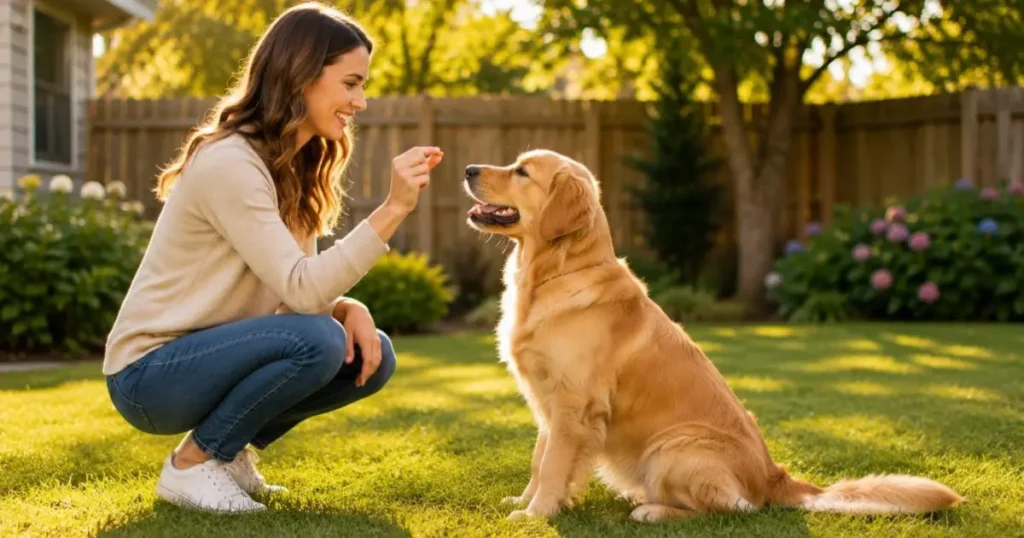
My dog ignored me completely for the first three weeks.
Not in a dramatic way. In that quiet, devastating way where you call his name, and he looks at everything in the yard except you. You say “sit”, and he just stares at a bird. You try a treat, and he sniffs it, then walks away.
I had followed every piece of advice I had been given.
Firm voice. Repeat the command. Show him who’s boss.
None of it worked. And I felt like a failure.
Then a trainer friend told me I had it all backwards. Dogs don’t respond to dominance or repetition. They respond to clarity, consistency, and reward. The moment I switched to positive reinforcement dog training for beginners, everything changed. Within two weeks, my dog was sitting, staying, and coming when called — reliably, happily, and with his tail wagging the whole time.
This guide gives you the complete foundation. The science behind why positive reinforcement works, the five commands every dog needs first, the daily training routine that builds real results, and every mistake to avoid so you don’t spend weeks going backwards as I did.
Let’s get started.
Start with five commands: sit, stay, come, down, and leave it. Train for 5 to 10 minutes twice a day using high-value treats.
Most dogs show clear improvement within 1 to 2 weeks of consistent daily sessions.
What Is Positive Reinforcement Dog Training — and Why It Works
Before we get into the how, it’s worth understanding the why — because once you understand the science behind this method, you’ll never want to train any other way.
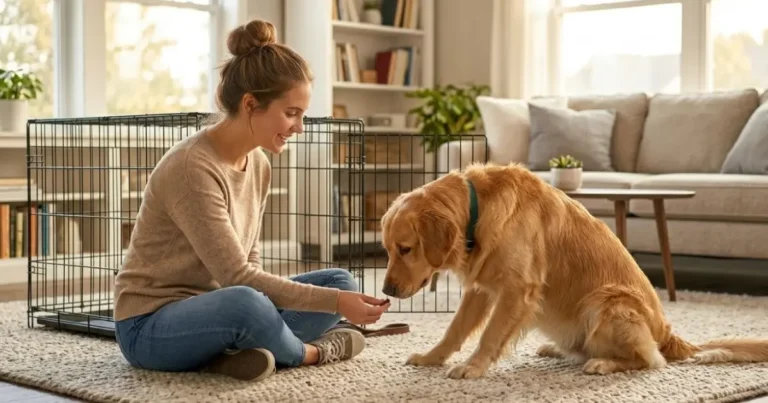
Positive reinforcement means adding something your dog values — usually a treat, praise, or play — immediately after they perform a desired behavior.
The result is simple: the dog learns that the behavior leads to good things, so they repeat it.
That’s it. That’s the whole science in one sentence.
Positive reinforcement is the most scientifically supported dog training method — dogs trained with rewards learn faster, retain commands longer, and show fewer fear and anxiety behaviors than dogs trained with punishment-based methods.
The Science Behind Why It Works
This isn’t just a feel-good theory. The foundation of positive reinforcement dog training is operant conditioning — the same learning principle documented by behavioral scientists for over a century.
When your dog sits and immediately receives a treat, their brain releases dopamine. The brain registers: “sitting caused a reward.” The neural pathway connecting the “sit command” to “sit behavior” becomes stronger with each repetition. Over time, the behavior becomes automatic.
Contrast this with punishment-based training: when a dog is corrected or punished, they learn to avoid the punishment — but they don’t necessarily learn what you actually wanted. They also learn that training sessions predict discomfort, which creates stress, avoidance, and eventually behavioral problems.
According to the American Kennel Club, dogs trained with positive reinforcement not only learn commands faster but are also more likely to generalize those commands to new environments and situations.
What “Positive Reinforcement” Does NOT Mean
One common misconception — and I had this one too — is that positive reinforcement means letting your dog do whatever they want and just hoping for the best.
It doesn’t. It means:
Clear communication about what you want, immediate reward when they get it right, consistent responses so your dog can predict outcomes Ignoring or redirecting unwanted behavior rather than punishing it
It’s not soft. It’s not permissive. It’s precise.
Why Timing Is Everything
The reward must happen within 1 to 2 seconds of the desired behavior. This is non-negotiable.
Your dog’s brain cannot connect a treat given 10 seconds after they sat to the act of sitting. They’ll connect it to whatever they were doing when the treat arrived — which might be sniffing the ground or looking away. This is why so many owners feel like treats “don’t work” — the timing is off, not the method.
This is also why many professional trainers use a clicker or a marker word like “yes” — it bridges the gap between the behavior and the reward with a precise, consistent signal. Our guide to training aids covers clickers and other tools worth having on hand.
HoAoOo Dog Training Clicker — 2-pack, black and blue, with spring wrist straps and keyrings — gives beginners a simple marker tool to press the moment their dog gets it right, then reward immediately for faster learning.
Not For : Not ideal if you already use a consistent marker word like “yes” perfectly every time — the article says a clicker helps precision, but it is not required.
Before You Train — What You Need to Set Up for Success
Training doesn’t start with commands. It starts with setting up the right conditions for learning. These are the things I wish I had done before that first disastrous week.
Choose the Right Treats
Not all treats are created equal for training purposes.
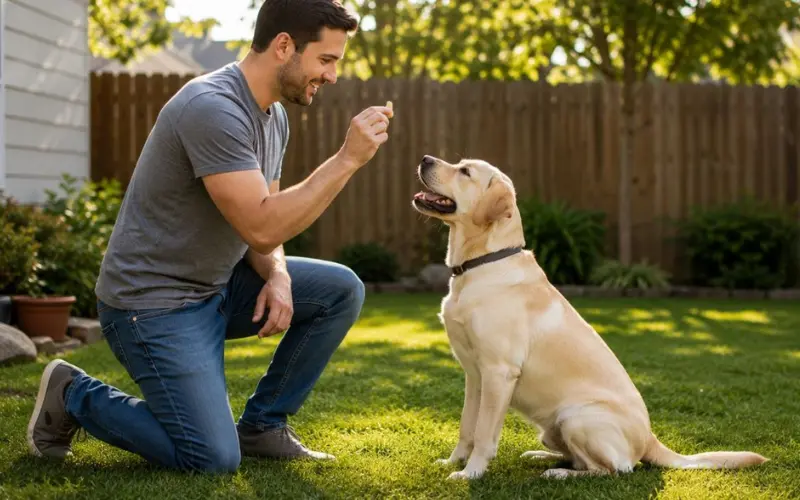
You need high-value treats — small, soft, smelly, and something your dog genuinely goes wild for.
For everyday training: small soft treats, cheese cubes, cooked chicken pieces about pea-sized
For challenging environments like parks: use their absolute favorites — the ones they never get otherwise Avoid dry biscuits as primary training treats — they take too long to chew and break the training momentum.
Size matters: each training treat should be about the size of a pea. You’ll be giving many repetitions — you don’t want your dog full before the session ends.
Zuke’s Mini Naturals Chicken Training Treats — soft bite-sized pieces, real chicken flavor, only 2 calories per treat, with no corn, wheat, or soy — fit the article’s advice for small, soft, high-value rewards that keep training momentum moving.
Not For: Not ideal for dogs with chicken sensitivity or owners who prefer single-ingredient treats like plain cooked chicken.
Find Your Dog’s Motivation
Not every dog is equally food motivated. Some dogs work better for:
Tug play as a reward — Border Collies, working breeds
Verbal praise + petting — some adult dogs
Ball play — Retrievers, high-drive sporting breeds
Most dogs, especially puppies, are highly food-motivated. If your dog seems disinterested in treats, try training before meals rather than after.
Choose the Right Environment — Start Easy
This is the mistake almost every new trainer makes. They take their dog to the park, surrounded by other dogs and people, and then wonder why the dog can’t focus.
Distractions compete with your dog’s attention. A dog cannot learn a new behavior in a high-distraction environment — they need to be under their distraction threshold to learn.
The rule: teach every new behavior at home first. Once they can perform it reliably at home, practice in the yard. Then on a quiet street. Then, in a busier area. This concept is called generalization — and it’s how real, reliable training is built.
Training Session Length and Frequency
Dog training sessions should be 5 to 10 minutes long, twice a day. Longer sessions cause mental fatigue and reduce learning efficiency in most dogs.
This surprises most new owners. More is not better. Short, focused sessions with high engagement outperform long, unfocused sessions every single time.
Session length by age:
The 5 Essential Commands Every Dog Needs First
These are the five commands that form the complete foundation of positive reinforcement dog training for beginners. Every other skill builds on these. Learn them in order — each one supports the next.
Command 1 — Sit
Sit is always first — not because it’s the most important, but because it’s the easiest for most dogs to learn, it builds your dog’s confidence quickly, and it forms the foundation for every other position command.
How to teach it:
- Hold a treat right at your dog’s nose
- Slowly move the treat back over their head
- As the nose goes up, the bottom goes down naturally
- The moment their bottom hits the ground — say “sit” and reward immediately
- Repeat 8 to 10 times per session
- Within 3 to 5 sessions, most dogs understand the word.
- Within 1 to 2 weeks, most dogs sit reliably on the first cue.
Command 2 — Down
Down is the most useful command you’ll ever teach — it puts your dog in a calm, relaxed position and is the basis for place training, greeting strangers politely, and long-duration settle.
How to teach it:
- Ask your dog to sit first.
- Hold a treat at their nose and move it straight down toward the floor between their front paws.
- When elbows hit the floor — say “down” and reward.
- Never push the dog down physically — this builds resistance, not understanding.
- This command takes slightly longer than sit for most dogs — plan for 2 to 3 weeks for solid reliability.
Command 3 — Stay
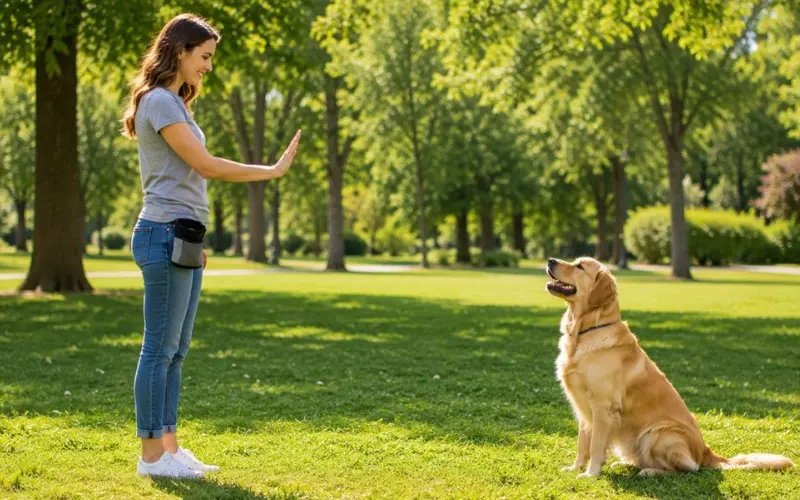
Stay teaches your dog impulse control — one of the most important skills in real life. A dog with a solid stay is safe near roads, calm at the front door, and manageable everywhere.
How to teach it:
- Ask your dog to sit
- Say “stay” — hold your palm toward them like a stop sign
- Take one step back
- Return to them, reward
- Gradually increase distance and duration over weeks
- Never recall from a stay — always return to reward the position
Start with 3 seconds. Build to 30 seconds. Then for 1 minute. Then add distance. Then add distractions. Never rush the progression.
Command 4 — Come (Recall)
Recall is the most important safety command you will ever teach your dog. A reliable come when called can save your dog’s life.
How to teach it:
- Start on a long leash in the yard.
- Crouch down, open your arms, and say your dog’s name, followed by “come” in a happy, excited voice.
- When they reach you, an enormous reward, big praise, and a real celebration
- Never call your dog to come for anything they don’t like — a bath, a nail trim, or the end of playtime.
- If they don’t come, never repeat the command — go get them instead.
Hi Kiss Dog/Puppy Obedience Recall Training Agility Lead — available in 15, 20, 30, 50, and 100-foot lengths — gives your dog room to wander while you safely practice “come” during recall training in the yard, backyard, beach, or open spaces.
Not For : Not ideal for crowded sidewalks or tight indoor spaces where a standard 4–6 foot leash gives better control.
According to Dr. Ian Dunbar, a pioneer of positive puppy training, recall is the command that requires the most ongoing reinforcement throughout the dog’s life. Never stop rewarding a good recall — make it the best thing that ever happens to your dog.
Command 5 — Leave It
Leave it teaches your dog to disengage from something they want — food on the floor, a squirrel, another dog’s toy. It’s one of the highest-value safety commands a dog can have.
How to teach it:
- Place a treat in your closed fist and hold it out
- When your dog sniffs and paws at your fist — wait
- The moment they pull away from your fist, say “yes” and reward with a different treat from your other hand.
- Never reward them with the item you asked them to leave.
Build to: treat on the floor, food dropped accidentally, objects on walks. Take weeks at each level.
5 Essential Commands — Quick Reference Table
Building Your Daily Training Routine
One of the most common reasons dog training fails is the lack of a consistent routine. Not because owners don’t care — but because life gets in the way and sessions become sporadic.
Here’s how to build a routine that actually sticks.
The 5-10-5 Rule
I call it the 5-10-5 rule because it’s what finally made consistency easy for me.
Morning session: 5 minutes — work on one command only
Evening session: 10 minutes — practice known commands plus introduce one new concept
Wind-down session: 5 minutes — easy familiar commands
before bed to end the day on a success
Total 20 minutes per day. Less than one episode of any TV show. And the results compound dramatically.
How to Structure Each Session
Start with something your dog already knows — a command they get right immediately. This warms them up, builds confidence, and gets rewards flowing early.
Middle: work on the new or challenging thing. This is where the real learning happens.
End with something easy again. Always, always end on a success. A dog that ends a session having just succeeded is more engaged at the start of the next one.
When Your Dog Is Not in the Mood
Some days your dog will be distracted, tired, or just not into it. Pushing through a disengaged session is counterproductive and occasionally damaging.
Signs your dog is done for the session:
- Looking away consistently
- Sniffing the ground instead of engaging
- Slow to respond to known commands
- Taking treats but not maintaining eye contact
When you see these signs, end the session with a known, easy command, reward it well, and stop. A short, successful session beats a long, frustrated one every time.
Tracking Progress — What to Expect Week by Week
Week 1: Your dog is learning the rules of the game — that behavior causes reward. Don’t expect clean commands. Expect attention and some approximations.
Week 2: Basic commands start to click. Sit down and become recognizable. Stay is shaky but beginning to form.
Week 3 to 4: Commands become more reliable at home. Come is developing. Leave it usable in low-distraction environments.
Month 2: You start working on generalization — taking commands into new environments and building real-world reliability.
Month 3 and beyond: Maintenance, refinement, and adding new skills to the foundation.
Two lines per day. This keeps you intentional, shows you genuine progress over weeks, and gives you real information to share with a trainer if you ever want one.
Most owners who track progress are shocked at how much their dog has improved in 30 days.
Common Dog Training Mistakes That Slow Everything Down
I made every mistake on this list before I figured out what actually works. Here’s what not to do — and what to replace each mistake with.
Repeating Commands Over and Over
“Sit. Sit. Sit sit sit. Siiiit.”
Every new dog owner does this. It feels like eventually the dog will hear the right version. What’s actually happening is your dog is learning that “sit” means nothing — the real cue is when your voice gets slightly higher and more frustrated after seven repetitions.
The fix: say the command once. If your dog doesn’t respond, help them into the position by luring. Reward the physical performance. Then try the verbal cue again, the next repetition.
Training in Too Many Locations Too Early
Your dog can sit perfectly in your kitchen. You take them to the park, ask for a seat, and they look at you like you spoke another language.
This isn’t stubbornness. Dogs don’t generalize automatically — they need to be taught each command in each new context. That’s normal canine cognition, not disobedience.
The fix: every new location is essentially a new training level. Start easier and rebuild from there.
Using the Dog’s Name as a Correction
“Max, no! Max, stop that! Max!”
When the dog’s name is constantly paired with correction and frustration, the dog starts to associate their name with something negative. They learn to ignore it or become anxious when they hear it.
The fix: use your dog’s name only to get their attention before a command, and only in a positive tone. Their name should always predict good things.
Training When You’re Frustrated
Dogs read emotional state. When you’re frustrated, your body language, tone, and timing all deteriorate. Your dog picks this up immediately and often responds by shutting down or becoming avoidant.
The fix: if you’re frustrated, end the session. Go for a walk together. Come back to training tomorrow. Training that frustrates costs you progress—it doesn’t build it.
Expecting Too Much Too Soon
Your dog learned to sit in the kitchen. You haven’t taken it outside yet. You haven’t added distractions. You haven’t trained it at the front door. The command is not “trained” — it’s just beginning.
Realistic training timelines:
Patience built on consistency is the only thing that gets you there.

Positive Reinforcement vs Other Training Methods
If you’ve been researching dog training, you’ve probably encountered other methods — dominance training, correction-based training, e-collar
training. It’s worth understanding how they compare and what the evidence actually says.
Dominance-Based Training — What the Science Says
The idea that dogs need to view humans as “pack leaders” and that training requires establishing dominance was largely popular in the 1970s and 1980s. More recent behavioral science has moved significantly away from this framework.
According to the American Veterinary Medical Association, dominance-based training methods — including alpha rolls, collar corrections, and physical intimidation — can increase aggression, fear, and anxiety in dogs and are not recommended by the veterinary behavioral science community.
Correction-Based Training — When It Becomes a Problem
Correction-based training uses a negative consequence to reduce unwanted behavior — a leash pop, a stern verbal correction, or a startling sound. Used infrequently and correctly, some corrections can work.
But when correction becomes the primary training tool, problems typically follow:
Dogs trained primarily through correction learn what NOT to do — but not what TO do instead. The result is often a dog that’s shut down, fearful, or inhibited rather than genuinely trained.
The Balanced Approach — What Actually Works Long Term
The most effective trainers primarily use positive reinforcement, with a clear, consistent marker system. Corrections, if used at all, are reserved for safety situations — not as primary training tools.
Dogs trained primarily with positive reinforcement show fewer fear responses, generalize commands more readily, and maintain learned behaviors longer than dogs trained primarily with punishment.
The goal is a dog that wants to work with you — not one that works with you to avoid something unpleasant. That distinction changes everything about your daily
life with your dog.
Building on the Foundation — Where to Go After the Basics
Once your dog has a reliable sit, down, stay, come, and leave it — the whole world of training opens up. Here’s the natural progression after the basics.
Loose Leash Walking
A dog that walks calmly beside you without pulling is one of the most practically useful training goals for any owner. It makes daily life dramatically more enjoyable and keeps both you and your dog safe.
For the complete step-by-step leash training method, read our guide on leash training a puppy that pulls on walks — it covers the exact technique for every type of puller.
Crate Training
Crate training gives your dog a safe, calm space they choose voluntarily — and makes travel, vet visits, and home management dramatically easier. A dog that loves their crate is a genuinely happier and more settled dog.
Advanced Commands to Add Next
Once your foundation commands are solid, these are the natural next additions:
Place or “go to your spot” — teaches the dog to go to a designated mat or area and stay there
Heel — formal walking position beside you
Leave it in motion — disengaging from triggers on leash
Wait — impulse control at doorways and before meals
Off — getting off furniture or jumping on people
Build these one at a time. Never add a new command until the previous one is reliable in at least two different environments.
Finding Professional Help When You Need It
There is absolutely no shame in working with a professional trainer. In fact, even experienced dog owners benefit from an outside perspective.
Look for trainers who:
- Use force-free or reward-based methods exclusively
- Have credentials from CPDT (Certified Professional
- Dog Trainer) or IAABC (International Association of Animal Behavior Consultants)
Can explain why they do what they do. Welcome your questions.
Avoid trainers who:
- Guarantee quick fixes
- Use physical corrections as a primary method
- Cannot explain the science behind their approach
- Use fear, pain, or intimidation as tools
For everything you need to know about the training techniques covered in this guide, read our complete collection of dog training guides.
Most owners are genuinely surprised by what they see. A week of video review can replace months of slow progress.
These behaviors require professional assessment. Do not attempt to train through fear or aggression-based responses without qualified guidance.
Every dog is different — if your dog has behavioral issues or shows signs of fear or aggression, please consult a certified professional trainer or your veterinarian.
Frequently Asked Questions About (FAQ)
How long does it take to train a dog with positive reinforcement?
Basic commands like sit and down show real improvement within 1 to 2 weeks of consistent daily training.u003cbru003eFull reliability in any environment typically takes 3 to 6 months of regular practice.u003cbru003eThe honest answer is that training never truly stops — it’s an ongoing relationship.u003cbru003eBut the good news is that the heavy lifting of teaching the foundation happens in the first 60 days, and most owners notice significant changes in their dog’s behavior within the first 2 to 3 weeks.
At what age should you start training a dog?
Training can start as soon as your puppy comes home at 8 weeks old.u003cbru003ePuppies are learning every single moment — the question is just whether you’re shaping that learning intentionally or not.u003cbru003eShort 3- to 5-minute sessions at 8 weeks work perfectly.u003cbru003eFor adult dogs, there is no upper limit.u003cbru003eDogs learn throughout their lives, and an adult dog can be trained just as effectively as a puppy — sometimes faster, because their attention span is longer.
What is the best treat for dog training?
The best training treats are small, soft, smelly, and something your dog genuinely loves.u003cbru003eCommon excellent choices are small pieces of cooked chicken, soft commercial treats like Zuke’s Mini Naturals, small cheese cubes, and cooked beef.u003cbru003eEach piece should be about the size of a pea.u003cbru003eFor high-distraction environments, upgrade to your dog’s absolute favorite.u003cbru003eDry biscuits are generally ineffective as primary training rewards because they take too long to chew, disrupting the flow of training.
Why does my dog not listen during training?
The three most common reasons are: the environment is too distracting for the dog’s training level, the treats aren’t valuable enough for the difficulty of the request, or the timing of the reward is off by too many seconds.u003cbru003eCheck all three before assuming the dog is being stubborn.u003cbru003eAlso, check whether you’ve been practicing enough sessions — inconsistent training produces inconsistent results.u003cbru003eFive minutes twice a day beats one hour once a week every single time.
Is it too late to train an older dog?
No.u003cbru003eAdult dogs can learn new behaviors throughout their lives.u003cbru003eThe phrase u0022you can’t teach an old dog new tricksu0022 is simply not supported by behavioral science.u003cbru003eAdult dogs often have longer attention spans than puppies and may focus more easily in training sessions.u003cbru003eThe process takes more patience and more repetitions for some previously formed habits, but the method is the same.u003cbru003eMany rescue dogs arrive as adults with no prior training and become reliable, well-behaved companions within a few months.
Should I use a clicker for positive reinforcement training?
A clicker is a highly effective tool for positive reinforcement training because it provides an extremely precise, consistent marker signal that bridges the gap between behavior and reward.u003cbru003eMany professional trainers prefer it for exactly this reason.u003cbru003eThat said, a clicker is not required.u003cbru003eA consistent marker word like u0022yesu0022 said at the exact moment of the desired behavior works equally well.u003cbru003eThe key is precision and consistency — not the specific tool you use to mark the behavior.
How do you train a stubborn dog?
What most owners call u0022stubbornu0022 is usually a dog that hasn’t found the training valuable enough or understandable enough to engage with.u003cbru003eTry upgrading to higher-value treats, training in a lower-distraction environment, shortening sessions, and using a clearer lure to help them understand what you want.u003cbru003eTrue stubbornness is rare — unclear communication and insufficient reward are much more common causes of training resistance.u003cbru003eIf the problem persists, consult a positive reinforcement trainer for an in-person assessment.
How many commands can I teach my dog at once?
Focus on one or two commands per training week, maximum, when starting.u003cbru003eTrying to teach too many things at once divides your dog’s cognitive resources and slows learning across the board.u003cbru003eThe five foundation commands in this guide should be learned sequentially — each reaching reasonable reliability before the next begins.
After you have a solid foundation, you can maintain multiple commands simultaneously because the dog already understands the training system.
Explore In-Depth Training Guides by Topic
This guide covers the foundation. Once your dog has a solid sit, stay, come, down, and leave it — These step-by-step guides cover every next skill Your dog needs:
- How to teach a dog to sit — step by step
- How to stop a dog from barking at strangers
- Leash training a puppy that pulls on walks
- How to crate train a dog that hates the crate
- How to stop dog separation anxiety when left alone
- Dog recall training — step-by-step guide
Every Day Is a Training Day — Final Thoughts
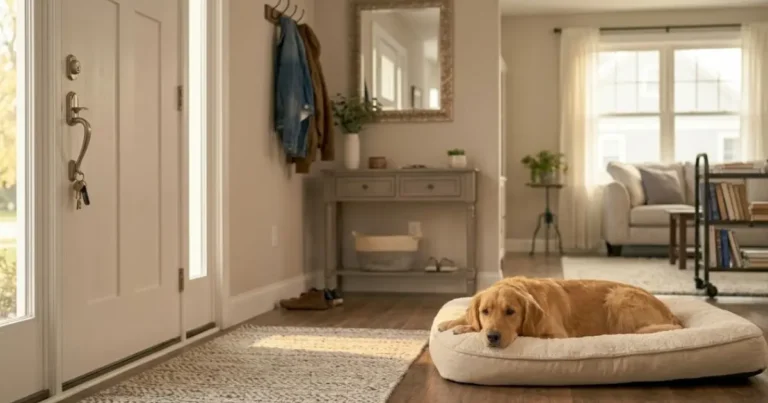
That dog who ignored me for three weeks — the one who stared at birds instead of responding to his name — sits at my feet right now as I write this. He checks in with me on walks, comes when called, and settles on his mat when I ask him to. Last week, he let a toddler hug him without flinching.
None of that came from force, repetition, or dominance. It came from clarity, consistency, and genuine reward. From understanding that he wasn’t being difficult in those first weeks — he just didn’t understand what I wanted. Once I learned how to communicate with him
Clearly, he gave me everything.
Now that you have the complete positive reinforcement dog training for beginners foundation, here are your three key takeaways:
- Timing is everything — reward within 1 to 2 seconds of the desired behavior, every single time. Get the timing right, and everything else becomes easier.
- Start easy and build gradually — every new command in every new environment is essentially a new challenge for your dog. Never assume a command is trained until it’s reliable in multiple real-world
contexts. - Consistency beats intensity — 5 minutes twice a day produces better results than one hour a week. Build the routine and protect it even on hard days.
The relationship you’re building with your dog through this process is the foundation for everything else. Training is not just about commands — it’s about communication. And the better you communicate, the better your dog becomes.
For everything your puppy needs alongside training from day one, read our complete guide on how to take care of a puppy for the first time — sleep, feeding, potty training, socialization, and more, all in one place.
And if your puppy is still struggling with biting during training sessions — our guide on how to handle Puppy biting and nipping gives you the complete system to manage it while training continues.


Pingback: SpiritDog Course Directory Compared, 9 Programs Reviewed (2026)
Pingback: Dog Training Aids, The Complete Guide for 2026
Pingback: Dog Jumping Training, How to Stop a Dog From Jumping on People (2026)
Pingback: Dog Counter Surfing Training, How to Stop It for Good (2026)
Pingback: Best Online Dog Training Courses 2026, 12 Programs Compared
Pingback: DIYK9 Reviews, Every Course Broken Down Honestly
Pingback: German Shepherd Puppy Training, Complete Timeline & Commands (2026)
Pingback: Dog Leash Reactivity Training, 7 Steps to Stop Reacting (2026)
Pingback: Ghost Costume for a Dog: 7 Best Picks + Easy DIY Guide (2026)
Pingback: 7 Best Dog Boots for Winter: Snow, Ice & Salt Picks (2026)