
Dinner lasts about twenty seconds in a German Shepherd house. The bowl hits the floor, the kibble disappears, and then those ears swivel toward you like radar. Was that really all? Next morning, out in the yard, you notice the stool is soft. Again.
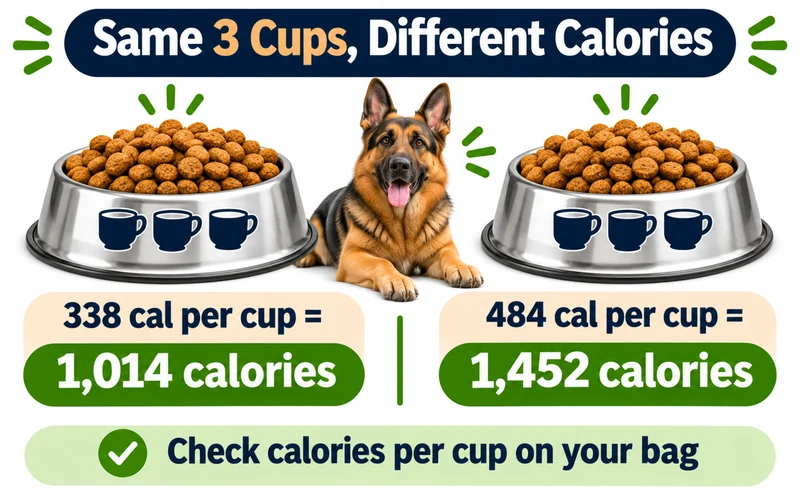
So you start hunting for the best dog food for German Shepherds, and the advice gets loud fast. The bag says 3 to 4 cups. Your breeder swears by one brand. A forum thread insists on raw. Here’s the part nobody mentions: “3 cups” can hold about 1,014 calories in one bag and about 1,452 in another. That’s a gap of more than 400 calories a day from the same scoop.
With this breed, those choices carry real weight. The American Kennel Club notes that German Shepherds can get bloat, a sudden, life-threatening emergency. Many shepherds also have touchy stomachs, and a big puppy needs slow, lean growth to give those hips a good start.
The good news is you don’t need a miracle recipe. You need a complete food that fits your dog’s age and body, fed the right way. In this guide you’ll find:
- 8 research-based picks, from big puppies to working dogs to gray-muzzled seniors
- A cups-per-day chart for German Shepherds from 50 to 90 pounds
- A bloat-smart feeding checklist, plus the puppy label line most owners miss
The best dog food for German Shepherds is a complete and balanced large-breed food matched to your dog’s age, such as Purina Pro Plan Adult Large Breed for most adults or a large-breed puppy food for growing pups.
Because shepherds often have sensitive stomachs and a higher bloat risk, check calories per cup and split the food into two or more meals a day.
Quick Picks: Best Dog Food for German Shepherds
What German Shepherds Need From Their Food
German Shepherds don’t need a secret formula. They need a complete, balanced food for their life stage, in the right amount for their body and their workload. Four traits of the breed shape what “right” looks like.
Adult male German Shepherds usually weigh 65 to 90 pounds and females 50 to 70 pounds, with a typical life span of 12 to 14 years, according to the American Kennel Club.
That puts almost every shepherd in large-breed territory.
- Size. Large-breed formulas are built for dogs this big, with a kibble size and calorie level that suit them. For puppies, size matters even more, as you’ll see in the puppy section.
- Energy that varies a lot. A couch-loving pet and a dog doing daily protection or herding work can need very different amounts of food. Calories matter more than the protein number printed in giant letters on the front of the bag.
- Touchy stomachs. Plenty of owners deal with gas and soft stool, and a gentle formula can help. But a shepherd who keeps losing weight while eating like a horse needs a vet, not a new bag. VCA Animal Hospitals notes that exocrine pancreatic insufficiency (EPI), where the pancreas doesn’t make enough digestive enzymes, is seen more often in German Shepherds.
- Bloat and hips. You can’t change your dog’s genes, but you can control how meals are served and how fast a puppy grows. We cover both below.
What food can’t do: no kibble prevents hip dysplasia or bloat on its own, and none can treat EPI. Be wary of any bag that hints otherwise.
How We Chose These Foods
This is a research-based comparison. We didn’t feed these foods to our own test dogs, and we won’t pretend we did. Every pick had to clear these bars:
- Complete and balanced for the right life stage. For puppies, we looked for foods whose makers state they meet AAFCO levels for growth of large-size dogs, meaning dogs expected to reach 70 pounds or more.
- How the food was tested. Some foods pass AAFCO feeding trials, where real dogs eat the food over time. Others are formulated to meet AAFCO nutrient levels on paper. Both are allowed, and we point out which is which where we could confirm it.
- Real nutrition expertise behind the bag. The World Small Animal Veterinary Association (WSAVA) suggests asking whether a company employs a qualified nutritionist and who formulates its diets. We stuck with makers known for that work.
- Published calories per cup, so you can portion with confidence.
- Easy to buy in the U.S., so you can stay on a food that agrees with your dog.
We left out grain-free foods on purpose. We’ll explain why near the end.
Best Dog Food for German Shepherds: Our 8 Picks
Each review covers who the food suits, why it works for a shepherd, and who should pass on it. Numbers come from the makers’ own pages, their labels or major retailer listings. Recipes change, so double-check your bag.
Best Overall: Purina Pro Plan Adult Large Breed Chicken & Rice

Purina Pro Plan Large Breed Dry Dog Food, Chicken & Rice, 34 lb Bag | High protein supports muscle conditioning and natural prebiotic fiber supports digestive health, SPECIALIZED for large dogs
- Glucosamine and EPA, an omega-3 fatty acid, for joint health and mobility
- High protein promotes muscle conditioning when combined with proper exercise
- High level of protein, combined with proper exercise, helps promote muscle conditioning
If your adult shepherd is healthy and moderately active, start here. It’s made for adult dogs of 50 pounds and up, with chicken as the first ingredient, 26% protein and 12% fat. Glucosamine and EPA, an omega-3, are added for joints. Most importantly, Purina’s label says AAFCO feeding tests back it for adult maintenance, so real dogs have eaten it, not just a spreadsheet.
It’s fairly rich at 407 calories per cup. For a lean, active shepherd that’s handy. For a laid-back one, measure every scoop.
Pros
- Feeding-trial backing for large adult dogs
- Moderate fat with joint-support extras
- Easy to find and fairly priced
Cons
- Calorie-dense, so free-pouring adds up fast
- Not the gentlest choice for a shepherd with an easily upset stomach
⚠️ NOT FOR
Puppies, which need a growth food, or shepherds with frequent soft stool, who may do better on the sensitive stomach pick below.
Alternative: For a slightly lighter feeding-trial-tested option, try Hill’s Science Diet Adult Large Breed, at 365 calories per cup.
Best Breed-Specific Adult: Royal Canin German Shepherd Adult
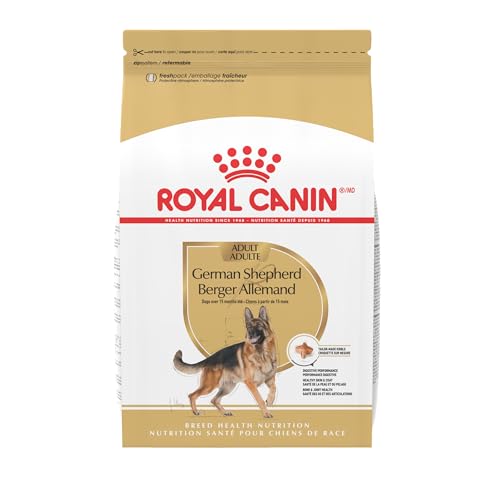
ROYAL CANIN German Shepherd Adult Dry Dog Food, 30 lb Bag | Digestive Health, Skin Health, Bone & Joint Support, For Adult German Shepherds 15+ Months, Specialized Kibble
- BREED HEALTH DOG FOOD: Royal Canin Breed Health Nutrition German Shepherd Adult Dog Food Dry Formula for purebred German Shepherds 15 months and older
- CRUNCHY KIBBLE: Specialized kibble shape and texture designed for a German Shepherds long, strong muzzle and teeth
- DIGESTIVE HEALTH DOG FOOD: Highly digestible proteins and specific fibers help maintain your dogs digestive health
This is the only adult food on our list made just for German Shepherds, from 15 months on. Royal Canin built it around digestion, with highly digestible proteins and specific fibers, and added EPA and DHA (0.22% minimum) plus glucosamine. At 338 calories per cup, it’s lighter than Pro Plan, so your dog gets a fuller-looking bowl for the same calories. Many owners of gassy shepherds swear by it.
Two honest notes. Royal Canin says it’s formulated to meet AAFCO levels for adult maintenance, which is not the same as a feeding trial. And chicken fat is the fourth ingredient. That matters only in light of one bloat study we explain later, so it’s a point to weigh, not a reason to panic.
Pros
- Made specifically for adult German Shepherds
- Fewer calories per cup than most large-breed foods
- Focus on digestion, plus omega-3s and joint nutrients
Cons
- One of the priciest foods here
- Chicken by-product meal is the first ingredient
- No feeding-trial statement
⚠️ NOT FOR
Shepherds under 15 months, or owners who want a feeding-trial-tested food.
Alternative: For feeding-trial backing at a lower price, go with Purina Pro Plan Adult Large Breed.
Best for Sensitive Stomach and Skin: Purina Pro Plan Sensitive Skin & Stomach Large Breed Salmon & Rice

Purina Pro Plan Sensitive Skin & Stomach Large Breed Dog Food, 34 lb Bag | Salmon & Rice Formula for large dogs, with prebiotic fiber, easily digestible and supports a healthy skin and coat
- High protein dog food promoting muscle conditioning when combined with proper exercise and featuring salmon is the first ingredient and fish oil sources of EPA for heart health
- Dog kibble featuring glucosamine and EPA, an omega-3 fatty acid, for joint health and mobility and 100 percent complete and balanced nutrition for large adult dogs
- Sensitive skin dog food with omega-6 fatty acids to nourish healthy skin and lustrous coat
Gas, soft stool and itchy skin are some of the most common complaints German Shepherd owners share online. This recipe swaps chicken for salmon as the main protein and pairs it with rice and prebiotic fiber. It has 26% protein and 12% fat, and Purina’s label says AAFCO feeding tests back it for adult maintenance.
If a shepherd’s stool is soft only now and then, a slow switch to a food like this is a reasonable first step. If problems keep coming back, read our sensitive stomach section before you change food again.
Pros
- Salmon-based, a change of protein for chicken-sensitive dogs
- Gentle ingredients with prebiotic fiber
- Feeding-trial backing for large adults
Cons
- We couldn’t confirm calories per cup, so check the bag before portioning
- Not a prescription diet, so it isn’t a fix for true food allergies
⚠️ NOT FOR
Dogs with ongoing diarrhea, weight loss or vomiting. Those need a vet visit first, not a new bag.
Alternative: If your vet suspects a food allergy, ask about a prescription hydrolyzed or novel-protein diet instead.
Best for Puppies: Purina Pro Plan Puppy Large Breed Chicken & Rice

Purina Pro Plan Large Breed Dry Puppy Food, Chicken & Rice, 34 lb Bag | Development puppy food with DHA for brain and vision development, calcium to build strong bones and teeth, for large dogs
- Formulated to support an appropriate growth rate for large breed puppies
- Glucosamine supports developing joints and cartilage
- Vitamin A and omega-6 fatty acids to nourish skin and coat
A shepherd puppy turns from a fuzzy little pup into a lanky teenager in what feels like weeks, so the puppy food has to be built for big dogs. This one carries the label line we look for: complete and balanced for all life stages, including the growth of large-size dogs that will weigh 70 pounds or more. It has 30% protein, 18% fat and DHA for brain and vision development.
At 419 calories per cup, it’s rich. Puppies need fuel, but fast growth isn’t the goal, so weigh or measure every meal.
Pros
- Labeled for the growth of large-size dogs
- DHA and high-quality protein for growing pups
- Easy to find, which makes it simple to stay consistent
Cons
- Calorie-dense, so overfeeding is easy
- Contains corn and poultry by-product meal, which some owners avoid
⚠️ NOT FOR
Adult shepherds who don’t need the extra calories, or puppies already on a vet-recommended diet.
Alternative: For a breed-specific option with fewer calories per cup, see Royal Canin German Shepherd Puppy, next.
Best Breed-Specific Puppy: Royal Canin German Shepherd Puppy

ROYAL CANIN German Shepherd Puppy Dry Dog Food, 30 lb Bag | Immune System Support, Digestive Health, Bone & Joint Development, For German Shepherd Puppies, Specialized Kibble
- BREED HEALTH DOG FOOD: Royal Canin Breed Health Nutrition German Shepherd Puppy Dog Food Dry Formula for purebred German Shepherds 8 weeks to 15 months old
- CRUNCHY KIBBLE: Specialized kibble shape and texture designed for a German Shepherd puppy's strong muzzle and teeth
- IMMUNE SUPPORT: Healthy dog food with antioxidants and vitamin E helps support healthy development of your puppy's immune system
Made for purebred German Shepherd puppies from 8 weeks to 15 months, this food has 28% protein, 14% fat and 331 calories per cup. Royal Canin’s U.S. page says it’s formulated to meet AAFCO levels for growth, “including growth of large size dogs (70 lb. or more as an adult).” That’s exactly the line you want for a breed whose males often pass 70 pounds.
With fewer calories per cup than Pro Plan Puppy, it’s a good match for a puppy who acts starved but shouldn’t grow too fast. Around 15 months, Royal Canin suggests moving to its adult shepherd food.
Pros
- Made specifically for German Shepherd puppies
- Large-size growth wording on the maker’s own page
- Fewer calories per cup than most large-breed puppy foods
Cons
- Pricey, especially for 15 months of a hungry puppy
- Formulated to meet AAFCO levels rather than feeding-trial tested
⚠️ NOT FOR
Adult dogs, or owners on a tight budget who’d rather feed a large-breed puppy food that’s labeled the same way.
Alternative: Purina Pro Plan Puppy Large Breed offers feeding-trial backing for less.
Best for Working and Very Active Dogs: Purina Pro Plan Sport Performance 30/20 Chicken & Rice

Purina Pro Plan Sport 30/20 High Protein Dry Dog Food, Chicken, 37.5 lb Bag | SPORT Performance Chicken & Rice Formula for canine athletes of all ages, fuels metabolic needs and maintains lean muscle
- Concentrated nutrition optimizes oxygen metabolism (VO2 MAX) for increased endurance
- High protein formula, with real chicken as the first ingredient
- Used to be known as SPORT Performance 30/20 Formula
Some shepherds are true athletes: daily protection work, herding, agility, long runs. This food is built for them, with 30% protein, 20% fat and 484 calories per cup, the most energy-dense food on our list. Purina says AAFCO feeding tests back it for all life stages, including the growth of large-size dogs, so active young dogs can eat it too.
For the average pet shepherd, though, it’s simply too many calories. And beef fat is the fourth ingredient, which is worth knowing if your dog has a history of bloat (see our bloat section below).
Pros
- High energy in smaller portions for hard-working dogs
- Feeding-trial backing for all life stages
- Easy to find in big bags
Cons
- Far more calories than a typical pet needs
- Fat appears high on the ingredient list
⚠️ NOT FOR
Couch-loving or overweight shepherds, and dogs with a personal or family history of bloat unless your vet approves.
Alternative: Moderately active shepherds usually do fine on Purina Pro Plan Adult Large Breed.
Best for Seniors: Hill’s Science Diet Adult 6+ Large Breed

Hill's Science Diet Adult 6+ Large Breed Dry Dog Food | #1 Veterinarian Recommended, Chicken Recipe, 33 lb. Bag
- Optimal levels of key nutrients to support eye, heart, kidney & joint health
- Lean muscles supported with high-quality protein
- Support for healthy joints with natural sources of glucosamine and chondroitin
Shepherds often slow down in their later years, and hips that were fine at five may feel stiff at nine. This food is made for large dogs aged 6 and up, with natural sources of glucosamine and chondroitin. Hill’s says AAFCO feeding tests back it for adult maintenance, and at 352 calories per cup it helps keep a less active senior trim.
Keep an eye on muscle. It’s lower in protein than many adult foods, about 18.7% on a dry-matter basis, so if your senior is getting bony over the back, ask your vet about a higher-protein option.
Pros
- Made for large dogs aged 6 and up
- Moderate calories with joint-support nutrients
- Feeding-trial backing
Cons
- Lower protein than many adult foods
- Chicken meal is the first ingredient, not whole chicken
⚠️ NOT FOR
Seniors losing weight or muscle, or dogs with kidney or other health conditions that need a vet-prescribed diet.
Alternative: For an overweight shepherd of any age, consider Hill’s Science Diet Perfect Weight & Joint Support Large Breed.
Best Budget Pick: IAMS Proactive Health Large Breed

IAMS Proactive Health Large Breed Dry Dog Food, Chicken, 40 lb | Veterinarian-recommended, real chicken #1 ingredient, Glucosamine & Chondroitin support bones & joints, optimal calcium
- Veterinarians Recommend IAMS: This IAMS Dog Food Recipe is made with real chicken as the #1 ingredient and contains no fillers or artificial flavors; ingredients are natural as defined by the Association of American Feed Control Officials (AAFCO)
- Tailored For Large Breed Dogs: This large breed dog food dry recipe is crafted with kibble that is specially designed for large breed dogs and helps support whole-body health and vitality
- Healthy Bones and Joints: IAMS Dry Dog Food for Large Dogs Chicken & Whole Grain Recipe is formulated with optimal calcium levels to help support healthy bones and joints, as well as natural sources of glucosamine and chondroitin
Feeding an 80-pound dog for twelve years is a real expense. This large-breed food starts with chicken, adds natural sources of glucosamine and chondroitin, and is sold as 100% complete and balanced for large-breed adults. It’s usually the least expensive bag on our list.
IAMS shows its nutrition numbers as images on its website, so we couldn’t confirm calories per cup. Use the bag’s chart as a starting point and check your dog’s waistline after a few weeks.
Pros
- Lower cost per bag
- Chicken is the first ingredient
- Joint-support nutrients for a big breed
Cons
- No feeding-trial statement we could confirm
- Calories per cup not published in a form we could check
⚠️ NOT FOR
Puppies, or shepherds with sensitive stomachs who already struggle with chicken-based foods.
Alternative: If budget allows, Purina Pro Plan Adult Large Breed adds feeding-trial backing.
Calories per Cup: Why “3 Cups” Isn’t One Amount
Two bags can both say “large breed” or even “German Shepherd” and still fill the bowl very differently. Here are the calories per cup we could confirm from the makers’ pages and major retailer listings:
That’s a gap of about 440 calories between the lightest and richest foods here, for the same three scoops. Switch from one to the other without changing the scoop, and your shepherd can quietly gain or lose weight within weeks. When you change foods, change your measuring too.
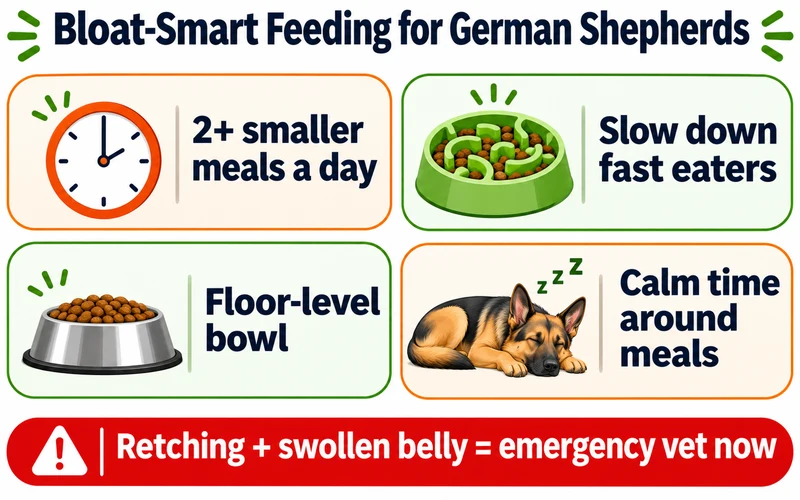
How to Feed a German Shepherd to Lower Bloat Risk
Bloat, or gastric dilatation-volvulus (GDV), happens when the stomach fills with gas and can twist on itself. It’s an emergency, and the American Kennel Club lists it as a risk for German Shepherds. No food or bowl can promise prevention, but research points to a few feeding habits worth building:
A fair warning about the evidence: the big Glickman study followed 11 large and giant breeds, and German Shepherds weren’t one of them. Both studies show links, not proof of cause. Still, these habits are easy, cheap and safe for nearly any shepherd. If your dog has a parent or sibling who bloated, ask your vet about prevention options, including a preventive stomach-tacking surgery called gastropexy.
Retching with nothing coming up, a swelling belly, drooling, an anxious look, or standing and stretching are possible signs of bloat, according to the American College of Veterinary Surgeons.
Don’t wait to see if it passes. Go to your vet or an emergency clinic right away.
German Shepherd Puppy Food: What to Check and When to Switch
The most important words on a shepherd puppy’s bag are easy to miss. Look for an AAFCO statement that says the food is complete and balanced for growth, or all life stages, “including growth of large size dogs (70 lb. or more as an adult).” Large-breed puppy foods keep calcium in a narrower range, because big puppies are more sensitive to too much or too little while their bones grow.
Male shepherds clear 70 pounds easily. What about females, who usually reach 50 to 70? Choose the large-breed food for them too. Tufts University’s Petfoodology notes that some experts consider 50 pounds a more conservative cutoff than AAFCO’s 70.
Two more puppy rules:
- Don’t add calcium or other supplements to a complete puppy food unless your vet tells you to.
- Keep them lean, not chunky. In a classic study of 48 Labrador puppies, those fed 25% less had less hip dysplasia at age 2: 7 of 24 versus 16 of 24 by OFA scoring (Kealy et al., 1992). That was Labradors, not shepherds, but hips are a known weak spot in both breeds.
How long should a German Shepherd eat puppy food? Usually until 12 to 18 months, depending on your dog’s size and how fast they’re filling out. Royal Canin moves shepherds to adult food at 15 months. Switch over about a week, mixing old and new, as shown in our guide on how to switch dog food without an upset stomach.
Food is only half of raising a good shepherd. Our German Shepherd puppy training timeline covers the other half.
Sensitive Stomach: Food Fix or Vet Visit?
Lots of shepherds have days with gas or soft stool. Sometimes a food change is the right move, and sometimes it hides a problem.
A food change may help if: your adult dog is otherwise healthy, energetic and holding weight, and the soft stool comes and goes. Try a gentle large-breed formula like the salmon-based pick above, switch slowly, and give it a few weeks. Our roundup of the best dog food for sensitive stomachs has more options.
See your vet first if:
- Diarrhea lasts more than a couple of days or keeps coming back
- Your dog loses weight even while eating hungrily
- Stool is bulky, greasy or pale
- There’s vomiting, blood in the stool or low energy
That second and third point can be signs of EPI, which VCA Animal Hospitals says shows up more often in German Shepherds. A simple blood test can check for it. For long-running gut problems, vets often start with a structured diet trial before moving to medicine, as in this study of dogs with chronic enteropathy. Itchy skin and ears can point to allergies, which we cover in food for puppies with allergies.
How Much Should a German Shepherd Eat?
A typical spayed or neutered adult shepherd needs roughly 1,000 to 1,800 calories a day, depending on size and activity. Here’s what that looks like in cups:
These figures use a standard formula vets use (resting energy × 1.4 to 1.6), so treat them as a starting point. Working dogs may need much more. Seniors, couch potatoes and recently neutered dogs usually need less.
- Do the rib check. You should feel ribs easily under a light layer of fat and see a waist from above. If you can’t, trim portions by about 10% and recheck in two weeks.
- Count every treat. Keep treats to 10% of daily calories or less, as the American Animal Hospital Association advises.
- Split it up. Two or more meals a day suits both a shepherd’s stomach and their bloat risk.
For other sizes, see our chart on how much to feed your dog by weight.
What About Grain-Free or Raw Food?
Grain-free. The FDA has been looking into reports of a heart disease called DCM in dogs eating certain diets, many of them grain-free. In its latest Q&A, the FDA says this type of DCM seems to involve several factors, including genetics, health and diet, and the cause isn’t settled. Most shepherds don’t need grain-free food, so our picks all include grains. If you’re thinking about grain-free, talk to your vet first.
Raw. Raw diets are popular in shepherd circles. In a two-year FDA screening of more than 1,000 pet food samples, raw pet food was more likely to carry harmful bacteria such as Salmonella and Listeria than other types tested (FDA). Those germs can affect people in your home, too. If you’re set on raw, work with your vet or a board-certified veterinary nutritionist so the diet is balanced and handled safely.
This article is for general information only.
PawWellCare is not a veterinarian, and this content doesn’t replace professional veterinary advice. Our picks are a research-based comparison, not the result of our own feeding trials. Calorie and cup figures are estimates. Talk to your veterinarian before changing your German Shepherd’s diet, especially for puppies, seniors, working dogs or dogs with health conditions. Signs of bloat are an emergency, so get veterinary help right away.
Frequently Asked Questions (FAQ)
How long should a German Shepherd eat puppy food?
Most German Shepherds stay on a large-breed puppy food until about 12 to 18 months. Royal Canin switches shepherds to adult food at 15 months. Bigger, slower-maturing dogs may stay a bit longer. Make the change gradually over about a week.
How much should a German Shepherd eat a day?
A typical adult needs about 1,000 to 1,800 calories a day, depending on weight and activity. That’s roughly 3 to 5 cups of most large-breed foods, but it varies a lot by bag. Start with the label, then adjust to your dog’s body.
How many times a day should a German Shepherd eat?
Adults do well on at least two meals a day. One large daily meal is linked to a higher bloat risk. Puppies usually eat three or four meals, dropping to two by around 6 to 12 months.
Is Royal Canin German Shepherd food worth it?
It can be, especially for shepherds with sensitive digestion. It’s made just for the breed, has fewer calories per cup than many large-breed foods and includes omega-3s and joint nutrients. It also costs more, and Royal Canin says it’s formulated to meet AAFCO levels rather than feeding-trial tested.
What’s the best dog food for German Shepherds with a sensitive stomach?
For an otherwise healthy adult with occasional soft stool, Purina Pro Plan Sensitive Skin & Stomach Large Breed Salmon & Rice is our pick. If diarrhea keeps coming back or your dog is losing weight, see your vet before switching foods.
Do German Shepherds need grain-free food?
No. Most shepherds do well on grain-inclusive food. The FDA is still studying a possible link between some diets, many of them grain-free, and a heart disease called DCM, so ask your vet before choosing grain-free.
Can German Shepherds eat human food?
Some plain foods, like cooked chicken or green beans, are fine as small treats. Others, like grapes, onions and chocolate, are dangerous. Check our list of human foods that are toxic to dogs first, and keep treats under 10% of daily calories.
Is wet or dry food better for German Shepherds?
Either works if it’s complete and balanced. Dry food is cheaper, easier to measure and simpler to store for a big dog. Wet food can tempt a picky eater or help a senior with dental pain, but check its calories if you mix the two.
Choosing the Best Dog Food for German Shepherds
The best dog food for German Shepherds isn’t the one with the fanciest bag. It’s the one that fits your dog’s age, gut and lifestyle, served in the right amount and the right way.
- Match the life stage. Large-breed puppy food until 12 to 18 months, then a large-breed adult food, then a senior formula as your dog slows down.
- Feed by calories, not by scoops. Check calories per cup and watch your dog’s waistline.
- Feed bloat-smart. Two or more smaller meals, slow eating, and a floor-level bowl.
Your next step: look at your current bag tonight and find two numbers, the calories per cup and the AAFCO statement. If both fit your shepherd, you may already have the right food. Planning grooming next? Our guide on how much German Shepherds shed has a brushing plan. Raising more than one breed? See our picks for golden retrievers and goldendoodles, or start with our complete dog nutrition guide.