


You bite into a crisp, cold apple, and the crunch is barely out of your mouth before your dog appears at your knee. Sitting perfectly. Tail sweeping the floor. Eyes going from the apple to your face and back again, like they’ve practiced this.
Sharing seems harmless. It’s fruit, after all, and “an apple a day” is supposed to be a good thing. But search “can dogs eat apples” and things get confusing fast. The ASPCA lists apple as “toxic to dogs.” Vets on other sites call apples one of the best treats you can give. And then there’s the line everyone has heard: apple seeds contain cyanide. So is a dropped apple core an emergency or not?
The details really matter here. A whole core can get stuck in a small dog’s throat or gut. Sweetened applesauce and apple pie can add a lot of sugar and fat, and some “sugar-free” products contain xylitol, which is dangerous for dogs. Even plain apple slices add up quickly if you’re not counting.
So, can dogs eat apples? Yes. Apples are a great low-fat treat for most dogs, as long as you skip the right parts and keep the portions sensible. In this guide you’ll find:
- Exactly how much apple is safe for your dog’s weight, from 5 lb to 100 lb
- The real numbers on apple seeds, so you know when to worry and when not to
- What to do if your dog ate an apple core, step by step
Yes, dogs can eat apples.
Plain, washed apple slices with the core, seeds and stem removed are a safe, low-fat treat with fiber and a little vitamin C. One slice (1/8 of a medium apple) has about 12 calories. Keep all treats under 10% of daily calories: about one slice a day for a 10-lb dog and two to three for a 40-lb dog.
Are Apples Good for Dogs?
Yes, apples are good for dogs as an occasional treat. They’re crunchy, sweet, almost fat-free and mostly water, which makes them a much lighter choice than many store-bought biscuits.
Here’s what’s actually inside one, based on USDA data:
One medium apple with skin (about 3 inches across, 182 g) has roughly 95 calories, 4.4 g of fiber, 19 g of natural sugar and about 8 mg of vitamin C, and it’s about 86% water.
One slice (1/8 of that apple) works out to about 12 calories and 2.4 g of sugar, according to USDA FoodData Central.
What that means for your dog:
- Low in fat and calories. An apple slice has almost no fat, so it’s an easy swap for a fatty treat, especially for dogs who need to watch their weight.
- A good dose of fiber. Most of it sits in and just under the skin. A little fiber helps keep stools regular, but a lot at once can mean gas or loose stool.
- Hydrating. At around 86% water, a few cold slices make a refreshing snack on a warm day.
- A little vitamin C and antioxidants. Nice to have, but not something your dog needs from fruit. Unlike people, dogs make their own vitamin C.
Now for the honest part. Apples aren’t medicine. A complete and balanced dog food already covers your dog’s vitamins and minerals, so think of apples as a healthy extra, not a supplement. You’ll also see claims that apples “clean teeth” or “prevent cancer” in dogs. There’s no good evidence for either in dogs. Crunchy fruit doesn’t replace brushing (here’s how to clean your dog’s teeth without brushing if brushing is a battle).
And the one real downside is sugar. Apples are sweeter than veggie treats like celery, so portion size matters more. We’ll get to exact amounts in a moment.
Which Parts of an Apple Can Dogs Eat?
This is where most of the confusion comes from. Some parts of an apple are great for dogs, and some should always go in the trash:
So why does the ASPCA say apples are toxic? The ASPCA’s plant entry for apple is about the apple tree, not the fruit you slice up in your kitchen. It says the stems, leaves and seeds contain cyanogenic glycosides (compounds that can release cyanide), especially as the plant wilts. The fruit’s flesh and skin aren’t the problem. That’s why the same ASPCA list that flags the plant doesn’t stop vets from recommending apple slices as a treat.
In short: flesh and skin, yes. Core, seeds, stem and leaves, no.

How Much Apple Can Dogs Eat?
With apples, calories and sugar set the limit. The American Animal Hospital Association (AAHA) recommends keeping all treats at or below 10% of your dog’s daily calories, with the other 90% coming from complete dog food.
We used that rule to build the table below. One “slice” means 1/8 of a medium apple (about 12 calories). The “everyday” column leaves room for your dog’s other treats. The “max” column is the most you’d give if apple were your dog’s only treat that day.
A few things to keep in mind:
- These are estimates for a typical healthy, neutered adult dog. Couch-potato dogs, seniors and dogs who need to lose weight burn fewer calories and should get less. Very active dogs can handle a bit more. Our guide on how much to feed your dog by weight explains how daily calories are worked out.
- The max isn’t a goal. Giving the “max” every day means apple is taking up your dog’s whole treat budget.
- Start small. The first time, give one slice (or a few cubes for a tiny dog) and watch for gas or soft stool over the next day.
- Your dog doesn’t need apples every day. A few times a week is plenty.
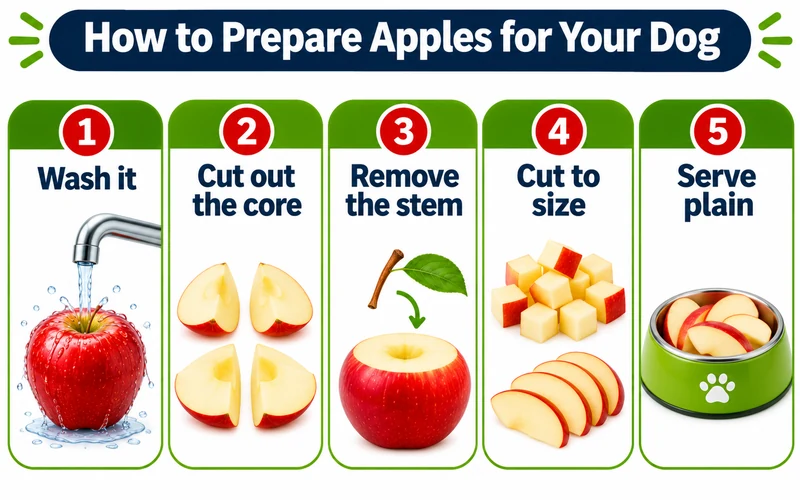
How to Cut and Serve Apples for Your Dog (5 Easy Steps)
Preparing an apple for your dog takes about a minute:
- Wash it. Rub the apple under cool running water to remove dirt and surface residue. Plain water is enough, no soap.
- Cut out the core. Slice the apple into quarters and cut away the core and every seed. An apple corer makes this fast.
- Remove the stem. And any leaves still attached.
- Cut to your dog’s size. Pea-size cubes for toy breeds and puppies, about 1/2-inch cubes for small and medium dogs, thin slices for large dogs. Fast eaters do better with smaller pieces, whatever their size.
- Serve it plain. No sugar, caramel, cinnamon sugar or peanut butter unless you know the peanut butter is xylitol-free.
Freeze it for a longer-lasting treat.
Frozen apple cubes make a cool summer snack and take longer to eat. You can also mash a slice or two into a KONG-style toy and freeze it. Keep frozen pieces small for little dogs, since hard chunks are easier to gulp.
Can Dogs Eat Apples With Skin?
Yes, dogs can eat apples with the skin on, and for most dogs it’s the better choice. The skin is where much of the apple’s fiber lives. USDA data shows apples with skin have about 2.4 g of fiber per 100 g, compared with about 1.3 g for peeled apples. Peeling throws away almost half the fiber.
That said, peeling is a good idea for:
- Puppies and toy breeds, whose small stomachs and throats do better with soft, smooth pieces
- Dogs with sensitive stomachs, since extra fiber can mean gas or loose stool
- Senior dogs with sore teeth or gums, for whom tough skin is harder to chew
What about pesticides? Apples are #8 on the Environmental Working Group’s 2026 Dirty Dozen, its list of produce with the most pesticide residue. A good rinse under running water removes much of what sits on the surface. Buying organic or peeling are both fine options if you’d rather limit residue further.
Apple Seeds and Cores: How Dangerous Are They Really?
This is the question that sends most people to Google, so let’s go through it properly, with real numbers instead of “trace amounts” and “large quantities.”
Apple seeds and cyanide: the real math
Apple seeds contain amygdalin, a natural compound that can release hydrogen cyanide when the seed is chewed or crushed. A swallowed whole seed usually passes through without releasing much.
Here’s how much is actually in there, and how much it would take to harm a dog:
- How much amygdalin is in apple seeds? A 2015 study in Food Chemistry tested seeds from 15 apple varieties and found 1 to 4 mg of amygdalin per gram of seed.
- How much cyanide is dangerous? The Merck Veterinary Manual puts the acute lethal oral dose of hydrogen cyanide at about 2 mg per kg of body weight in most animal species.
- Putting it together: Amygdalin releases only about 6% of its weight as cyanide. For a 22-lb (10-kg) dog, a dangerous dose would take roughly 85 grams of thoroughly chewed seeds, even at the highest amygdalin level measured. One apple has only about 5 to 10 seeds, which together weigh well under a gram.
Bottom line on seeds:
A dog who eats the seeds from one apple core is very unlikely to get cyanide poisoning, even a small dog. It would take the well-chewed seeds of a very large number of apples at once. This is our estimate from the published numbers, not a safe dose to aim for.
So why does every vet still say to remove the seeds? A few good reasons:
- Dogs handle cyanide less well than many animals. Merck notes that dogs have lower activity of rhodanese, the main enzyme the body uses to detoxify cyanide.
- Chewing changes everything. Crushed or ground seeds release far more cyanide than whole ones, and some dogs chew thoroughly.
- Not all apples are equal. Wild apples and crab apples may contain more amygdalin than store-bought varieties, and dogs with an apple tree in the yard may eat fallen fruit again and again.
- There’s zero benefit. Seeds add nothing good, so there’s no reason to take even a small risk.
Apple cores: the bigger real-world risk
For most dogs, the core is more dangerous than the seeds inside it. It’s hard, fibrous and about the right size to cause trouble:
- Choking. A dog who gulps a core can get it lodged in the throat, especially small breeds and fast eaters.
- Intestinal blockage. A core doesn’t break down easily. In a small dog, or a dog who eats several, it can get stuck in the stomach or intestines and may need surgery.
A large dog who swallows one core is usually fine. A Yorkie who swallows one is a different story. Size matters a lot here.
My Dog Ate an Apple Core: What Should I Do?
First, don’t panic. In most cases, a single core is more of a “watch closely” situation than an emergency. Here’s what to do:
- Stay calm and check what was eaten. One core? A whole apple? Several apples from under a tree? Also check the size of your dog against the size of the core.
- Don’t make your dog vomit at home. Unless your vet tells you to, don’t give hydrogen peroxide or salt. It can cause more harm than the apple, and a core coming back up can cause choking.
- Call your vet if: your dog is small (under about 20 lb) and swallowed a core or a whole apple, ate several cores, ate wild or crab apples, or ate apple leaves or branches.
- Watch for 24 to 72 hours. Most cores pass on their own within a day or two. Keep an eye on appetite, energy, vomiting and poop.
Go to a vet right away if you see any of these signs.
Possible blockage: repeated vomiting, retching with nothing coming up, a painful or swollen belly, refusing food, or no poop for more than a day.
Possible cyanide poisoning (rare): bright brick-red gums, heavy panting, trouble breathing, dilated pupils, weakness or collapse. For poison advice, call the ASPCA Animal Poison Control Center at (888) 426-4435 or Pet Poison Helpline at (855) 764-7661 (fees may apply).
Green vs Red Apples: Which Is Better for Dogs?
You’ll often read that green apples are much healthier for dogs because they have less sugar. Here’s what USDA data actually shows for 100 grams of each with the skin on:
Source: USDA FoodData Central (SR Legacy), raw apples with skin, per 100 g.
The verdict: Green Granny Smith apples do have a little less sugar and a little more fiber, but the gap is small, about 2 grams of sugar per 100 grams compared with Fuji, and the calories are nearly the same. Can dogs eat green apples? Absolutely. So can they eat Gala, Honeycrisp, Fuji and every other common variety. Pick whatever is in your fruit bowl. How much you give matters far more than which color it is. If your dog is diabetic or overweight, Granny Smith is a slightly better pick.
Apple Products: Which Are Safe for Dogs?
Fresh apple is the gold standard. Once apples are cooked, dried, juiced or baked, things change quickly. Here’s how the common ones compare:
Calorie, sugar and fiber figures: USDA FoodData Central (SR Legacy).
A few notes on the table:
- Xylitol is the big one. This sugar substitute can cause a dangerous drop in blood sugar and liver failure in dogs, according to the U.S. Food and Drug Administration. It may also be listed as “birch sugar.” If it’s on the label, keep the product away from your dog.
- Applesauce is handy for pills. A small spoonful of plain, unsweetened applesauce is an easy way to hide a pill, as long as your vet says it’s okay to give that medicine with food.
- Spices in pie are a smaller worry than the fat. Pet Poison Helpline vets say the small amount of nutmeg used in recipes is very unlikely to cause serious problems, though it may cause mild stomach upset, and it takes more than a teaspoon of cinnamon powder to cause trouble for most pets. With apple pie, the butter, sugar and pastry are the real problem.
Can Puppies Eat Apples?
Yes, puppies can eat small amounts of apple once they’re fully weaned and eating solid puppy food, usually from around 8 weeks old. A puppy’s stomach is still getting used to new foods, so go slowly:
- Peel it and cut it tiny. Fingernail-size pieces, or smaller for toy-breed puppies. Soft, peeled apple is easier to chew and gentler on the tummy.
- Start with one or two pieces. Then watch the next day’s poop. Soft stool or gas means it’s too much for now.
- Puppy food comes first. Growing puppies need a complete diet made for growth, so treats of any kind should stay small. Apple pieces also make great low-calorie training rewards.
- Never let a puppy have a core. Puppies are champion gulpers, and a core is a real choking and blockage risk at that size.
When Apples Aren’t a Good Idea for Your Dog
Apples are safe for most dogs, but not every dog should get them, and not every apple is a good one:
- Diabetic dogs. Each slice has about 2.4 g of natural sugar. Some diabetic dogs can still have a small piece, but it can affect blood sugar control, so ask your vet first and count it in the daily plan.
- Overweight dogs. Apples are a better choice than fatty treats, but the calories still count. Use the “everyday” column in the table above and take the calories out of the treat budget.
- Sensitive stomachs. Dogs with frequent diarrhea, inflammatory bowel disease or a history of pancreatitis may not handle extra fiber and sugar well. Check with your vet before adding apples.
- Food allergies. Rare, since apples have very little protein, but possible. Itching, red skin, vomiting or diarrhea after eating apple are reasons to stop and call your vet.
- Fallen or moldy apples in the yard. This one surprises a lot of owners. The ASPCA warns that moldy fruit that has fallen from trees can carry fungal toxins that cause vomiting, muscle tremors and seizures in dogs. If you have an apple tree, pick up fallen fruit often and keep your dog away from rotting apples and compost.
- Crab apples and wild apple trees. The small, sour fruit isn’t a treat worth sharing. Dogs tend to swallow crab apples whole, seeds and all, and the leaves and twigs on the ground carry the same cyanide compounds as other apple plant parts.
This article is for general information only.
PawWellCare is not a veterinarian, and this content doesn’t replace professional veterinary care. Serving amounts and the seed figures are general estimates for healthy adult dogs, not safe doses to test. If your dog has a health condition such as diabetes, a food allergy or is on a special diet, talk to your veterinarian before sharing apples. If you think your dog has eaten something harmful, call your vet or an animal poison control line right away.
Frequently Asked Questions (FAQ)
Can dogs eat apples every day?
Most healthy adult dogs can have a slice or two of apple a day, as long as it fits inside their 10% treat allowance. That said, dogs don’t need apples daily. A few times a week keeps it special and leaves room for other healthy treats. Cut back if you notice gas or soft stool.
How many apple seeds are toxic to dogs?
There’s no exact number, because it depends on the dog’s size, the apple variety and how well the seeds are chewed. Based on published amygdalin and cyanide figures, a 22-lb dog would need roughly 85 grams of thoroughly chewed seeds to reach a dangerous dose, far more than the few seeds in one core. Still, remove every seed, since there’s no benefit to the risk.
Can dogs eat applesauce?
Yes, plain unsweetened applesauce is safe in small amounts: about a teaspoon for small dogs and up to a tablespoon or two for large dogs. Skip sweetened applesauce, and always check the label for xylitol (sometimes listed as birch sugar), which is dangerous for dogs.
Can dogs drink apple juice?
It’s best to skip it. Apple juice has almost all the sugar of fresh apple with very little of the fiber, so it’s basically sugar water for your dog. A lick that spills on the floor won’t hurt, but don’t put it in the water bowl. Hard cider contains alcohol and should never be given.
Is apple cider vinegar safe for dogs?
Apple cider vinegar isn’t toxic, but it’s not the same as apple, and the online claims about it curing itching, fleas or digestive problems in dogs aren’t backed by good evidence. Undiluted vinegar is acidic and can upset the stomach. Talk to your vet before adding it to your dog’s food or water.
Do apples clean dogs’ teeth?
Not really. Crunchy apple slices may scrape away a little food, but they don’t remove plaque below the gumline, and their natural sugar isn’t great for teeth. Daily brushing or vet-approved dental products work far better. See our guide to cleaning your dog’s teeth without brushing for options that actually help.
Can dogs eat apples and peanut butter?
Yes, apple slices with a thin layer of peanut butter are a favorite dog snack, as long as the peanut butter is plain and xylitol-free. Peanut butter is high in calories, so use a small smear rather than a big scoop, and count both in your dog’s daily treat allowance.
Can dogs eat crab apples?
It’s best not to let them. Crab apples aren’t usually dangerous in a bite or two, but dogs tend to swallow them whole, seeds and stems included, and fallen crab apples are often moldy. If your dog ate a lot of crab apples or is showing signs like vomiting or tremors, call your vet.
So, Can Dogs Eat Apples? The Bottom Line
So, can dogs eat apples? Yes. A plain, fresh apple is one of the easiest healthy treats you can share, as long as you prepare it with care. Here’s what to remember:
- Flesh and skin are fine. Core, seeds, stem and leaves go in the trash.
- Keep it to your dog’s size: about one slice for a 10-lb dog, two to three for a 40-lb dog, and always within the 10% treat rule
- Fresh beats processed: skip apple juice, pie and sweetened applesauce, and never give anything with xylitol
Your next step: the next time you slice an apple for yourself, set aside one cored slice, cut it to your dog’s size and see what they think. Looking for more ideas? See our guides on whether dogs can eat bananas or watermelon, our list of human foods that are safe or toxic for dogs, some vet-informed homemade dog food recipes, and our complete dog nutrition guide for the bigger picture.
One crisp slice, a happy crunch and a wagging tail. That’s an apple a day done right.



Pingback: Can Dogs Eat Cantaloupe? Yes, With 5 Safe Serving Tips