

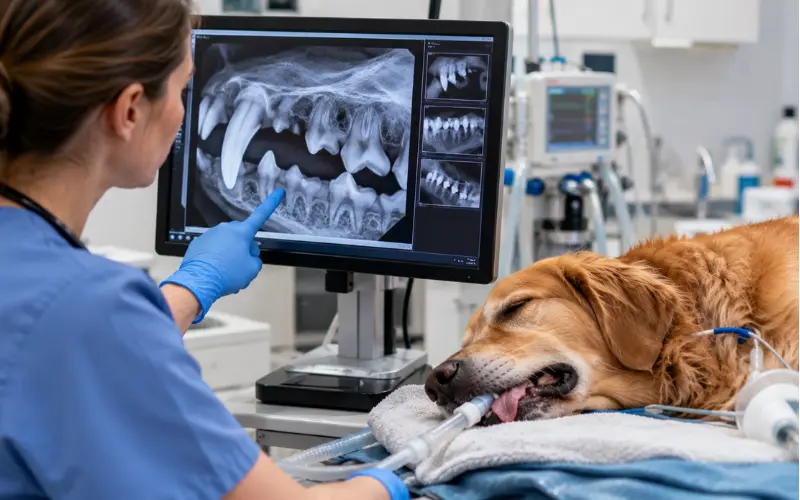
My vet pointed at an X-ray once and said “see this dark gap, that’s bone that used to be there.” I hadn’t noticed anything wrong with my dog’s mouth at all. No missing teeth, no obvious pain, just slightly duller breath I’d chalked up to age creeping in.
That gap turned out to be Stage 2 of dog periodontal disease.
Dog periodontal disease stages don’t announce themselves the way a limp or a rash does. They show up in bone loss you can’t see without an X-ray, at a pace that gives owners plenty of time to miss the whole thing, sometimes for years, all while a dog seems completely normal at home.
This guide uses the official staging system published by the American Veterinary Dental College (AVDC), the actual body that defines these terms, not a simplified paraphrase of it.
Most articles skip the first stage entirely and call this a “4-stage” system. It’s actually five stages, starting at PD0, and that missing starting point matters more than it sounds like it should, since it’s the baseline every other stage gets measured against.
Understanding dog periodontal disease stages properly changes how urgently you treat a vet’s recommendation, whether that’s “let’s clean this now” or “let’s watch it.”
This isn’t background trivia. It’s the difference between catching something reversible and missing the window entirely.
The AVDC recognizes five stages of dog periodontal disease: PD0 (Normal, no disease), PD1 (Gingivitis, no bone loss, fully reversible), PD2 (Early periodontitis, under 25% attachment loss), PD3 (Moderate, 25-50% loss), and PD4 (Advanced, over 50% loss, often requiring extraction).
Only PD0 and PD1 involve no permanent damage; everything from PD2 onward is irreversible.
Dog periodontal disease stages are determined by how much bone and attachment loss has occurred around each individual tooth, confirmed through dental X-rays, not by how bad a dog’s breath smells.
PD0 to PD4, The Official 5-Stage Scale
Most competitor content simplifies dog periodontal disease stages to four points and skips the starting point entirely.
According to the American Veterinary Dental College, the official nomenclature body for veterinary dentistry, the actual scale has five points, and severity is assessed per individual tooth, not per dog as a whole.
- PD0 (Normal): Clinically normal; no gingival inflammation or periodontitis evident
- PD1 (Gingivitis): Inflammation only, no attachment loss; alveolar margin height is normal
- PD2 (Early periodontitis): Less than 25% attachment loss
- PD3 (Moderate periodontitis): 25% to 50% attachment loss
- PD4 (Advanced periodontitis): More than 50% attachment loss
The AVDC’s official periodontal disease staging system for dogs runs from PD0, clinically normal, through PD4, advanced disease with over 50% attachment loss, making it a five-point scale rather than the simplified four-stage version many articles describe.
A single dog can have teeth sitting at completely different stages of dog periodontal disease at the same time.
A front incisor might be PD1 while a back molar is already PD3, with nothing visible to tell you that without a proper exam.
This is exactly why a full-mouth dental X-ray during a cleaning matters far more than checking a couple of visible front teeth, and why relying on a quick glance at the mouth misses more than most owners assume, even when that glance is done carefully and repeatedly over several weeks of watching for changes.
PD1, Gingivitis
This is the only stage beyond PD0 that’s fully reversible, and the only one involving zero bone loss, which makes it the single most important window in the entire progression of dog periodontal disease stages.
Common signs include:
- Red or swollen gums, especially along the gumline
- Gums that bleed during brushing or chewing, sometimes barely noticeable
- Bad breath, often the first thing an owner actually notices
- No loose teeth, exposed roots, or structural damage yet
PD1 gingivitis in dogs involves gum inflammation with zero bone or attachment loss, and it’s the only disease stage beyond normal that’s fully reversible with professional cleaning and consistent home care afterward.
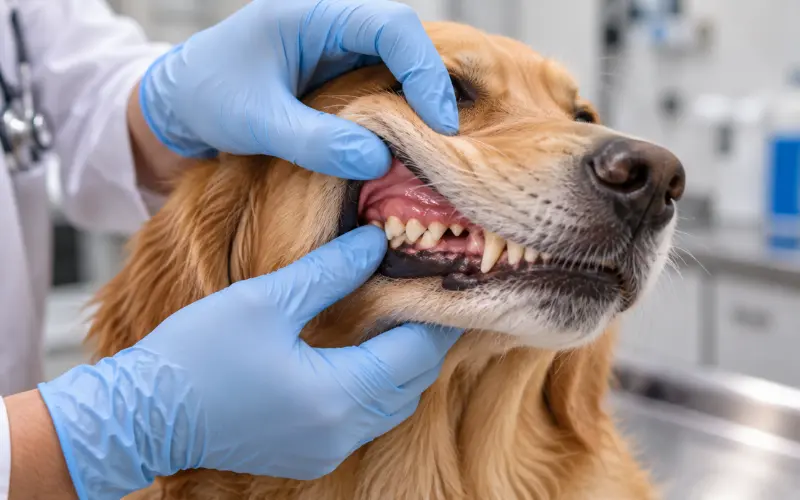
A dog can look completely fine at home and still have PD1 changes a vet catches immediately during an exam.
This is why annual dental checks matter even for dogs showing zero visible symptoms day to day.
Gingivitis develops because plaque, a sticky bacterial film, builds along the gumline and irritates the tissue underneath.
Left alone for even a few days, that plaque begins mineralizing into tartar, the hard yellowish buildup a toothbrush alone can no longer remove.
Once tartar forms, it creates a rougher surface for more plaque to grip, which is part of why this first stage of dog periodontal disease can move faster than owners expect once it actually starts building momentum.
Genetics and jaw structure influence how quickly this happens too, which is why identical care routines can produce very different outcomes across dog periodontal disease stages in two different dogs.
If you catch gingivitis early, one professional cleaning combined with a genuine daily brushing habit afterward can fully reverse it.
Waiting a few extra months “to see if it clears up” is exactly how PD1 quietly becomes PD2.
PD2, Early Periodontitis
Left untreated, gingivitis progresses here, and this is the point where the damage stops being reversible in any meaningful sense, marking a real turning point in dog periodontal disease stages overall.
Under 25% of the attachment holding a tooth in place is lost.
Dental X-rays taken during a cleaning show early bone loss and periodontal pockets forming, small spaces between gum and tooth where bacteria and debris collect and actively worsen the condition over time.
Signs may include:
- All PD1 signs, plus noticeably more persistent bad breath
- Periodontal pockets beginning to form beneath the gumline
- Mild to moderate discomfort while eating certain foods
- Possible mouth sensitivity a dog didn’t show before
PD2 early periodontitis in dogs involves under 25% loss of the attachment structures holding a tooth in place, and unlike PD1, this damage is permanent even with proper treatment afterward.
If your vet mentions “pocket depth” during an exam, ask for the actual millimeter measurement rather than just a stage number alone.
It gives a concrete baseline to compare against at the next cleaning, so you can actually track how dog periodontal disease stages are progressing, or staying stable, across successive visits.
PD3, Moderate Periodontitis
Between 25% and 50% of the attachment is now gone.
Dogs typically start showing more consistent, visible discomfort here rather than the occasional sensitivity seen at PD2, and this is where dog periodontal disease stages start meaningfully affecting daily comfort.
Signs may include:
- Noticeably receding gums, sometimes visible without a close look
- Increased redness, swelling, and outright pain during eating
- Teeth may feel slightly loose to the touch during a home check
- Dogs may chew more cautiously or consistently favor one side
According to AAHA’s dental care guidelines, the official treatment approach shifts meaningfully at this stage.
Periodontal therapy, including surgery, is only worth attempting if the owner is committed to consistent daily home care afterward.
If that commitment isn’t realistic, extraction is the recommended path instead of trying to save a tooth likely to fail again regardless of the surgical effort involved.
Bhai, maine is continuation ko bhi same exact PawWellCare formatting style mein clean kar diya hai – [AI SNIPPET] labels hata diye, [IMAGE 4] placement preserve ki, raw markdown/escape formatting fix ki, internal links clean kiye, FAQ publish-ready banaya, aur ending section ka SEO/research angle intact rakha.
This table is worth bookmarking or screenshotting, since it condenses what would otherwise take several vet visits’ worth of explanation into a single reference for dog periodontal disease stages and what each one actually calls for in terms of treatment.
Many dogs live comfortably for years at PD3 with consistent management and close monitoring. This isn’t a stage of dog periodontal disease that demands panic, but it does demand actually following through rather than waiting around to see what happens next.
PD4, Advanced Periodontitis
More than half the attachment structure is gone by this point, the final and most severe stage in dog periodontal disease stages.
Teeth are often visibly loose, and extraction becomes the realistic path forward rather than an aggressive or premature option chosen too early.
Signs may include:
- Loose or genuinely missing teeth in more advanced cases
- Exposed tooth roots visible along the gumline
- Excessive drooling, sometimes blood-tinged in severe instances
- Significant pain, though dogs often still eat, just noticeably differently
- Visible pus or discharge around affected teeth in the worst cases
At this final stage of dog periodontal disease, the conversation with a vet typically shifts from “how do we save this tooth” to “how do we stop the infection from spreading to healthier teeth nearby.”
At PD4, over 50% of a tooth’s supporting attachment is lost, and AAHA guidelines list extraction or resective periodontal surgery as the appropriate care, with prognosis considered guarded even after treatment.
Dogs are exceptionally good at hiding dental pain, and PD4 dogs sometimes still eat normally despite genuinely significant discomfort underneath.
Don’t use a normal appetite alone as proof that everything is fine at this stage.
Why You Can’t Just Look and Tell
This is where dog periodontal disease stages get genuinely counterintuitive, and it’s backed by real research rather than assumption or guesswork.
A study examining how accurately vets can visually stage periodontal disease compared to actual radiographic staging found agreement only 41.57% to 61.02% of the time, depending on which raters were involved, even among trained professionals doing a hands-on oral exam.
That’s a moderate-at-best agreement rate for something owners often assume can be judged just by looking inside a dog’s mouth.
Research comparing visual assessment of dog periodontal disease against radiographic staging found agreement rates of only 41.57% to 61.02%, meaning even trained visual exams frequently misjudge the actual severity without X-rays to confirm it.
This is exactly why a “clean-looking” mouth doesn’t rule out real disease underneath.
AAHA’s own guidelines state that periodontal disease staging is most accurate when performed on an unconscious patient after both intraoral radiographs and periodontal probing, never a conscious visual check alone, no matter how thorough that check seems.
How Fast Does This Actually Progress?
The honest answer is faster than most owners expect once brushing stops entirely, and this speaks directly to how quickly dog periodontal disease stages can advance without intervention.
A study of 52 miniature schnauzers found that 98% of the dogs had developed some level of periodontitis within just 30 weeks of toothbrushing being discontinued.
That’s roughly seven months from a clean baseline to measurable disease in nearly every single dog in the study.
A study of 52 miniature schnauzers found that 98% developed some degree of periodontitis within 30 weeks of stopping toothbrushing, showing how quickly dog periodontal disease stages can progress without consistent home care.
Small breeds and short-muzzled dogs tend to progress through these stages faster than average, largely due to jaw crowding that creates more hiding spots for plaque to accumulate undisturbed.
Diet plays a role too: wet food sticks to teeth more than dry kibble, meaning wet-fed dogs need closer attention to their brushing routine, not that wet food is inherently bad for a dog’s overall health.
Common Mistakes Owners Make Tracking This
A lot of owner confusion around dog periodontal disease stages traces back to a handful of repeated assumptions, worth clearing up directly here rather than leaving them unaddressed.
- Assuming good breath means no disease. As covered above, some dogs show minimal odor even at PD2 or PD3, so breath alone is an unreliable indicator either way.
- Waiting for a loose tooth before acting. By the time a tooth is visibly loose, the dog has usually already reached PD3 or PD4, well past the reversible window.
- Treating every dog’s mouth as one single stage. Since staging happens per tooth, a single “how bad is it” question about dog periodontal disease stages doesn’t really apply the way owners often expect it to.
- Skipping X-rays to save money. Given that visual staging alone agrees with radiographic staging barely half the time, skipping X-rays means genuinely guessing at the real severity involved.
- Restarting brushing after a long gap and assuming it undoes past damage. Brushing prevents further progression through dog periodontal disease stages, but it doesn’t reverse attachment loss that’s already occurred.
None of these mistakes come from carelessness on the owner’s part. They come from reasonable assumptions that just don’t match how this particular disease actually behaves in practice.
Staying Ahead of the Stages
Consistent daily maintenance is what keeps a dog from advancing past PD1 in the first place, which is really the whole point of understanding dog periodontal disease stages before they become a problem rather than after.
Options range from brushing to dental strips like Prodogi that dissolve along the gumline over several hours, though it’s worth knowing no strip format currently carries VOHC certification, so it works best as a daily supplement alongside real veterinary checkups, never a replacement for them.
For the full picture on how this disease develops and what causes it, our complete guide to dog dental disease covers the underlying mechanics in more depth than a stage-by-stage breakdown alone can.
And if you’ve seen “tooth decay” used interchangeably with these stages, or clinic blogs whose stage numbers don’t match your vet’s chart, our dog tooth decay stages guide translates between them.
And if what you’re seeing is a sore or ulcer rather than red, swollen gums, our dog mouth sores and ulcers guide sorts the likely causes by where the sore is.
And since dental needs shift with age, our senior dog care guide covers how monitoring and routines need to change once a dog reaches their older years.
I’m a dog owner sharing personal experience and research, not a veterinarian. This guide draws on published sources including the AVDC and AAHA, but it doesn’t replace professional veterinary care.
Only a vet can accurately stage periodontal disease using X-rays and probing.
Frequently Asked Questions (FAQ)
What are the stages of periodontal disease in dogs?
The official AVDC scale for dog periodontal disease stages has five points:
PD0: Normal
PD1: Gingivitis, reversible
PD2: Early periodontitis, under 25% attachment loss
PD3: Moderate periodontitis, 25% to 50% loss
PD4: Advanced periodontitis, over 50% loss, often requiring extraction
Can periodontal disease in dogs be reversed?
Only PD1, gingivitis, can be fully reversed with professional cleaning and consistent home care.
Every stage from PD2 onward involves permanent bone and attachment loss that treatment can only slow, never fully undo, regardless of how consistent the follow-up care is.
How do vets determine the stage of periodontal disease?
Vets stage dog periodontal disease using dental X-rays taken under anesthesia plus periodontal probing, since visual assessment alone agrees with actual radiographic staging only 41% to 61% of the time, even when performed by trained professionals.
Is PD2 periodontal disease serious?
PD2 marks the point where damage becomes permanent, even though symptoms may still look fairly mild on the surface.
It’s a meaningful turning point in dog periodontal disease stages worth taking seriously rather than waiting to see if things get worse.
Do all of a dog’s teeth progress through stages at the same rate?
No. Different teeth in the same dog’s mouth commonly sit at different stages simultaneously, which is exactly why a full-mouth X-ray during a cleaning matters far more than checking just a few visible teeth up front.
How fast can dog periodontal disease stages progress?
A study of miniature schnauzers found 98% developed some level of periodontitis within 30 weeks of stopping toothbrushing, showing progression can happen considerably faster than most owners expect it to.
Can a dog have periodontal disease with no bad breath at all?
Yes. While bad breath is a common early sign, some dogs show minimal odor even with meaningful bone loss already underway, which is another reason regular checkups matter more than symptom-watching alone ever will.
What Actually Changes at Each Stage
Understanding dog periodontal disease stages comes down to one number: how much bone and attachment a tooth has actually lost, confirmed by X-ray, not how bad the breath smells that particular week.
Three things are worth remembering here.
PD1 is the only genuinely reversible window past normal, and it’s remarkably easy to miss without an actual vet exam catching it in time.
Damage from PD2 onward is permanent, even when it’s still very manageable day to day with the right care.
And staging requires X-rays and probing, not guesswork from across the room, backed by research showing even trained visual exams get it wrong roughly 4 times out of 10.
We compared this guide against the top-ranking pages for dog periodontal disease stages before writing it.
Most cite only four stages and skip PD0 entirely, treating “normal” as too obvious to mention. None cite the AVDC’s own primary-source definitions directly, choosing instead to paraphrase secondhand summaries.
None reference AAHA’s stage-specific treatment guidance in a clean, usable format, and none mention the 41% to 61% visual-versus-radiographic agreement study or the 30-week schnauzer progression data anywhere in their content.
Those four gaps, taken together, are exactly what this guide fills in, and they’re the difference between an article that repeats the same four bullet points everyone else uses and one that actually adds something a reader couldn’t already find elsewhere.



Pingback: Dog Mouth Sores and Ulcers: Causes and When to Worry
Pingback: Dog Tooth Decay Stages: What Your Vet's PD Chart Means