I bought the wrong crate twice before getting it right.
The first one was too small.
My 75-pound Lab could technically fit inside but could not turn around without bumping the sides.
He lasted two nights before refusing to enter.
The second one was too big.
He used the far corner as a bathroom and the rest as a bedroom — which destroyed three weeks of potty training progress in a single weekend.
The third crate was the right size, the right type, and the right build quality.
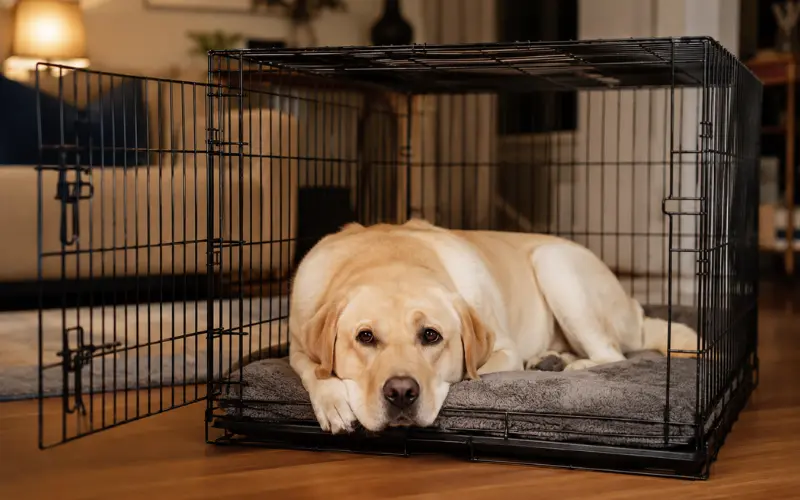
Two years later, he still sleeps in it every night — voluntarily, door open, because it became his space.
Finding the best dog crate for large dogs is not about buying the most expensive option or the one with the most features.
It is about matching the crate to your specific dog’s size, temperament, and what you need it for — and getting the sizing right the first time.
This guide reviews 6 crates that cover every large-breed situation — from budget wire crates to escape-proof heavy-duty models — with honest assessments of what each one does well and where it falls short.
For puppy training with divider included, the FDW ($35 to $50) is the best value.
For small spaces, the ZOMISIA Collapsible ($80 to $110) folds to just 5.7 inches flat.
Always measure your dog’s height and length first and add 4 inches to each for correct crate size.
Why the Right Crate Matters for Large Dogs
A crate that is the wrong size or wrong type for a large breed creates problems that most owners blame on the dog rather than the equipment.
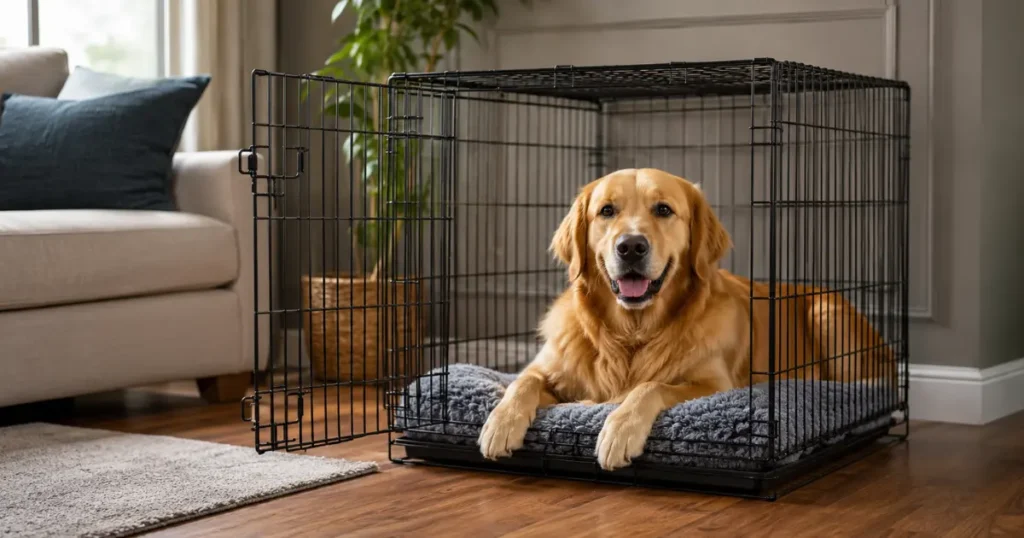
The correct dog crate size allows a large dog to stand without their head touching the top, turn around in a full circle without their body pressing against the sides, and lie down with legs extended — anything smaller restricts natural movement and creates anxiety that leads to crate resistance.
A crate that is too small causes anxiety, restlessness, and outright refusal to enter.
A 70-pound German Shepherd crammed into a 36-inch crate is not going to settle.
They are going to fight to get out — because they are physically uncomfortable.
A crate that is too large undermines potty training.
Dogs instinctively avoid soiling their sleeping area — but only if the sleeping area is genuinely their space.
A crate with extra room gives them space to eliminate at one end and sleep at the other, which defeats the entire purpose.
According to the American Kennel Club, the correct crate size allows your dog to stand up, lie down, and turn around comfortably — with approximately 3 to 4 inches of headroom and legroom beyond their body measurements.
Types of Dog Crates — Which Style Fits Your Situation
Not every best dog crate for large dogs is the same type.
The right choice depends on what you need it for, your dog’s temperament, and how your dog behaves when left alone.
Wire Crates
The most popular and versatile option.
Wire crates provide excellent ventilation, fold flat for storage, and most include a divider panel for growing puppies.
Large dogs can see their surroundings, which keeps calm dogs relaxed.
Most affordable option.
Best for: general home use, crate training, dogs that are not aggressive chewers or escape artists.
Heavy-Duty Metal Crates
Welded aluminum or reinforced steel construction designed for dogs that destroy wire crates.
Escape-proof with industrial latches and no exposed weld points.
Significantly more expensive but genuinely indestructible.
Best for: high-anxiety dogs, escape artists, dogs with destructive chewing habits, breeds with extremely high drive.
Plastic/Airline Crates
Enclosed design with ventilation holes.
Required for airline travel.
The enclosed feeling calms some dogs but causes claustrophobia in others.
Best for: travel, airline requirements, dogs that prefer enclosed den-like spaces.
Furniture-Style Crates
Wood or composite crates designed to look like end tables or furniture pieces.
Aesthetic but lower security.
Not for chewers, escape artists, or dogs still in training.
Best for: fully crate-trained dogs in homes where appearance matters.
Best Dog Crate for Large Dogs — 6 Picks Reviewed
Every crate reviewed includes: what makes it work, best for whom, who should skip it, sizing, and pricing.
1. Sweetcrispy 42-Inch Dog Crate — Best Overall for Most Large Dogs
This is the crate I recommend for most large dog owners who want reliability without overspending.
The Sweetcrispy 42-inch delivers the features that matter most at a price point that makes sense.
Double-door design — front and side — so you can place it against any wall and still access both doors.
Thick metal mesh with double sliding bolt locks on each door prevents escape attempts.
Rounded corners on every edge protect both your dog and your floors.
The collapsible frame folds flat in seconds with no tools required.
A built-in handle makes carrying the folded crate easy.
The leak-proof plastic tray slides out for cleaning without removing the dog — a small detail that matters more than you think during potty training accidents.
Available in 30, 36, 42, and 48-inch sizes.
The 42-inch model fits dogs 71 to 90 lbs — Labrador Retrievers, Golden Retrievers, German Shepherds, Boxers, and similarly sized breeds.
The Sweetcrispy 42-Inch Dog Crate — Double Door, Folding Metal Wire — features double doors with double-latch locks, thick metal mesh, a leak-proof plastic tray, rounded corners, and a fold-flat design for travel.
Available in 30, 36, 42, and 48-inch sizes.
Not ideal for: dogs with severe separation anxiety that actively destroy crates — the wire gauge is standard residential grade.
Dogs that bend wire or break latches need a heavy-duty upgrade.
Also does not include a divider panel — purchase separately if needed for puppy crate training.
2. MidWest iCrate 48-inch — Best for Giant Breeds
Same build quality as the 42-inch but sized for dogs 91 to 110 lbs — Great Danes, Mastiffs, Saint Bernards, Bernese Mountain Dogs, and other giant breeds.
At 48 inches long, this is one of the largest wire crates available.
Same double-door design.
Same divider panel.
Same fold-flat convenience.
The MidWest Homes for Pets iCrate — 48-inch, Double Door — offers the same trusted features as the 42-inch model in a size designed for giant breeds.
Fits dogs weighing 91 to 110 lbs.
Includes a divider panel.
Folds flat for storage and travel.
Double-door design for flexible placement.
Not ideal for: standard large breeds (Labs, Goldens, Shepherds) — the 48-inch is too large for dogs under 90 lbs and can undermine potty training by providing excess space.
3. FDW Dog Crate with Double Door and Divider — Best Value with Divider
If you are crate training a large breed puppy and need a divider panel included without paying premium prices, the FDW is the practical choice.
Double-door access — front and side — with secure slide-bolt locks.
The included divider panel lets you start with a puppy-sized interior and expand as your dog grows.
One crate purchase covers puppyhood through adult size.
Powder-coated, rust-resistant metal wire construction handles daily use without deterioration.
The detachable leak-proof plastic tray runs the full length of the crate and slides out for quick cleanup.
The entire crate folds completely flat for storage or travel.
The 42-inch model suits large breeds up to 90 lbs.
The FDW Dog Crate Kennel — 42-inch, Double Door with Divider — features double doors, an included divider panel, rust-resistant powder-coated wire, a leak-proof tray, and a fold-flat design.
A budget-friendly option with all the essential features.
Not ideal for: aggressive chewers or escape artists — the wire gauge and latch construction are standard grade.
Dogs that test their crates with sustained force need heavier-gauge construction.
Also not ideal for owners who need wheels for repositioning — this crate does not include casters.
4. ZOMISIA Collapsible Dog Crate — Best Space-Saving Design
If storage space is your biggest constraint, the ZOMISIA solves a problem most crates ignore entirely.
This crate collapses to just 5.7 inches flat — thin enough to slide behind a door, under a bed, or on a closet shelf.
No other large dog crate on this list folds this compact.
The construction is a hybrid approach — reinforced hard plastic panels with strong metal wire on all four sides.
Squeeze-latch locks on the door for quick access.
Two smooth-rolling wheels on the back and sturdy handles on both sides make repositioning effortless.
Modern aesthetics that blend with home furniture rather than looking like a kennel.
The design works equally well in a living room, bedroom, or patio.
The 36-inch model fits dogs up to 70 lbs.
Weighs approximately 29 lbs.
The ZOMISIA Collapsible Dog Crate for Large Dogs — 36-inch — folds flat to just 5.7 inches and features reinforced plastic and metal wire construction, a squeeze-latch door, two wheels, side handles, and a modern home-friendly design. No tools required.
Not ideal for: heavy chewers or determined escape artists — the hard plastic panels are durable for normal use but not rated for extreme destructive behavior.
Also, the 36-inch size caps at approximately 70 lbs.
Labs and Shepherds over 75 lbs need the 42-inch ZOMISIA model or a different brand.
5. Amazon Basics Folding Metal Crate — Best Budget
If budget is the primary concern and your large dog is well-behaved in a crate, the Amazon Basics delivers functional quality at the lowest price point.
Single-door design.
Standard wire gauge.
Divider panel included.
Fold-flat design.
Basic but functional.
The trade-off is everywhere — thinner wire, simpler latches, less padding on the tray, and a door that does not feel as solid as the MidWest.
But it works for dogs that do not test their crates.
The Amazon Basics Folding Metal Dog Crate — 42-inch — features a single-door design, an included divider panel, and a fold-flat frame.
The most affordable large dog crate from a reliable brand.
Fits dogs up to 90 lbs.
Not ideal for: dogs that push against doors, chew wire, or have any anxiety about crate confinement.
The single latch and thinner wire will not hold up under pressure.
Also not ideal for growing puppies — the divider panel is lower quality than MidWest’s.
6. Diggs Revol Dog Crate — Best Premium Collapsible
The best dog crate for large dogs that need to travel regularly.
Collapses flat with one hand.
Reopens and locks in under 30 seconds.
Puppy divider included.
Diamond-shaped mesh instead of wire — no snag points for paws or snouts.
Reinforced polymer and steel construction.
Built-in wheels and handle.
This is the crate you buy when you need something that moves between rooms, fits in the car easily, and looks good enough to sit in your living room without an apology.
The Diggs Revol Collapsible Dog Crate — Large — collapses flat with one hand and features a diamond-mesh design, an included puppy divider, and built-in wheels.
The premium portable large dog crate.
Not ideal for: aggressive chewers or escape artists — the mesh is strong but not indestructible.
And at $400 to $600, it is a significant investment for a crate that is not the most durable on this list.
Quick Comparison — Which Crate Fits Your Dog
How to Size a Crate for a Large Dog — The 4-Inch Rule
The best dog crate for large dogs means nothing if the size is wrong.
Sizing is the number one reason crates fail — owners either buy too small or too large.
Two Measurements You Need
Height — with your dog standing, measure from the floor to the top of the head (or the tips of the ears, whichever is higher).
Add 4 inches.
Length — measure from the tip of the nose to the base of the tail (not the tip of the tail).
Add 4 inches.
The resulting measurements are your minimum crate dimensions.
To correctly size a dog crate, measure your dog’s height from the floor to the top of the head and length from the nose to the base of the tail, then add 4 inches to each measurement.
This gives your dog enough room to stand without touching the top, turn around comfortably, and lie down with legs fully extended.
Standard Crate Sizes for Large Breeds
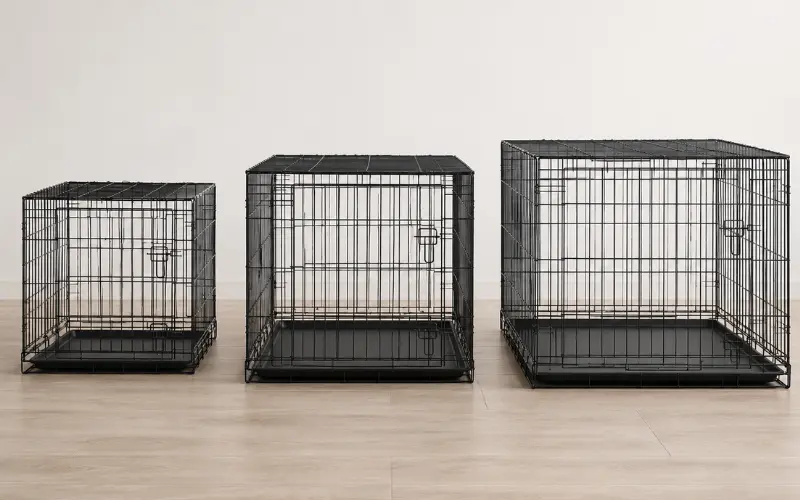
36-inch crate — fits dogs 40 to 70 lbs (medium-large breeds like Border Collies and smaller Labrador Retrievers).
42-inch crate — fits dogs 71 to 90 lbs (standard large breeds such as Labrador Retrievers, Golden Retrievers, German Shepherds, and Boxers).
48-inch crate — fits dogs 91 to 110 lbs (giant breeds such as Great Danes, Mastiffs, Saint Bernards, and Irish Wolfhounds).
When between sizes, size up.
A slightly large crate can be made smaller with a divider panel.
A too-small crate cannot be made larger.
A MidWest iCrate 42-inch with the included divider starts at puppy size and expands as your dog grows — saving you from buying 2 to 3 crates during the first year.
One crate, adjusted over time, costs $75.
Three crates in different sizes costs $200+.

Crate Training Basics — The Crate Is Only as Good as the Training
Even the best dog crate for large dogs will not work if the dog is not properly introduced to it.
A crate forced on a dog without positive association creates a dog that fights confinement.
A crate introduced gradually with rewards creates a dog that enters voluntarily.
The first 3 days are critical:
- Day one: door open, treats tossed inside, dog explores freely.
- Day two: meals fed inside the crate, door still open.
- Day three: door closed briefly while dog eats, opened immediately after.
Build duration gradually.
Five minutes becomes ten.
Ten becomes thirty.
Thirty becomes an hour.
Rushing this process is the number one crate training mistake and the reason most owners say “my dog hates the crate” within a week.
For the complete step-by-step crate training method, read our guide on how to crate train a dog that hates the crate.
According to the AKC, making positive associations with the crate from day one is the single most important factor in successful crate training — dogs that are forced into the crate without gradual introduction develop lasting anxiety about confinement.
This creates a powerful association — the crate predicts the best treat of the day.
After 1 to 2 weeks, most dogs walk into the crate on their own the moment they see the KONG come out of the freezer.
The most effective crate training method combines gradual duration building with high-value food rewards — starting with treats tossed into an open crate on day one and progressing to a frozen KONG given only during crate time, creating a positive association that makes most dogs enter their crate voluntarily within 1 to 2 weeks.
Common Crate Mistakes Large Dog Owners Make
These mistakes turn the best dog crate for large dogs into a source of anxiety for both dog and owner.
Buying too small to save money is the most common mistake.
A large dog in a medium crate is physically uncomfortable, psychologically stressed, and will fight confinement.
The $20 you save on a smaller crate costs you weeks of crate training progress.
Using the crate as punishment destroys the positive association instantly.
One time using “go to your crate” as a consequence teaches the dog that the crate is where bad things happen.
The crate should only predict good things — meals, treats, rest.
Leaving a dog crated too long causes physical and psychological damage.
Adult dogs should not be crated for more than 4 to 5 hours at a time during the day.
Puppies need out every 1 to 2 hours.
Overnight is acceptable because dogs naturally sleep for extended periods.
Not removing the collar before crating is a safety hazard.
Collar tags and buckles can catch on wire crate bars, creating a strangulation risk.
Always remove the collar before crating.
Skipping the divider for puppies allows them to potty at one end and sleep at the other — which undermines the entire potty training benefit of crate confinement.
According to the ASPCA, crate training provides dogs with a safe, den-like space that reduces anxiety and supports house training — but requires patience and positive reinforcement to be effective.
For puppies starting crate training from day one, read our guide on how to take care of a puppy for the first time.
Severe crate anxiety requires professional help, not a stronger crate.
The product recommendations in this guide are based on published reviews, professional trainer endorsements, and real-world owner feedback.
Every dog is different — consult a professional trainer if your dog has severe crate anxiety or destructive behavior.
Frequently Asked Questions (FAQ)
What size crate does a large dog need?
Most standard large breeds — Labrador Retrievers, Golden Retrievers, German Shepherds — fit a 42-inch crate designed for dogs 71 to 90 lbs.
Giant breeds over 90 lbs need a 48-inch crate.
Measure your dog’s height (floor to head) and length (nose to tail base), add 4 inches to each, and match to the crate dimensions.
When between sizes, always size up.
What is the best crate for a large dog that chews?
For moderate chewers, the Frisco Heavy Duty Crate with 20-gauge steel wire is significantly stronger than standard wire crates.
For severe chewers and escape artists, the Impact High Anxiety Crate is made of welded aircraft-grade aluminum that no dog can destroy — it is the only crate genuinely rated escape-proof.
Can I use a 48-inch crate for a regular large dog?
A 48-inch crate is too large for standard large breeds under 90 lbs.
The excess space allows the dog to eliminate at one end and sleep at the other, which undermines potty training.
A divider panel can reduce the space, but the 42-inch model is the correct choice for most large breeds and is less expensive.
How long can a large dog stay in a crate?
Adult large dogs should not be crated for more than 4 to 5 hours during the day.
Overnight crating is acceptable because dogs naturally sleep for extended periods.
Puppies need out every 1 to 2 hours during the day.
Extended crating without exercise and bathroom breaks causes physical discomfort and behavioral problems.
Should I get a single-door or a double-door crate?
Double-door crates offer significantly more placement flexibility.
You can position the crate in corners, against walls, or in tight spaces and still access the door.
For large dogs in apartments or smaller homes, the side-door access makes daily use much more practical.
Single-door crates cost less but limit where you can place them.
Is a wire crate or a plastic crate better for large dogs?
Wire crates provide better ventilation, more visibility, fold flat for storage, and most include divider panels — making them the better choice for home use.
Plastic crates are required for airline travel and preferred by dogs that like enclosed, den-like spaces.
For general home crate training, wire crates are the standard recommendation.
How much should I spend on a large dog crate?
For most large dogs, $70 to $85 is sufficient for a quality wire crate, such as the MidWest iCrate.
Budget options start at $45 for the Amazon Basics.
Heavy-duty crates for dogs that destroy standard crates cost $120 to $160.
Escape-proof aluminum crates for severe cases start at $300.
Buy the level your dog actually needs — not the most expensive option available.
Do large dogs need a crate cover?
A crate cover creates a darker, more den-like environment that calms many dogs — particularly at night or during thunderstorms.
Cover three sides and leave the front open for visibility and airflow.
Not all dogs benefit from covers — some prefer seeing their surroundings.
Test with a blanket draped over three sides before buying a fitted cover.
One Crate, Done Right — Final Thoughts
Two wrong crates.
Two returns.
One dog that refused to enter anything with metal bars for a month.
That was the cost of not understanding how to choose the best dog crate for large dogs before buying one.
The third crate — a MidWest iCrate 42-inch — cost $75 and has been used daily for over two years.
My dog walks in voluntarily.
Sleeps in it with the door open.
Retreats to it during thunderstorms.
It became his space because it was the right size, introduced correctly, and associated with good things from day one.
Three things to take with you:
Measure before you buy.
Height plus 4 inches.
Length plus 4 inches.
Those two numbers determine everything.
A crate that is the wrong size will never work — no matter how expensive or well-reviewed it is.
Match the crate to the behavior, not the breed.
A calm Golden Retriever needs a $75 wire crate.
A high-anxiety rescue German Shepherd that has destroyed three crates needs the Impact.
Breed size determines dimensions.
Behavior determines type.
The crate is the container. Training is the content.
A $450 Impact Crate with zero positive introduction will still produce a dog that hates it.
A $75 iCrate with gradual introduction, frozen KONGs, and patience will produce a dog that loves it.
For the complete crate training method that makes any crate work, read our guide on how to crate train a dog that hates the crate.
And for setting up the perfect crate routine from day one with a new puppy, read our New Puppy First Day Checklist.