

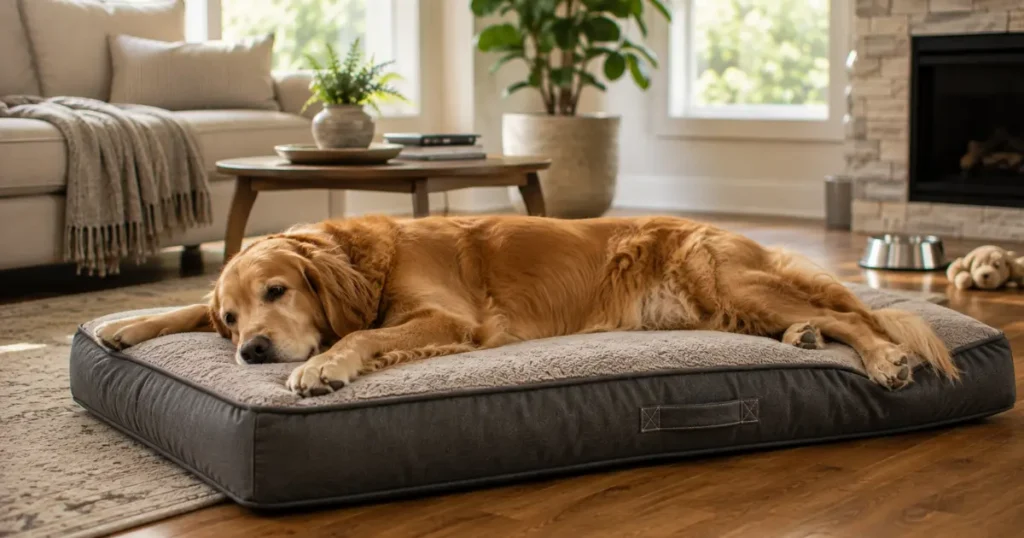
I bought the wrong dog bed twice before I got it right.
The first one looked perfect in photos, roomy, plush, exactly the style I wanted.
My dog’s legs hung off the edge within a week, and the foam had gone flat under his weight by month two.
The second one fit better, but he refused to sleep on it at all, he was a leaner, the kind of dog who wants something to rest his head against, and I’d bought a completely flat pad with no support anywhere.
That’s the thing nobody tells you before learning how to choose a dog bed for large dogs.
Size is only the first variable.
Sleeping style, foam density, and material durability all matter just as much, and getting any one wrong means a bed your dog either doesn’t physically fit or simply won’t use.
This guide covers how to actually get this right: measuring correctly, why sleeping position changes what you should buy, how much foam thickness genuinely matters, and the material differences that determine whether a bed lasts two years or two months.
Choosing a Bed for Large Dogs
Key Rules for Sizing, Orthopedic Support & Sleeping Styles
To choose the right dog bed for a large dog, measure your dog lying flat from nose to base of tail and add 6 to 12 inches for stretching room. Match the bed to your dog’s natural sleeping style, bolster or donut shapes for dogs that curl up or lean, flat rectangular beds for dogs that sprawl. For large and giant breeds, look for at least 4 inches of high-density orthopedic foam rather than loose fiberfill, which compresses and loses support within months. Prioritize washable, chew-resistant covers if your dog is destructive (our guide to beds for aggressive chewers goes deeper on this specifically), and always size by your dog’s projected adult length, not their current size.
Choosing a dog bed for large dogs starts with measuring nose-to-tail while lying flat and adding 6 to 12 inches, then matching bed shape to sleeping style and choosing at least 4 inches of high-density orthopedic foam over loose fiberfill, which compresses and loses support relatively quickly under a large dog’s weight.
Always measure your dog while sleeping flat from nose to tail base, then add 6 to 12 inches. Avoid relying solely on weight or breed average charts.
Polyester fiberfill sags within months under large dogs. Look for a minimum of 4 inches of solid orthopedic support foam for lasting joint protection.
How to Measure Your Dog for the Right Bed Size
Getting the size wrong is the single most common mistake when learning how to choose a dog bed for large dogs, and it’s genuinely avoidable with 2 minutes and a soft measuring tape.
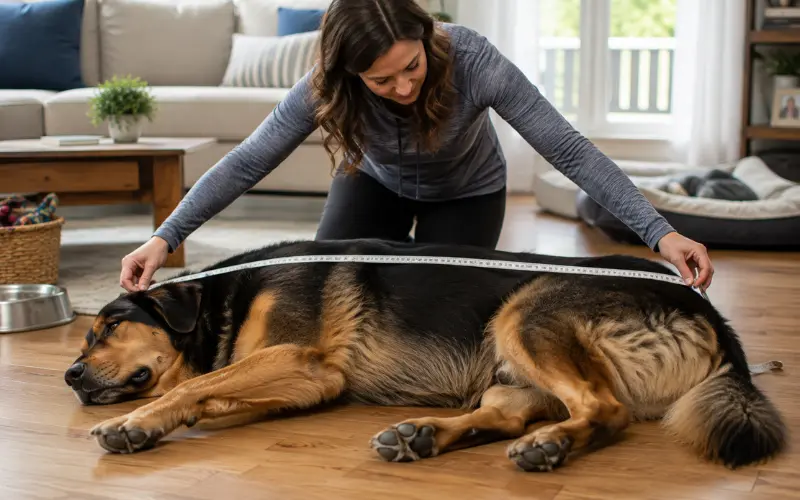
- Have your dog lie down flat on their side, in a natural resting position, not stretched artificially.
- Measure from the tip of the nose to the base of the tail, not including the tail itself.
- Add 6 to 12 inches to that number for stretching room. Err toward the larger end of that range for dogs that fully extend when they sleep.
- Measure width separately, across the shoulders at the widest point, and add 4 to 6 inches.
Size for Your Dog’s Projected Adult Measurements
Why Sleeping Position Actually Matters
This is the part most buying guides skip past too quickly, and it’s genuinely the difference between a bed your dog uses daily and one that becomes a very expensive floor decoration.
- Sprawlers and stretchers extend fully on their side, legs out. These dogs need a larger flat surface with no raised edges limiting their range.
- Curlers and nesters tuck into a tight ball. These dogs generally prefer smaller, more enclosed shapes, round or donut-style beds with raised sides.
- Leaners like something to rest their head or back against while resting. Bolster-style beds with a raised edge suit this style specifically.
- Back sleepers lie fully exposed on their spine, legs in the air. According to the American Kennel Club, this position often signals comfort and trust, and it’s frequently more common in senior dogs or dogs with joint discomfort, since it reduces pressure on sore areas. American Kennel Club — Why Does My Dog Sleep on His Back?
Watching your dog’s actual resting habits for a few days before buying tells you more than any size chart.
A dog that sprawls across the whole couch needs a different bed than one who squeezes into the smallest corner of a room.
Bed Thickness for Large Dogs
Thickness matters more for large breeds than it does for small dogs, and it’s one of the most commonly underestimated specs when learning how to choose a dog bed for large dogs online.
- Minimum 4 inches of foam for large breeds, according to general guidance repeated across most large-breed bed manufacturers. Thinner beds compress under weight and stop providing real support within weeks.
- 7 inches or more is common on premium orthopedic models built specifically for giant breeds, offering meaningfully more support for dogs over 90 pounds.
- One solid piece or layered foam, not loose or shredded fill, holds its shape significantly longer under sustained weight.
Memory Foam vs Other Materials
Not every “orthopedic” label means the same thing, and the material underneath the cover matters more than the marketing copy on the listing.
- Memory foam molds to a dog’s body shape and redistributes weight, and according to the AKC, doesn’t need to be as thick as standard polyurethane foam to provide equivalent support, since its density does more work per inch. American Kennel Club — Making Your Home Accessible for a Senior Dog
- High-density polyurethane foam is firmer and holds its shape well under heavier dogs, a common choice specifically for large and giant breed orthopedic beds.
- Polyester fiberfill is the cheapest and most common filling in basic beds, but compresses relatively quickly and offers minimal actual joint support once flattened.
- Cooling gel-infused foam helps dogs that overheat, useful for thick-coated breeds or warm climates, though it adds cost without necessarily adding support.
Check Actual Foam Specifications Beyond Marketing Labels
Memory foam and high-density polyurethane both outperform loose polyester fiberfill for large-breed dog beds, with memory foam requiring less thickness to provide equivalent joint support due to how its density distributes weight across a dog’s body.
For dogs already dealing with diagnosed joint pain or mobility issues, our guide on senior dog care and health covers broader support strategies beyond just bedding.
Bolster vs Flat Beds
This decision comes directly back to the sleeping-style observation covered earlier, and it’s worth revisiting specifically before you buy.
- Flat beds work best for sprawlers and dogs that fully extend their legs. No raised edges to limit range of motion.
- Bolster beds (raised edges on 1 to 3 sides) suit leaners and dogs that like head or back support while resting. They also help contain a dog on beds placed in open, high-traffic areas.
- Donut or cave-style beds work well for curlers and nesters but are genuinely a poor fit for large dogs that stretch out, since the enclosed shape limits their natural range.
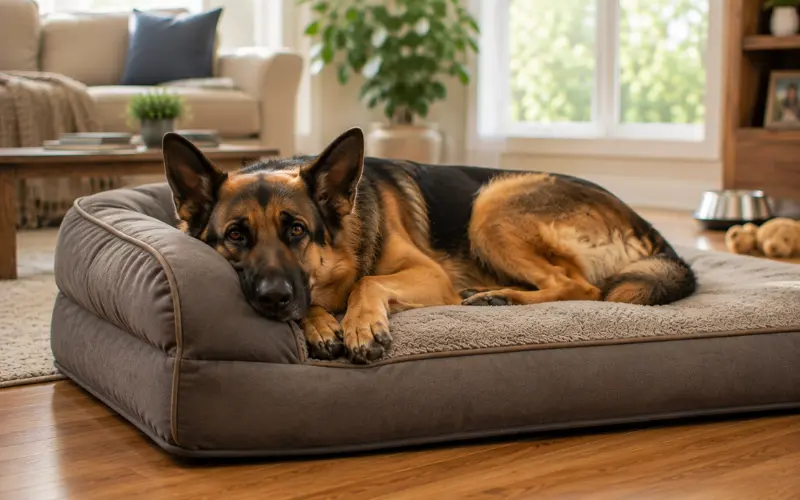
For a bed built specifically with bolster support for large breeds, our Bully Beds Review covers the 3 Sided Bolster Bed and several other orthopedic options in detail.
Chew-Resistant Materials
If you have a destructive chewer, this consideration changes what you should shop for entirely, regardless of size or sleeping style.
- Reinforced seams at high-tension stress points are the first thing to fail on standard beds under determined chewing.
- Ballistic nylon or ripstop fabric covers resist tearing significantly better than standard microfiber or cotton covers.
- Heavy-duty closures (industrial Velcro rather than exposed zippers) reduce the risk of a dog getting a closure piece into its mouth.
- No chew-resistant material is genuinely indestructible against every dog. Manufacturers offering a chew warranty with a specific replacement policy are being more honest than ones claiming total indestructibility.
Check One-Time vs. Unlimited Replacement Limits
Washable and Removable Covers
This is a practical detail that matters daily, not just at purchase.
- A separate, removable cover lets you wash the bed without compressing or damaging the foam itself.
- A waterproof inner liner, distinct from the outer cover, protects the foam from accidents, drool, or spills reaching the material that actually provides support.
- Machine-washable materials save genuine time over spot-cleaning or hand-washing, especially relevant for larger beds that are harder to maneuver.
Support for Older or Larger Dogs
This is where bed choice moves from comfort preference to something closer to genuine health support.
According to the American Kennel Club’s Chief Veterinarian, Dr. Jerry Klein, signs of arthritis in dogs include difficulty or reluctance to stand from a lying position, and difficulty going up stairs or jumping onto furniture, symptoms that a properly supportive bed can help manage alongside veterinary care. American Kennel Club — Dealing With Canine Arthritis
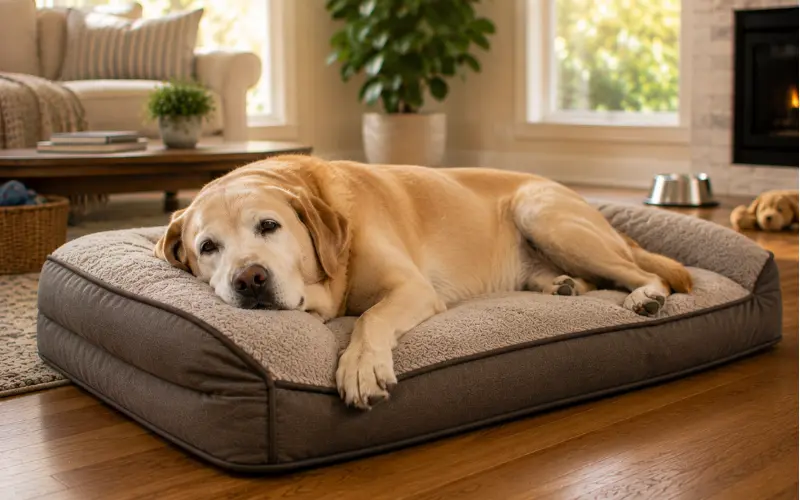
- Older large dogs benefit specifically from firmer, higher-density foam that doesn’t require extra effort to rise from.
- Low-profile beds without raised edges to climb over are easier for dogs with mobility limitations to access.
- An orthopedic bed supports comfort, but it is not a substitute for veterinary diagnosis if your dog shows sudden mobility changes.
Stiffness, Limping & Veterinary Assessment First
Mistakes to Avoid, How to Choose a Dog Bed for Large Dogs
These mistakes show up repeatedly across large-breed dog owners, based on the pattern of complaints seen across product reviews and buying guides.
- Sizing by breed average instead of actual measurement. Individual dogs within the same breed vary meaningfully in length and build.
- Buying the cheapest available orthopedic-labeled bed and assuming the label alone guarantees real support.
- Ignoring sleeping style entirely and buying whatever shape looks appealing in product photos.
- Skipping the washable-cover check and ending up with a bed that can’t be properly cleaned after the first accident or muddy walk.
- Assuming chew-resistant means indestructible, then being surprised when a determined chewer eventually gets through reinforced material.
Looking for a premium bed designed specifically for large dogs, covering multiple sleeping styles and including a genuinely chew-resistant option? Our Bully Beds Review is worth comparing against, with real pricing, materials, and warranty details broken down in full.
ℹ️ Important Reader Disclaimer
PawWellCare Editorial TransparencyFrequently Asked Questions (FAQ)
How do I choose a dog bed for a large dog?
Measure your dog from nose to tail while lying flat, and add 6 to 12 inches for stretching room. Match the bed shape to your dog’s natural sleeping style: flat for sprawlers, bolster for leaners, and donut-style only for smaller curlers. Choose at least 4 inches of high-density foam over loose fiberfill for genuine support.
What size bed does a large dog need?
Large breeds (roughly 50 to 90 pounds) typically need beds in the 40- to 50-inch range, while giant breeds over 90 pounds often need XXL sizing beyond standard u0022largeu0022 listings. Always measure your specific dog rather than relying on breed averages alone.
Is memory foam better than regular foam for large dogs?
Memory foam molds to a dog’s body and redistributes weight effectively, often requiring less thickness than standard polyurethane foam to provide equivalent support. Both are significant upgrades over loose polyester fiberfill, which compresses quickly under the sustained weight of a large dog.
How thick should a dog bed be for a large breed?
At least 4 inches of solid, high-density foam for large breeds, with 7 inches or more common on premium orthopedic models designed for giant breeds. Thinner beds compress and lose support within weeks under sustained heavy weight.
Do orthopedic dog beds actually help with arthritis?
Orthopedic beds can support comfort by distributing weight and reducing joint pressure, which may help manage arthritis symptoms alongside veterinary care. They are not a substitute for a proper diagnosis or treatment plan from a veterinarian.
What’s the difference between a bolster bed and a flat bed?
Bolster beds have raised edges on 1 to 3 sides, suited to dogs that like to lean or rest their head against something. Flat beds have no raised edges and work better for dogs that fully stretch out or sprawl when they sleep.
Getting It Right the First Time, Final Thoughts
Two wrong beds taught me more than any size chart could.
The lesson wasn’t really about measurements, it was that sleeping style and material quality matter just as much as fit, and skipping either one means buying twice.
Three things to take with you.
- Measure your dog, don’t guess by breed. Individual dogs vary enough within the same breed that averages alone will let you down.
- Match the shape to how your dog actually sleeps. A beautiful bed your dog won’t use is money wasted, regardless of size or material quality.
- Foam thickness and density matter more than the word “orthopedic” on the label. Check the actual specs before trusting the marketing term.
For a specific bed built around large-breed sizing, orthopedic support, and a genuinely chew-resistant option, our Bully Beds Review breaks down real pricing and materials in full.



Pingback: Best Dog Bed for Aggressive Chewers 2026 - PawWellCare