

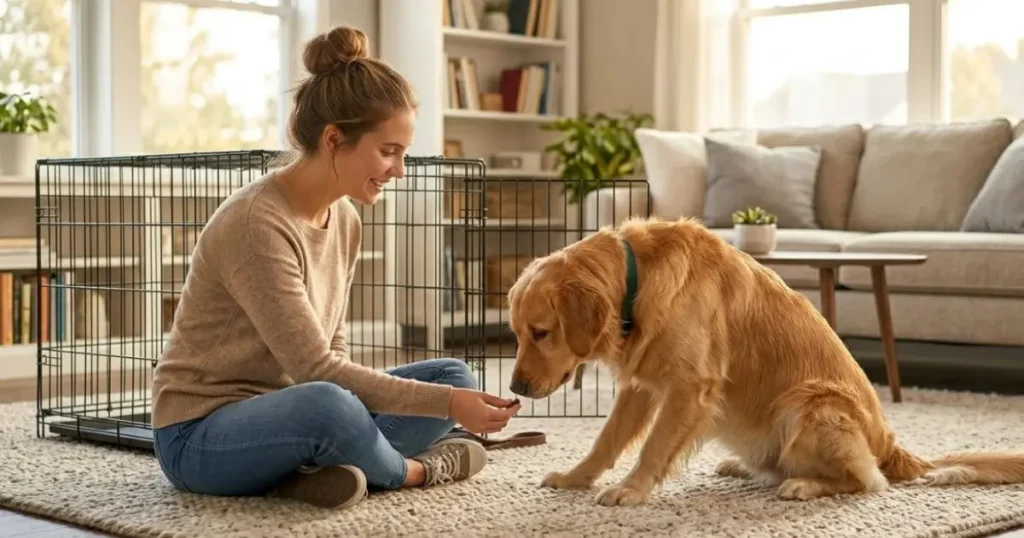
My dog would not go near the crate.
Not if I threw a whole roasted chicken in there.
Not if I left the door open for a week.
Not if I sat next to it for twenty minutes, talking to him in my most encouraging voice.
He would walk up, sniff the edge, look at me like I had personally offended him, and then go lie down on the couch.
I tried pushing him in gently.
He planted all four paws and became a forty-pound wall.
I tried putting his bed inside.
He dragged it out.
I tried a towel with my scent on it.
He pulled that out, too, and then chewed it on the couch, which felt pointed.
The problem wasn’t my dog.
It was my approach.
If you’re dealing with a dog that hates the crate — whether that’s a new puppy, a rescue, or a dog that had a bad experience — this guide on how to crate train a dog that hates the crate gives you the complete gentle method.
No force.
No pushing.
No trauma.
Just the step-by-step process that actually builds genuine comfort with the crate over time.
It works.
I promise.
Most dogs that initially resist the crate accept it willingly within 1 to 2 weeks of this gradual positive association method. Patience and consistency matter more than speed.
Why Dogs Hate the Crate — Understanding the Real Problem
Here is something most crate training guides skip entirely: dogs don’t hate the crate itself. They hate what the crate has come to mean to them. Every mistake below is one reason how to crate train a dog that hates the crate takes longer than it should.
That distinction changes everything about how you fix it.
Dogs that resist crate training have typically formed a negative association with the crate — through forced entry, isolation, or using the crate as punishment — rather than having an inherent problem with enclosed spaces.
The 4 Most Common Reasons Dogs Resist the Crate
Dogs Are Natural Den Animals — But Dens Must Feel Safe
Dogs are descended from animals that sought out small, enclosed spaces for rest and safety. The instinct to seek a den is real. But a den must feel chosen — not forced.
A crate that a dog walks into voluntarily, settles in, and sleeps in happily is using that instinct correctly. A crate that a dog is pushed into, trapped in, or punished with is working directly against it.
The entire goal of this guide is to get from one to the other. Gently and permanently.
Rescue Dogs — Extra Consideration
If your dog is a rescue, they may have had genuinely traumatic crate experiences — crates used for prolonged confinement, punishment, or isolation in their previous situation.
For these dogs, the process takes longer and requires even more patience. Every stage described in this guide still applies — but expect weeks instead of days at each stage. That is completely normal and not a sign of failure.
According to the American Kennel Club, crate training is one of the most effective tools for helping rescue dogs feel secure in a new home — when introduced correctly and gradually.
Setting Up the Crate for Maximum Success
Before a single training session begins, the crate set-up matters more than most owners realize. A poorly set-up crate makes every stage harder. A well-set-up crate makes your dog’s first voluntary entry happen
faster than you’d expect.
Choosing the Right Crate Size
This is where many owners unknowingly set themselves up for failure. A crate that is too large actually makes crate training harder — not easier.
The crate should allow your dog to stand up without ducking, turn around comfortably, and lie fully stretched. Nothing more. A crate with extra space gives your dog room to toilet at one end and sleep at the other — defeating the entire purpose.
If you bought a larger crate for your puppy to grow into, use a divider panel to block off the extra space. Most wire crates include one.
MidWest Homes for Pets iCrate — 24-inch, single door, for small breeds 12–20 lbs — includes a divider panel, leak-proof tray, secure latch, and foldable wire design, so it fits perfectly where the article explains crate sizing and using a divider as your puppy grows.
Not For : Not ideal for medium or large breeds at adult size — size up to 36-inch, 42-inch, or larger based on the dog’s final weight and comfort needs.
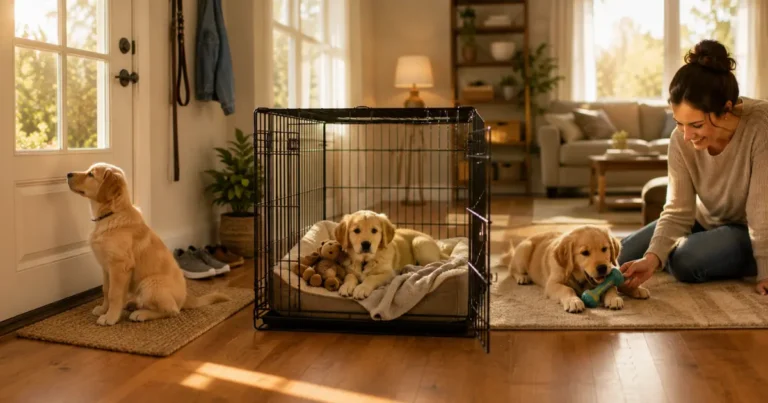
The Right Crate Setup — Do This Before Training Starts
- Remove the door completely for the first week of training — an open doorless crate feels like
furniture, not a trap. - Place a soft washable mat or pad inside — comfort matters.
- Add a worn piece of your clothing — your scent is the single most calming thing available.
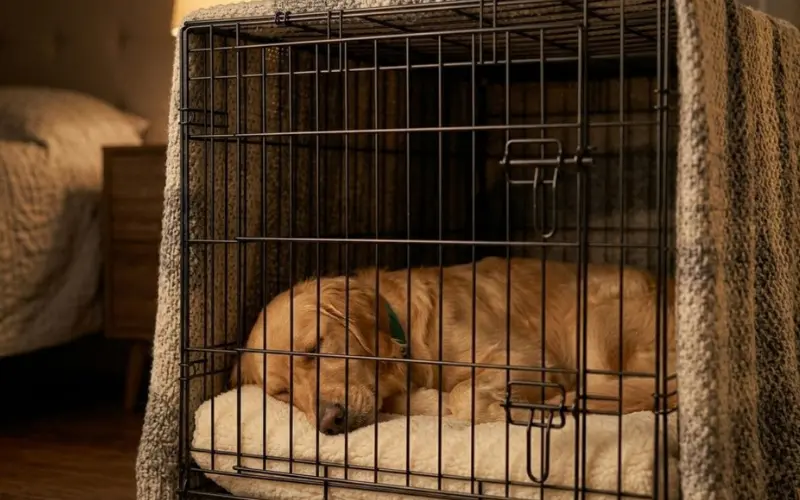
- Cover three sides with a blanket or crate cover — The enclosed den feeling reduces anxiety significantly.
- Place the crate in the room where the family spends most of the time, never in an isolated corner or another room to start.
MidWest Homes for Pets Small Dog Crate Cover — fits most 24-inch crates, machine washable, poly-cotton privacy cover with Teflon fabric protector — gives the same enclosed den-style feeling the article recommends without needing to drape a loose blanket over the crate.
Not For : Not ideal for dogs who chew fabric, overheat easily, or need the crate front fully open for airflow and visibility.
Where to Place the Crate
Location matters more than most people think. A crate in a busy, social room becomes part of the household environment. A crate isolated in a back room becomes a place of exile.
Start placement here:
- Living room or main family room where you spend evenings
- Bedroom, if your dog will sleep there at night
- Never in a laundry room, garage, or isolated space
during the introduction phase
Once your dog is comfortable — which can take weeks — you can gradually move the crate if needed.
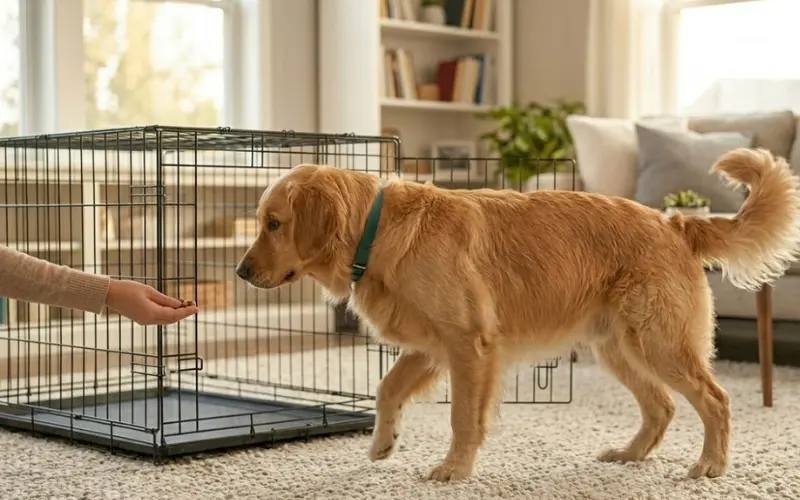
Toss treats randomly into the open crate throughout the day when you are not actively training — while watching TV, while cooking, while on the phone.
The dog starts to associate the crate with unexpected good things happening inside it. Within 3 to 4 days most dogs start checking the crate on their own.
Zuke’s Mini Naturals Chicken Training Treats — small soft training bites in a resealable 16 oz pouch — make it easy to toss frequent rewards into the crate throughout the day without using large treats every time.
Not For : Not ideal for dogs with chicken sensitivity or owners who prefer using plain cooked chicken, kibble, or single-ingredient treats.
How to Crate Train a Dog That Hates the Crate — Step by Step
This is the complete method for dogs that have never accepted the crate or have learned to fear it. Every stage must be completed before moving to the next one. Do not rush. Rushing is what created the problem in the first place.
Stage 1 — Introduction With Zero Pressure
Duration: 3 to 5 days minimum
During this stage, your only job is to make the crate interesting through smell and reward, not by making any requests or encouraging the dog to enter.
What to do:
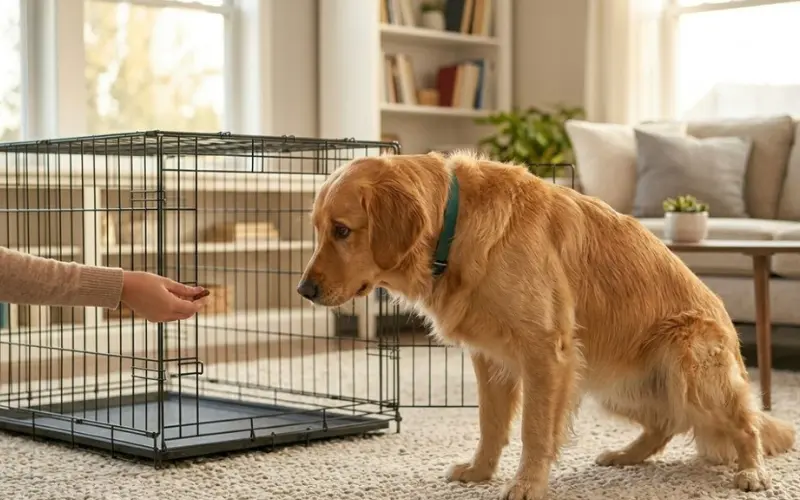
- Toss treats near the crate entrance — not inside yet
- Gradually toss treats closer and closer to the opening
- Never block the dog’s exit from the crate area
- Never ask the dog to “go in” or point toward the crate
- Let your dog approach, sniff, and retreat completely
on their own terms
What success looks like at Stage 1:
- Dog approaches the crate voluntarily and sniffs it
- Dog eats treats near the entrance without hesitation
- Dog shows no anxiety when near the crate
Move to Stage 2 only when your dog is consistently calm and relaxed around the crate for at least 2 days.
Stage 2 — Feed Every Meal at the Crate
Duration: 3 to 5 days
Food is the most powerful positive association tool available. When a dog consistently eats where they are nervous, the anxiety begins to be replaced by anticipation.
The progression:
- Day 1 to 2: Feed bowl right at the crate entrance
- Day 3: Move the bowl just inside the entrance
- Day 4: Move the bowl halfway inside
- Day 5 to 6: Move the bowl to the back of the crate
The dog must always be able to back out freely. Never close the door during this stage — not even for a second. This is about building positive associations, not testing confinement.
What success looks like at Stage 2:
- Dog walks confidently to the back of the crate to eat
- Dog shows no hesitation at mealtime in the crate
- Dog does not back out during eating
Stage 3 — Introduce the Closed Door
Duration: 5 to 7 days
This is the stage where most owners rush — and where most crate training collapses. Do not add duration faster than your dog can handle calmly.
The progression:
If your dog shows any stress at any duration — whining, pawing at the door, panting heavily — go back one step and build more slowly.
What success looks like at Stage 3:
- Dog settles after the door closes rather than panicking
- Dog does not paw or cry when the door closes
- Dog remains calm when you move away from the crate
Stage 4 — Build Duration Gradually
Duration: 1 to 2 weeks
Once your dog is calm with 10 minutes of door-closed crate time, you can begin extending the duration.
Duration building guide:
Never leave a dog alone in a crate for longer than they can hold their bladder:
- Puppies 8 to 10 weeks: maximum 1 hour
- Puppies 3 to 4 months: maximum 2 to 3 hours
- Adult dogs: maximum 4 to 5 hours
Stage 5 — The Crate Becomes Their Space
Duration: ongoing
The final stage is not something you train — it is something that happens when all the previous stages are done correctly.
Signs your dog genuinely accepts the crate:
- Goes into the crate voluntarily without being asked
- Sleeps in the crate with the door open
- Enters the crate when they want to rest or have
quiet time - Shows no stress when the door closes
- Looks to the crate as their safe space during
loud events like thunderstorms or fireworks
This is the goal. A dog that chooses the crate is a dog that feels safe in it — and that is entirely different from a dog that is forced into it. Following this how to crate train a dog that hates the crate timeline consistently gives you the best chance of success.
A 45-year-old habit can be maintained with one surprise chicken piece in the crate per week. Dogs that continue to experience positive things in their crate never backslide. Dogs whose crate stops being rewarding sometimes do.
Crate Training Schedule — Week by Week
Here is what the complete timeline looks like when everything goes smoothly. Every dog is different — some move faster, some slower. Use this as a guide, Q not a deadline.
The honest truth about timelines:
- Dogs with no prior bad crate experiences: 2 to 3 weeks
- Dogs with mild crate resistance: 3 to 4 weeks
- Dogs with significant negative associations: 4 to 8 weeks
- Rescue dogs with trauma history: 8 to 16 weeks
Slower progress is not failure. It is information about where more work is needed.
Common Crate Training Mistakes That Create Haters
Most dogs that hate the crate were created by one of these mistakes. Understanding them protects both the current training and any future dogs in your home.
Mistake Reference Table
The Biggest Mistake — Letting the Dog Out When Whining
This one is worth its own section because it is the most common mistake and the hardest to avoid.
When your dog whines in the crate, and you open the door to let them out, you have just taught them the most powerful lesson of crate training: whining opens the door.
I did this on night two. My dog whined for six minutes, and I caved. The next night was significantly worse because he now knew exactly how long to hold out.
What to do instead:
- Wait for even a 2-second pause in the whining
- The moment they go quiet — mark with “yes” and open
- If whining continues without pause — wait it out calmly and quietly (no talking, no eye contact)
- Start with a shorter duration so whining doesn’t happen
You are not being cruel by waiting. You are teaching your dog that quiet behavior — not whining — is what opens the door. That is the lesson that makes crate training work long-term.
Using the Crate as a Punishment
This one is irreversible in the short term. If your dog has been sent to the crate after misbehaving — told “go to your crate” in an angry tone — that association is now part of how they experience it.
The fix:
- Stop using the crate as punishment immediately
- Restart from Stage 1 of the introduction process
- Use a different cue word for the crate — “bed” or “place” instead of “crate” — to break the old association before building the new one
- Rebuild over 2 to 4 weeks of positive-only experiences
Every mistake below is one reason how to crate train a dog that hates the crate takes longer than it should.
Consult a certified professional trainer or your veterinarian immediately. Some dogs require behavioral medication alongside training for severe confinement anxiety.
Nighttime Crate Training — Surviving the First Nights
Nighttime is where crate training either succeeds or collapses. Here is how to get through the first night without destroying all the progress you have made.
Where to Put the Crate at Night
Next to your bed. Always, for the first 2 to 4 weeks.
I know this is not what most people want to hear. But a crate next to your bed — close enough that your dog can smell you and hear you breathe — dramatically reduces nighttime crying. Your presence is comfort. Distance is anxiety.
You can move the crate gradually further away after your dog is sleeping through the night consistently. Do not start with the crate across the room.
The Nighttime Routine That Works
How to Handle Nighttime Crying
- Short bursts of 2 to 3 minutes: let them settle — do not rush in immediately
- Crying that escalates: place your hand near the crate bars so they can smell you, say nothing
- Urgent quality crying: check if bathroom trip needed
- Crying that stops briefly: mark the quiet and wait
Never take the dog out of the crate because they are crying unless it is a genuine bathroom need. Every time crying is rewarded with release, the crying gets longer the next night.
According to the ASPCA, allowing puppies to sleep in a crate near the owner’s bed significantly reduces nighttime distress and accelerates crate acceptance compared to placing the crate in a separate room.
Every dog is different — if your dog shows severe anxiety, self-harm during crate training, or has a history of trauma, please consult a certified professional trainer or your veterinarian before proceeding.
Frequently Asked Questions (FAQ)
How long does it take to crate train a dog that hates the crate?
Dogs with no prior negative crate experiences typically accept the crate within 2 to 3 weeks of consistent positive training.
Dogs that actively resist or show fear of the crate usually take 4 to 8 weeks when the gradual introduction method is followed consistently.
Rescue dogs with significant anxiety or trauma history may take 8 to 16 weeks.
The timeline is entirely determined by how patient and consistent the training is — rushing any stage always extends the overall process.
Is it cruel to crate train a dog?
No — when done correctly, crate training is not cruel.
A dog that has been gradually and positively introduced to a crate will actively seek it out for rest and comfort.
The cruelty concern comes from misuse — using a crate as punishment, confining a dog for too many hours, or forcing a dog in before they are ready.
A properly introduced crate gives a dog their own safe, predictable space — which most dogs find genuinely comforting.
Should I put a blanket over the crate?
Yes — covering three sides of the crate with a blanket creates a den-like environment that most dogs find calming.
Leave the front uncovered for airflow, so the dog does not feel completely cut off.
The enclosed feeling mimics a natural den, which reduces anxiety for most dogs.
Remove the blanket if your dog chews at it or shows signs of overheating in warm weather.
My dog whines in the crate all night — what do I do?
First, check that the crate is next to your bed and not in an isolated room — proximity to you is the single biggest factor in nighttime crying.
Second, ensure the crate was not introduced too fast — if the door was closed before the dog was fully comfortable, rebuild from Stage 2.
Third, wait for even 2 seconds of quiet before opening the door — never open to ongoing whining.
If nighttime crying persists beyond 2 weeks of consistent training, consult a professional trainer.
Can I use the crate for an adult dog that was never crate-trained?
Yes — adult dogs can be crate trained at any age.
The process is identical to the method in this guide.
Adult dogs often move through the stages slightly faster than puppies because they have longer attention spans and more impulse control.
The key is going slowly enough that the adult dog never feels forced — their stronger physical resistance to entry makes positive association even more important than with puppies.
How long can I leave my dog in the crate?
Maximum crate times based on age and bladder capacity:
Puppies 8 to 10 weeks: 1 hour maximum during the day.
Puppies 3 to 4 months: 2 to 3 hours maximum.
Puppies 4 to 6 months: 3 to 4 hours maximum.
Adult dogs: 4 to 5 hours maximum during the day.
No dog of any age should be crated for more than 8 hours in a 24-hour period.
Crating for work hours requires a dog walker or a midday break.
What do I put in the crate to make my dog comfortable?
Keep it simple — a soft washable mat or crate pad, a worn piece of your clothing for scent comfort, and one safe chew toy or durable plush toy.
Avoid leaving water inside the crate overnight, as it leads to unnecessary bathroom trips.
Avoid fluffy toys with stuffing that can be torn apart and swallowed.
For puppies in the teething stage, a frozen rubber Kong toy provides both comfort and appropriate chewing.
My dog goes into the crate but panics when I close the door — why?
This means the positive association with the crate interior has been built, but the closed door was introduced too quickly.
The door closing is a separate trigger that needs its own gradual introduction.
Go back to Stage 3 — close the door for 10 seconds only while your dog is eating or chewing something high-value inside, then open immediately.
Build from 10 seconds to 30 seconds to 1 minute over several days before extending further.
Worth Every Minute — Final Thoughts
The dog that planted all four paws and refused to move toward the crate — the one I spent twenty embarrassing minutes trying to lure with treats — now walks into his crate on his own every evening around 9 pm.
Not because I tell him to. Because that is when he wants to go to bed.
I did not believe this was possible during week one. It felt like a personality trait, not a training challenge. It wasn’t. It was a relationship with an object, and relationships can be rebuilt.
Now that you know exactly how to crate train a dog that hates the crate, here are three things to take with you:
- Never force, never rush — every stage must be completed before the next begins. The patience you show in week one pays back in years of genuine crate comfort.
- The crate is never a punishment — not once, not in frustration, not for convenience. One negative association undoes weeks of positive work.
- Success looks like a dog that chooses the crate — not one that tolerates it. Build toward voluntary entry, and you will have built something permanent.
For the complete foundation of positive training methods, this guide is built on — read our complete positive reinforcement dog training for beginners guide.
And if your dog is also struggling with separation anxiety beyond the crate — read our guide on how to stop dog separation anxiety when left alone for the complete approach.

Pingback: Best Dog Bed for Aggressive Chewers 2026 - PawWellCare
Pingback: German Shepherd Puppy Training, Complete Timeline & Commands (2026)
Pingback: Dog Training Aids, The Complete Guide for 2026
Pingback: Golden Retriever Puppy Training, Step-by-Step Guide (2026)