

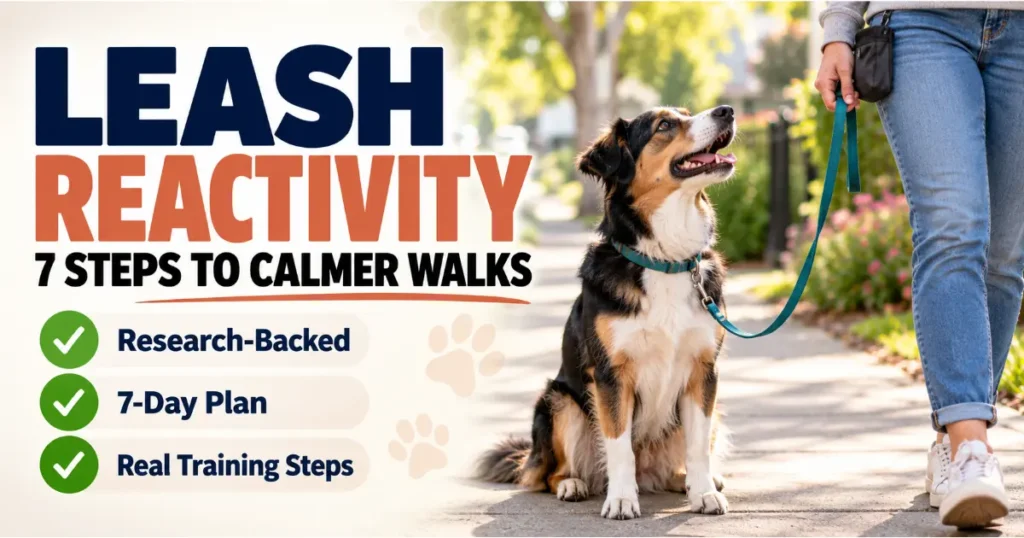
My dog was a completely different animal the moment I clipped on his leash. Off-leash at the park, he’d trot right up to other dogs, sniff, and move on like nothing happened. On-leash, the same dog 20 feet away turned him into a lunging, barking mess who left me apologizing to strangers on every single walk.
That contradiction is genuinely the whole story of dog leash reactivity training. The leash itself is doing something to your dog’s behavior, not just holding him back from it. Most owners assume their dog is simply “being difficult,” when really the leash changes what’s physically and emotionally available to the dog in that moment. Understanding that difference is where real progress starts, and it’s the piece most quick-fix advice skips entirely.
Generic tips like “just ignore it” or “use more treats” rarely work on their own, because they don’t address whether your dog’s reaction comes from fear, frustration, or both, a distinction that genuinely changes which techniques will help.
This guide covers dog leash reactivity training through a real 7-step protocol, the actual science behind why the leash makes things worse, a day-by-day plan you can follow starting today, and specific troubleshooting for when your dog reacts to everything, not just one obvious trigger.
Dog leash reactivity training works by identifying whether your dog’s reaction comes from fear or frustration, then using counter-conditioning below your dog’s reaction threshold to change the emotional response to triggers like other dogs, strangers, or bikes. The leash itself can make reactivity worse by removing a fearful dog’s ability to flee and by physically blocking a frustrated dog from greeting.
Most dogs show real improvement within 4 to 8 weeks of consistent practice, with significant change often taking 2 to 6 months.
Dog leash reactivity training combines identifying the underlying cause (fear or frustration), working below your dog’s reaction threshold, and pairing triggers with rewards through counter-conditioning, with most dogs showing measurable improvement within 4 to 8 weeks of consistent daily practice.
What Is Dog Leash Reactivity?
Leash reactivity is an exaggerated, out-of-proportion response to a trigger while your dog is on leash, barking, lunging, growling, or pulling hard either toward or away from whatever set them off. This is genuinely the starting point for any dog leash reactivity training approach, understanding what you’re actually working with before jumping into techniques.
Why the Leash Makes It Worse
A dog’s nervous system responds to a perceived threat with a fight-or-flight reaction. Off-leash, a nervous dog can simply create distance and choose flight. On a leash, that option is physically removed. Fight becomes the only remaining option, which is why so many leash-reactive dogs are completely different when off-leash.
Frustration works in the opposite direction but produces a similar-looking outburst. A dog who genuinely wants to greet another dog and is physically restrained by the leash builds arousal with nowhere to release it, and that arousal comes out as barking, spinning, and pulling.
How Off-Leash Greetings Are Different
According to ASPCApro, socially skilled dogs greeting off-leash typically approach in a gradual arc, avoiding direct eye contact until they’ve circled and sniffed each other. On a leash, dogs are forced into a head-on approach with direct eye contact, which reads as a threatening gesture in dog body language, all while the leash tension itself adds physical tension that both dogs can feel.
Dog leash reactivity training benefits from understanding that off-leash dogs naturally greet in a gradual arc while avoiding direct eye contact, whereas the leash forces a head-on approach with direct eye contact, a body-language signal dogs interpret as threatening even between 2 otherwise friendly animals.
Is My Dog Reactive or Aggressive?
This is genuinely the question that comes up most in dog leash reactivity training, and it deserves a direct answer.
Most leash-reactive dogs are not trying to cause harm. Their behavior is rooted in fear, frustration, or over-excitement, and most would not follow through with a bite if the trigger simply walked past them. True aggression involves more calculated, intentional behavior with fewer visible warning signs beforehand.
- Reactivity: Highly context-dependent, tied specifically to the leash and often reduces or disappears entirely off-leash.
- True aggression: Least context-dependent. The underlying willingness to escalate tends to surface across different situations, not just on walks.
- A useful diagnostic: If your dog is significantly calmer and more social off-leash with the same triggers, fear or frustration is very likely driving the on-leash behavior.
Untreated reactivity can escalate toward genuine aggression over time if the underlying stress is never addressed. That’s why early, consistent dog leash reactivity training matters, even when the behavior currently seems manageable.
A leash-reactive dog that is significantly calmer and more social when off-leash with the same triggers is very likely driven by fear or frustration rather than true aggression, since aggression tends to surface across contexts rather than disappearing the moment the leash comes off.
Fear-Based vs Frustration-Based Reactivity
The outward behavior can look nearly identical, barking, lunging, generally losing composure, but the underlying emotion driving it is different, and that difference changes the entire dog leash reactivity training approach.
Signs Your Dog Is Fear-Reactive
- Pulls or lunges away from the trigger as much as toward it
- Low, tense body posture, weight often shifted backward
- Hackles raised, whale-eye, tight facial muscles
- Can switch quickly from bark-lunge to freeze or attempt to flee if given the chance
- Often worse in tight spaces with no visible escape route
Signs Your Dog Is Frustration-Reactive
- Pulls hard directly toward the trigger, not away from it
- Bouncy, high energy rather than tense and low
- More barky and whiny than growly
- May be perfectly social and friendly off-leash with the exact same dogs they react to on-leash
- Worse specifically when they can see the trigger but can’t reach it for an extended time
Many dogs show elements of both, and a dog who started out purely frustration-reactive can develop genuine fear over time if on-leash encounters keep going badly. Paying attention to context and history over multiple walks gives a clearer picture than judging from a single incident.
Understanding Threshold and Trigger Stacking
Finding Your Dog’s Threshold Distance
Threshold is the specific point where your dog shifts from calmly noticing a trigger to actively reacting to it. Below threshold, your dog can still take treats, make eye contact with you, and respond to cues. Above threshold, none of that works, the instinctive part of the brain takes over completely.
This matters because dog leash reactivity training can only happen below threshold. A dog who is already reacting is not learning anything useful in that moment, they’re just practicing being reactive.
The “Stress Bucket” Concept
Trigger stacking happens when your dog encounters multiple stressors in a short window without enough recovery time between them. Each stressor adds to an accumulating stress load, and once that load crosses a threshold, even a normally tolerable trigger can produce a full reaction.
A peer-reviewed study on stress resilience in dogs discusses trigger stacking as an established phenomenon, where a dog’s resilience to a relatively mild stressor becomes reduced due to an accumulation of prior stressors.
Trigger stacking, a concept discussed in peer-reviewed canine stress research, explains why a dog can react explosively to a seemingly minor trigger after already encountering several smaller stressors earlier the same day, since accumulated stress reduces a dog’s resilience to the final trigger rather than that trigger being unusually severe on its own.
Keep a simple mental log of your dog’s day before a walk. A stressful vet visit, poor sleep, or an earlier startling noise can all fill the stress bucket before you even leave the house, meaning a walk that would normally go fine might not on that specific day.
Dog Leash Reactivity Training in 7 Steps
Work through these in order for effective dog leash reactivity training. Don’t move to the next step until the current one is reliable at your dog’s current distance from triggers.
Step 1, Management First, Stop the Rehearsal
Before training changes anything, stop reinforcing the pattern by rehearsing it daily.
- Walk at off-peak hours when trigger density is genuinely lower.
- Choose quieter routes deliberately, not just your default path.
- Cross the street, use parked cars as visual barriers, or change direction before your dog notices a trigger.
Step 2, Find Your Dog’s Threshold Distance
Start far enough from a typical trigger that your dog notices it but doesn’t react. This becomes your working distance for every session that follows.
Step 3, Counter-Conditioning, Trigger Means Treats
- The moment your dog notices the trigger at threshold distance, begin feeding high-value treats continuously and quickly.
- When the trigger disappears or you increase distance, stop the treats immediately.
- Over repeated sessions, your dog begins to anticipate good things specifically when the trigger appears.

According to the American Veterinary Society of Animal Behavior, aversive methods, including electronic collars, prong collars, and choke chains, should not be used under any circumstances, and reward-based methods are supported by current evidence for both teaching new behaviors and addressing existing behavior problems.
Step 4, the Look at That (LAT) Game
- Mark the instant your dog looks at the trigger calmly, before any reaction starts.
- Immediately deliver a treat. Your dog will often look back at you afterward.
- Mark and reward that return eye contact too.
- Repeated over sessions, looking at the trigger calmly becomes the behavior that earns rewards, which changes the emotional association itself, a core mechanism behind effective dog leash reactivity training.
For a structured program built specifically around this exact problem, our SpiritDog Tackling Reactivity Bundle covers a complete framework for this training approach.
SpiritDog Tackling Reactivity Bundle
Force-Free • Step-by-Step Video Lessons
See the Reactivity Bundle →Step 5, Build an Emergency U-Turn
Teach a specific cue that means “turn around and walk the other way immediately.” Practice it first at home with zero distraction, then on easy walks, well before you actually need it in a real encounter.
Pro Tip: Use a genuinely upbeat, cheerful tone for your U-turn cue, not an urgent or panicked one. Your dog reads your tone before the words register, and a tense-sounding cue can add stress right when you’re trying to defuse a building reaction.
Step 6, Gradually Decrease Distance
Only once your dog is consistently calm at the current distance, move a small amount closer to the trigger. If your dog reacts at any point, you moved too fast, increase distance again immediately and rebuild from there.
Step 7, Generalize to Real-World Walks
A dog who’s calm with a helper dog in a controlled setup may still react to a random dog on an actual walk. Practice specifically in the real environments where your walks normally happen, not just in a single training setup.
What to Do When Your Dog Reacts Mid-Walk
Even with consistent dog leash reactivity training, reactions will still happen sometimes. Here’s how to handle the moment itself.
- If your dog reacts to another dog: Increase distance immediately. Don’t try to correct or reassure mid-reaction, your dog is over threshold and can’t process anything useful right now.
- If your dog reacts to a person: Create distance the same way, then wait until your dog can take a treat and respond to their name before continuing the walk.
- If your dog won’t calm down even with distance: The walk may need to end there. There will be another walk, and ending without frustration matters more than finishing the planned route.
- If this keeps happening on every walk: Your dog may genuinely need more distance than you’re currently giving, or a quieter route while training catches up.
Reactivity in Multi-Dog Households
This genuinely gets skipped in most dog leash reactivity training guides, and it’s worth covering directly if you have more than one dog.
- Other dogs in the household can pick up reactive behavior through observational learning. Watching one dog repeatedly react can normalize that response for a calmer housemate over time.
- Walk dogs separately during the active training phase when possible, so the reactive dog’s training sessions aren’t complicated by a second dog’s presence and reactions.
- A calm, well-socialized housemate can sometimes help during later stages of training, once your reactive dog is already working reliably below threshold, but shouldn’t be part of early counter-conditioning sessions.
In multi-dog households, other dogs can pick up reactive behavior through observational learning simply by watching a housemate react repeatedly, which is why walking dogs separately during the active phase of dog leash reactivity training genuinely helps prevent the behavior from spreading.
Tools That Help (and Tools to Avoid)
Equipment choices matter significantly for dog leash reactivity training, and getting this right makes every other step easier.
Front-Clip Harness and Head Halters
According to AVSAB’s own training guidance, a front-clip harness is a genuinely safe recommendation for a dog that pulls, and it won’t cause the harm that aversive equipment can.
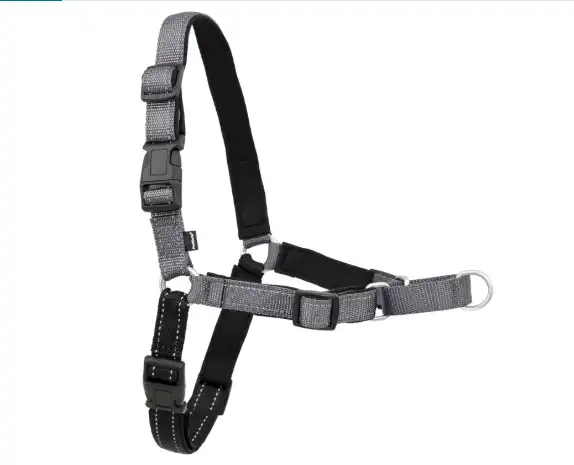
PetSafe Easy Walk Deluxe Harness
Front-clip design helps redirect pulling without putting pressure on your dog’s neck.
Check Price on Amazon →A head halter can help for dogs that are extremely reactive or highly frustrated, since it gives more direct control over head direction without relying on neck pressure.
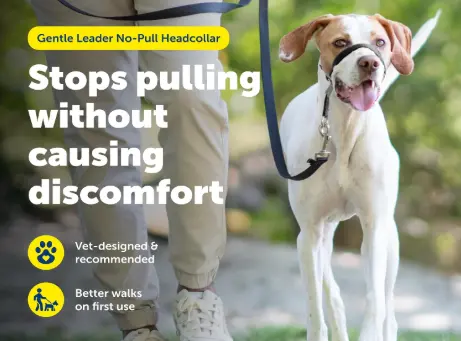
PetSafe Gentle Leader No-Pull Headcollar
Provides more direct head control for dogs that are difficult to manage on leash.
Check Price on Amazon →For our detailed method on general leash-pulling that overlaps with equipment choice for dog leash reactivity training, read our guide on leash training a puppy that pulls on walks.
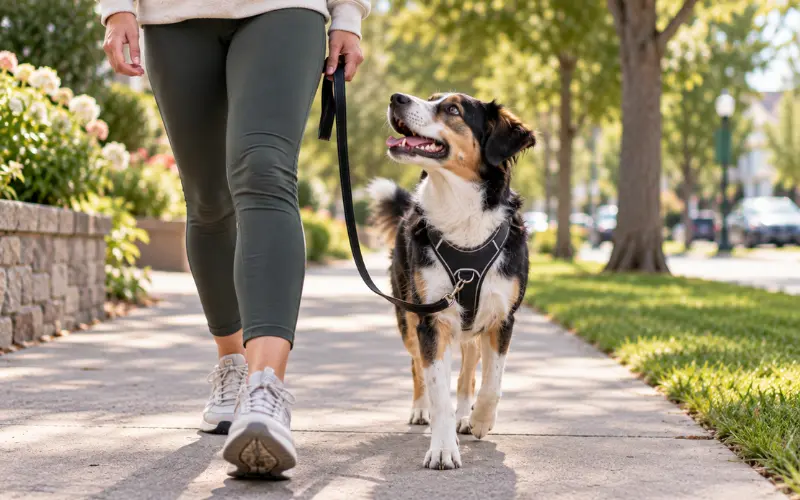
Tools to Avoid, Aversive Equipment
Shock collars, prong collars, and choke chains all rely on inflicting discomfort or pain to suppress behavior, and they work directly against the emotional-association goal of counter-conditioning. Suppressing the visible warning signs of fear or frustration doesn’t resolve the underlying emotion, it can simply remove the warning before a more serious reaction.
For our detailed guide to positive-reinforcement fundamentals that apply here, read our positive reinforcement dog training for beginners.
A 7-Day Dog Leash Reactivity Training Plan
Most competing guides describe general week-ranges without a concrete daily structure. Here’s a specific plan to actually follow.
This timeline assumes daily practice with a dog that hasn’t been severely reactive for years. Dogs with a long, established pattern will likely need to repeat this 7-day structure multiple times, gradually decreasing distance across several cycles rather than one.
Common Mistakes That Make Reactivity Worse
These mistakes genuinely undo weeks of otherwise solid dog leash reactivity training progress.
Punishing the Reaction
Correcting a reaction after it happens addresses the visible symptom, not the underlying fear or frustration driving it, and can add a negative association on top of an already stressful moment.
Forcing Greetings
Pushing a reactive dog into a greeting because “they just need to say hi” almost always backfires. A dog who is already over threshold learns nothing positive from a forced interaction.
Tight Leash, Tense Handler
Leash tension travels directly down the lead to your dog. A tight leash and a tense handler communicate that something is wrong, even before your dog has independently decided to react.
Keeping the leash as loose as realistically possible helps more than it seems like it should.
Flooding Instead of Gradual Exposure
This is one mistake genuine dog leash reactivity training guides warn against consistently. Exposing a reactive dog to a flood of triggers at close range, hoping they’ll simply “get used to it,” genuinely tends to make reactivity worse rather than better, since the dog stays over threshold the entire time with no opportunity to learn a calmer response.
According to the American Kennel Club, flooding carries real ethical concerns since a dog can’t consent to an overwhelming experience, and it’s far more likely to backfire and leave a dog more frightened than before, rather than resolving the underlying fear.
Much of this becomes easier to prevent early. For puppies not yet showing reactivity, our puppy socialization checklist by age covers the early exposure work that genuinely reduces the odds of leash reactivity developing in the first place.
Realistic Timeline, How Long Does This Take?
Setting realistic expectations for dog leash reactivity training genuinely makes the whole process easier to stick with.
- Weeks 1 to 4: Management systems in place, fewer reactive episodes simply from better distance and route planning.
- Weeks 4 to 8: Early counter-conditioning progress, your dog may start glancing at you when they spot a trigger instead of immediately reacting.
- Months 2 to 6: Noticeable improvement in threshold distance, handling situations that previously caused full reactions.
- Months 6 to 12-plus: Significant change in many dogs, some triggers may stop producing reactions at all.
Setbacks happen, and they’re normal. A single bad encounter or a stressful week can temporarily reset progress. When that happens, rest a few days, lower the difficulty, and resume with more distance than before.
What If My Dog Reacts to Everything?
Sometimes dog leash reactivity training progress stalls because the real problem isn’t one specific trigger.
- Multiple triggers, not just one: This often points to a fuller stress bucket overall rather than a single unmanageable trigger. Reducing daily stress load, not just training the one most obvious trigger, tends to help.
- Reacts even at long distances: Your dog’s actual threshold may be further than you’ve assumed. Start training sessions much farther away than feels necessary.
- Reacts on some days but not others: Trigger stacking is the most likely explanation, check what happened earlier that day before assuming the training has stopped working.
- Reacts specifically near home: This can indicate barrier or territorial reactivity, a related but distinct pattern that benefits from the same core approach applied specifically near the trigger zone.
When Should You Get Professional Help?
Not every dog leash reactivity training situation is safe to handle entirely on your own.
- Reactivity that includes an actual bite or bite attempt, not just barking and lunging.
- No meaningful improvement despite several weeks of genuinely consistent training.
- Reactivity that’s escalating in intensity over time rather than gradually improving.
- You’re not confident you’re correctly reading whether your dog’s reaction is fear, frustration, or something more serious.
A certified trainer with specific reactivity experience can catch details you might miss and adjust the plan to your dog’s specific situation.
I am a dog owner sharing personal research and experience, not a certified professional trainer or applied animal behaviorist. If your dog’s reactivity includes a bite history, or escalates despite consistent training, consult a certified professional trainer with specific reactivity experience or a veterinary behaviorist.
Frequently Asked Questions (FAQ)
How do I stop my dog from reacting on leash?
Effective dog leash reactivity training identifies whether fear or frustration is driving the reaction, then uses counter-conditioning below your dog’s threshold distance, pairing the trigger with high-value rewards until the emotional response changes.
Why is my dog reactive on leash but not off-leash?
The leash removes a fearful dog’s ability to flee and physically blocks a frustrated dog from reaching what they want to greet. Both problems tend to resolve when the leash comes off, which is why the same dog can seem completely different in each context.
What is the fastest way to stop leash reactivity?
There isn’t a genuinely fast method. Counter-conditioning and desensitization is the evidence-supported approach, and it takes consistent work over weeks to months. Methods claiming quick fixes, especially punishment-based ones, typically suppress the behavior rather than resolving the underlying cause
Is leash reactivity the same as aggression?
No. Most leash-reactive dogs aren’t trying to cause harm, and their behavior is rooted in fear, frustration, or over-excitement rather than genuine intent to injure. True aggression tends to show up across multiple contexts, not just on leash.
How long does dog leash reactivity training take?
Most owners see early signs of progress with dog leash reactivity training within 4 to 8 weeks of consistent daily practice, with more significant, lasting change often developing over 2 to 6 months depending on how established the reactivity was beforehand.
Should I use a prong collar or shock collar for a reactive dog?
No. The American Veterinary Society of Animal Behavior states that aversive methods, including prong and shock collars, should not be used under any circumstances, since reward-based methods are supported by current evidence for both training and behavior modification.
Dog Leash Reactivity Training, Final Takeaway
That contradiction I saw in my own dog, calm off-leash and a completely different animal on-leash, is genuinely the key to understanding this whole problem. The leash isn’t neutral. It’s actively shaping the behavior, and once you understand how, the training makes a lot more sense.
Three things to take with you.
- Identify the cause before choosing a method. Fear and frustration need the same foundational approach but respond differently to specific techniques.
- Training only works below threshold. A reacting dog is practicing the behavior, not learning past it.
- Progress isn’t linear, and that’s normal. A bad walk is information, not a verdict on whether this dog leash reactivity training approach is working.
For the complete comparison of structured training programs that build on these exact principles, read our guide on the best online dog training courses.




Pingback: Leash Training a Puppy That Pulls on Walks — Complete Guide