

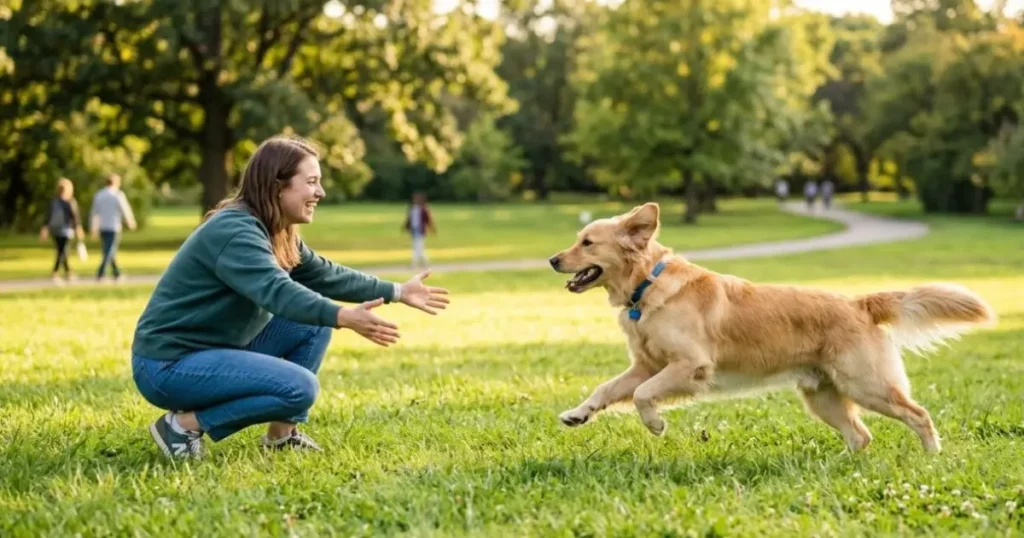
The moment that changed everything happened on a Tuesday morning in the park.
My dog had found something in the bushes.
Something deeply, magnificently interesting — I still do not know what it was.
I called his name.
He ignored me.
I called again.
Nothing.
I started walking toward him feeling that particular mixture of panic and embarrassment that every dog owner knows.
Then I remembered what the trainer had told me:
If you have to chase your dog to get them back, your recall is not trained. It is borrowed time.
She was right.
I had been using recall as a retrieval tool — something I called when I needed my dog back, without ever building it as a genuine trained behavior.
That is not recall training.
That is hoping your dog feels like coming today.
This dog recall training step by step guide gives you the complete method — from the first session building the foundation to proofing it against the most distracting environments your dog will ever encounter.
A recall that works when it matters is not luck.
It is built.
Let’s build it.
Start on a long training leash in a quiet, distraction-free area. Say your dog’s name followed by “come” in an excited, happy voice.
The moment your dog reaches you, reward them with the highest-value treat of the session and plenty of praise.
Never call your dog for something unpleasant, and never punish a slow return. Recall should always predict good things.
Why Recall Is the Most Important Command You Will Ever Teach
Every command in this dog recall training step by step guide ultimately serves one purpose: safety.
Recall is the one command that can save your dog’s life.
Not sit.
Not stay.
Not leave it.
Recall.
A reliable recall — a dog that comes when called in any environment, under any distraction — is the most important safety behavior a dog can have and the one that requires the most ongoing reinforcement throughout the dog’s life.
Real Situations Where Recall Saves Lives
- Dog slips the leash near a road
- Dog runs through an open gate
- Dog approaches an aggressive animal
- Dog heads toward a dangerous person or situation
- Dog finds something toxic on the ground
In each of these situations, a reliable recall is the difference between a close call and a tragedy.
No other command comes close to this level of real-world importance.
Why Most Dogs Have Unreliable Recall
Most owners call their dog in these situations regularly:
- When the walk is over — come means fun ends
- Before a bath — come means something unpleasant
- When in trouble — come is said in a sharp frustrated tone
- When leaving the dog park — come means playtime ends
Every time recall predicts something the dog does not want, the value of the word erodes.
Over hundreds of repetitions, “come” can come to mean “something I probably don’t want is about to happen.”
A reliable recall requires a completely different relationship with the word.
Come must predict the best things that ever happen to your dog — every time it is used, for the rest of the dog’s life.
The One Rule That Changes Everything
Never punish a dog for coming back — no matter how long it took, no matter what they were doing, no matter how frustrated you are.
A dog that returns slowly and gets scolded learns: returning to the owner leads to negative outcomes.
Next time, they will be even slower.
Or they will not come at all.
According to the ASPCA, punishing a dog for a slow or reluctant return — even when the owner is frustrated — is the leading cause of recall failure and teaches the dog to avoid returning to the owner altogether.
Every return must be rewarded, always.
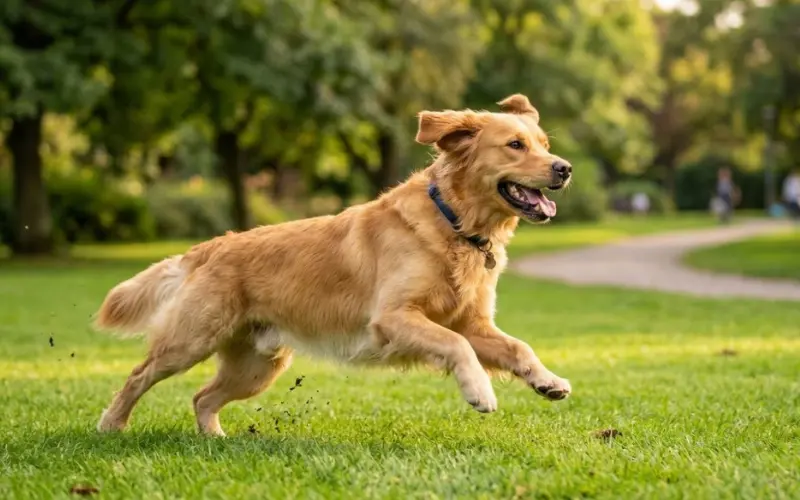
Setting Up Recall Training for Maximum Success
Before the first session, three things need to be in place.
Skipping any of them slows the entire process.
Choose Your Recall Cue Word Carefully
Most people use “come.”
That works — but only if the word has not already been poisoned by repeated use without reward, by being said in a frustrated tone, or by always predicting something the dog dislikes.
If you have been using “come” inconsistently for months or years — start with a fresh word that has no history.
Options that work well:
- “Here” — short, sharp, easy to say quickly
- “Come” — fine if it has no negative history
- A whistle cue — two short blasts — excellent for distance and loud environments
- Your dog’s name plus “come” — “Max, come”
Choose one cue and protect it fiercely.
Never use your recall cue in a negative context again.
This word is now sacred — it means the best thing ever.
Choose the Right Rewards for Recall Training
Recall requires your absolute highest-value rewards — not the everyday treats used for sit and stay.
The recall reward should be:
- Something your dog almost never gets
- Something they would interrupt almost any activity for
- Given in abundance at the moment of arrival — not a single small treat
Best recall rewards:
The reward at recall should feel like a party — not a transaction.
Enthusiasm matters as much as the treat.
A portable single-ingredient beef liver treat made from freeze-dried raw beef liver. The 2 oz tub contains about 45 pieces and works well as a high-value reward for outdoor recall training or as a meal topper.
Get a Long Training Leash
A 20 to 30 foot long line is essential for early recall training.
It gives your dog freedom to move while keeping them safe and giving you the ability to gently encourage return if needed.
A beginner-friendly nylon long line available in 15, 20, 30, 50, and 100 feet, giving your dog more freedom while keeping recall practice controlled and connected.
Dog Recall Training Step by Step — The Complete Method
This is the complete dog recall training step by step method.
Every stage must be solid before moving to the next.
Recall built slowly is recall that holds when it matters.
Stage 1 — Foundation at Home
Start here — not in the yard, not outside.
In the smallest, most boring room in your house.
How to run the first sessions:
- Let your dog move slightly away from you — even just 2 to 3 feet
- Say their name once in a happy, excited voice: “Max, come!”
- Crouch down, open your arms, make yourself exciting
- The moment they reach you — enormous reward, big praise, real celebration
- Let them move away again — repeat
What you are building: the emotional association that coming to you when called is the best possible outcome.
Do this 10 to 15 times per session.
Keep sessions short and finish while your dog is still enthusiastic.
Stage 2 — Yard Training on Long Line
Once Stage 1 is solid — meaning your dog turns and runs to you every single time you call in the house — move to the yard with a long line.
The long line provides:
- Safety during outdoor practice
- Ability to follow through if dog does not respond
- Freedom for the dog that makes the choice feel genuine rather than forced
How to use the long line:
- Let your dog explore on the long line
- Wait until they are mildly distracted — sniffing the ground, looking around
- Call once: “Max, come!”
- If they turn and run to you — enormous reward
- If they do not respond in 3 seconds — begin gently reeling in the long line while continuing to call in an encouraging excited voice
- When they reach you — celebrate regardless of whether they came freely or needed gentle guidance
Never jerk or drag the long line — gentle consistent pressure only.
The goal is to make arriving at you feel rewarding even when they needed encouragement.
Stage 3 — Building Distance and Adding Distractions
The same principle from stay training applies here: distance and distraction are separate variables that must be built one at a time.
Distance progression for recall:
Stage 3a
Distance: 5 to 10 feet
Environment: Quiet yard
Success Criteria: Instant response to every recall cue.
Stage 3b
Distance: 15 to 20 feet
Environment: Quiet yard
Success Criteria: Comes within 3 seconds of being called.
Stage 3c
Distance: 25 to 30 feet
Environment: Quiet yard
Success Criteria: Reliable at full long-line distance.
Stage 3d
Distance: 10 feet
Environment: Quiet street with mild distractions
Success Criteria: Responds despite light environmental interest.
Stage 3e
Distance: 20 to 30 feet
Environment: Park with moderate distractions
Success Criteria: Interrupts sniffing and returns immediately.
Stage 3f
Distance: 30+ feet
Environment: Park with high distractions
Success Criteria: Interrupts play or other high-interest activities to return.
Stage 4 — Protecting the Recall Word
This stage never ends.
It is a lifetime commitment.
Every time recall is used, it must end with a reward.
Not sometimes.
Every time.
If you need your dog for something they will not enjoy:
- Walk to them and put the leash on calmly
- Use a different cue — “let’s go” instead of “come”
- Recall, reward generously, then do the unpleasant thing — so the reward comes before the bath, not after
Situations to NEVER use the recall cue:
- Calling your dog to end a walk or playtime — go get them instead
- Calling when you are frustrated or angry — your tone poisons the word
- Calling to put them in a crate they dislike
- Calling repeatedly when you know they will not come — each ignored call reduces the word’s value
Stage 5 — Maintenance Recall for Life
Here is something most owners do not know:
Recall weakens over time without maintenance.
A dog with a perfect recall at 6 months can have a mediocre recall at 2 years if it was never practiced after the initial training.
Maintenance recall — 3 times per day minimum:
- Call your dog in the house for no reason
- They come — enormous reward — release them
- Call again from a different room
- They come — reward — release
- Done — 60 seconds total
This random reinforcement keeps the value of “come” high throughout the dog’s life.
It takes almost no time and prevents the slow erosion that turns a great recall into an unreliable one.
Call your dog enthusiastically when they are mildly distracted and take a few steps backward as they come.
Reward every successful recall with a jackpot of treats, a favorite toy, or enthusiastic praise.
Just 3–4 surprise recalls per walk can significantly improve responsiveness over time.
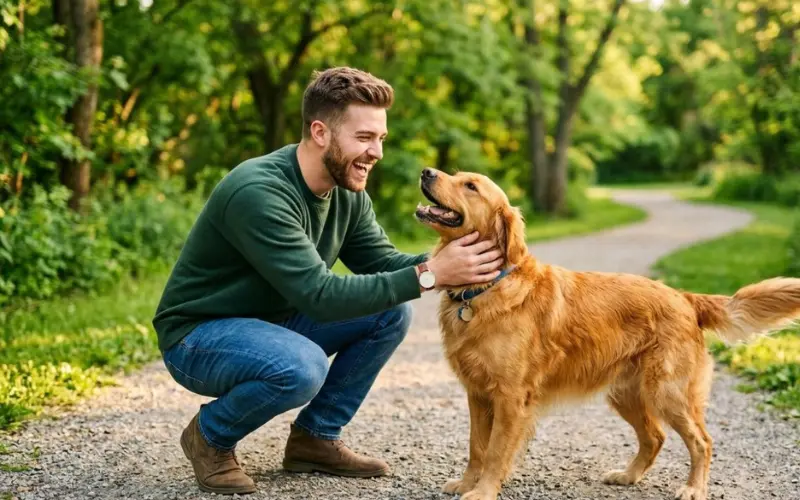
Recall in Real Life — Proofing Against High Distractions
A recall that works in your backyard and a recall that works when your dog is running toward something exciting are two different behaviors.
This is where most owners discover their recall is not as trained as they thought.
Distraction Difficulty for Recall
The Emergency Recall — Train It Separately
An emergency recall is a special cue — different from your everyday recall — reserved only for genuine safety situations.
You might use it twice in your dog’s life.
That rarity is what makes it effective.
How to build it:
- Choose a unique word or sound — a whistle, or a word you never use in conversation
- Pair it with the most extraordinary reward your dog has ever received — real meat, a jackpot of treats, their absolute favorite in the world
- Practice it once per month maximum — always with the exceptional reward
- Never use it casually — only in true emergencies
SportDOG Roy Gonia Special Whistle
A practical choice for long-distance recall training, with strong sound projection, a lower pitch, distinctive pea trill, durable plastic construction, and an easy-to-blow design.
Best used after your dog has learned that the whistle consistently predicts an exceptional reward.
🛒 View on Amazon →Affiliate Disclosure: PawWellCare may earn a commission if you purchase through this link, at no additional cost to you.
According to the American Kennel Club, an emergency recall trained with an exceptional reward and practiced rarely maintains its effectiveness far longer than a recall that is overused or paired with ordinary rewards.
Common Recall Training Mistakes That Destroy the Behavior
Mistake Quick Reference
❌ Calling Repeatedly When Your Dog Ignores You
What It Does: Teaches your dog that ignoring the first recall cue is acceptable.
Fix: Give the cue once. If there is no response, use a long line to guide your dog back.
❌ Punishing a Slow or Reluctant Return
What It Does: Teaches your dog that coming back can lead to unpleasant outcomes.
Fix: Reward every return, even if it takes longer than you wanted.
❌ Calling Your Dog for Unpleasant Things
What It Does: Recall begins to predict negative experiences and loses value.
Fix: Go get your dog instead. Never use recall to deliver bad news.
❌ Using Recall Only at the End of Walks
What It Does: Your dog learns that coming to you means the fun is over.
Fix: Recall randomly during walks, reward generously, then release your dog to continue exploring.
❌ No Maintenance After Initial Training
What It Does: Recall reliability gradually weakens over time.
Fix: Practice a few recall repetitions every day for life.
❌ Rewards Too Low for the Difficulty Level
What It Does: Environmental distractions become more rewarding than returning to you.
Fix: Increase reward value as distractions become more challenging.
The Recall Trap — Using “Come” for Everything
Most owners use their recall cue in these ways without thinking about it:
- “Come eat your dinner” — fine, positive
- “Come here right now” in a frustrated tone — damaging
- “Come on, we’re going home” — slightly negative
- “Come here, I need to put you in the car” — neutral
The accumulation of these mixed-value uses slowly erodes the power of the word.
Over months, “come” becomes background noise rather than a high-value cue.
The fix is not to stop using “come” in daily language — that is unrealistic.
The fix is to:
- Use a different cue for training — one you only say in training contexts
- Maintain that trained cue by rewarding it every time
- Reserve your trained recall for when it matters
Repeating the Cue When Ignored
Every time you say “Max, come… Max… come on… MAX, COME” without the dog responding, you are teaching Max that the first “come” means nothing.
The real cue is apparently the frustrated third or fourth one.
The rule: say the recall cue once.
If no response in 3 seconds, use the long line to guide them back without repeating the verbal cue.
Reward generously when they arrive regardless of how they got there.
One call. Follow through. Reward. Always.
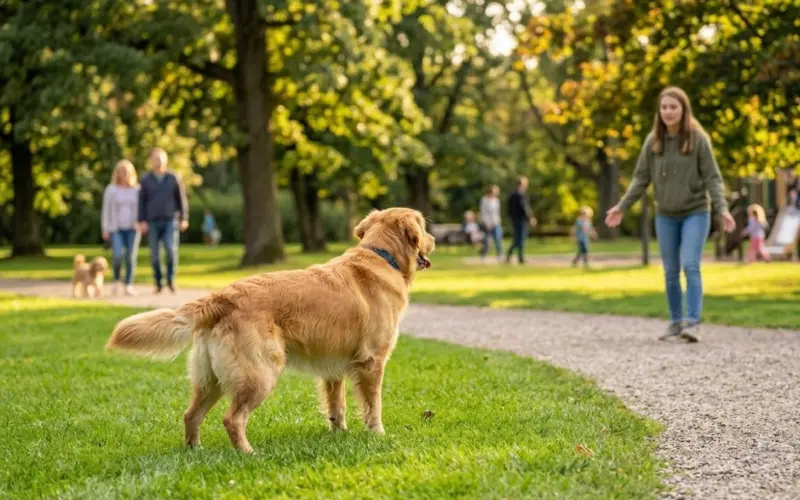
Recall Timeline — What to Realistically Expect
This dog recall training step by step guide works — but it works over months, not days.
Here is the honest timeline.
Week 1 to 2
Where Training Should Be: Foundation at home
What Reliable Means: Instant response every time you call indoors.
Week 2 to 3
Where Training Should Be: Yard on a long line
What Reliable Means: Reliable recall at full long-line distance in a quiet yard.
Week 3 to 4
Where Training Should Be: Quiet outdoor environments
What Reliable Means: Responds despite mild environmental distractions.
Month 2
Where Training Should Be: Parks with moderate distractions
What Reliable Means: Interrupts sniffing and returns when called.
Month 3
Where Training Should Be: High-distraction environments
What Reliable Means: Interrupts play or movement and returns promptly.
Month 4 to 6
Where Training Should Be: Full proofing complete
What Reliable Means: Reliable recall in most real-world situations.
Ongoing — Forever
Where Training Should Be: Daily maintenance recalls
What Reliable Means: Recall remains strong through lifelong reinforcement.
Honest note: no recall is 100% reliable in every situation, at every arousal level, for every dog.
The goal is a recall that is reliable in the vast majority of everyday situations and that continues to improve with consistent maintenance over the dog’s lifetime.
The goal is a recall that is reliable in the vast majority of everyday situations and that continues to improve with consistent maintenance over the dog’s lifetime.
If following this timeline solo feels like a lot to track, SpiritDog’s Coming When Called + Outdoor Focus course walks through the exact same distance-and-distraction progression across 28 structured lessons, useful if you want a guided path rather than building the stages yourself.
Until your dog reliably responds in real-world situations, use a leash or long line whenever safety is a concern.
The methods in this guide are based on positive reinforcement principles supported by organizations such as the AKC and ASPCA.
Every dog learns differently, and recall reliability depends on factors like age, breed, temperament, environment, and training consistency.
For severe behavioral issues, fear, aggression, or persistent recall problems, consult a certified professional trainer.
Frequently Asked Questions (FAQ)
How long does it take to train a reliable recall?
A basic indoor recall typically develops within 1 to 2 weeks of consistent daily practice.
Reliable recall in low-distraction outdoor environments takes 3 to 4 weeks.
True real-world reliability — recall that interrupts interesting activities in busy environments — takes 3 to 6 months of systematic proofing.
Recall also requires lifetime maintenance to stay sharp.
Dogs whose recall is trained well but never maintained often regress within 6 to 12 months of the initial training ending.
My dog comes when called at home but ignores me outside — why?
Because recall in a new environment is essentially a different behavior that has not been trained there yet.
Every new environment reduces effective training performance, and the distractions outside are dramatically more compelling than anything at home.
Go back to basics in outdoor environments — use a long line, use your highest-value treats, practice at very short distances first, and rebuild recall in each new location before relying on it there.
This is not stubbornness — it is a generalization gap that requires specific outdoor practice to close.
What should I do when my dog ignores a recall completely?
Never repeat the cue and never chase your dog — both responses teach your dog that ignoring works.
Instead, use your long line to gently guide them back while continuing to encourage with an excited voice.
When they reach you — regardless of how much guidance was needed — reward generously.
Then reduce the difficulty level of the next session: shorter distance, fewer distractions.
The ignored recall tells you the current level was too hard.
Go back one step and rebuild.
Is it too late to train recall in an adult dog?
No — adult dogs can absolutely learn a reliable recall, even dogs with a long history of ignoring being called.
The process takes longer for dogs with established habits — plan for 4 to 6 months of consistent work rather than 2 to 3.
Consider starting with a fresh recall word that has no history of being ignored.
Adult dogs often have excellent focus when they understand the training rules and the rewards are truly worth their attention.
Should I use an e-collar for recall training?
E-collars — electronic collars — are not recommended for recall training in positive reinforcement methodology.
Recall built on avoiding correction is fundamentally different from recall built on reward — and significantly more fragile.
A dog that comes to avoid stimulation will become less reliable as arousal levels increase, while a dog that comes because coming is genuinely wonderful becomes more reliable as the training builds.
The ASPCA and AVMA both advise against aversive tools for recall training.
Can I use a clicker for recall training?
Yes — a clicker is an excellent tool for recall because it provides a precise, consistent marker at the exact moment of the desired behavior.
For recall specifically, click the moment your dog’s feet start moving toward you — not when they arrive.
This marks the turning and coming behavior precisely.
Follow immediately with your arrival reward.
If you do not have a clicker, a consistent verbal marker — “yes” — said at the same moment works equally well.
How do I practice recall safely off leash?
Only practice off-leash recall in fully enclosed, secure areas until your recall is genuinely proven reliable at high distraction levels — typically after 3 to 4 months of systematic training.
Suitable enclosed spaces include: fenced dog parks during quiet hours, fenced backyards, tennis courts, and enclosed training fields.
Never assume a recall is reliable off leash because it worked a few times — test systematically and increase difficulty gradually before trusting it in truly open environments.
Why does my dog only come for treats — not when I have nothing?
This means the lure-to-reward transition has not been completed.
The goal is a dog that comes on the recall cue alone, with treats appearing unpredictably from a pocket or treat pouch — not a dog that only responds when they can see or smell the treat.
Build this by progressively hiding treats before calling — in a pocket, in a treat pouch, in a bag nearby.
Call, reward from the hidden source.
Over weeks, the visual cue of a treat disappears but the expectation of a reward stays strong.
Intermittent rewards — sometimes treating, sometimes just praising — actually strengthen the behavior over time.
The Recall That Matters — Final Thoughts
My dog now turns and runs to me the moment he hears his name followed by “come” — not because he has to, but because in his experience, that sound has always meant the best thing that happened that day.
That did not come from one training session.
It came from hundreds of small, rewarded repetitions over several months.
From never punishing a return.
From maintenance recalls three times a day for the entire time I have owned him.
From upgrading treats in hard environments.
From following through on the long line calmly when he needed guidance.
Now that you have this complete dog recall training step by step guide — here are your three key takeaways:
- Every return gets rewarded — always, forever, without exception. Speed does not matter. What matters is that coming to you always predicts something wonderful.
- Never call what you cannot reward — if you need your dog for something unpleasant, go get them. Protect the recall word like it is the most valuable thing in your training vocabulary. Because it is.
- Maintenance is not optional — three practice recalls per day for the life of your dog. Sixty seconds. The behavior that is reinforced stays strong. The behavior that is ignored fades. Recall fades.
For the complete positive reinforcement foundation that makes this guide work — read our complete positive reinforcement dog training for beginners guide.
And if you are also building stay alongside recall — the two commands work beautifully together. Read our guide on how to train a dog to stay with distractions for the complete method.



Pingback: Dog Training Aids, The Complete Guide for 2026