My dog ate a couch cushion because I left him alone with nothing to do for four hours.
Not chewed it.
Ate it.
I came home to a gutted cushion, a living room covered in foam, and a dog who looked at me like nothing unusual had happened.
He was not being bad.
He was bored out of his mind.
Four hours with zero mental stimulation and a brain that needed something — anything — to work on.
The cushion was the most interesting thing available.
That $200 cushion replacement was the moment I invested in interactive toys.
Not as treats.
Not as extras.
As essential daily equipment — the same category as food and water.
The best interactive dog toys are not fancy gadgets.
They are simple tools that give your dog’s brain something to solve while you are busy, sleeping, or not home.
The difference between a bored dog and a mentally satisfied dog is usually a $15 puzzle toy and 10 minutes of daily use.
This guide reviews 6 best interactive dog toys that actually prevent boredom — tested, honest, with the specific dogs each one works best for.
Budget pick: AWOOF Snuffle Mat ($15 to $20).
15 minutes of mental stimulation equals roughly 30 minutes of physical exercise for cognitive fatigue — making puzzle toys the most efficient boredom buster available.
Why Boredom Destroys More Than Furniture
A bored dog is not a lazy dog.
A bored dog is a dog whose brain has nothing to work on — and a brain that needs work will find it.
Dogs evolved to spend much of their waking hours solving problems — hunting, foraging, navigating terrain, and exploring their environment.
Modern dogs, however, often receive their entire daily calorie intake in a bowl that takes less than a minute to finish, leaving their problem-solving brain largely unstimulated for the rest of the day.
Chewing furniture.
Digging holes.
Excessive barking.
Destroying shoes.
Shredding pillows.
These are not behavioral problems.
They are often symptoms of a brain that has nothing productive to do.
According to the American Kennel Club, dogs need mental stimulation as well as physical exercise, and puzzle toys that challenge a dog to work for treats provide cognitive engagement that can reduce boredom and destructive behavior.
The fix is not always more walks.
Most owners already walk their dogs.
The fix is mental enrichment — giving your dog’s brain a daily problem to solve.
That is exactly what the best interactive dog toys are designed to do.
Best Interactive Dog Toys — 6 Picks Reviewed
These 6 toys cover every type of mental enrichment — stuffable toys, puzzle boards, foraging mats, and tough-chewer options.
Every product is verified available on Amazon.
1. KONG Classic — Best Overall
The gold standard of interactive dog toys for over 40 years.
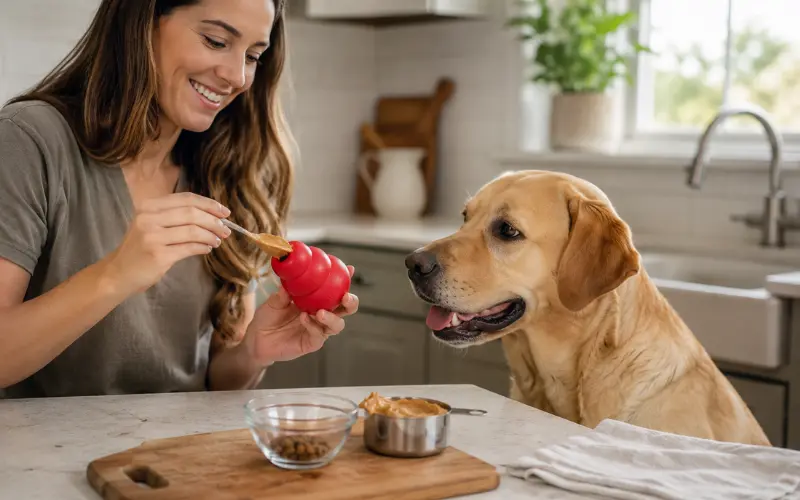
Stuff it with peanut butter, kibble, or wet food.
Freeze it overnight.
Hand it to your dog.
Twenty minutes of focused licking and chewing that calms, engages, and satisfies.
Natural rubber that bounces unpredictably for fetch.
Dishwasher safe.
Veterinarian and trainer recommended worldwide.
Available in 6 sizes from X-Small to XX-Large.
The KONG Classic is one of the most recommended interactive dog toys by veterinarians and professional trainers.
When stuffed and frozen, it can provide 15 to 30 minutes of focused mental engagement that creates meaningful cognitive fatigue and enrichment.
KONG Classic Stuffable Dog Toy — Large, Red — Natural rubber, stuffable, freezable, and dishwasher safe. A long-standing bestseller in the dog toy category and an industry standard for canine enrichment.
Not ideal for: power chewers who destroy standard rubber — upgrade to the KONG Extreme (black) for aggressive chewers.
2. Nina Ottosson Dog Tornado — Best Puzzle Board
One of the best interactive dog toys for dogs that need to think — not just chew.
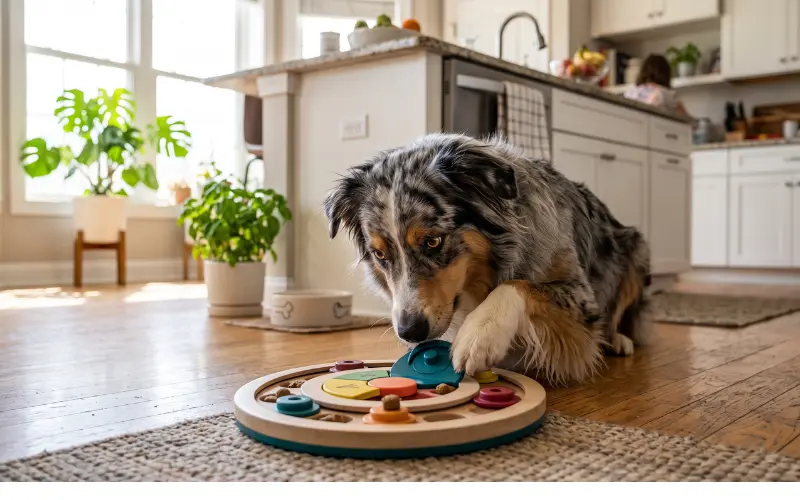
Three spinning layers contain twelve treat compartments.
The dog nudges the layers, they spin, and treats appear.
The reward loop establishes within the first minute for most dogs.
Level 2 intermediate difficulty.
Bone-shaped covers add extra challenge for smart dogs that solve it too quickly.
Holds approximately half a cup of kibble.
BPA, PVC, and phthalate free.
Hand washable.
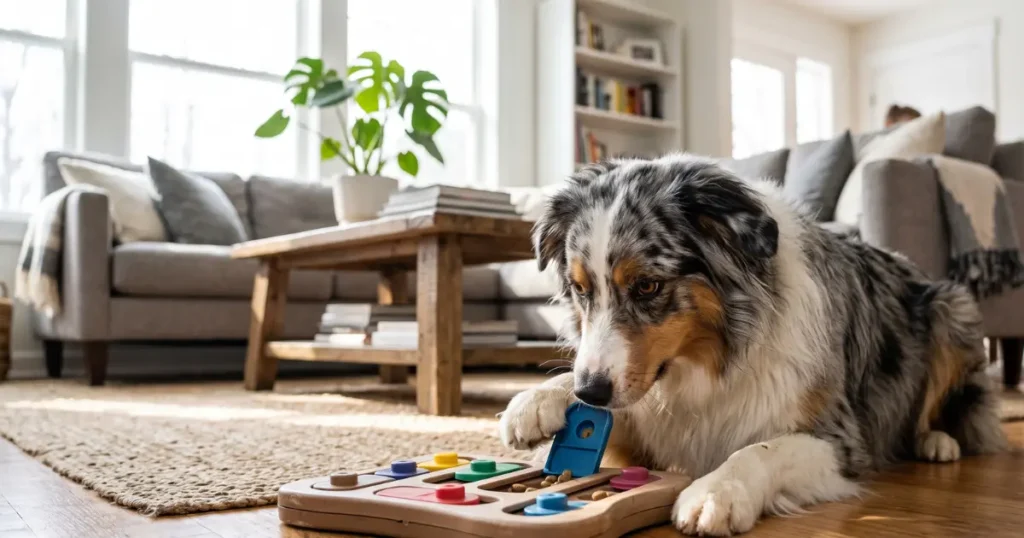
Nina Ottosson Dog Tornado — Level 2 — Three spinning layers, 12 treat compartments, and adjustable difficulty using bone-shaped covers. One of the most popular dog puzzle boards available.
Not ideal for: dogs that flip puzzle boards over rather than solving them, or dogs that chew plastic. This is a supervised toy and should be removed after the play session.
Price range: $10 to $15
3. West Paw Zogoflex Toppl — Best Freezable Treat Toy
The KONG alternative that is easier to fill, easier to clean, and can interlock with a second Toppl for increased difficulty.
The bowl-shaped design features flexible rubber prongs that help hold treats in place.
Stuff it with wet food, peanut butter, or kibble and freeze it.
Dogs lick, nudge, and roll the toy to extract rewards.
Buying two sizes allows the smaller Toppl to lock into the larger one, creating a more advanced puzzle.
Made in Bozeman, Montana from recyclable Zogoflex material.
BPA free.
Dishwasher safe.
West Paw Zogoflex Toppl — Large — Freezable, stuffable, interlocking design. Made in the USA, BPA free, dishwasher safe, and fully recyclable through West Paw’s recycling program.
Not ideal for: power chewers that routinely bite through rubber toys. The Toppl is designed for moderate chewers. Aggressive chewers are better served by the West Paw Tux.
Price range: $16 to $22
4. Nina Ottosson Dog Brick — Best Multi-Method Puzzle
The most challenging beginner-friendly puzzle on this list.
Dogs must perform three different actions to access rewards: flip open lids, slide bone covers, and remove blocks.
Because it requires multiple solving strategies, it keeps intelligent dogs engaged longer than simpler puzzles.
Level 2 intermediate difficulty with a 3-in-1 challenge design.
Holds approximately three-quarters of a cup of kibble.
It can also function as a slow feeder, turning a 30-second meal into a 15 to 20-minute enrichment session.
Nina Ottosson Dog Brick — Level 2 — Flip, slide, and remove compartments with adjustable difficulty levels. A strong choice for smart breeds that need additional mental stimulation.
Not ideal for: dogs that quickly lose interest in stationary toys. Start with easier compartments uncovered and increase the challenge gradually.
5. AWOOF Snuffle Mat — Best Foraging Enrichment
One of the best interactive dog toys for nose work and scent-based enrichment.
A snuffle mat transforms mealtime into a scent hunt that engages your dog’s strongest natural ability — their sense of smell.
The 28 × 28-inch design features layered fabric petals and grass-like strips that conceal kibble and treats.
A non-slip backing helps keep the mat in place.
Release buckles allow it to attach to furniture legs.
Several additional feeding challenges are built into the design for experienced dogs.
Machine washable.
According to the American Kennel Club, snuffle mats help keep dogs mentally stimulated, encourage natural foraging behavior, and slow down fast eaters.
AWOOF Snuffle Mat — 28 × 28 Inch Interactive Feeding Mat — Layered fabric petals, multiple enrichment challenges, non-slip backing, and machine-washable construction. One of the most popular snuffle mats available.
Not ideal for: aggressive chewers that rip fabric. Supervise early sessions. If your dog destroys the mat instead of sniffing it, switch to a hard-surface puzzle toy.
6. West Paw Zogoflex Tux — Best for Power Chewers
Most interactive toys cannot survive aggressive chewers.
The Tux can.
A deep treat cavity securely holds food and rewards.
The Zogoflex material is flexible enough to remain engaging while being tough enough for dogs that destroy standard enrichment toys.
It also bounces unpredictably and floats, making it useful for both enrichment and fetch.
Dishwasher safe.
Made in the USA from recyclable materials.
West Paw Zogoflex Tux — Large — Tough Zogoflex construction, stuffable cavity, dishwasher safe, floating design, and made in the USA. Built specifically for aggressive chewers.
Not ideal for: dogs that are not strong chewers. The Tux is firmer than a KONG Classic or Toppl, making treats more difficult to access. Dogs that become frustrated easily may do better with softer enrichment toys first.
Quick Comparison — Which Toy Fits Your Dog
How to Choose the Right Interactive Toy
Not every toy works for every dog.
Choosing the best interactive dog toys means matching the toy type to your dog’s personality.
That determines whether the toy gets used daily or ignored after day one.
Chewers → Stuffable Toys (KONG, Toppl, Tux)
If your dog’s default behavior is chewing, stuffable toys redirect that energy into something productive.
Fill them with kibble, wet food, yogurt, or peanut butter and freeze them for longer-lasting engagement.
These toys satisfy the natural urge to chew while keeping your dog mentally occupied.
Problem Solvers → Puzzle Boards (Tornado, Brick)
If your dog figures things out quickly, opens doors, finds hidden treats, or learns commands fast, puzzle boards are usually the best fit.
Toys that require multiple actions and problem-solving strategies provide the mental challenge intelligent dogs crave.
Sniffers → Foraging Toys (Snuffle Mats)
If your dog spends most walks with their nose glued to the ground, snuffle mats are often the most rewarding enrichment option.
They tap directly into a dog’s natural foraging instincts and transform ordinary meals into scent-based treasure hunts.
The most effective way to choose an interactive dog toy is to match the toy type to your dog’s natural behavior.
Chewers usually benefit most from stuffable toys such as KONGs and Toppls.
Problem solvers thrive with multi-step puzzle boards.
Scent-driven dogs tend to get the most enjoyment from snuffle mats and other foraging games.
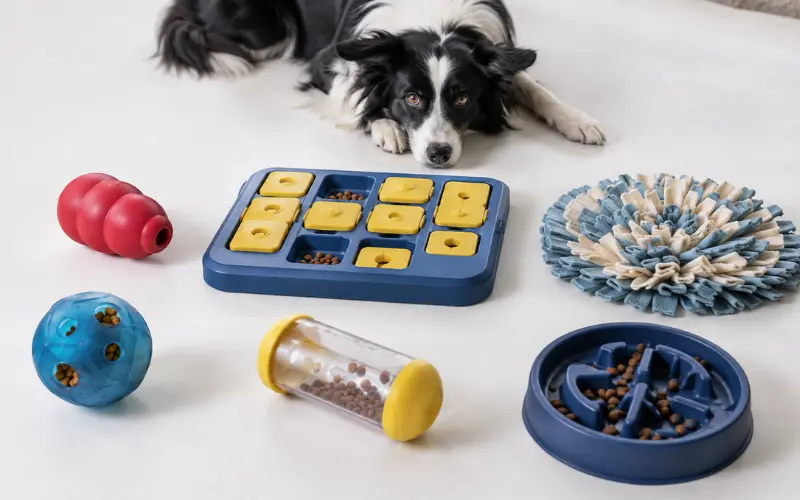
The Rotation System — Why 2–3 Toys Beat 10
Dogs get bored of the same toy the same way you get bored of the same meal.
Even the best interactive dog toys lose their appeal when they are available 24/7.
The solution is not buying more toys.
It is rotating fewer toys more strategically.
Keep only 2 to 3 interactive toys available at any given time.
Store the rest out of sight.
Every 3 to 4 days, swap the current toys for different ones from storage.
When a toy returns after a week or so of being unavailable, most dogs treat it like something brand new.
The novelty returns without spending another dollar.
Rotating a small collection of toys is often far more effective than leaving 10 toys on the floor all the time.
Dogs tend to lose interest in constantly available toys within a few days, but toys that disappear and reappear remain exciting and engaging for much longer.
A simple rotation system keeps mental enrichment fresh while maximizing the value of every toy you already own.
Rotate the puzzle boards and snuffle mat around it.
The stuffable toy becomes a predictable daily enrichment ritual while the rotating toys provide variety.
This two-layer system keeps your dog engaged without requiring you to buy a new toy every week.
According to the American Kennel Club, brain games and puzzle toys provide mental stimulation that is just as important as physical exercise. For many dogs, 15 minutes of focused puzzle-solving can create a level of mental fatigue comparable to approximately 30 minutes of walking, making enrichment toys an effective way to supplement daily exercise and reduce boredom.
For the training foundation that makes interactive toys more effective, read our guide on positive reinforcement dog training for beginners.
Common Mistakes That Make Interactive Toys Fail
These mistakes are why many owners say, “My dog doesn’t like puzzle toys.”
In reality, even the best interactive dog toys fail when they are introduced incorrectly.
Starting Too Hard
Beginning with a difficult challenge frustrates dogs and often causes them to quit.
Start with the toy completely open and the treats easy to access.
Let your dog experience success immediately.
Increase the difficulty gradually over multiple sessions.
A dog that fails on the first attempt often learns to ignore the toy altogether.
Leaving Puzzle Toys Out All Day
Puzzle boards lose their novelty when they are always available.
Think of puzzle boards as session toys.
Use them for 10 to 15 minutes of supervised enrichment, then put them away.
Stuffable toys such as KONGs and Toppls can remain available longer because the challenge is built into the food extraction process.
Using Low-Value Rewards
A puzzle toy is only as motivating as what is inside it.
Dry kibble often provides less motivation than high-value treats.
For puzzle boards, use small pieces of chicken, cheese, freeze-dried liver, or other rewards your dog loves.
Reserve kibble for snuffle mats, where the scent-hunting experience is the primary source of engagement.
Only Offering Toys After Bad Behavior
One of the biggest mistakes is treating enrichment toys as a response to destructive behavior.
Interactive toys work best when they are part of a daily routine.
Mental stimulation should be preventative, not reactive.
Give your dog regular opportunities to engage their brain before boredom becomes a problem.
According to the ASPCA, regular mental enrichment through interactive toys, training games, and problem-solving activities is one of the most effective ways to prevent behavioral issues and improve a dog’s overall quality of life.
For dogs with boredom-driven separation anxiety, read our guide on how to stop dog separation anxiety when left alone.
Always supervise your dog during puzzle board sessions.
Remove and replace any toy that shows damage — cracked plastic, torn fabric, or broken pieces are choking hazards.
Stuffable rubber toys (KONG, Toppl, Tux) are designed for longer unsupervised use but should still be inspected regularly.
The products in this guide are based on real-world testing, professional trainer endorsements, and verified Amazon reviews.
Every dog is different — supervise all toy use and choose toys matched to your dog’s size and chewing behavior.
Frequently Asked Questions (FAQ)
What are the best interactive toys for dogs?
The KONG Classic is the best overall interactive toy for daily enrichment.
Stuff it, freeze it, and it can provide 15 to 30 minutes of focused engagement.
For puzzle-solving dogs, the Nina Ottosson Dog Tornado and Dog Brick offer multi-level mental challenges.
For nose work and scent enrichment, the AWOOF Snuffle Mat turns meals into engaging foraging games.
For power chewers, the West Paw Tux provides durable construction with a stuffable cavity.
How long should a dog play with a puzzle toy?
Ten to fifteen minutes per session is ideal for puzzle boards and snuffle mats.
Stuffable toys such as KONGs and Toppls can last 15 to 30 minutes when frozen.
Most dogs experience mental fatigue after about 15 minutes of focused problem-solving.
Two short daily enrichment sessions are usually more effective than one long session.
Do interactive toys actually help with boredom?
Yes.
Interactive toys are one of the most effective tools for preventing boredom-related destructive behavior.
Dogs that receive daily mental enrichment often show less chewing, barking, digging, and anxiety than dogs that receive only physical exercise.
The key is consistency.
Daily enrichment is far more effective than occasional enrichment.
Can I leave my dog alone with a puzzle toy?
Stuffable rubber toys such as KONGs, Toppls, and Tux toys are generally safer for independent use because they are made from durable materials.
Puzzle boards with removable plastic pieces should only be used under supervision.
Snuffle mats should also be supervised for dogs that chew fabric rather than naturally sniff and forage.
What is the best toy for a dog that destroys everything?
The West Paw Zogoflex Tux and KONG Extreme are among the best choices for aggressive chewers.
Both use durable rubber compounds designed to withstand heavy chewing.
Avoid fabric toys and plastic puzzle boards for dogs that routinely destroy toys.
Instead, focus on solid rubber enrichment toys designed for power chewers.
How do I get my dog interested in puzzle toys?
Start with the easiest possible setup.
Leave compartments open, make treats visible, and keep the challenge minimal.
Allow your dog to succeed immediately.
Gradually increase the difficulty as confidence grows.
Use high-value rewards such as chicken, cheese, or freeze-dried liver during the first few sessions.
Never force interaction.
Curiosity and success should drive engagement.
Are snuffle mats good for dogs?
Yes.
Snuffle mats provide mental stimulation, slow down fast eaters, and encourage natural foraging behavior.
They are especially helpful for anxious dogs because sniffing activities can have a calming effect.
As with any fabric enrichment toy, supervise dogs that tend to chew or shred material.
How many interactive toys does a dog need?
Two to three interactive toys in rotation are usually ideal.
Keep one daily anchor toy, such as a KONG or Toppl, and rotate one or two puzzle toys or snuffle mats every few days.
Rotation maintains novelty and interest more effectively than having a large collection available all the time.
A $15 Toy Saved a $200 Cushion — Final Thoughts.
One couch cushion.
That is what it took for me to realize that my dog did not have a behavior problem.
He had a boredom problem.
A $15 KONG Classic, frozen with peanut butter every morning before I left for work, changed everything.
No more destroyed cushions.
No more shredded shoes.
No more coming home to a living room that looked like a crime scene.
Three things to take with you:
Start with one stuffable toy.
A KONG Classic is one of the highest-return investments in dog enrichment.
Freeze it overnight and include it in your morning routine.
Few enrichment tools deliver as much value for so little cost.
Match the toy to the dog.
Chewers need stuffable rubber toys.
Problem solvers need puzzle boards.
Sniffers need snuffle mats.
A toy that does not match your dog’s instincts will often be ignored, regardless of ratings or reviews.
Mental exercise matters.
Mental enrichment does not replace physical exercise, but it fills a gap that walking alone cannot address.
A dog that uses their brain regularly is often calmer, more satisfied, and less likely to invent their own entertainment.
For the complete training approach that pairs perfectly with interactive enrichment, read our guide on Positive Reinforcement Dog Training for Beginners.
For nutrition that supports the calorie management needed when using treat-based enrichment daily, read our complete dog nutrition guide for beginners.