


My dog once cleared an entire cooling rack of cookies in the 4 minutes it took me to answer the front door. Not one bite left behind, just crumbs and a suspiciously innocent expression.
That single successful raid taught him more than 6 months of “no counter surfing” ever undid. That’s genuinely the frustrating truth about this behavior: it doesn’t take repetition to become a habit. One good payoff is often enough to convince a dog the counter is worth checking, every single time, for years.
This guide covers real dog counter surfing training, a 7-step protocol backed by actual research on why dogs do this, a day-by-day plan you can follow, and specific troubleshooting for when the usual advice isn’t working. No vague “just keep your counters clean” advice. Real mechanics, real steps, real timelines.
Most guides online repeat the same 3 or 4 tips without explaining why they work or what to do when they don’t. This one goes further, covering the specific evolutionary reasons dogs scavenge in the first place, the real difference between training a puppy who’s never succeeded yet versus an adult dog with months of reinforcement history, and exactly what to do if progress stalls after weeks of genuine effort.
To stop counter surfing, remove the payoff by keeping counters clear and managing access, while teaching an alternative such as “place” or “leave it” that earns a better reward.
Counter surfing is self-reinforcing because your dog rewards itself the moment it succeeds, so punishment after the fact usually won’t help. With consistent management and training, many dogs show noticeable improvement within 2 to 3 weeks, though long-established habits can take longer to fully resolve.
This training works best when management (clearing counters, blocking access) is combined with teaching an incompatible behavior like “place” or “leave it,” since the behavior is self-reinforcing and punishment after the dog has already stolen food does little to change future attempts.
Why Do Dogs Counter Surf?
It’s a Self-Rewarding Behavior
Counter surfing doesn’t need your involvement to succeed. The moment a dog’s mouth reaches food on a counter, the behavior has already paid off, with or without you noticing.
One prominent theory of dog domestication, called the “commensal scavenger hypothesis,” proposes that dogs’ wolf ancestors essentially domesticated themselves by scavenging food scraps left at the edges of early human settlements, with bolder wolves tolerating human proximity to gain a food advantage. A detailed 2021 academic review of dog domestication theories examined this idea directly, alongside a competing theory, and concluded the scavenger hypothesis alone does not fully explain domestication, favoring instead a theory centered on early human adoption and socialization of wolf pups. Either way, the review confirms that a drive toward scavenging opportunistic food sources is a genuinely old and well-documented behavioral thread in dogs’ evolutionary history.
Citation, Frontiers in Veterinary Science (2021) Verified
“Commensalism or Cross-Species Adoption? A Critical Review of Theories of Wolf Domestication.”
A widely cited 2021 academic review of dog domestication theories found that scavenging alone likely doesn’t fully explain how dogs became domesticated, but confirmed that a drive toward opportunistic food-seeking is a genuinely old and well-documented behavioral thread running through dogs’ evolutionary history.
Intermittent Reinforcement Makes It Worse
If a dog succeeds even occasionally, the behavior becomes genuinely harder to eliminate than if it worked every single time. This is the same mechanism behind slot machine addiction in people, an unpredictable reward schedule keeps the behavior alive far longer than a consistent one would.
Boredom and Under-Exercise
Dogs without enough physical or mental stimulation often look for their own entertainment, and a kitchen counter full of interesting smells is a genuinely reliable source of it.
Puppies vs. Adult Dogs
Puppies often start investigating counters out of simple curiosity and a developing sense of smell, before any specific reward has occurred. Adult dogs who counter surf almost always have a documented history of at least one successful raid, which means the training approach for an adult dog needs to specifically account for an existing reinforcement history, not just prevent a new habit from forming.
For our complete guide to teaching a puppy good household manners from the start, read our guide on how to potty train a puppy fast at home.
Before Training, Remove the Reward
Kitchen Management Basics
- Clear counters completely when you’re not actively supervising, not just food, but anything with an interesting smell.
- Wipe down surfaces after cooking. Lingering scent alone can trigger investigation even on a visually empty counter.
- Store trash in a container your dog genuinely can’t open, since trash scavenging follows the same reinforcement pattern as counter surfing.
According to the American Kennel Club, if a dog never finds food on the counter, it genuinely won’t develop the association in the first place, which is why prevention is considered the single most effective starting point before any specific training technique.
Managing food properly means using airtight storage, keeping food away from counter edges during preparation, and getting consistent follow-through from everyone in the household. Even occasional lapses can keep a counter-surfing habit going when it’s otherwise close to resolved.
What Everyone in the Household Must Do
One household member who occasionally feeds from the table, “just this once,” genuinely undermines weeks of consistent work from everyone else. Brief every family member on the same rule before training starts.
The American Veterinary Society of Animal Behavior’s own article on counter surfing explains that by the time an owner reacts to a dog stealing food, even a mild scolding, the behavior has already been reinforced, since the reward (the food) was obtained before any correction could happen.
Response prevention – simply never letting the behavior succeed – can be more effective long-term than correcting it after the fact. If your dog has never found food on the counter, there’s nothing to self-reward, making the habit much harder to establish in the first place.
Dog Counter Surfing Training in 7 Steps
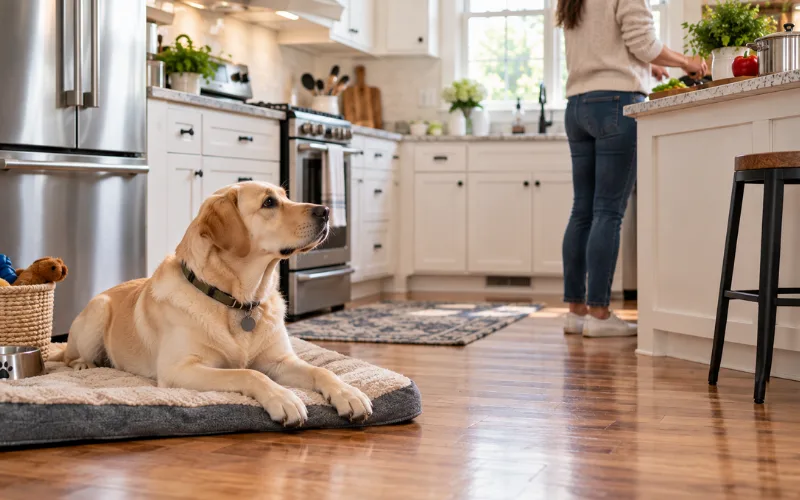
Step 1, Teach “Place” or “Go to a Mat”
A dog lying on a designated mat is physically unable to counter surf at the same time. This incompatible-behavior approach is genuinely more effective long-term than only telling your dog what not to do.
- Start away from the kitchen entirely. Lure your dog onto a mat or bed, mark with “yes” or a clicker, and reward.
- Gradually increase how long your dog stays on the mat before the reward arrives.
- Common mistake: moving to the kitchen too soon, before the mat behavior is genuinely reliable elsewhere first.
Step 2, Teach “Leave It” Away From the Kitchen First
Building this command outside the high-temptation kitchen environment sets your dog up to actually succeed once the real test comes.
- Show a treat in your closed fist. Say “leave it,” and wait for your dog to stop sniffing or pawing at your hand.
- The instant they back off, mark and reward from your other hand, not the one they were investigating.
- Common mistake: introducing “leave it” for the first time directly at the counter, where the stakes and distraction are both too high for a new skill.
Practice “leave it” with the treat visible and reachable at first, rather than hiding it. Dogs often learn the impulse-control part faster when they can clearly see what they’re choosing not to take, instead of starting with a closed hand.
Step 3, Practice With Low-Value Temptation
Once both behaviors are solid separately, combine them with a low-stakes test.
- Place a low-value item (not your dog’s favorite food) on the counter with your dog on leash nearby.
- Cue “place” or “leave it” before your dog has a chance to investigate on their own.
- Common mistake: skipping straight to high-value temptation (like real cooking) before this easier version is reliable.
Step 4, Add Real Cooking Distractions
Cooking is genuinely the highest-distraction scenario most dogs face daily, real food smells, movement, and sustained time near the counter.
- Cue your dog to their place before you start cooking, not after they’ve already approached the counter.
- Reward intermittently throughout cooking, not just at the very end, to keep the mat genuinely more rewarding than the counter.
- Common mistake: only rewarding once, at the very end of cooking, which makes staying on the mat feel far less worthwhile than checking the counter repeatedly.
Step 5, Reward Calm Behavior During Meal Prep
This step is about catching the behavior you want, proactively, rather than only reacting when things go wrong.
- Actively praise or toss a treat to your dog’s mat when they’re simply lying there, doing nothing, while you cook.
- This directly counters the common mistake of only paying attention to a dog once it’s already at the counter.
Step 6, Generalize to the Dining Table
Counter surfing and table surfing use the same underlying mechanism, but dogs don’t always automatically transfer a learned behavior between contexts.
- Repeat the same place/leave it protocol specifically during meals at the table, not just during kitchen cooking.
- Common mistake: assuming success in the kitchen automatically means success at the dining table too.
Step 7, Maintain With Intermittent Real-Life Practice
Ongoing, occasional practice in real conditions (unattended food briefly on the counter, under close supervision) keeps the learned behavior genuinely solid over the long run.
- Once reliable, transition from food rewards every time to occasional praise, mimicking a natural, sustainable long-term pattern.
- Common mistake: stopping all practice the moment the behavior seems solved, which can allow the old habit to resurface.
What to Do When Your Dog Counter Surfs During Training
If Your Dog Jumps Up Anyway
Calmly redirect to the mat without scolding. A frustrated reaction still counts as attention, and attention can inadvertently reinforce the behavior in some dogs. If jumping is a bigger issue than counter surfing right now, our jumping training guide covers it in depth.
If Your Dog Steals Something Before You Notice
Don’t chase or grab at your dog’s mouth, this can teach a genuinely worse habit of running off with stolen items. Focus instead on preventing the next opportunity rather than punishing this one.
If Progress Stalls After Several Weeks
Check for household inconsistency first, one person feeding from the table is the single most common reason training plateaus. Also verify the mat or “leave it” reward is genuinely more valuable to your dog than whatever’s typically on the counter.
If Your Dog Won’t Settle on the Mat During Cooking
Drop back to shorter, easier durations. A dog that can’t hold a 5-minute mat-stay yet isn’t ready for a 30-minute cooking session next to real food.
Counter Surfing in Puppies vs Adult Dogs
This distinction genuinely matters for how you approach training, and it’s a gap most guides skip entirely.
- Puppies are often investigating out of simple curiosity and a developing sense of smell, before any specific reward has reinforced the behavior yet. Early management (never letting a puppy successfully steal food even once) is genuinely easier than correcting an adult dog’s established habit.
- Adult dogs with an established habit need training that accounts for a real reinforcement history. Expect a longer timeline and a stronger, more reliable competing reward than you’d need for a puppy who has never succeeded yet.
- Senior dogs developing counter surfing for the first time later in life are worth mentioning to a veterinarian, since new food-seeking behavior can occasionally reflect an underlying medical cause rather than a purely behavioral one.
For puppies specifically, addressing counter surfing works best as part of a complete early-training foundation. Our DIYK9 Puppy Essentials review covers a full course built around exactly this stage.
For Puppies Specifically
DIYK9 Puppy Essentials
Potty Training | Crate Training | Early Manners
See Puppy Essentials →Puppy counter surfing typically starts from curiosity before any reward has reinforced it, making early prevention genuinely easier, while adult dogs who counter surf almost always have an established reinforcement history that requires a stronger competing reward and a longer training timeline to override.
A 7-Day Counter Surfing Training Plan
Most competing guides list the steps without a concrete daily structure. Here’s one to actually follow.
This timeline assumes daily practice with a dog that has no significant prior reinforcement history. Adult dogs with an established counter surfing habit will likely need to repeat this structure 2 to 3 times before the new behavior feels genuinely solid.
Common Mistakes That Make Counter Surfing Worse
Leaving “Just One Item” Out
A single unattended item is genuinely enough to reinforce months of otherwise good management, since the dog only needs one success to keep trying.
Feeding From the Table
This directly teaches a dog that human food surfaces are a legitimate, sometimes-rewarding source of food, undermining the entire premise of the training.
Inconsistent Household Rules
Covered above, worth repeating: one household exception, maintained consistently, keeps the whole behavior alive indefinitely.
Punishing After the Fact
By the time you notice and react, the food is already gone and the behavior has already paid off. Correction at this point addresses your frustration, not the dog’s learning.
Skipping the Extinction Burst Warning
When a previously successful behavior suddenly stops working, some dogs briefly intensify their efforts before giving up entirely, jumping higher, trying new counters, or persisting longer than before. This is a normal, temporary phase, not a sign the training has failed.
Recognizing an extinction burst as a normal, temporary increase in effort, rather than a training failure, helps owners avoid giving up right before the behavior would have genuinely resolved on its own.
What If My Dog Still Counter Surfs?
- Dog only counter surfs when left alone: This often means the behavior was never actually eliminated, only suppressed by your physical presence. Management (a gate, a closed door) is necessary specifically for unsupervised time until training catches up.
- Dog specifically targets the trash can: Apply the same management-plus-incompatible-behavior approach. Secure the trash physically rather than relying on training alone for this specific target.
- Dog counter surfs despite knowing “leave it” reliably elsewhere: The command likely isn’t proofed under kitchen-level distraction yet. Rebuild the difficulty gradually in the actual target environment.
- Small breed dog jumps onto counters directly: The same incompatible-behavior training applies, though physical management (keeping chairs and stools pushed in, which some small dogs use as steps) becomes an additional practical consideration.
For a structured program addressing impulse control issues that often overlap with counter surfing, our SpiritDog course comparison includes a dedicated course built around this exact skill.
When Should You Get Professional Help?
- Counter surfing paired with growling or stiff body language when approached near food: This may indicate resource guarding rather than simple food-seeking.
- No meaningful improvement despite several weeks of genuinely consistent management and training across the whole household.
- A dog that appears to counter surf compulsively: Unable to be distracted or redirected even with high-value rewards available.
- New counter-surfing behavior appearing suddenly in a senior dog: A veterinary check is worth considering first to rule out a medical cause.
I am a dog owner sharing personal research and experience, not a certified professional trainer or applied animal behaviorist. If counter surfing is accompanied by food guarding, growling, or resource-guarding behavior around stolen items, consult a qualified professional before continuing training on your own.
Frequently Asked Questions (FAQ)
How do I stop my dog from counter surfing?
Combine strict kitchen management (clearing counters, blocking access) with teaching an incompatible behavior like u0022placeu0022 or u0022leave itu0022 that earns a reward your dog values more than stolen food. Consistency across every household member matters as much as the specific technique used
Why does my dog counter surf?
Counter surfing is self-reinforcing behavior rooted in dogs’ evolutionary history as opportunistic scavengers. A single successful raid can be enough to establish the habit, since the dog rewards itself the moment it succeeds, regardless of whether an owner notices.
Is it too late to stop an adult dog’s counter surfing habit?
No, but adult dogs with an established reinforcement history generally need a longer training timeline and a stronger competing reward than puppies who haven’t yet had a successful counter surfing experience.
Does punishing my dog after it steals food work?
Generally not well. By the time an owner reacts, the food is already gone and the behavior has already been reinforced.u003cbru003eResponse prevention, never letting the behavior succeed in the first place, is considered more effective long-term than after-the-fact correction.
What is an extinction burst in dog training?
An extinction burst is a temporary, often more intense attempt at a previously successful behavior right after it stops working. It’s a normal phase in eliminating a self-reinforcing behavior like counter surfing, not a sign the training has failed.
How long does it take to stop dog counter surfing?
Most dogs show real improvement within 2 to 3 weeks of consistent management and training. A habit built over months or years in an adult dog can take longer, sometimes requiring the training structure repeated 2 to 3 times before it feels fully solid.
Dog Counter Surfing Training, Final Takeaway
That cooling rack of cookies taught me the real lesson behind dog counter surfing training: it isn’t about correcting the dog in the moment, it’s about making sure that moment of opportunity never arrives in the first place.
Manage the environment relentlessly, teach a genuinely better option, and stay patient through the occasional setback. That combination, not any single clever trick, is what actually works.
For the complete comparison of structured training programs that build on these exact principles, read our guide on the best online dog training courses.
For the foundational method every technique in this guide relies on, read our positive reinforcement dog training for beginners guide.



Pingback: Dog Jumping Training, How to Stop a Dog From Jumping on People (2026)