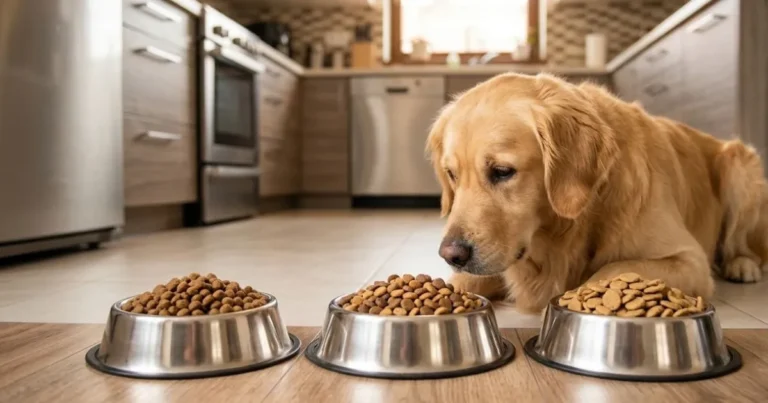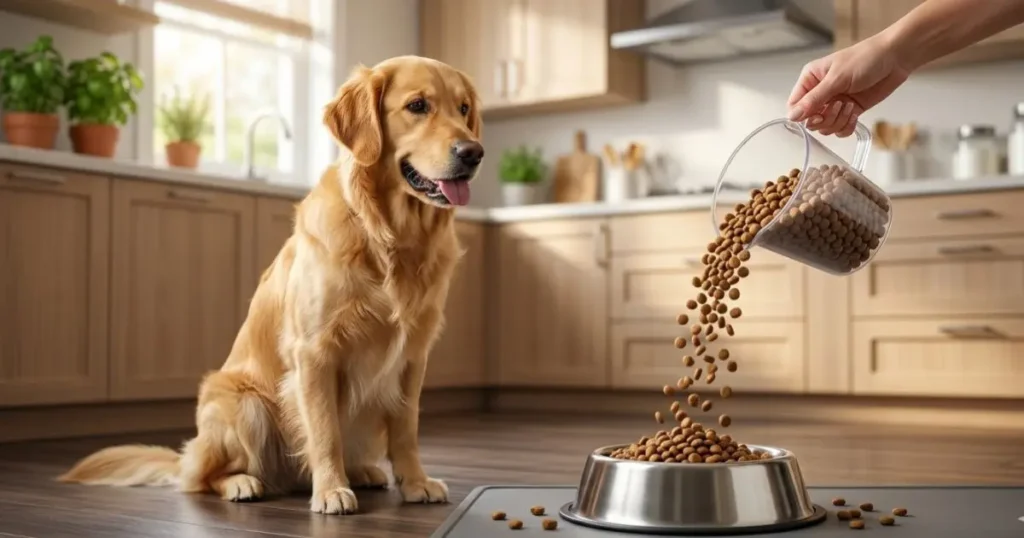
I was overfeeding my dog for four months before I realized it.
The bag said 2 cups per day.
My vet said 1.5 cups.
The difference was barely half a cup — but over four months it added 6 pounds to a dog that should have weighed 55.
That is like a person gaining 15 pounds from an extra handful of food per day.
The frustrating part was that I thought I was doing it right.
I was measuring.
I was following the instructions on the bag.
But the bag’s feeding guide is a general estimate — not a personalized prescription.
It does not know my dog’s activity level, metabolism, treat intake, or body condition.
Figuring out how much should I feed my dog by weight sounds like it should be simple.
It isn’t — not without understanding the factors that make every dog’s needs different.
This guide gives you the complete feeding charts by weight, breed size, age, and activity level, plus the body condition check that tells you whether your portions are actually right.
Let’s get your dog’s me/als dialed in.
As a general guideline, dogs weighing 5–10 lbs typically need about ⅓–¾ cup of food daily, dogs weighing 25–50 lbs need approximately 1½–2½ cups, and dogs weighing 75–100 lbs generally require around 3½–4½ cups per day.
Most adult dogs do best when their daily food amount is divided into two meals.
Always measure food with a proper measuring cup rather than estimating portions, and adjust feeding amounts based on your dog’s body condition, activity level, age, and the calorie density of the food.
Why Getting Portions Right Actually Matters
This is not about being precise for the sake of it.
Getting portions wrong has real health consequences for your dog — and most owners are getting it wrong without realizing.
Over 56% of dogs in the United States are classified as overweight or obese, and the primary cause is overfeeding — not poor food quality or lack of exercise.
The Cost of Overfeeding
An overweight dog is not just a heavier dog.
Excess weight directly causes:
- Joint problems — arthritis develops earlier and progresses faster in overweight dogs
- Shortened lifespan — studies show overweight dogs live 2 to 2.5 years less than dogs at healthy weight
- Diabetes — insulin resistance increases with body fat
- Heart disease — extra weight puts chronic stress on the cardiovascular system
- Reduced quality of life — less mobility, less play, more pain
A landmark study by Purina showed that Labrador Retrievers maintained at ideal weight lived an average of 1.8 years longer than their overfed littermates.
Almost two extra years — from portion control alone.
The Cost of Underfeeding
Underfeeding is less common but equally harmful:
- Muscle wasting and weakness
- Dull, dry coat and skin problems
- Weakened immune system
- Slowed growth in puppies — permanent damage possible
- Lethargy and behavioral changes
The goal is a dog at ideal body condition — not too heavy, not too thin, with energy, a shiny coat, and visible health.
According to the American Kennel Club, maintaining a healthy weight through appropriate portion sizes is one of the most impactful things an owner can do for their dog’s long-term health and longevity.
Complete Dog Feeding Chart by Weight
This is what you came here for.
Here is how much should I feed my dog by weight — the complete chart for standard adult dry kibble.
Adult Dog Daily Feeding Chart
These amounts are for standard adult dry kibble with approximately 350 to 400 calories per cup.
Premium high-calorie kibble requires less per meal.
Always check the specific calorie content on your food bag.
Puppy Feeding Chart by Weight and Age
Puppies need significantly more calories per pound than adult dogs — but fed in smaller, more frequent meals.
Use the feeding guide on your puppy food package as a starting point, then adjust portions based on your puppy’s growth, body condition, and your veterinarian’s recommendations.
For the complete week-by-week puppy feeding breakdown, read our puppy feeding schedule by age guide.
Senior Dog Feeding Adjustments
Dogs over 7 years typically need 20 to 30% fewer calories than young adult dogs.
Their metabolism slows, activity decreases, and excess weight becomes increasingly dangerous for aging joints.
Senior feeding adjustments:
- Reduce daily amount by 20 to 30% from adult chart
- Maintain 2 meals per day
- Consider senior-specific formula with joint support
- Weigh monthly and adjust as needed
- Consult vet for any significant weight changes

Adjusting Portions by Activity Level
The chart above is a starting point — not a final answer.
Your dog’s actual needs depend heavily on how active they are throughout the day.
A highly active working dog may need up to 40% more calories than the standard feeding chart suggests, while a sedentary indoor dog may need 20 to 30% less than the chart amount.
Activity Level Adjustments
Seasonal Adjustments Most Owners Miss
Dogs burn more calories in cold weather to maintain body temperature, and less in hot weather when activity naturally decreases.
- Winter months: increase portions by 10 to 15% for outdoor dogs
- Summer months: decrease portions by 10 to 15% if activity drops
- Indoor-only dogs: seasonal adjustment usually unnecessary
The Treat Problem — Hidden Calories
This is where most portion calculations fall apart.
A 50-pound dog eating 2.5 cups of kibble per day is getting approximately 900 calories.
Now add:
- 3 training treats throughout the day — 30 calories
- 1 dental chew — 70 calories
- A small piece of cheese from the table — 60 calories
- A biscuit before bed — 40 calories
That is 200 extra calories — roughly 22% of their daily needs — on top of their regular meals.
The rule: treats should never exceed 10% of daily caloric intake.
If you give regular treats, reduce the next meal by the same approximate amount.
The Body Condition Score — The Real Answer
Charts tell you where to start.
The body condition score tells you whether you are feeding the right amount for your specific dog.
This is the single most important tool for answering how much should I feed my dog by weight accurately.
How to Check Body Condition at Home
Three simple checks — takes 30 seconds:
Check 1 — The Rib Test
Run your hands along your dog’s ribcage.
You should feel the ribs under a thin layer of fat without pressing hard.
Like the back of your hand when you make a fist — bones detectable but cushioned.
- Cannot feel ribs at all → overweight
- Ribs easily felt with light touch → ideal
- Ribs visible without touching → underweight
Check 2 — The Overhead View
Look at your dog from directly above.
You should see a visible waist — a narrowing behind the ribs before the hips.
Like a gentle hourglass shape.
- No waist visible, barrel shaped → overweight
- Clear waist visible → ideal
- Dramatic waist, spine visible → underweight
Check 3 — The Side View
Look at your dog from the side.
The belly should tuck up from the chest — a slight upward angle from the ribcage to the back legs.
- Belly hangs down level with chest → overweight
- Gentle upward tuck visible → ideal
- Severe tuck, abdomen hollow → underweight
What to Do With Your Body Condition Score
- Dog is overweight → reduce daily food by 10 to 15% for 4 weeks, recheck
- Dog is at ideal weight → keep current portions
- Dog is underweight → increase daily food by 10 to 15% for 4 weeks, recheck
- Any extreme → consult your vet before adjusting
According to the ASPCA, the body condition score is a more accurate indicator of proper feeding than weight alone, because ideal weight varies significantly even within the same breed based on bone structure, muscle mass, and individual metabolism.
Many owners do not recognize small increases in body weight because they occur slowly over time. A quick routine check can help identify changes early, when portion adjustments are typically easier to make.
Choose a consistent schedule—such as every other weekend or the same day twice per month—and evaluate your dog’s waistline, rib coverage, and overall body shape.
This simple habit takes less than a minute and can help maintain a healthy body condition throughout your dog’s life.
Feeding by Breed Size — What Is Different
Breed size affects feeding needs beyond just “bigger dog equals more food.”
The metabolism, growth rate, and health risks are genuinely different between small and large breeds.
Small Breeds — Under 25 Pounds
Chihuahuas, Yorkies, Maltese, Pomeranians, Shih Tzus
- Faster metabolism — burn calories per pound faster than large breeds
- Higher calorie density food needed — small breed formulas pack more calories per cup
- Hypoglycemia risk — never skip meals for small breeds
- May need 3 meals per day instead of 2 for very small dogs under 10 lbs
- Small kibble size matters — large kibble can be difficult to chew
Medium Breeds — 25 to 60 Pounds
Beagles, Cocker Spaniels, Bulldogs, Border Collies
- The chart amounts work best for medium breeds with minimal adjustment
- Standard kibble size is appropriate
- 2 meals per day is ideal
- Moderate adjustment needed based on activity level
Large Breeds — 60 to 100+ Pounds
Labrador Retrievers, Golden Retrievers, German Shepherds, Great Danes, Rottweilers
- Slower metabolism per pound — actually need fewer calories per pound than small breeds
- Large breed specific formulas recommended
- Joint health is a major concern — excess weight accelerates arthritis
- Bloat risk — feed 2 to 3 smaller meals rather than 1 large meal
- Giant breeds 100+ lbs may need 3 meals per day
According to the American Veterinary Medical Association, large breed dogs are disproportionately affected by obesity-related joint disease, making accurate portion control especially critical for breeds like Labrador Retrievers, Golden Retrievers, and German Shepherds.
Common Feeding Mistakes That Cause Weight Problems
Mistakes Quick Reference
❌ Using a Scoop Instead of a Measuring Cup
Why It Causes Problems: Scoops vary significantly in size, making overfeeding surprisingly common.
Fix: Use the same standard dry measuring cup for every meal.
❌ Following the Bag Guide Exactly
Why It Causes Problems: Feeding guides are general recommendations and may not match your dog’s actual needs.
Fix: Use the guide as a starting point and adjust based on body condition.
❌ Ignoring Treat Calories
Why It Causes Problems: Treats can contribute a significant portion of daily calorie intake.
Fix: Account for treats when calculating daily food portions.
❌ Free Feeding All Day
Why It Causes Problems: It’s difficult to monitor how much food your dog actually consumes.
Fix: Feed measured portions on a regular schedule.
❌ Using the Same Portions for Every Life Stage
Why It Causes Problems: Calorie requirements change as dogs age.
Fix: Reassess portions whenever your dog enters a new life stage.
❌ Eyeballing Portions
Why It Causes Problems: Portion estimates are often larger than intended.
Fix: Measure every meal consistently.
The Measuring Cup Mistake — Most Common Error
This single fix prevents more weight gain than any other change you can make.
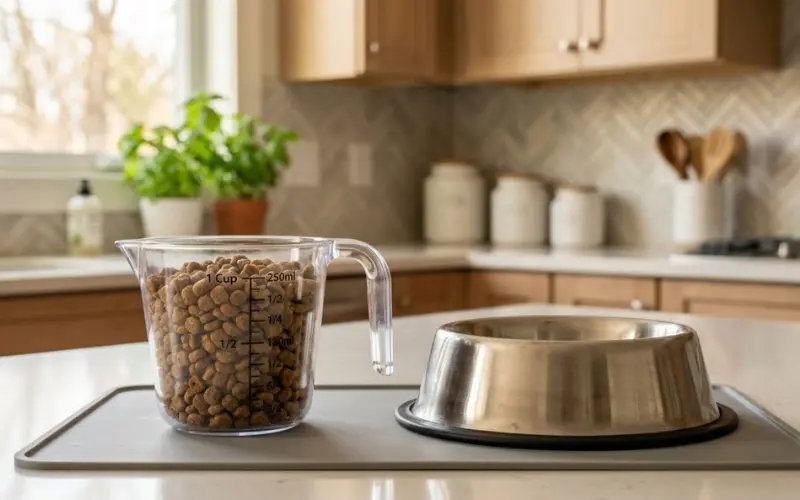
Most dog owners use a random scoop, coffee mug, or the cup that came with the food bag.
None of these are accurate.
A standard dry measuring cup — the same kind you use for baking — is the only tool that gives consistent, accurate portions.
Buy one. Keep it in the food container. Use it every single meal.
This one habit is worth more than every other feeding tip in this guide combined.
The Free Feeding Trap
Leaving food out all day means you have no idea how much your dog is eating.
Some dogs self-regulate perfectly.
Most do not.
Switch to scheduled meals:
- Pour measured portion into bowl
- Give dog 15 to 20 minutes to eat
- Pick up whatever remains
- Next meal at the next scheduled time
This gives you complete control over portions and makes it immediately obvious if your dog’s appetite changes — which is often the first sign of a health issue.
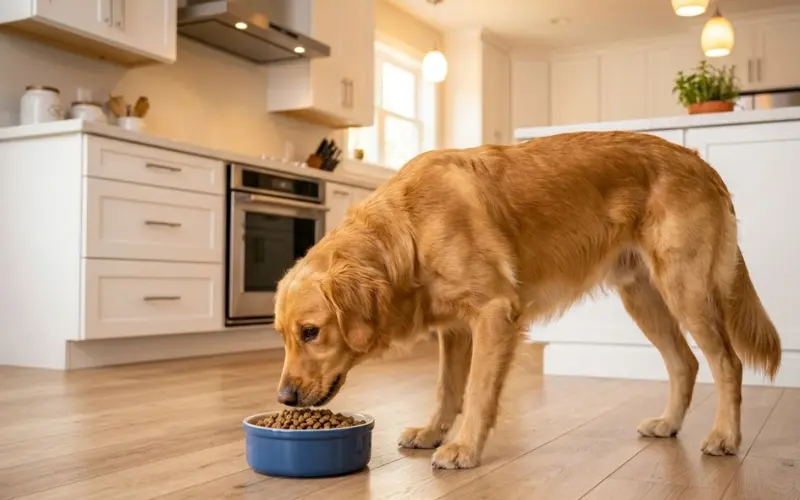
A modest reduction of approximately 10–15% is often easier to maintain and allows you to monitor progress before making additional adjustments.
Gradual weight loss is generally safer and more sustainable than rapid weight loss, helping preserve muscle mass while reducing excess body fat.
Reassess your dog’s body condition every 4–6 weeks and adjust portions only if needed. For dogs with significant weight issues or underlying health conditions, work with your veterinarian to create an appropriate weight-management plan.
Excess weight can sometimes be linked to underlying medical conditions, age-related changes, medications, or reduced activity levels rather than food intake alone.
A veterinarian can evaluate your dog’s body condition, identify potential health concerns, and recommend an appropriate calorie target and feeding strategy.
Safe, gradual weight loss under professional guidance is generally more effective and sustainable than aggressive calorie restriction.
The feeding amounts provided in this guide are general starting points based on typical adult dry dog food and are intended for educational purposes only.
Every dog has unique nutritional needs influenced by factors such as age, breed, activity level, body condition, metabolism, and overall health.
Puppies, pregnant or nursing dogs, senior dogs, dogs with medical conditions, and dogs following weight-management plans may require different feeding amounts than those shown in this guide.
For personalized feeding recommendations, consult your veterinarian or a qualified veterinary nutrition professional.
Frequently Asked Questions (FAQ)
How many cups of food should I feed my dog per day?
The amount depends on your dog’s weight, age, and activity level.
As a general guide: a 10-pound dog needs about 3/4 cup per day, a 30-pound dog needs about 1.75 cups, a 50-pound dog needs about 2.5 cups, and a 75-pound dog needs about 3.5 cups — all split into 2 meals.
These amounts are for standard dry kibble with approximately 350 to 400 calories per cup.
High-calorie premium foods require less per serving.
Always check the specific calorie content on your food bag and use a standard measuring cup.
How do I know if I am feeding my dog too much?
Check your dog’s body condition score at home.
Run your hands along their ribs — if you cannot feel ribs under the fat, your dog is likely overweight.
Look from above — a healthy dog has a visible waist.
Look from the side — the belly should tuck up slightly.
Other signs of overfeeding include difficulty getting up, reluctance to exercise, labored breathing during play, and gradual weight gain that makes their collar or harness feel tighter.
A body condition check every two weeks catches weight gain early.
Should I feed my dog based on current weight or ideal weight?
Feed based on ideal weight, not current weight.
If your dog weighs 70 pounds but should weigh 60, feed the portion for a 60-pound dog — not a 70-pound dog.
Feeding based on current overweight perpetuates the overweight.
Your veterinarian can tell you your dog’s ideal weight based on breed, frame size, and body condition at your next visit.
This one adjustment is often all that is needed to start healthy weight loss without any other changes.
How often should I feed my adult dog?
Adult dogs should eat twice per day — morning and evening — on a consistent schedule.
Two meals per day keeps metabolism steady, prevents excessive hunger, and reduces the risk of bloat in large breeds.
Some small breeds under 10 pounds may benefit from 3 meals per day due to their faster metabolism and hypoglycemia risk.
One meal per day is generally not recommended — it causes blood sugar spikes and increases hunger-driven behavioral problems.
Does my dog need more food in winter?
Dogs that spend significant time outdoors in cold weather may need 10 to 15% more food to maintain body temperature.
Indoor dogs that simply go outside for walks and bathroom trips do not typically need any seasonal adjustment.
The most reliable approach is to use the body condition score — if your dog feels thinner during winter months, increase portions slightly.
If they are gaining weight during a less active winter, reduce portions accordingly.
Should I feed my dog wet food or dry food?
Both are nutritionally complete when they meet AAFCO standards.
Dry kibble is more calorie-dense per cup, more convenient, and better for dental health through chewing action.
Wet food has higher moisture content, higher palatability, and fewer calories per volume — making it useful for picky eaters and dogs needing hydration support.
Many owners feed primarily kibble with a small amount of wet food mixed in for palatability.
The feeding chart in this guide is based on standard dry kibble — reduce kibble proportionally if adding wet food.
My dog always seems hungry — should I feed more?
Not necessarily.
Some breeds — Labrador Retrievers are the classic example — have a genetic mutation that reduces their satiety signal, meaning they always feel hungry regardless of how much they eat.
Feeding more does not fix this — it just makes them overweight and still hungry.
If your dog is at healthy body condition and the portions match the chart, the hunger behavior is normal for that dog.
Adding low-calorie volume like green beans or canned pumpkin to meals can help them feel fuller without adding significant calories.
How do I adjust food when my dog is spayed or neutered?
After spaying or neutering, caloric needs typically drop by 25 to 30% because the metabolic rate decreases without reproductive hormones.
Reduce daily food portions by approximately 25% immediately after the procedure and monitor body condition closely for the next 2 to 3 months.
Most post-spay or neuter weight gain happens in the first 6 months and is entirely preventable with portion adjustment starting from day one after the procedure.
The Right Amount Changes Everything — Final Thoughts
Six pounds.
That is how much weight my dog lost when I finally started measuring properly instead of following the bag blindly.
Same food.
Same walks.
Same treats.
Just the right amount in the bowl instead of too much.
He moved better.
He played longer.
His coat looked better.
His energy came back.
Six pounds made a genuinely visible difference in his daily life.
Now that you know how much should I feed my dog by weight — here are your three key takeaways:
- Use a measuring cup every single meal — not a scoop, not a mug, not an estimate. A standard dry measuring cup is the single most effective weight management tool you own.
- The chart is a starting point, not a prescription — your dog’s actual ideal portion depends on activity level, treats, age, and individual metabolism. Use the body condition score every two weeks to know whether your portions are right.
- Treats count — every biscuit, every training treat, every piece of cheese is part of the daily calorie budget. Count them or reduce the next meal proportionally.
For the complete nutrition foundation — what to feed, how to read labels, and why it all matters — read our complete dog nutrition guide for beginners.
And if you are switching to a new food alongside adjusting portions — read our guide on how to switch dog food without upset stomach for the safe transition method.