

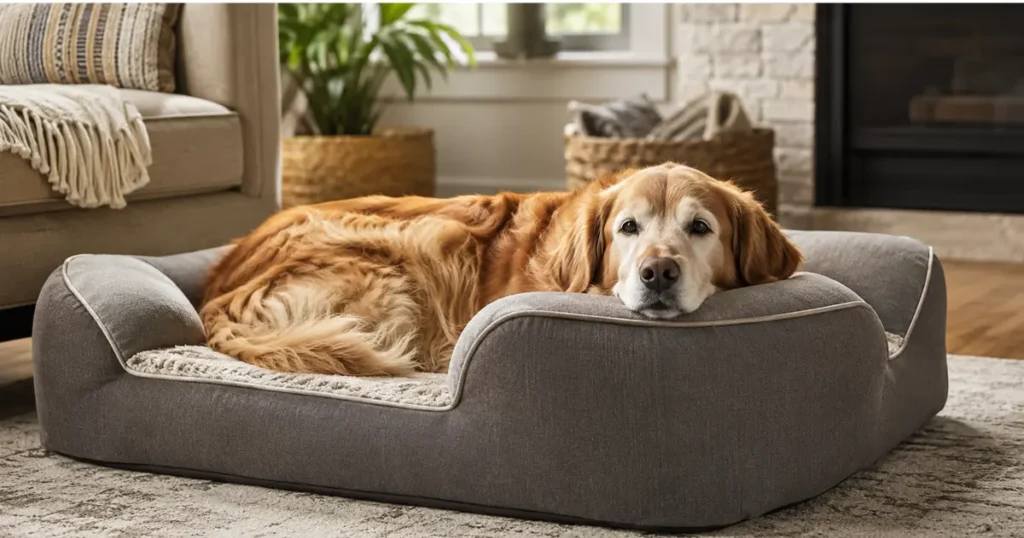
I watched my senior dog struggle to stand up from his bed one morning, and something shifted inside me.
He had been sleeping on the same flat pillow bed for three years.
It was soft.
It looked comfortable.
But that morning, watching him plant his front legs, push, hesitate, push again, and finally heave himself up with visible effort — I realized the bed was not helping him.
It was making things harder.
The pillow had compressed to almost nothing over time.
He was sleeping on a thin layer of polyester fill over a hardwood floor.
Every joint — hips, elbows, shoulders — pressed against what was functionally a hard surface for 10 to 12 hours every night.
The orthopedic bed I bought the next day changed his mornings within a week.
Not a miracle.
Not a cure for his arthritis.
But he stood up on the first attempt instead of the third.
He walked to his bowl without that stiff, careful gait that told me his joints were screaming.
Finding the best dog bed for senior dogs is not about buying the softest bed you can find.
It is about finding one with the right foam density to support aging joints without letting your dog sink through to the floor underneath.
This guide covers 6 orthopedic beds that actually work — from $40 to $280 — with the foam science that separates real joint support from marketing claims.
Best value: EHEYCIGA Orthopedic Bed ($45 to $55) with memory foam and waterproof liner.
Always choose memory foam over egg crate, minimum 4 inches thick for dogs over 50 lbs, and measure your dog lying fully stretched before ordering.
Why Orthopedic Matters — The Science Behind Senior Dog Beds
A regular dog bed and an orthopedic dog bed look similar.
But the difference underneath is what matters for a senior dog’s joints.
Approximately 80 percent of dogs over 8 years old have some degree of arthritis, making orthopedic joint support during the 10 to 14 hours seniors spend sleeping each day one of the highest-impact comfort upgrades an owner can provide for an aging dog.
Standard dog beds use polyfill stuffing — loose polyester fibers that feel soft initially but compress under body weight within weeks.
Once compressed, there is no support.
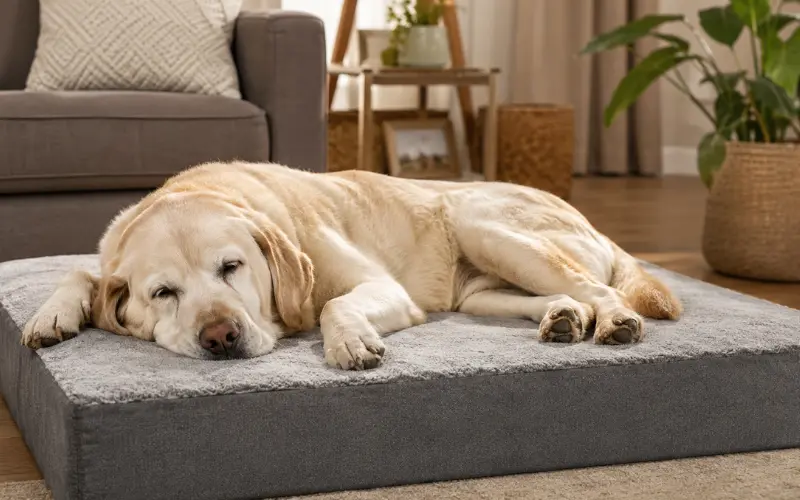
Your dog is sleeping on fabric over a hard floor.
Orthopedic beds use high-density foam that maintains its shape under sustained pressure.
The foam distributes your dog’s weight across the entire sleeping surface instead of concentrating it at the hip, shoulder, and elbow contact points where arthritis pain is often worst.
The practical difference is simple.
A dog on a compressed polyfill bed has their full body weight pressing on 3 to 4 pressure points against a hard surface for 10+ hours every night.
A dog on proper orthopedic foam has that same weight spread across their entire body, reducing pressure at every joint.
According to the American Kennel Club, senior dogs benefit from orthopedic beds made of thick solid polyurethane foam or memory foam, which distribute weight evenly and provide firm support that eases achy muscles and stiff joints.
Memory Foam vs Egg Crate — The Difference That Matters
Most “orthopedic” dog beds use one of two foam types.
Understanding which one matters when choosing the best dog bed for senior dogs prevents expensive mistakes.
Solid Memory Foam (Best for Joint Pain)
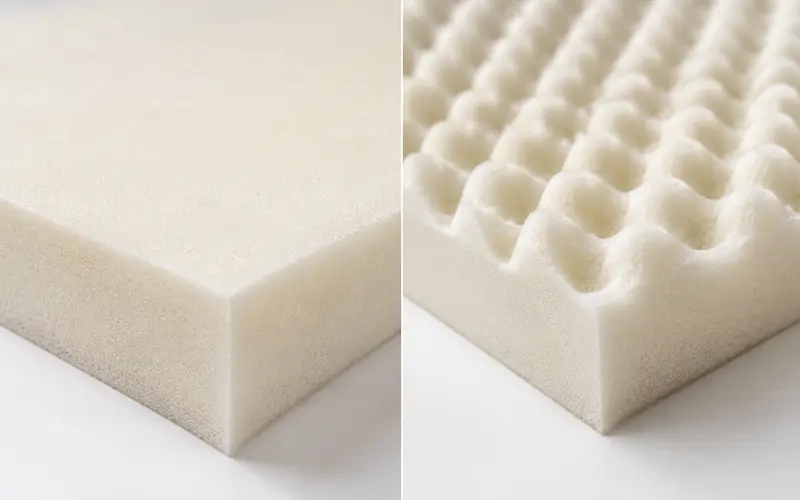
Memory foam conforms to your dog’s body shape under heat and pressure.
It cradles joints rather than pushing against them.
When the dog moves, the foam slowly returns to its original shape.
For senior dogs with arthritis, hip dysplasia, or chronic joint pain, solid memory foam with a density of 3 to 4 lbs per cubic foot is the minimum standard.
Anything below 3 lbs per cubic foot compresses too easily under a large dog’s weight and provides inadequate support.
Egg Crate Foam (Adequate for Mild Stiffness)
Egg crate foam has a textured surface that improves airflow and provides light pressure relief.
It is less expensive than solid memory foam and lighter weight.
For dogs with mild age-related stiffness — no diagnosed arthritis, no hip dysplasia — egg crate foam is adequate.
But for dogs with genuine joint pain, egg crate foam compresses too easily and does not provide enough resistance to prevent the dog from sinking through to the base.
The most important distinction when choosing a senior dog bed is foam density.
Beds with memory foam density of 3 to 4 lbs per cubic foot maintain their shape under a large dog’s weight and provide genuine joint relief.
Beds under 2 lbs per cubic foot compress quickly and offer no meaningful support.
Premium beds like Big Barker and PetFusion prominently display their foam specifications because the numbers are their competitive advantage.
If the listing says “orthopedic” but gives no foam density — be skeptical.
Best Dog Bed for Senior Dogs — 6 Picks Reviewed
These 6 beds cover every senior dog situation — from budget to clinical-grade, small dogs to giant breeds.
Every product below is verified available on Amazon.
1. Big Barker Orthopedic Dog Bed — Best Overall
The only dog bed backed by peer-reviewed clinical research.
A University of Pennsylvania School of Veterinary Medicine study found measurable improvements in joint pain, stiffness, and gait in senior dogs sleeping on Big Barker beds.
7-inch therapeutic 3-layer foam system — 2-inch base, 3-inch support layer, 2-inch comfort top.
Engineered specifically to prevent bottoming out under large dog weight.
10-year guarantee against going flat.
Made in the USA.
Microsuede cover with waterproof inner liner.
Machine washable.
In the clinical study, over 70% of dogs showed less pain and stiffness within 30 days.
Dogs were up to 67% more mobile after consistent use.
The Big Barker Orthopedic Dog Bed is the only consumer dog bed with peer-reviewed clinical research from the University of Pennsylvania showing that 70% of senior dogs experienced measurable improvement in joint pain and stiffness within 30 days, backed by a 10-year no-flatten guarantee.
Big Barker Orthopedic Dog Bed — 7-inch, Large — 7-inch 3-layer therapeutic foam, clinically studied, 10-year guarantee, waterproof liner, machine-washable microsuede cover. Made in the USA. For dogs 50+ lbs.
Not ideal for: small dogs under 30 lbs — the 7-inch foam is calibrated for large breed weight, and a lighter dog will not create enough pressure to activate proper contouring. Also not ideal for owners on a tight budget — at $250 to $280, it is the premium investment on this list.
Price range: $250 to $280
2. Rainmr 7-Inch Orthopedic Dog Bed — Best Mid-Range Memory Foam
More foam than most beds twice the price.
The Rainmr delivers 7-inch 3-layer memory foam that prevents bottoming out even for large dogs over 70 lbs — at a mid-range price point.
Three layers include a high-density base, a support layer, and a memory foam top that adjusts to your dog’s body shape for targeted joint relief.
Chew-resistant microsuede cover.
100% TPU waterproof liner.
Non-slip rubber bottom.
Machine-washable cover.
Fits Labrador Retrievers, Golden Retrievers, Boxers, and Huskies in the 48 × 30 size.
Allow 24 to 48 hours after unboxing for the vacuum-packed foam to fully expand.
Rainmr 7-Inch Orthopedic Dog Bed for Large Dogs — 48 × 30, Grey — 7-inch 3-layer memory foam, chew-resistant microsuede cover, 100% TPU waterproof liner, non-slip bottom, and a machine-washable cover. Designed for dogs up to 90 lbs.
Not ideal for: giant breeds over 90 lbs — size up to the Rainmr XL (60 × 48) for Great Danes and Mastiffs. Allow 24 to 48 hours after unboxing for the foam to fully expand before giving it to your dog.
Price range: $70 to $90
3. EHEYCIGA Orthopedic Dog Bed — Best Budget Memory Foam
The best dog bed for senior dogs if you want real memory foam support under $60.
Dual-layer foam — memory foam top plus egg crate base — that provides genuine joint relief for most senior dogs.
Four-sided bolsters for full neck and head support.
Waterproof inner liner protects the foam.
Plush Sherpa top surface.
Machine-washable removable cover.
Non-slip bottom.
Over 38,000 Amazon reviews with a 4.5+ star rating.
A consistent Best Seller in the Dog Beds category.
EHEYCIGA Orthopedic Dog Bed — 44 × 32 inch — Dual memory foam plus egg crate construction, four-sided bolsters, waterproof liner, Sherpa top, machine-washable cover, and non-slip bottom. Available in sizes from Small through XXL.
Not ideal for: dogs over 100 lbs with severe arthritis — the dual-foam design provides good support for moderate joint issues, but very heavy dogs or advanced conditions need the thicker clinical-grade foam in Big Barker or PetFusion. Side bolsters are not fully waterproof — for incontinence issues, consider Bedsure.
Price range: $45 to $65
4. FurHaven Orthopedic Sofa Dog Bed — Best for Curlers and Small Seniors
The most popular orthopedic sofa bed for senior dogs who sleep curled up against bolstered sides rather than stretched flat.
CertiPUR-US certified US-made foam with sofa-style three-sided bolsters.
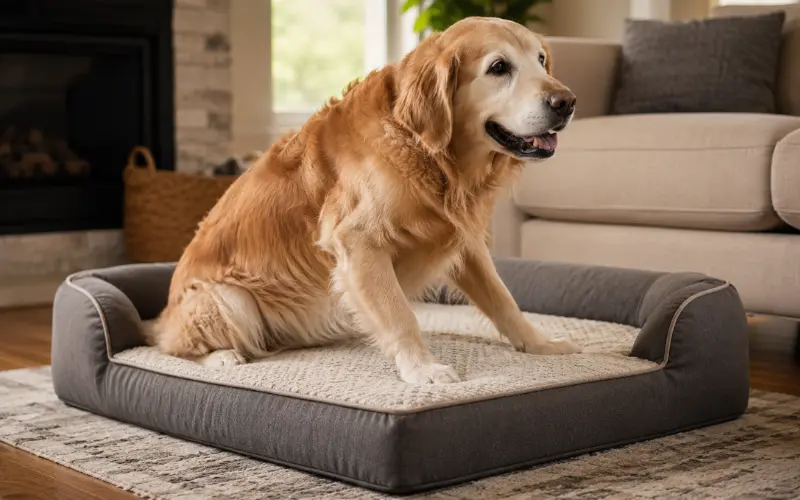
Open-front design for easy step-in access — ideal for seniors with limited mobility who cannot step over a bolster edge.
Plush faux fur sleep surface.
Machine-washable removable cover.
90-day warranty.
Multiple foam options — egg crate, memory foam, and cooling gel — are available in the same design.
FurHaven Orthopedic Dog Bed — Plush & Suede Sofa, Large — CertiPUR-US foam, three-sided bolsters, open-front step-in design, plush faux fur surface, and a machine-washable cover. The Large size fits dogs up to 55 lbs, with a Jumbo XL option available for dogs over 95 lbs.
Not ideal for: dogs over 55 lbs that sleep fully stretched out — even the Jumbo XL bolster design limits full extension. For large dogs that sleep flat, PetFusion or EHEYCIGA provides more usable sleeping space. Also, the egg crate version is comfort-grade rather than therapeutic — choose the memory foam version for genuine joint support.
Price range: $35 to $65
5. Bedsure Orthopedic Dog Bed — Best for Senior Dogs with Incontinence
Senior dogs with bladder control issues need a bed that handles accidents without destroying the foam.
The Bedsure is built specifically for this.
Memory foam base with a full waterproof liner and a non-skid bottom.
Removable cover that machine washes easily and dries quickly.
Bolstered sides for added comfort.
Available in sizes up to XL (42 inches).
The waterproofing is more complete than EHEYCIGA because the liner fully surrounds the foam base rather than protecting only the sleeping surface.
Bedsure Orthopedic Dog Bed — Large, Waterproof — Memory foam, full waterproof liner, bolstered sides, non-skid bottom, and a machine-washable removable cover. Designed for daily accident management in senior dogs.
Not ideal for: dogs with advanced arthritis who need clinical-grade foam support. The foam is comfort-grade and adequate for moderate stiffness, but not therapeutic-grade for severe conditions. Choose Big Barker or PetFusion for advanced joint disease, then add a waterproof mattress protector.
Price range: $45 to $75
6. FurHaven Dreamer Sofa Orthopedic Dog Bed — Best Jumbo Size for Giant Breeds
For giant breeds — Great Danes, Mastiffs, Saint Bernards, and Bernese Mountain Dogs — most beds simply do not come large enough.
The FurHaven Dreamer fills this gap with Jumbo XL sizing.
Orthopedic egg crate foam combined with a solid orthopedic foam base.
Quilted sofa cover.
Open-front design for easy senior access.
Available in Jumbo XL for dogs over 95 lbs and Jumbo Plus for the largest giant breeds.
FurHaven Dreamer Sofa Orthopedic Dog Bed — Jumbo XL — Egg crate plus solid foam base, Jumbo XL sizing for giant breeds, open-front step-in design, quilted sofa cover, and a machine-washable cover.
Not ideal for: standard large breeds under 80 lbs — the Jumbo sizing is oversized for Labs and Goldens, creating unnecessary extra space. For standard large breeds, choose the FurHaven Sofa or EHEYCIGA in Large or XL.
Price range: $65 to $90
Quick Comparison — Which Bed Fits Your Senior Dog
Signs Your Senior Dog Needs an Orthopedic Bed — Right Now
If your senior dog is showing any of these signs, the best dog bed for senior dogs should be your next purchase — not your next consideration.
Recognizing these signals early prevents weeks of unnecessary joint pain.
Difficulty standing up after lying down — especially in the morning.
This is the single most common sign that their current sleeping surface is not supporting their joints.
A dog that struggles to rise is a dog whose joints stiffened overnight on an inadequate surface.
Avoiding their bed — choosing the hard floor or tile instead.
This seems counterintuitive, but dogs with joint pain sometimes prefer a firm, cool floor over a soft bed that lets them sink into an unsupported position.
Pacing or repositioning repeatedly before settling down.
A dog that cannot find a comfortable position is often dealing with pressure point pain that the current bed is not relieving.
Stiffness or limping in the first few minutes after waking.
Morning stiffness that improves with movement is a classic arthritis sign, and the overnight sleeping surface directly affects its severity.
Reluctance to jump on or off furniture.
A dog that used to jump on the couch but now hesitates is experiencing joint discomfort that an orthopedic bed can help reduce overnight.
For the complete guide to recognizing hidden pain signals in your dog, read our post on Signs Your Dog Is in Pain and Hiding It.
According to the American Kennel Club, dogs with joint conditions such as arthritis benefit from orthopedic or memory foam beds that provide proper support, and heated orthopedic beds may offer additional comfort for stiffness and aching joints.
How to Size an Orthopedic Bed for Your Senior Dog
Sizing mistakes are the most common reason the best dog bed for senior dogs fails to help.
A bed that is too small forces your dog into positions that increase joint pressure rather than relieve it.
The Stretch Measurement
With your dog lying on their side in their natural sleeping position, measure from the tip of the nose to the base of the tail, and from the top of the head to the bottom of the paws.
Add 6 to 8 inches to each measurement.
This is your minimum bed size.
Senior dogs need more room than younger dogs because they change positions more frequently during the night to relieve pressure.
A bed that accommodates full stretching in every direction prevents them from hanging off the edges.
When sizing an orthopedic bed for a senior dog, measure them fully stretched on their side and add 6 to 8 inches to each measurement.
The extra space allows comfortable repositioning throughout the night without increasing pressure on sore joints.
Foam Thickness Guide
- Under 30 lbs: 3 inches of memory foam is adequate.
- 30 to 60 lbs: Minimum 4 inches.
- 60 to 90 lbs: 5 to 6 inches recommended.
- Over 90 lbs: 7 inches (Big Barker territory).
Heavier dogs compress foam more and need thicker foam to prevent “bottoming out” — sinking through the foam until the hips and elbows contact the base.
Beyond the Bed — Complete Senior Dog Comfort
The best dog bed for senior dogs is one part of a larger comfort strategy.
These additional steps maximize your senior dog’s quality of life alongside the right bed.
Maintain a healthy weight.
Extra weight puts additional strain on every joint.
Even 2 to 3 pounds of excess weight in a senior dog can significantly increase joint pain and reduce mobility.
Work with your veterinarian on an appropriate calorie plan.
Keep movement consistent.
Short, gentle walks twice daily help maintain muscle tone that supports the joints.
A senior dog that stops moving stiffens faster than one that stays gently active.
Consider joint supplements.
Glucosamine and chondroitin are among the most common supplements used to support canine joint health.
Talk with your veterinarian about whether they are appropriate for your dog.
According to the American Kennel Club, managing arthritis in senior dogs works best with a combination approach that includes weight management, appropriate exercise, a supportive sleeping surface, and veterinary-guided pain management.
For the complete preventive health approach for dogs at every age, read our guide on Keeping Your Dog Healthy and Happy.
For the nutrition foundation that supports joint health and a healthy weight, read our Complete Dog Nutrition Guide for Beginners.
According to the ASPCA, regular veterinary care combined with appropriate home comfort adjustments is essential for maintaining senior dogs’ quality of life as they age.
Do not move them to a new location and expect them to adapt.
Senior dogs are creatures of habit — putting a new bed in their existing preferred spot virtually guarantees they will use it immediately.
Schedule a veterinary exam for a proper arthritis assessment and pain management plan.
A bed manages overnight comfort. Your vet manages the underlying condition.
The product recommendations in this guide are based on published reviews, clinical research, and real-world owner feedback.
If your senior dog has arthritis, hip dysplasia, or chronic pain, consult your veterinarian for a comprehensive management plan that may include medication, supplements, physical therapy, and appropriate bedding.
Frequently Asked Questions (FAQ)
What is the best bed for an older dog with arthritis?
The Big Barker Orthopedic Dog Bed is the best option for senior dogs with diagnosed arthritis.
It is the only bed backed by a University of Pennsylvania clinical study showing measurable improvements in pain and mobility.
Its 7-inch therapeutic foam is specifically calibrated for large dogs with joint conditions.
For a more affordable alternative with genuine memory foam support, the EHEYCIGA Orthopedic Bed, priced at $45 to $55, provides solid pressure relief for moderate arthritis.
Is memory foam or egg crate foam better for senior dogs?
Memory foam is significantly better for senior dogs with joint pain.
Solid memory foam with a density of 3-4 lb/ft³ conforms to your dog’s body and distributes weight evenly across the sleeping surface.
Egg crate foam provides airflow and light cushioning but compresses too easily under a large dog’s weight, offering inadequate support for genuine arthritis or hip dysplasia.
Choose memory foam for joint conditions and egg crate foam only for mild age-related stiffness in dogs under 40 lbs.
How thick should a senior dog bed be?
Foam thickness should match your dog’s weight.
Under 30 lbs: At least 3 inches of memory foam.
30 to 60 lbs: Minimum 4 inches.
60 to 90 lbs: 5 to 6 inches.
Over 90 lbs: 7 inches to prevent bottoming out.
The most common mistake is buying a bed that is too thin for the dog’s weight.
How do I know if my senior dog needs an orthopedic bed?
The clearest signs include difficulty standing after lying down, especially in the morning; stiffness or limping during the first few minutes after waking; repeatedly repositioning before settling; avoiding their current bed in favor of hard floors; and reluctance to jump onto furniture they previously used with ease.
Any of these signs in a dog over 7 years old warrants an orthopedic bed and a conversation with your veterinarian about arthritis.
Can a good bed actually reduce my dog’s joint pain?
Yes.
Peer-reviewed research from the University of Pennsylvania demonstrated measurable improvements in joint pain, stiffness, and gait in senior dogs sleeping on high-density orthopedic beds compared with standard beds.
An orthopedic bed does not treat arthritis, but it reduces the overnight pressure that contributes to daytime discomfort.
The improvement is often most noticeable during the first 10 to 15 minutes after waking.
What size orthopedic bed does my senior dog need?
Measure your dog lying fully stretched on their side — from the nose to the base of the tail, and from the top of the head to the paws.
Add 6 to 8 inches to each measurement.
Senior dogs need more room than younger dogs because they reposition frequently during the night to relieve pressure.
A bed that forces a senior dog to curl up to fit increases joint compression rather than relieving it.
Are heated dog beds safe for senior dogs?
Heated dog beds can provide additional comfort for senior dogs with arthritis by soothing stiff joints and muscles.
However, they should always be used under supervision because dogs with reduced mobility may not be able to move away if they become too warm.
Self-warming beds that reflect body heat without electricity are a safer alternative for overnight use.
Always consult your veterinarian before using a heated bed, especially if your dog has circulation problems.
How often should I replace my senior dog’s orthopedic bed?
Replace the bed when you notice visible compression, flat spots that no longer recover, or your dog’s hips and elbows leaving permanent impressions in the foam.
Budget beds typically last 1 to 2 years.
Mid-range beds such as the PetFusion usually last 3 to 4 years.
The Big Barker includes a 10-year guarantee against flattening.
Replace the bed sooner if your dog begins avoiding it or develops increased morning stiffness after previously improving.
The Bed Changed His Mornings — Final Thoughts
Three pushes to stand up.
That was my dog’s morning routine on his old bed.
Plant the front legs.
Push.
Fail.
Push again.
Fail.
Third push — finally up, and then that slow, stiff walk to his water bowl that told me everything about how his joints felt after a night on compressed polyester fill.
The best dog bed for senior dogs did not cure his arthritis.
Nothing will.
But it changed his mornings from three pushes to one.
From stiff limping to a slightly slow but steady walk.
From avoiding his bed to walking to it voluntarily every evening.
Three things to take with you:
Memory foam, not egg crate.
For any dog with genuine joint pain, solid memory foam with a density of 3 to 4 lbs per cubic foot is the minimum standard.
Egg crate foam is for mild stiffness — not arthritis.
Match thickness to weight.
A 70-pound dog on 3-inch foam will bottom out.
Heavier dogs need thicker foam — 5 to 7 inches — to prevent hips and elbows from pressing through to the base.
The bed helps overnight. The vet helps overall.
An orthopedic bed is one part of arthritis management.
Weight control, gentle exercise, and veterinary-guided pain management complete the picture.
The bed alone is not enough — but without it, everything else works less effectively.
For a better understanding of the pain signals your senior dog may be hiding, read our guide on Signs Your Dog Is in Pain and Hiding It.



Pingback: UltraK9 Pro Review 2026, Is It Worth Buying?